











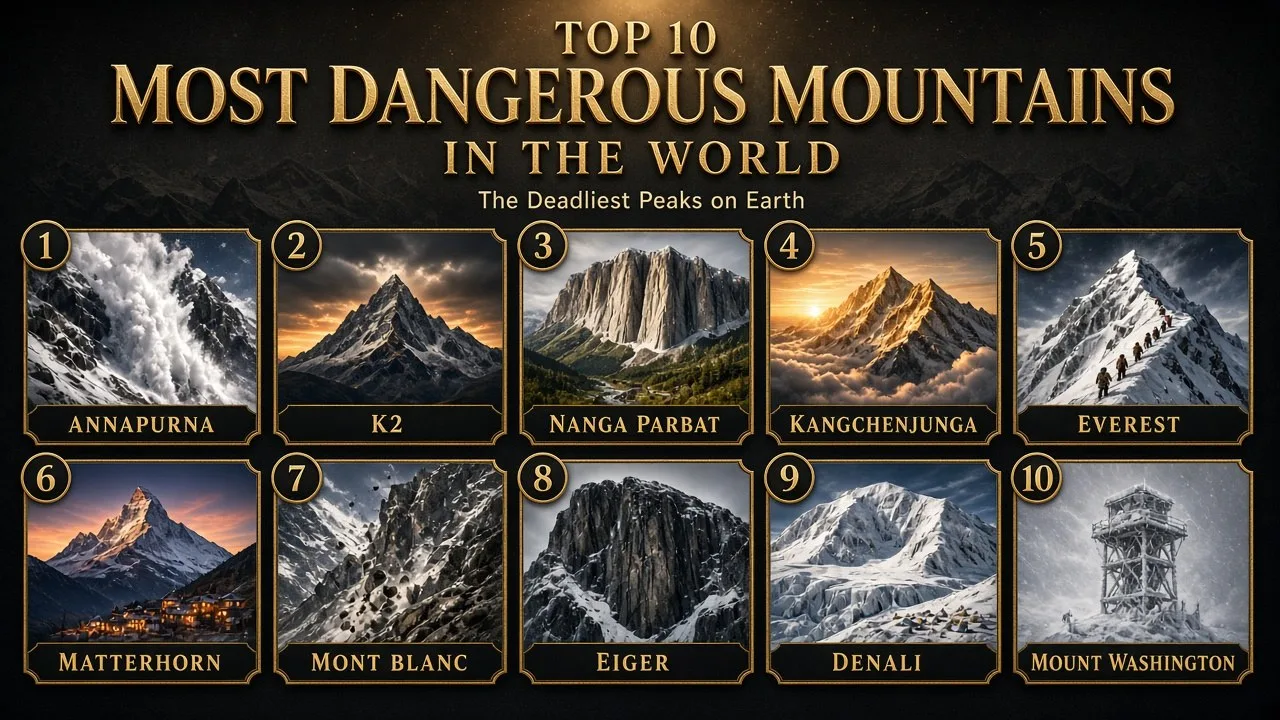
The most dangerous mountains in the world are led by Annapurna I, K2 and Nanga Parbat, where far more climbers die per summit than on Mount Everest.
Every mountain on this list has killed experienced climbers, not just careless ones. Some are deadly because of sheer altitude, where the air holds too little oxygen to keep a body working for long. Others are deadly because of avalanches, falling ice and rock, or storms that arrive with almost no warning. A few are deadly simply because so many people climb them every year that accidents add up.
This guide ranks ten of the most dangerous mountains on Earth. For each peak you will find a Quick Facts table, a short history, what makes it dangerous, why it matters and a few facts that surprise most readers. Death figures come from mountaineering statisticians, national park records and peer-reviewed studies, and each one is given with the period it covers, because these numbers change every climbing season.
How We Ranked the Most Dangerous Mountains
There is no single official list of the deadliest mountains, and two different questions are often mixed together. The first is how likely you are to die if you try to climb a peak. The second is how many people have died on it in total. A remote Himalayan giant with few climbers can have a frightening death rate but a modest death toll, while a popular Alpine peak can have a low death rate but hundreds of deaths.
This list uses both questions in a clear order:
- Ranks 1 to 5 are eight-thousanders, the 14 peaks above 8,000 metres. They are ordered by the ratio of deaths to successful summits, using the long-running figures of statistician Eberhard Jurgalski and the Himalayan Database.
- Ranks 6 to 10 are lower peaks that kill climbers and hikers year after year because of crowds, rockfall, steep faces or extreme weather. They are ordered by the size and steadiness of their death toll.
A ratio of deaths to summits is not the same as your personal chance of dying. It counts every death above base camp, including Sherpas and support climbers, and divides it by the number of people who reached the top. The Himalayan Database also publishes a narrower climber death rate, which looks only at expedition members who went above base camp. Both numbers are shown where they exist.
Most Dangerous Mountains in the World at a Glance
| No. | Mountain | Height | Location | Main danger |
|---|---|---|---|---|
| 1 | Annapurna I | 8,091 m (26,545 ft) | Nepal | Avalanches on steep, exposed faces |
| 2 | K2 | 8,611 m (28,251 ft) | Pakistan and China | Technical climbing, storms and the Bottleneck seracs |
| 3 | Nanga Parbat | 8,126 m (26,660 ft) | Pakistan | Huge faces, avalanches and long retreats |
| 4 | Kangchenjunga | 8,586 m (28,169 ft) | Nepal and India (Sikkim) | Long route, cold and avalanches |
| 5 | Mount Everest | 8,849 m (29,032 ft) | Nepal and China | Death zone altitude, icefall and crowds |
| 6 | Matterhorn | 4,478 m (14,692 ft) | Switzerland and Italy | Rockfall, crowds and sudden storms |
| 7 | Mont Blanc | 4,807 m (15,772 ft) | France and Italy | Rockfall in the Goûter couloir, crevasses |
| 8 | Eiger | 3,967 m (13,015 ft) | Switzerland | The north face, known as the Mordwand |
| 9 | Denali | 6,190 m (20,310 ft) | Alaska, USA | Arctic cold, crevasses and long expeditions |
| 10 | Mount Washington | 1,917 m (6,288 ft) | New Hampshire, USA | Hurricane-force winds and fast-changing weather |
1. Annapurna I
| Attribute | Details |
|---|---|
| Height | 8,091 metres (26,545 feet), the 10th-highest mountain on Earth |
| Location | Annapurna range, Gandaki Province, north-central Nepal |
| First ascent | 3 June 1950, Maurice Herzog and Louis Lachenal (French expedition) |
| Deaths per summit, 1950 to 2012 | 31.9 percent (61 deaths, 191 ascents), per Eberhard Jurgalski |
| Latest totals | 559 summits and 75 deaths as of February 2025 |
Annapurna I has long carried the grim title of the deadliest mountain in the world. For most of its climbing history, roughly one person died for every three who reached the summit, a ratio the Guinness World Records has used to name it the world's most dangerous peak. Its height is not extreme by Himalayan standards. Its slopes are what make it so lethal.
Origins and History
Annapurna was the first of the 14 eight-thousanders to be climbed. In 1950 a French expedition led by Maurice Herzog found a route up the north face, and Herzog and Louis Lachenal stood on top on 3 June. The descent turned into an ordeal of storms, crevasses and frostbite, and it set the tone for the mountain's reputation.
The south face, a vast wall of rock and ice, was climbed in 1970 by Don Whillans and Dougal Haston on a British expedition led by Chris Bonington. Their teammate Ian Clough was killed by a falling serac on the way down. Since then many of the best climbers of their generation have died on Annapurna, including Alex MacIntyre in 1982, Pierre Béghin in 1992 and Anatoli Boukreev in 1997.
What Makes It So Dangerous
- The main routes cross slopes threatened by hanging glaciers and seracs that collapse without warning
- Heavy snowfall loads the faces, so large avalanches are common
- Weather in the region changes quickly, leaving climbers exposed high on the mountain
- The summit area is a long ridge with several high points, which makes the final push long and committing
Why It Matters
Annapurna shows that height alone does not decide how dangerous a mountain is. It is lower than the other peaks in this top five, yet its death ratio was the highest of them all for decades. The good news is that the trend has improved. With 559 summits and 75 deaths recorded by February 2025, the ratio has fallen to roughly 13 percent, still high but far from one in three.
The danger is not limited to climbers. In October 2014 a sudden snowstorm near Annapurna and Dhaulagiri killed at least 43 people, many of them trekkers on the popular Annapurna Circuit.
Interesting Facts
- Annapurna was the first eight-thousander climbed, three years before Everest
- The surrounding Annapurna Conservation Area is the first and largest conservation area in Nepal
- The Himalayan Database narrow climber death rate for Annapurna, 4.05 percent for 1950 to 2009, is the highest of the Nepalese eight-thousanders
- Herzog's book Annapurna, about the 1950 climb, became one of the best-selling mountaineering books ever written
2. K2
| Attribute | Details |
|---|---|
| Height | 8,611 metres (28,251 feet), the second-highest mountain on Earth |
| Location | Karakoram range, on the border of Pakistan (Gilgit-Baltistan) and China (Xinjiang) |
| First ascent | 31 July 1954, Lino Lacedelli and Achille Compagnoni (Italian expedition) |
| Nickname | The Savage Mountain |
| Deaths per summit, 1950 to 2012 | 26.5 percent, per Eberhard Jurgalski |
K2 earned its nickname from American climber George Bell, who said after the 1953 expedition that it was "a savage mountain that tries to kill you." It is lower than Everest, but it is steeper, more technical, more remote and far more exposed to storms. Until 2021, roughly one person died on K2 for every four who reached the top.
Origins and History
K2 was first climbed in 1954 by an Italian expedition led by Ardito Desio, with Lino Lacedelli and Achille Compagnoni reaching the summit. The year before, an American team had been forced into a desperate retreat, during which Pete Schoening stopped a fall of several teammates with a single ice axe belay, a moment climbers still call The Belay. Art Gilkey was lost in the same retreat.
The mountain's darkest seasons came later. Thirteen climbers died in the summer of 1986, including British climber Julie Tullis, who had reached the summit. Six died in a storm in 1995, among them Alison Hargreaves. In August 2008, eleven climbers from several expeditions died in a series of accidents, many caused by ice falling into a narrow gully called the Bottleneck.
What Makes It So Dangerous
- The Bottleneck, a steep couloir near 8,200 metres, sits directly beneath a wall of hanging seracs
- Storms can lock the summit area for several days at a time
- Most routes are steeper and more technical than the standard routes on Everest
- Its remote position in the Karakoram makes rescue slow and often impossible
Why It Matters
K2 was the last eight-thousander to be climbed in winter. In January 2021 a team of ten Nepalese climbers led by Nirmal Purja and Mingma Gyalje Sherpa reached the summit together, closing one of the last great problems in Himalayan climbing. Since then commercial expeditions have brought many more people to the top, and as of August 2023 an estimated 800 people had summited K2, with 96 deaths recorded during attempts.
Interesting Facts
- K2 is also called Mount Godwin-Austen, after an early British surveyor
- Reinhold Messner called it the "mountain of mountains"
- The name K2 comes from the Great Trigonometrical Survey of India, where it was peak number 2 in the Karakoram
- Women climbers were hit especially hard in its early history: several of the first women to reach the summit died on the descent or on later climbs
3. Nanga Parbat
| Attribute | Details |
|---|---|
| Height | 8,126 metres (26,660 feet), the ninth-highest mountain on Earth |
| Location | Western Himalayas, Gilgit-Baltistan, Pakistan |
| First ascent | 3 July 1953, Hermann Buhl, solo and without bottled oxygen |
| Nickname | Killer Mountain |
| Deaths per summit, 1950 to 2012 | 20.3 percent (68 deaths, 335 ascents), per Eberhard Jurgalski |
Nanga Parbat means "naked mountain" in Sanskrit, and it rises almost alone at the western end of the Himalayas. Its south side, the Rupal Face, climbs about 4,600 metres from its base and is often described as the highest mountain face in the world. The peak earned the name Killer Mountain long before anyone stood on its summit.
Origins and History
Nanga Parbat was the scene of the first recorded attempt on any eight-thousander. In 1895 British climber Albert Mummery tried the Diamir Face and later disappeared with two Gurkha companions, Ragobir Thapa and Goman Singh, while scouting another side of the mountain. German expeditions in the 1930s fared worse. In 1934, three leading German climbers and six Sherpas died during a storm-bound retreat, and in 1937 an avalanche buried a camp and killed all sixteen men inside.
By the time Austrian climber Hermann Buhl reached the summit alone in 1953, 31 people had died on the mountain. His climb, made without bottled oxygen, is still the only solo first ascent of an 8,000-metre peak.
What Makes It So Dangerous
- Enormous faces on three sides, the Rupal, Diamir and Rakhiot, each with severe avalanche risk
- Long approaches and long retreats, so climbers stay high for many days
- Exposure to storms with little shelter
- Remote terrain where rescue is difficult
Why It Matters
Nanga Parbat helped shape the image of high-altitude climbing as a matter of life and death. Its history includes some of the most famous tragedies and triumphs in mountaineering. In 1970 brothers Reinhold and Günther Messner made the first ascent of the Rupal Face, but Günther was killed in an avalanche on the descent, and his remains were found only in 2005.
The danger has not always come from the mountain itself. In June 2013, armed militants attacked base camp and killed ten foreign climbers and a Pakistani guide, one of the worst attacks on climbers anywhere.
Interesting Facts
- Nanga Parbat has the second-highest prominence among the world's 100 tallest mountains, behind only Everest
- Guinness World Records lists it as the fastest-growing mountain, rising about 7 millimetres a year
- In 2012 Sandy Allan and Rick Allen made the first ascent of the 10-kilometre Mazeno Ridge
- In Shina, the local language, the mountain is called Diamir
4. Kangchenjunga
| Attribute | Details |
|---|---|
| Height | 8,586 metres (28,169 feet), the third-highest mountain on Earth |
| Location | Border of Nepal (Koshi Province) and India (Sikkim) |
| First ascent | 25 May 1955, Joe Brown and George Band (British expedition) |
| Deaths per summit, 1950 to 2012 | 14.1 percent, per Eberhard Jurgalski |
| Climber death rate | 3.00 percent for 1950 to 2009, per the Himalayan Database |
Kangchenjunga was thought to be the highest mountain in the world until surveyors in the mid-1800s proved that Everest was taller. It remains one of the least climbed of the great peaks, and one of the most dangerous. Its routes are long, cold and exposed to avalanches, and the summit lies far from help.
Origins and History
Early expeditions met with disaster. In 1905 an expedition led by Aleister Crowley ended when climber Alexis Pache and three porters were killed in an avalanche. German teams tried the north-east spur in 1929 and 1931 and were turned back by storms, illness and deaths.
The British reached the top on 25 May 1955, when Joe Brown and George Band made the first ascent, followed the next day by Norman Hardie and Tony Streather. In 1986 Polish climbers Jerzy Kukuczka and Krzysztof Wielicki made the first winter ascent.
What Makes It So Dangerous
- Long routes mean many nights at high altitude and a long descent after the summit
- Avalanche-prone slopes on the main faces
- Severe cold and frequent bad weather
- Far fewer climbers than Everest, so fixed ropes, trail-breaking help and rescue are often limited
Why It Matters
Kangchenjunga is sacred to people in Nepal and Sikkim, and that belief has shaped how it is climbed. The 1955 summit team stopped a short distance below the true top to keep a promise to the Chogyal of Sikkim that the highest point would stay untouched, and many climbers since have followed that tradition. Despite better gear, the mountain still takes lives in the modern era, including an Indian climber on a summit push in 2022 and a German climber who died attempting a ski descent in 2023.
Interesting Facts
- The name is often translated as "five treasures of the snow", for its five high summits
- The local Lhopo people believe treasures are hidden on the mountain and revealed to the devout when the world is in danger
- It lies partly inside India, making it the highest mountain in the country
- Its Jurgalski death ratio of 14.1 percent is close to that of Dhaulagiri, at 15.4 percent
5. Mount Everest
| Attribute | Details |
|---|---|
| Height | 8,849 metres (29,032 feet), the highest mountain on Earth |
| Location | Mahalangur Himal, on the border of Nepal and China (Tibet) |
| First ascent | 29 May 1953, Edmund Hillary and Tenzing Norgay |
| Total deaths | At least 346 people have died on the mountain |
| Deaths per summit, 1950 to 2012 | 3.9 percent (223 deaths, 5,656 ascents), per Eberhard Jurgalski |
Mount Everest has the highest death toll of any eight-thousander, but not the highest death rate. Thousands of people have reached its summit, mostly on guided expeditions with fixed ropes and bottled oxygen, so the ratio of deaths to summits is far lower than on Annapurna or K2. That does not make it safe. Every year, climbers die in the death zone above 8,000 metres.
Origins and History
The first recorded deaths on Everest came in 1922, when seven porters were killed in an avalanche during a British expedition. Edmund Hillary and Tenzing Norgay made the first confirmed ascent in 1953 by the South-East Ridge, and in 1978 Reinhold Messner and Peter Habeler showed it could be climbed without bottled oxygen.
Commercial guiding changed the mountain from the 1990s onward. In May 1996 eight climbers died when guided teams were caught in a blizzard, and 15 people died that season. On 18 April 2014, 16 Sherpas were killed in an ice avalanche in the Khumbu Icefall. A year later, an earthquake in Nepal triggered an avalanche that killed 19 people at base camp, the most deaths on Everest in a single day.
What Makes It So Dangerous
- Extreme altitude: in the death zone, the body uses oxygen faster than it can replace it
- The Khumbu Icefall, a shifting maze of ice towers and crevasses on the Nepal side
- Crowding on summit days, which leaves climbers waiting in the cold with limited oxygen
- Altitude sickness, including fluid on the lungs or brain, which can strike strong climbers
Why It Matters
Everest is where the public learns about mountain danger, and its deaths raise hard questions. The 2006 death of David Sharp, whom several climbers passed on their way up, sparked years of debate about climbing ethics. The large number of deaths among Sherpa workers has also drawn attention to the risks local guides take so that foreign clients can reach the top.
Interesting Facts
- The most recent years without a known death on Everest were 1977 and 2020, when Nepal suspended permits during the COVID-19 pandemic
- In 2019 eleven people died during a record-busy season
- In 2023, 17 climbers died going to or returning from the summit
- Nepali guide Kami Rita reached the summit for the 30th time in May 2024
6. Matterhorn
| Attribute | Details |
|---|---|
| Height | 4,478 metres (14,692 feet) |
| Location | Pennine Alps, on the border of Switzerland and Italy |
| First ascent | 14 July 1865, a party led by Edward Whymper |
| Total deaths | Estimated at more than 500 since 1865 |
| Recent average | About 12 deaths a year between 2005 and 2015 |
The Matterhorn is perhaps the most recognisable mountain in the world, a near-perfect pyramid above Zermatt. It is also among the deadliest. More than 500 climbers are estimated to have died on it since the first ascent, and in a typical recent decade it claimed about a dozen lives every summer.
Origins and History
The first ascent was also one of the most famous disasters in climbing. Edward Whymper's party of seven reached the summit on 14 July 1865, but on the way down one climber slipped and pulled three others off the mountain. The rope connecting them to the rest of the party snapped, and Michel Croz, Charles Hudson, Douglas Hadow and Lord Francis Douglas fell to their deaths. Whymper later found that the rope that broke was the oldest and weakest of the three the group had carried.
The tragedy shocked Victorian Britain, and Whymper's book Scrambles Amongst the Alps became a worldwide bestseller. Days later an Italian party led by Jean-Antoine Carrel reached the summit from the Italian side.
What Makes It So Dangerous
- Loose rock, often knocked down by climbers above onto those below
- Heavy traffic on the Hörnli ridge in summer, which slows descents and creates queues
- Afternoon storms that can bring snow and lightning
- Many climbers underestimate the route, which is steep and long even if not highly technical
Why It Matters
The Matterhorn shows how popularity can make a mountain deadly. Its standard route is within reach of fit, guided climbers, so huge numbers try it every season. When the weather turns or a climber slips on loose rock, the steep ground leaves little margin. In summer 2018 at least ten people died on the mountain.
Interesting Facts
- Its north face, about 1,200 metres high, is one of the most dangerous north faces in the Alps
- The mountain is sometimes called the "mountain of mountains" in German, Berg der Berge
- Its four faces are separated by the Hörnli, Furggen, Zmutt and Lion ridges
- Three of the four men killed in 1865 are buried in the Zermatt churchyard; Lord Francis Douglas was never found
7. Mont Blanc
| Attribute | Details |
|---|---|
| Height | About 4,807 metres (15,772 feet), the highest mountain in the Alps |
| Location | Mont Blanc massif, on the border of France and Italy |
| First ascent | 8 August 1786, Michel-Gabriel Paccard and Jacques Balmat |
| Annual deaths | Usually between 10 and 20 a year since the 1990s |
| Total deaths | A 1994 estimate put them at 6,000 to 8,000, more than any other mountain |
Mont Blanc may have killed more climbers than any other mountain on Earth. That is not because it is especially hard. It is because of the sheer number of people who try it, often with little alpine experience, and a handful of passages where falling rock is a constant threat.
Origins and History
The first ascent in 1786 by Michel-Gabriel Paccard and Jacques Balmat is often seen as the birth of modern mountaineering. In 1808 Maria Paradis became the first woman to reach the summit, with Balmat as her guide. Today Chamonix, at the foot of the mountain, is one of the busiest climbing centres in the world.
What Makes It So Dangerous
- The Goûter couloir on the normal route, a gully swept by rockfall that climbers must cross
- Hidden crevasses on the glaciers
- Fast-changing weather at high altitude
- Large crowds, many of them inexperienced, on summer weekends
Why It Matters
A French study of the Goûter couloir found 74 deaths between the Tête Rousse and Goûter refuges from 1990 to 2011, in one short section of the most popular route. On the busiest summer weekends, local rescue teams carry out an average of about 12 missions. In 2017, 14 people died out of about 20,000 summit attempts. Claims often repeated online that about 100 people die on Mont Blanc every year are not supported by reported figures.
Interesting Facts
- Two Air India flights crashed into the mountain, in 1950 and 1966, killing 48 and 117 people
- A fire in the Mont Blanc road tunnel in 1999 killed 39 people
- In August 2017, nine-year-old twins and their mother were rescued by helicopter from about 3,800 metres
- Mont Blanc is the highest mountain in Europe outside the Caucasus
8. Eiger
| Attribute | Details |
|---|---|
| Height | 3,967 metres (13,015 feet) |
| Location | Bernese Alps, above Grindelwald, Switzerland |
| First ascent | 11 August 1858, Charles Barrington with guides Christian Almer and Peter Bohren |
| North face first climbed | 1938, by an Austrian and German team of four |
| Deaths on the north face | At least 64 since 1935 |
The Eiger is the lowest mountain in this top ten, but its north face is one of the most feared walls in climbing. Rising more than 3,000 metres above the valleys, the face is so deadly that Germans nicknamed it the Mordwand, or murder wall, a play on its real name, Nordwand, or north wall.
Origins and History
The Eiger itself was first climbed in 1858 by its gentler west flank. The north face became the "last problem" of the Alps in the 1930s, and the attempts were deadly. In 1935 two Germans froze to death at a spot later named Death Bivouac. In 1936 four climbers died in a storm, and Toni Kurz died slowly on the end of a rope, just out of reach of his rescuers.
In 1938 a party of four, Anderl Heckmair, Ludwig Vörg, Heinrich Harrer and Fritz Kasparek, finally climbed the face. Harrer's book The White Spider made their route, and the whole face, legendary.
What Makes It So Dangerous
- Constant rockfall, especially as the sun warms the face
- Sudden storms that turn rock into ice-covered slabs
- A concave shape that traps bad weather and makes retreat difficult
- Famous sections, such as the Hinterstoisser Traverse and the Spider ice field, that are hard to reverse
Why It Matters
The Eiger shows that a mountain does not need great height to be lethal. What matters is the terrain. The north face combines steep rock, ice and rockfall on one huge wall that can be watched from hotels in the valley below, which made its tragedies public spectacles in the 1930s. A railway tunnel inside the mountain even has windows on the face, and it has sometimes been used to rescue climbers.
Interesting Facts
- In 1938 a British editor called the north face "an obsession for the mentally deranged"
- The features on the face include the Ramp, the Traverse of the Gods and the Exit Cracks
- The 2008 German film Nordwand tells the story of the 1936 disaster
- Jeff Lowe climbed a new route on the face alone in winter in 1991, without placing bolts
9. Denali
| Attribute | Details |
|---|---|
| Height | 6,190 metres (20,310 feet), the highest peak in North America |
| Location | Alaska Range, Denali National Park and Preserve, Alaska, USA |
| First ascent | 7 June 1913, Hudson Stuck, Harry Karstens, Walter Harper and Robert Tatum |
| Summit success rate | 52 percent of 32,419 attempts, 1903 to 2007, per park records |
| Deaths | 120 on Denali itself since the first park climbing death in 1932, as of 2012 |
Denali, once officially called Mount McKinley, rises about 5,500 metres above the surrounding lowlands, one of the biggest vertical reliefs on Earth. It is lower than the Himalayan giants, but its far-northern position makes it colder and the air feel thinner than its height suggests. Only about half the people who try it reach the top.
Origins and History
Frederick Cook claimed the first ascent in 1906, but his claim is not accepted. The first confirmed ascent came on 7 June 1913, led by Hudson Stuck and Harry Karstens. Walter Harper, the son of a Koyukon Athabascan mother, was the first person to stand on the summit. In 1951 Bradford Washburn pioneered the West Buttress, which is now used by about 95 percent of Denali climbers.
What Makes It So Dangerous
- Arctic cold: a weather station high on the mountain has recorded temperatures near minus 75 degrees Fahrenheit
- Crevasses hidden on the long glacier approach
- Climbs that last two to four weeks, with heavy loads and long exposure to storms
- Falls on steep, icy sections, most often during the descent
Why It Matters
Denali shows how good management can save lives. A peer-reviewed study of deaths from 1903 to 2006 counted 96 deaths on the mountain, a rate of about 3 per 1,000 summit attempts. It found that 61 percent of deaths happened on the descent, 45 percent were caused by falls, and fatalities dropped by 53 percent after the National Park Service introduced a climber registration system in 1995.
Interesting Facts
- Denali is the third most prominent and third most isolated peak on Earth
- The deadliest year on the mountain, according to the 2008 study, was 1992
- In 1970 an all-women team, the Denali Damsels, reached the summit
- In 1979 a team reached the top with a dog team, including sled-dog racer Susan Butcher
10. Mount Washington
| Attribute | Details |
|---|---|
| Height | 1,917 metres (6,288 feet), the highest peak in the north-eastern USA |
| Location | Presidential Range, White Mountains, New Hampshire, USA |
| Record wind | 231 mph (372 km/h) on 12 April 1934 |
| Record wind chill | Minus 108 degrees Fahrenheit, February 2023, a US record |
| Deaths | More than 161 in the Presidential Range since records began in 1849, as of 2019 |
Mount Washington is less than a quarter the height of Everest, yet it has killed more than 160 people. Its danger is the weather. The summit sits where storm tracks meet, and conditions can turn from a pleasant hike to a life-threatening blizzard in a few hours, even in summer.
Origins and History
Darby Field claimed the first ascent in 1642. Today the mountain is one of the most visited in the United States, with a road and a cog railway to the summit, the Appalachian Trail crossing it and a weather observatory on top. That easy access is part of the problem, because many visitors arrive unprepared for what the summit can do.
What Makes It So Dangerous
- Some of the strongest winds ever measured on Earth
- Very fast changes in weather above the tree line
- Severe cold, with deep sub-zero temperatures common in winter
- Avalanches in Tuckerman Ravine, which see around 100 slides a year
Why It Matters
Mount Washington is a warning that small mountains can kill too. Many of its deaths have been blamed on poor planning and on hikers not understanding how different the weather is on the summit from the town below. In 1900 the amateur athletics pioneer William Buckingham Curtis died of exhaustion in a summer snowstorm near the Lakes of the Clouds hut.
Interesting Facts
- Its 231 mph gust was the world wind record from 1934 to 1996
- It still holds the record for the fastest wind not linked to a tornado or tropical cyclone
- Avalanches in Tuckerman Ravine have killed six people since 1849
- Author Nicholas Howe tells the stories of many of its deaths in the book Not Without Peril
How the Deadliest Eight-Thousanders Compare
| Mountain | Ascents, 1950 to 2012 | Deaths, 1950 to 2012 | Deaths per summit | Climber death rate, 1950 to 2009 (Himalayan Database) |
|---|---|---|---|---|
| Annapurna I | 191 | 61 | 31.9% | 4.05% |
| Nanga Parbat | 335 | 68 | 20.3% | Not covered (Pakistan) |
| Dhaulagiri I | 448 | 69 | 15.4% | 2.94% |
| Kangchenjunga | Not given | Not given | 14.1% | 3.00% |
| Mount Everest | 5,656 | 223 | 3.9% | 1.52% |
| Cho Oyu | 3,138 | 44 | 1.4% | 0.64% |
K2 also ranks near the top, at 26.5 percent for 1950 to 2012, but the Himalayan Database does not cover Pakistan, so it has no narrow climber death rate. Cho Oyu is included for comparison as the safest of the eight-thousanders. The Himalayan Database also found that, for 1990 to 2009, climber death rates on these peaks were roughly half of the 1950 to 2009 average, a sign that climbing is slowly getting safer.
Why Mountains Kill: The Main Dangers
Across all ten peaks, the same few hazards account for most deaths:
- Altitude: above about 8,000 metres, the death zone, the body cannot adapt and slowly shuts down without extra oxygen
- Avalanches and serac falls: collapsing snow and ice account for many deaths on the Himalayan peaks
- Falls: often during the descent, when climbers are tired and short of oxygen
- Rockfall: the main killer on busy Alpine routes such as the Goûter couloir
- Weather: storms, extreme cold and wind, from K2 to Mount Washington
- Crowds and inexperience: long queues and unprepared climbers on popular peaks
Frequently Asked Questions
What is the most dangerous mountain in the world?
Annapurna I in Nepal is usually named the most dangerous mountain in the world. Between 1950 and 2012, about one person died for every three who reached its summit, the highest ratio of any eight-thousander. Its rate has fallen in recent years, to roughly 13 percent by early 2025, but avalanche risk remains severe.
Is K2 more dangerous than Mount Everest?
Yes. K2 is lower than Everest but much more dangerous to climb. Its routes are steeper and more technical, it is more remote, and storms can last for days. From 1950 to 2012 it recorded about 26.5 deaths for every 100 summits, compared with about 3.9 on Everest, which has far more climbers and fixed ropes.
How many people have died on Mount Everest?
At least 346 people have died on Mount Everest, the highest total of any eight-thousander. Causes include altitude sickness, avalanches, falls, collapsing ice, exposure and frostbite. The worst single day was 25 April 2015, when an earthquake-triggered avalanche killed 19 people at base camp.
Which mountain has killed the most people?
Mont Blanc is often said to have the highest total death toll of any mountain. A 1994 estimate put the number of climbers who had died there at 6,000 to 8,000. In recent decades reported deaths have usually been between 10 and 20 a year, many of them on the rockfall-prone Goûter couloir of the normal route.
Why is Annapurna so dangerous?
Annapurna's main routes cross steep slopes beneath hanging glaciers and seracs, which can break off and start huge avalanches at any time. Heavy snowfall and fast-changing weather add to the risk. Even the best climbers of their generation have died there, which is why its death ratio has been the highest of the 8,000-metre peaks for most of its history.
What is the most dangerous mountain in the US?
Denali in Alaska has the highest climbing death toll in the US, with 120 deaths on the mountain since 1932, as of 2012. Mount Washington in New Hampshire is far lower but has killed more than 160 people in its range, mostly because of extreme winds and weather that can change within hours.
What is the death zone on a mountain?
The death zone is the altitude above roughly 8,000 metres, where the air pressure is so low that the human body cannot get enough oxygen. Climbers cannot adapt to it, and a long stay without bottled oxygen leads to weakness, confusion, loss of consciousness and death. All 14 eight-thousanders have summits in the death zone.
Conclusion
The most dangerous mountains in the world are not always the highest. Annapurna, K2 and Nanga Parbat lead this list because of their death ratios, while Everest stands out for the number of lives it has taken. In the Alps and North America, peaks such as the Matterhorn, Mont Blanc, the Eiger, Denali and Mount Washington show that crowds, rockfall and weather can be just as lethal as altitude.
The encouraging trend is that climbing is slowly getting safer, thanks to better forecasting, rescue services and rules such as Denali's registration system. Even so, every one of these mountains demands respect, careful preparation and the willingness to turn back.
- Eberhard Jurgalski, 8000ers.com, ascent and death statistics for the eight-thousanders, 1950 to 2012
- Elizabeth Hawley and Richard Salisbury, The Himalayan Database and The Himalaya by the Numbers (climber death rates, Nepal Himalaya)
- Guinness World Records, Annapurna I deaths and ascents as of February 2025
- McIntosh, S. E. and others, Mountaineering Fatalities on Denali, High Altitude Medicine and Biology, 2008
- Denali National Park and Preserve, mountaineering statistics 1903 to 2007, and the International Snow Science Workshop proceedings, 2012
- Mount Washington Observatory, summit weather records
- Wikipedia articles used for orientation and cross-checking: Eight-thousander, Annapurna, K2, Nanga Parbat, Kangchenjunga, Mount Everest, Matterhorn, Mont Blanc, Eiger, Denali and Mount Washington

















Log in with