






Ancient Rome has been retold for centuries in books, paintings and films, and many of its most famous images blend real evidence with later storytelling. Some of these myths began with a misunderstood word, others with a dramatic painting, and others with ancient writers who disliked the people they wrote about.
This Finepedia list examines the top 10 Ancient Rome myths and what the evidence actually shows. Some are simple corrections, while others need more careful explanation because the surviving sources are limited or disagree.
Separating myth from evidence does not make Rome less interesting. It shows a society that was more varied, more practical and in many ways more surprising than the popular image suggests.
Key Facts
The table below sums up the 10 myths on this list, with the evidence-based picture for each.
The 10 Ancient Rome Myths at a Glance
| No. | Myth | What the evidence shows |
|---|---|---|
| 1 | A vomitorium was a room for vomiting | It was a passage for crowds to exit quickly |
| 2 | Nero fiddled while Rome burned | The fiddle did not exist, and Nero was probably at Antium |
| 3 | Thumbs down meant death in the arena | The exact gesture and its meaning are debated |
| 4 | All gladiators were slaves | Many were paid volunteers |
| 5 | Every gladiator fight ended in death | Most fighters survived individual bouts |
| 6 | The Romans invented the aqueduct | Earlier peoples built aqueducts first |
| 7 | Romans wore togas every day | Most people wore tunics, and the toga was formal dress |
| 8 | Plebeian simply meant poor | Plebeians were a legal class that included wealthy families |
| 9 | Women never fought in the arena | Female gladiators existed until banned around 200 AD |
| 10 | The Colosseum was Rome's largest venue | The Circus Maximus held far more people |
1. Myth: A Vomitorium Was a Room for Vomiting
One of the best-known Roman myths is that wealthy diners used special rooms called vomitoria to empty their stomachs so they could keep feasting. There is no evidence that such rooms existed.[1]
A vomitorium was a passage situated below or behind a tier of seats in an amphitheatre or stadium. It allowed large crowds to leave rapidly at the end of an event.[1] The word comes from the Latin verb vomere, "to spew forth", describing the way the passages poured people out into the streets.
The same design is still used in modern stadiums and large theatres, and the architectural term vomitory survives today.[1] The misunderstanding probably grew from the word's sound and from stories about Roman excess, rather than from any ancient source.
2. Myth: Nero Fiddled While Rome Burned
The Great Fire of Rome broke out in July AD 64 and destroyed much of the city. Of Rome's fourteen districts, three were completely devastated and seven more were badly damaged.[2]
The fiddle did not exist in the 1st century AD, so Nero could not have played one. Later writers claimed that he sang and played the lyre while watching the fire, giving rise to the expression "to fiddle while Rome burns". Accounts even disagree about where he stood, with one placing him at his palace on the Palatine Hill and another at the Tower of Maecenas on the Esquiline Hill.[2] Tacitus, the most reliable surviving source, reported that Nero was away at his villa in Antium when the fire started.
According to Tacitus, Nero returned to the city, brought in food supplies and opened gardens and public buildings to shelter refugees.[2] Rumours that he started the fire to make room for his new palace, the Domus Aurea, spread quickly, and he blamed the Christians. His reputation suffered, but the fiddle story is a later image, not a historical fact.
3. Myth: Thumbs Down Meant Death in the Arena
Films often show a crowd turning thumbs down to demand a gladiator's death and thumbs up to spare him. The Latin phrase pollice verso, "with a turned thumb", does appear in Roman sources about gladiatorial combat.[3]
Related: Top 10 Colosseum Facts and Myths: What Really Happened in Rome's Arena
However, the precise gesture and its meaning are the subject of scholarly debate. The classical scholar Anthony Corbeill has argued that a thumbs up may actually have signalled killing a defeated gladiator, while a closed fist or hidden thumb may have meant mercy.[3]
The modern image owes much to the 1872 painting Pollice Verso by Jean-Léon Gérôme, which showed spectators pointing their thumbs down.[3] Its popularity shaped later films, even though the ancient evidence is far less clear.
4. Myth: All Gladiators Were Slaves
Many gladiators were enslaved people, prisoners of war or condemned criminals forced into the arena. Most were socially marginalised and trained under harsh conditions.[4]
Yet not every gladiator was unfree. Paid volunteers, called auctorati, may have made up around half of all gladiators by the late Republic, and possibly the most capable half.[4] For poor people and non-citizens, enrolling in a gladiator school offered regular food, training and the chance of fame and prize money.
The games themselves probably began in Campania, which hosted the earliest known gladiator schools, and they grew into a huge public business.[4] Gladiators were trained in these schools under a lanista, the owner who bought, trained and hired out fighters. That system made skilled gladiators valuable property and professional performers, not just doomed captives.
5. Myth: Every Gladiator Fight Ended in Death
The popular image of gladiator combat is a fight to the death every time. In reality, gladiators were expensive to train and maintain, and their owners and the sponsors of games had good reasons to keep skilled fighters alive.[4]
Using evidence from 1st-century gladiator headstones, the historian Georges Ville calculated an average age at death of 27, and mortality among all who entered the arena at about 19 in 100.[4] Other scholars dispute his figures, pointing out that most gladiators would have had no headstone at all.
Related: Cleopatra's Tomb: History, Theories and the Search at Taposiris Magna
Trained gladiators were expected to follow professional rules of combat. Most matches used a senior referee, the summa rudis, and an assistant, shown in mosaics with long staffs to caution or separate the fighters.[4] Death was a real risk, and many gladiators died young, but a match did not automatically end with a killing.
6. Myth: The Romans Invented the Aqueduct
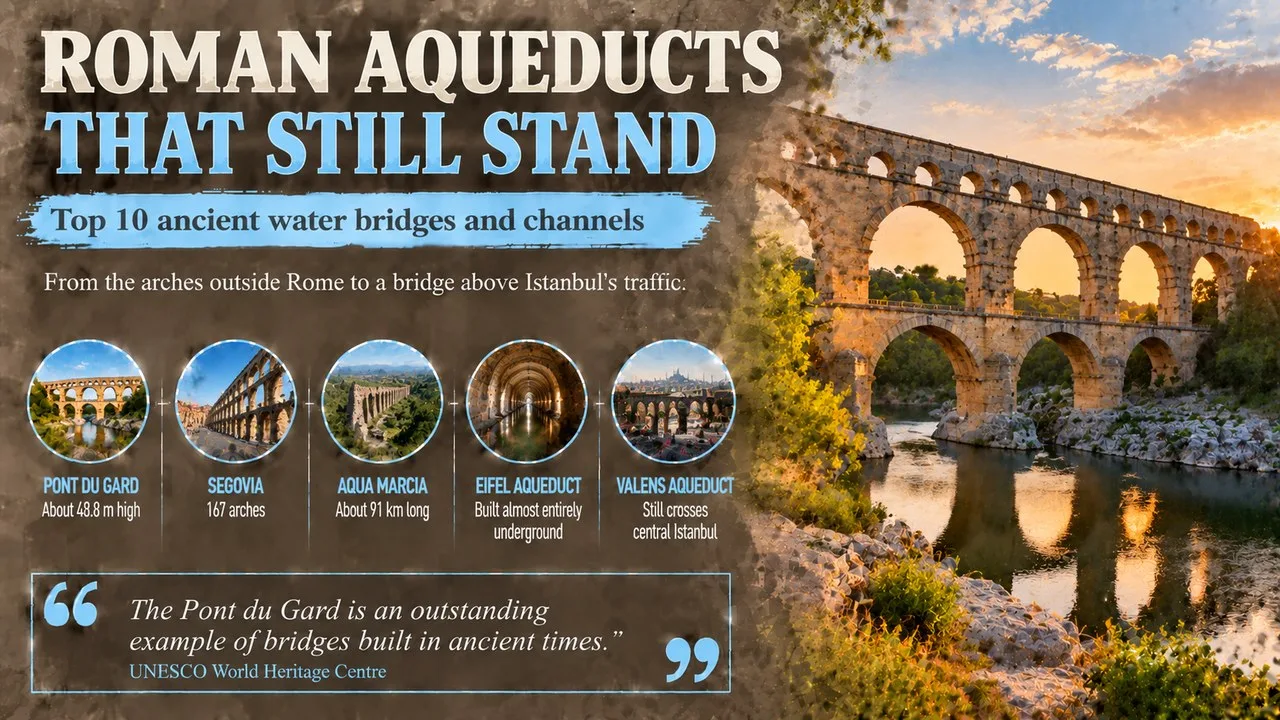
Roman aqueducts are among the most impressive engineering works of the ancient world, and many still stand. But the Romans did not invent the idea of carrying water over long distances.[5]
Aqueducts were likely first used by the Minoans on Crete around 2000 BC. In the 7th century BC, the Assyrians built an aqueduct with an 80 metre long raised section crossing a 300 metre wide valley to carry water to their capital, Nineveh.[5]
What the Romans did was build aqueducts on a huge scale across their empire, supplying cities with water for baths, fountains, toilets and private homes.[5] Rome's first aqueduct was built in 312 BC, and by the 3rd century AD the city had eleven aqueducts supplying a population of more than a million people.[11] Their contribution was engineering, organisation and scale, not the original invention.
7. Myth: Romans Wore Togas Every Day
The toga is the classic image of Roman dress. It was a roughly semicircular piece of white wool, between 12 and 20 feet long, draped over the shoulders and around the body and worn over a tunic.[6]
The toga's bulk and complex drapery made it impractical for manual work or active leisure. It was heavy, hot, easily stained and hard to clean.[6] Most Romans, especially working people, wore simple tunics for daily life.
Over time ordinary citizens abandoned the toga, while the office-holding aristocracy adopted ever more elaborate forms. It remained the formal costume of the senatorial elite and of important public occasions.[6] Different togas also marked status. The toga praetexta, with a broad purple border, was worn by senior magistrates and by freeborn children, while a plain white toga virilis was given to boys at their coming of age, usually between about 14 and 17.[6] Seeing every Roman in a toga is like imagining every modern person always dressed in formal evening wear.
Related: Top 10 Legendary Pyramids Around the World
8. Myth: Plebeian Simply Meant Poor
Today the word plebeian is often used to mean common or low-class. In Rome, however, plebeians were a legal order of citizens, distinct from the patricians, the hereditary aristocratic families.[7]
During the long Conflict of the Orders, plebeians struggled for full political rights. After 342 BC they regularly reached the consulship, Rome's highest regular office, and by 287 BC their assemblies could pass laws binding on all citizens.[7]
Many plebeian families became wealthy and powerful, joining a new governing elite of nobiles defined by holding high office, not by birth.[7] Most plebeians were ordinary working people, but the category itself was about legal status, not poverty.
9. Myth: Women Never Fought in the Arena
Gladiatorial combat is usually imagined as entirely male, but female gladiators did exist. They are mentioned in literary sources from the late Republic and early Empire and attested in a few inscriptions.[8]
During the reign of Domitian, around 89 AD, one set of games featured battles between female gladiators likened to the warrior women of Greek legend.[8] Female fighters seem to have been rare and treated as an exotic novelty.
Female gladiators were officially banned as unseemly from 200 AD onwards.[8] The ban itself shows that women had fought often enough for authorities to forbid it.
Related: Top 10 Roman Aqueducts That Still Stand
10. Myth: The Colosseum Was Rome's Largest Venue
The Colosseum was the largest amphitheatre ever built, and it could hold an estimated 50,000 to 80,000 spectators at various points in its history, with an average audience of around 65,000.[9]
Rome had an even bigger venue, however. The Circus Maximus, a chariot-racing stadium between the Aventine and Palatine hills, was the first and largest stadium in ancient Rome. It measured 621 metres long and 118 metres wide and could hold more than 150,000 spectators.[10]
Chariot racing was enormously popular, and the Circus Maximus hosted races, processions and other events for centuries.[10] The Colosseum is more famous today largely because more of it survives.
Conclusion
The top 10 Ancient Rome myths show how a mix of misunderstood words, dramatic art and biased ancient writers can shape modern ideas about the past. The real evidence often tells a more practical and varied story.
Rome was a society of tunics as well as togas, of volunteers as well as slaves in the arena, and of engineers who improved on older ideas. Looking past the myths gives a clearer and more human picture of the Roman world.
Many of these myths also say more about later centuries than about Rome itself. Victorian painters, Hollywood studios and moralising writers each found in Rome a mirror for their own concerns, and the images they created have often outlasted the evidence. Returning to the sources, and admitting where they are uncertain, is the best way to see the Romans as they actually were.
- ^ [1] "Vomitorium". Wikipedia. Wikipedia
- ^ [2] "Great Fire of Rome". Wikipedia. Wikipedia
- ^ [3] "Pollice verso". Wikipedia. Wikipedia
- ^ [4] "Gladiator". Wikipedia. Wikipedia
- ^ [5] "Aqueduct (water supply)". Wikipedia. Wikipedia
- ^ [6] "Toga". Wikipedia. Wikipedia
- ^ [7] "Plebeians". Wikipedia. Wikipedia
- ^ [8] "Gladiatrix". Wikipedia. Wikipedia
- ^ [9] "Colosseum". Wikipedia. Wikipedia
- ^ [10] "Circus Maximus". Wikipedia. Wikipedia
- ^ [11] "Roman aqueduct". Wikipedia. Wikipedia























Discussion
Log in with