




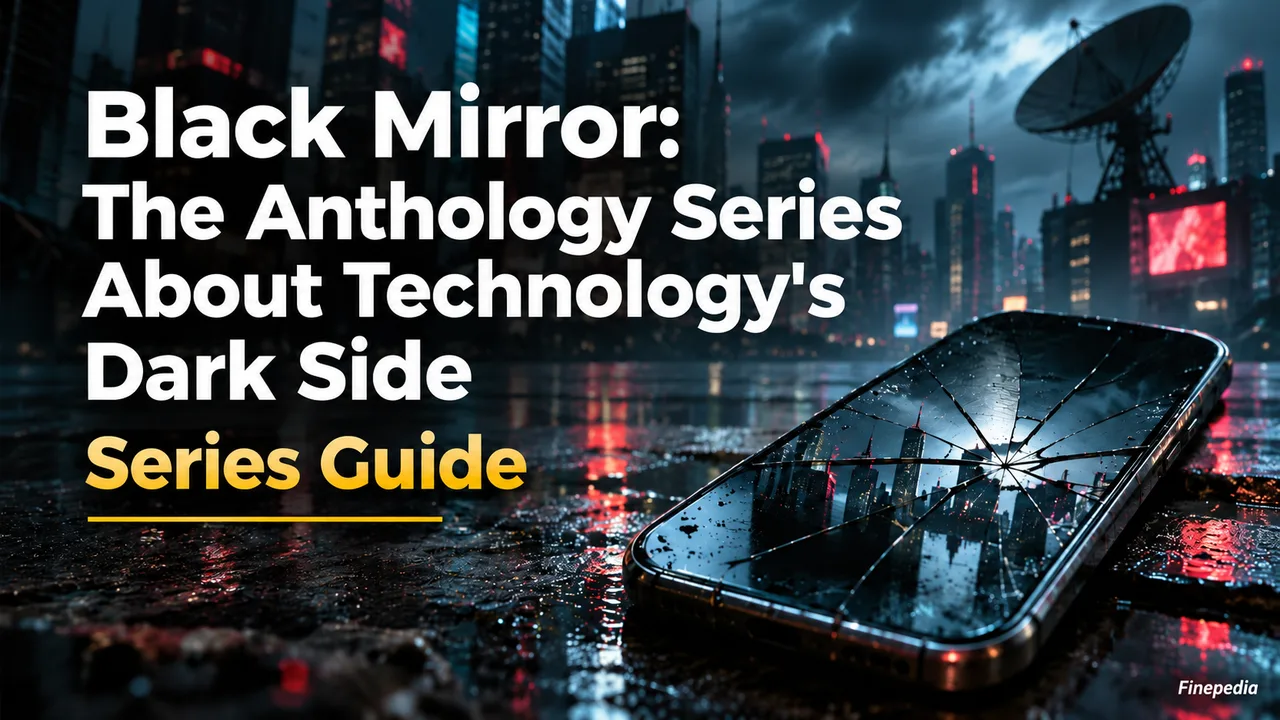
Black Mirror is a British anthology television series created by Charlie Brooker that imagines how new technology could go wrong in the near future.[1] Each episode tells a separate story with its own cast and setting, and together they have made the show one of the best-known examples of speculative fiction on television.
The series began on Channel 4 in 2011 and moved to Netflix in 2016. This Finepedia guide covers how the show was created, its themes, each series and the interactive film Bandersnatch, its Emmy-winning episodes, the debate over its quality, and the many moments when its fictional technology seemed to come true.
Quick Facts
The table below sums up the key facts about the series.
Black Mirror at a Glance
| Attribute | Details |
|---|---|
| Creator | Charlie Brooker |
| Executive producer | Annabel Jones |
| Genre | Anthology, speculative fiction, satire, drama |
| Original network | Channel 4 (2011 to 2014), then Netflix (from 2016) |
| Series | Seven series plus the special "White Christmas" |
| Episodes | 33, plus the interactive film Bandersnatch (2018) |
| First episode | "The National Anthem", 4 December 2011 |
| Latest series | Series 7, released 10 April 2025 |
| Major awards | International Emmy (2012); Outstanding Television Movie Emmy three years running |
| Status | Renewed for an eighth series in January 2026 |
Origins and Creation
Charlie Brooker's Background
Charlie Brooker, born in 1971, built his career as a comedy writer and critic. He reviewed video games for PC Zone in the late 1990s and later wrote television reviews for The Guardian, before creating satirical shows such as Screenwipe and the zombie drama Dead Set.[1][2]
Brooker and the producer Annabel Jones had worked together on Charlie Brooker's Screenwipe, and in 2010 they began developing a new drama.[1] Their partnership would shape every stage of Black Mirror, from the first idea for an episode to the final edit.
Inspiration and the Name
Brooker modelled the show on classic anthology series, above all The Twilight Zone, along with Tales of the Unexpected and Hammer House of Horror.[1] He admired how Rod Serling had used fantasy settings to discuss sensitive social issues, and he decided to do the same for the effects of technology, aiming to show how people might be living "in 10 minutes' time".
The title came from the Arcade Fire song "Black Mirror". Brooker used it to describe the dark, reflective glass of a phone, television or computer screen when it is switched off.[1] A recurring cast or presenter was considered but dropped, so each episode could stand alone.
How the Episodes Are Written
Most episodes are credited to Brooker alone. Many begin as a "what if" conversation with Jones about a new technology, which he then pushes to a worst-case outcome.[1] Brooker has said that each story should ask the audience to accept only one unusual element, while the characters behave in realistic ways.
A few episodes have other writers. Jesse Armstrong wrote "The Entire History of You", and for "Nosedive" Michael Schur and Rashida Jones wrote the script from Brooker's outline.[1] After the first two series, Brooker moved from writing scripts as he went to planning full outlines before each first draft.
Themes and Style
Because Black Mirror is an anthology, episodes can be watched in any order. Most are set in a dystopian near future where a single invention exaggerates a familiar habit, often linked to the internet, social media or personal devices.[1] Many of these technologies change the human body or mind, offering convenience while bringing out people's worst instincts.
Recurring themes include surveillance and data privacy, virtual reality, digital consciousness, consumerism and the pressure of public opinion.[1] Many episodes end with a twist, and the tone is usually bleak, though not always.
The show also crosses genres. "The National Anthem" is a black comedy and political satire, "Hated in the Nation" and "Smithereens" are crime stories, "Metalhead" is a post-apocalyptic chase filmed in black and white, and "San Junipero" and "Hang the DJ" are love stories.[1] That variety helps explain why the series has stayed fresh for more than a decade.
Related: The Evolution of Stranger Things: Seasons, Themes, and Characters
The Series
The Channel 4 Years (2011 to 2014)
Channel 4 commissioned three hour-long episodes for the first series, produced by Brooker's company Zeppotron for Endemol. It began on 4 December 2011 with "The National Anthem", in which Rory Kinnear plays a British prime minister faced with an outrageous blackmail demand.[1] The series continued with "Fifteen Million Merits", starring Daniel Kaluuya, and "The Entire History of You", about a device that records every memory.
The second series of three episodes began on 11 February 2013. "Be Right Back" follows a grieving woman, played by Hayley Atwell, who turns to an artificial version of her dead partner, played by Domhnall Gleeson. It was followed by "White Bear" and the political satire "The Waldo Moment".[1]
The 2014 Christmas special "White Christmas", starring Jon Hamm and Rafe Spall, wove three stories into one 90-minute episode and aired on 16 December 2014.[1] It was the last new Black Mirror story made for Channel 4.
The Move to Netflix
Netflix added the first two series to its US service on 1 December 2014, which brought the show a large new audience. In September 2015 Netflix commissioned 12 new episodes, and in March 2016 it outbid Channel 4 for the UK rights to the third series.[1] It was the first time a streaming service had taken over a series that its original broadcaster had wanted to renew.
Series 3 and 4 (2016 and 2017)
The third series of six episodes was released worldwide on 21 October 2016. It opened with "Nosedive", starring Bryce Dallas Howard as a woman obsessed with her social media rating, and included the hopeful love story "San Junipero", starring Gugu Mbatha-Raw and Mackenzie Davis.[1] Brooker wrote "San Junipero" first, as a deliberate change of tone.
The fourth series followed on 29 December 2017. It featured the space adventure "USS Callister" with Jesse Plemons and Cristin Milioti, "Arkangel" directed by Jodie Foster, "Crocodile", "Hang the DJ", "Metalhead" and "Black Museum".[1]
Bandersnatch (2018)
Black Mirror: Bandersnatch was released on 28 December 2018 as an interactive film. Set in 1984, it follows a young programmer, played by Fionn Whitehead, who adapts a fantasy novel into a video game as his grip on reality slips.[1][3] Viewers make choices on screen that change the story, which has five main endings.
The film won two Emmys in 2019, including Outstanding Television Movie. In May 2025 Netflix removed it from the service, saying its interactive features limited technical work in other areas.[1][3]
Related: Chernobyl Miniseries: Stories of Tragedy of a Nuclear Catastrophe, Heroism and Sacrifice
Series 5, 6 and 7 (2019 to 2025)
The fifth series of three episodes arrived on 5 June 2019, with "Striking Vipers", "Smithereens" starring Andrew Scott, and "Rachel, Jack and Ashley Too" featuring Miley Cyrus.[1] The sixth series of five episodes, released on 15 June 2023, leaned more towards horror and past settings, with episodes such as "Joan Is Awful", "Beyond the Sea" and "Demon 79".
The seventh series of six episodes was released on 10 April 2025. It included "Common People", "Plaything" and "USS Callister: Into Infinity", the first sequel to an earlier Black Mirror story.[1][4] In January 2026 Netflix renewed the show for an eighth series.[1]
Episode Guide by Series
The table below summarises each series and its release.
| Series | Released | Episodes | Notable episodes |
|---|---|---|---|
| Series 1 | December 2011 (Channel 4) | 3 | The National Anthem, Fifteen Million Merits |
| Series 2 | February 2013 (Channel 4) | 3 | Be Right Back, White Bear |
| Special | December 2014 (Channel 4) | 1 | White Christmas |
| Series 3 | 21 October 2016 (Netflix) | 6 | Nosedive, San Junipero |
| Series 4 | 29 December 2017 (Netflix) | 6 | USS Callister, Hang the DJ |
| Film | 28 December 2018 (Netflix) | 1 | Bandersnatch |
| Series 5 | 5 June 2019 (Netflix) | 3 | Striking Vipers, Smithereens |
| Series 6 | 15 June 2023 (Netflix) | 5 | Joan Is Awful, Beyond the Sea |
| Series 7 | 10 April 2025 (Netflix) | 6 | Common People, USS Callister: Into Infinity |
Notable Episodes
A handful of episodes are mentioned again and again when critics and fans discuss the series.
The National Anthem
The very first episode set the tone for the show's shock value. A British prime minister is told that a kidnapped royal will be released only if he performs a degrading act on live television.[1] It drew 145 complaints to the regulator Ofcom, the eighth-highest number for any programme that year, but critics praised how naturally each turn of the plot followed from the last.
Be Right Back
This quiet second-series story asks whether technology can ease grief. After her partner dies, a woman signs up for a service that rebuilds his personality from his online messages, first as a chatbot and then as a physical copy.[1] It is often cited as one of the show's most moving episodes and, years later, as one of its most prophetic.
Nosedive
"Nosedive" imagines a pastel-coloured world where every interaction is rated from one to five stars and a person's average score controls their access to housing, travel and status.[1] Bryce Dallas Howard was nominated for a Screen Actors Guild Award for her role as the increasingly desperate Lacie.
San Junipero
Set partly in a seaside party town in the 1980s, "San Junipero" follows two women who fall in love, and it slowly reveals the technology behind their meeting.[1] Its hopeful ending surprised viewers used to the show's darker conclusions, and it won the Emmy for Outstanding Television Movie in 2017.
USS Callister
"USS Callister" opens like an affectionate parody of classic space adventures, then turns into a story about a bullying programmer who traps digital copies of his colleagues inside a game.[1] It won three Emmy Awards, including Outstanding Television Movie, and in 2025 it became the first episode to receive a sequel.
Related: The Family Man: A Spy Thriller of Modern India Balancing Family Life and National Security
Metalhead
Shot in black and white and directed by David Slade, "Metalhead" is a lean survival story about a woman, played by Maxine Peake, fleeing a relentless robotic "dog" across a bleak landscape.[1] It shows how far the series can move from its usual social satire.
Production Companies
The first series was made by Zeppotron for Endemol, and later episodes were produced under House of Tomorrow, a division of Endemol that Brooker and Jones set up.[1] Around January 2020 they left House of Tomorrow and formed a new company, Broke and Bones, which made the sixth and seventh series for Netflix. In July 2025 the pair announced they were leaving Broke and Bones at the end of their five-year Netflix deal, although Brooker said he would still like to write more episodes.
Reception
Critical Response
Black Mirror has generally been praised by critics, and several publications named it among the best television series of the 2010s.[1] In 2023 Variety ranked it 95th on its list of the 100 greatest TV shows of all time. Early episodes such as "The National Anthem" and "Be Right Back" were widely admired for their ideas and acting.
The show also has critics. Some reviewers find its moral lessons obvious and its pessimism repetitive, and several argued that the quality became more uneven after the move to Netflix, with longer episodes and more polished production not always matching the early impact.[1] The seventh series was generally seen as a return to form.
Audience
The series has at times been among the most-watched programmes in the world. Netflix reported that viewers watched 60 million hours of the sixth series in its first week, and Nielsen ranked it the most-viewed streaming programme in the United States that week.[1]
Awards
Black Mirror won the International Emmy Award for best TV movie or miniseries in November 2012.[1] It then won the Primetime Emmy for Outstanding Television Movie three years in a row, for "San Junipero" in 2017, "USS Callister" in 2018 and Bandersnatch in 2019.[1][5]
Cultural Impact
Reviving the Anthology Format
Along with American Horror Story, Black Mirror is credited with bringing the anthology format back to popularity after it had been rare in the 1990s and 2000s.[1] Later anthologies and science fiction shows, including Electric Dreams and the 2019 revival of The Twilight Zone, were often compared with it, and the name "Black Mirror" became shorthand for unsettling technology stories.
When Fiction Seemed to Come True
Commentators have often described Brooker as prescient. "Nosedive", with its society ruled by personal ratings, has frequently been compared with China's Social Credit System.[1][6] "The Waldo Moment", about a cartoon character who runs for Parliament, was compared by journalists with the rise of outsider politicians.
Related: Game of Thrones: A Fantasy Epic of Power and Betrayal on HBO
"Be Right Back", about an AI that imitates a dead partner, has been linked to modern chatbots and to a 2022 announcement that a voice assistant could imitate the voices of lost loved ones.[1] Smaller details have also echoed real events, such as a self-driving pizza delivery van shown in "Crocodile" shortly before a similar concept was presented at the 2018 Consumer Electronics Show.
Spin-offs and Tie-ins
The show has inspired a board game based on "Nosedive", the mobile game Thronglets based on "Plaything", soundtrack albums and the companion book Inside Black Mirror, published in 2018.[1] A walk-through attraction, the Black Mirror Labyrinth, opened at Thorpe Park in England in 2021 and closed at the end of 2023.
Interesting Facts
The following points highlight lesser-known details about the series.
- The title refers to the dark screen of a switched-off phone or television.[1]
- An unmade early script called "Inbound" later fed ideas into "Men Against Fire".[1]
- Brooker has said he sometimes writes standing up to avoid wasting time.[1]
- Bandersnatch offers more than a trillion possible paths through its story.[1][3]
- "USS Callister: Into Infinity" is the first Black Mirror sequel episode.[4]
What to Watch Next
Fans of Black Mirror often turn to other anthology and technology-themed series. Options frequently compared with it include Electric Dreams, Inside No. 9, Years and Years and the 2019 version of The Twilight Zone, each offering a different balance of satire, horror and drama.[1]
Frequently Asked Questions
Do you need to watch Black Mirror in order?
No. Each episode is a standalone story with its own characters, so the episodes can be watched in any order, though some contain small references to others.[1]
How many episodes of Black Mirror are there?
As of November 2026 there are 33 episodes across seven series and one special, plus the interactive film Bandersnatch.[1]
Why is it called Black Mirror?
The name refers to the black, reflective surface of a screen when a phone, TV or computer is turned off.[1]
Is there a Black Mirror series 8?
Yes. Netflix renewed the show for an eighth series in January 2026.[1]
Conclusion
Black Mirror turned a simple idea, asking what happens when a familiar technology is pushed a little too far, into one of the most influential television series of its time. From its sharp early Channel 4 episodes to its Emmy-winning Netflix stories and the experiment of Bandersnatch, it has kept changing tone and genre while holding on to its core question.
Its critics argue that the show can be preachy or uneven, but its ideas have entered everyday conversation, and many viewers now describe unsettling real-world inventions simply as "very Black Mirror". With an eighth series on the way, its reflection of modern life is not finished yet.
- ^ [1] "Black Mirror". Wikipedia. Wikipedia
- ^ [2] "Charlie Brooker". Wikipedia. Wikipedia
- ^ [3] "Black Mirror: Bandersnatch". Wikipedia. Wikipedia
- ^ [4] "List of Black Mirror episodes". Wikipedia. Wikipedia
- ^ [5] "Primetime Emmy Award for Outstanding Television Movie". Wikipedia. Wikipedia
- ^ [6] "Social Credit System". Wikipedia. Wikipedia
Content adapted from Wikipedia (Black Mirror: The Anthology Series About Technology's Dark Side). Licensed under CC BY-SA.
Source
Portions of this article are adapted from the Wikipedia article 'Black Mirror', licensed under CC BY-SA 4.0. (revision 1382853100)




















Discussion
Log in with