



Top 10 Misidentified Prehistoric Animals and How Science Corrected Them
 By Dhiraj Sharma · Published
A fossil is an incomplete record, not a ready-made picture of an extinct animal. Bones often arrive scattered, crushed or separated from the parts that would identify them, and early researchers had to compare strange remains with living animals and with the small number of fossils already known. A sensible interpretation could later prove badly wrong once a better specimen came to light.
This Finepedia list brings together the top 10 misidentified prehistoric animals. Each entry explains what scientists first thought they had found, what later evidence showed, and why the mistake happened, from a single worn tooth mistaken for an ape to a giant pair of arms that waited almost fifty years for a body.
These cases are not stories of foolish scientists. They show the normal working of palaeontology, where every reconstruction is a hypothesis that new fossils can test. Several of the corrections changed how museums display these animals and how the public imagines them.
Key Facts
The table below sums up all 10 entries on this list, with the original interpretation and the correction that replaced it.
The 10 Misidentified Prehistoric Animals at a Glance
| No. | Animal | First interpretation | What later evidence showed |
|---|---|---|---|
| 1 | Nebraska Man | A North American ape-like human relative | The tooth came from an extinct peccary |
| 2 | Anomalocaris | Shrimp bodies, a jellyfish and other animals | All parts of one large radiodont predator |
| 3 | Iguanodon | A horn on the nose | The spike was a modified thumb |
| 4 | Oviraptor | An egg thief raiding a nest | A parent brooding its own eggs |
| 5 | Hallucigenia | Walking on spines, upside down | Spines on the back, legs below, head at the other end |
| 6 | Apatosaurus | Mounted with a Camarasaurus-like skull | Its real skull resembled Diplodocus |
| 7 | Elasmosaurus | Skull placed on the end of the tail | The long part was the neck |
| 8 | Tanystropheus | A pterosaur with wing bones | The "wing bones" were neck vertebrae |
| 9 | Deinocheirus | A mystery predator known only from arms | A huge, bulky, omnivorous ornithomimosaur |
| 10 | Spinosaurus | A land-based sail-backed predator | Evidence for a semiaquatic life, still debated |
1. Nebraska Man: A Tooth That Became a Human Relative
In 1917 the rancher and geologist Harold Cook found a single fossil tooth in Nebraska. In 1922 it was described by Henry Fairfield Osborn of the American Museum of Natural History as belonging to a new primate, Hesperopithecus haroldcookii, meaning "ape of the Western World".[1] Other specialists at the museum, including William K. Gregory, agreed that it came from an anthropoid ape related to humans.
The find caught the public imagination. The artist Amédée Forestier drew a full reconstruction of the creature for the Illustrated London News, modelled on the Java ape-man. Osborn himself dismissed the drawing as "a figment of the imagination of no scientific value".[1]
Further digging at the site turned up more of the skeleton, and these pieces showed the tooth belonged neither to a man nor an ape but to an extinct peccary called Prosthennops. The original tooth was badly weathered, which helped explain the error, and the identification was retracted in 1927.[1] Nebraska Man was not a deliberate hoax, but it remains a warning about building a whole animal from a single fragment.
2. Anomalocaris: A Predator Filed in Pieces
The first fossils of Anomalocaris were described in 1892 by Joseph Frederick Whiteaves of the Geological Survey of Canada. He interpreted them as the abdomens of shrimp-like crustaceans, and the name he chose means "unlike other shrimp".[2] What he actually had were the animal's grasping front appendages.
Other parts of the same kind of creature were given separate identities. Charles Doolittle Walcott found a fossilised circular mouth and mistook it for a jellyfish, placing it in the genus Peytoia, and he took a frontal appendage for the feeding limb of another animal.[2] For decades, a single predator was spread across several unrelated groups.
The confusion was untangled during a major revision of the Burgess Shale fossils led by Harry B. Whittington of Cambridge University, with his students Simon Conway Morris and Derek Briggs.[2] Complete body specimens finally showed that the appendages, mouth and body belonged together. Anomalocaris is now recognised as a radiodont, one of the large early relatives of arthropods, and one of the top predators of Cambrian seas.
3. Iguanodon: The Thumb Spike That Started on the Nose
Iguanodon was named in 1825 by the English geologist Gideon Mantell, who presented his findings to the Royal Society of London. It was only the second dinosaur ever named, after Megalosaurus, and was known at first from teeth and scattered bones.[3]
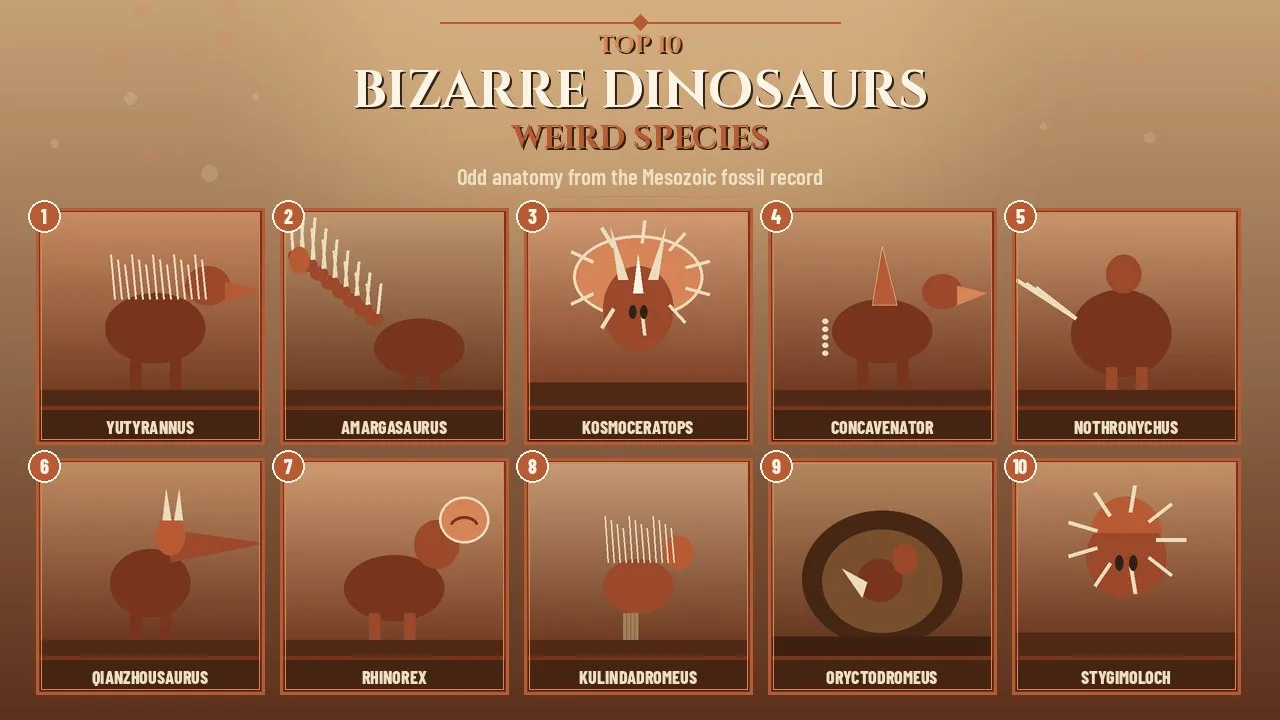
Related: Top 10 Most Bizarre Dinosaurs
With so little to go on, Mantell had to guess at the animal's shape. His most famous mistake was placing a conical bone, which he took for a horn, on the end of the creature's nose.[3] Early reconstructions showed a heavy, lizard-like beast with a rhinoceros-style horn.
In 1878 far more complete skeletons were discovered in a coal mine at Bernissart in Belgium and studied by Louis Dollo.[3] These specimens revealed that the "horn" was actually a modified thumb spike on each hand. Iguanodon is now known as a large plant eater with a prehensile fifth finger, related to the later duck-billed hadrosaurs.
4. Oviraptor: The Egg Thief That Was a Parent
The first Oviraptor remains were collected in 1923 at the Flaming Cliffs of Mongolia, during an American Museum expedition led by Roy Chapman Andrews. The skeleton lay on top of a nest of eggs that were assumed to belong to the horned dinosaur Protoceratops.[4]
In 1924 Henry Fairfield Osborn named the animal Oviraptor philoceratops, a name meaning "egg thief" with a fondness for ceratopsian eggs. Osborn himself urged caution, noting that the name might mislead about the animal's habits.[4] Even so, oviraptorids were widely regarded for decades as egg-eating dinosaurs.
In the 1990s, discoveries of oviraptorids sitting on nests, together with an embryo of the related Citipati described in 1994, proved that Osborn had been right to be careful.[4] The eggs belonged to oviraptorids, and the adults found on top of nests were brooding them, much like birds. The animal remembered as a thief was most likely a parent protecting its clutch, but the name stays because the rules of naming do not allow it to be changed.
5. Hallucigenia: Walking on the Wrong Side
Hallucigenia is a small, worm-like animal from the Cambrian Burgess Shale. Walcott first described it as a species of the polychaete worm Canadia, and Simon Conway Morris gave it its own name in 1977, choosing one that reflected its dreamlike appearance.[5]
Conway Morris reconstructed the animal standing on its pairs of stiff spines, with a single row of soft tentacles waving on its back. A dark stain at one end was interpreted as a featureless head.[5] It looked like no other animal alive, which only added to its fame.
Related: Top 10 Most Bizarre Phobias: Strange Fears That Exist
In 1991 Lars Ramsköld and Hou Xianguang compared it with related fossils from the Maotianshan shales of China and turned it over, showing that Hallucigenia was a lobopodian, a legged worm with protective spines on its back.[5] Research in the mid-2010s then showed that the longer end was the head, with a mouth and at least one pair of simple eyes, so the animal had been both upside down and back to front.
6. Apatosaurus: The Wrong Skull on a Famous Skeleton
Othniel Charles Marsh named Apatosaurus ajax in 1877, and the giant sauropod soon became one of the most famous dinosaurs. Its skull, however, was missing from the early skeletons, and for many years it was confused with the skulls of Camarasaurus and Brachiosaurus.[6]
In 1909 a skeleton of Apatosaurus louisae was found with a complete skull lying a few metres from the front of the neck. Osborn disagreed that the skull belonged to it, and mounted skeletons continued to carry shorter, boxier heads based on Camarasaurus.[6] Museum visitors for decades saw an Apatosaurus wearing the wrong face.
The question was settled in 1970, when John McIntosh showed that more robust skulls assigned to Diplodocus were more likely to be from Apatosaurus.[6] The animal's real skull is long and low, much like that of Diplodocus. The same group of fossils also fed a long debate about Brontosaurus, which was treated as the same animal for over a century until a 2015 study by Emmanuel Tschopp and colleagues argued that it was a distinct genus.[12]
7. Elasmosaurus: The Head on the Wrong End
The first Elasmosaurus specimen was found in 1867 near Fort Wallace, Kansas, and sent to the palaeontologist Edward Drinker Cope, who named it Elasmosaurus platyurus in 1868.[7] It was a plesiosaur, a marine reptile from the Late Cretaceous, about 80 million years ago.
Cope's first reconstruction placed the skull at the end of the tail. He had assumed that the long part of the skeleton was the tail and the short part the neck, when the opposite was true.[7] Elasmosaurus had one of the longest necks of any plesiosaur, which made the mistake easier to make.
The error was publicised by Cope's rival Othniel Charles Marsh, and it became part of their bitter feud known as the Bone Wars.[7] That competition between the two men drove a rush of fossil collecting in the American West, but also hasty work and personal attacks.[11] Cope tried to recall all copies of the preprint and published a corrected version with the head on the neck, but the story of the backwards plesiosaur followed him for the rest of his career.
Related: Top 10 Facts About Dogs
8. Tanystropheus: Wing Bones That Were Neck Vertebrae
Tanystropheus was a reptile from the Middle Triassic, known especially from Monte San Giorgio on the border of Switzerland and Italy. When the species Tanystropheus longobardicus was first described in 1886, its fossils were mistaken for those of a pterosaur and given the name Tribelesodon.[8]
The long, hollow bones that looked like the elongated finger bones supporting a pterosaur wing were something quite different. Starting in the 1920s, systematic excavations at Monte San Giorgio uncovered many more skeletons. These showed that the supposed wing bones were actually extremely long neck vertebrae.[8]
The real animal had a neck longer than its body and tail combined, with only a small number of very long vertebrae. Most fossils come from marine or coastal deposits, and a second, larger species, Tanystropheus hydroides, was formally distinguished in 2020 on the basis of its distinctive skull.[8] The animal is still one of the strangest-looking reptiles ever found.
9. Deinocheirus: Two Giant Arms Without a Body
In 1965 an expedition in the Nemegt Formation of Mongolia found a pair of enormous arms, shoulder girdles and a few other bones of a new dinosaur. In 1970 they became the type specimen of Deinocheirus mirificus, a name from Greek meaning "horrible hand".[9]
The arms were among the largest of any two-legged dinosaur, at about 2.4 metres long, with large claws on three-fingered hands.[9] For almost fifty years no further remains were found, and many people imagined a giant predator to match those fearsome limbs.
Two more complete specimens were described in 2014, parts of which had been looted from Mongolia and later returned.[9] They revealed a very different animal: an ornithomimosaur about 11 metres long and weighing around 6.5 tonnes, with a tall sail on its back, short legs and blunt claws. Fish scales and stomach stones found with one specimen suggest it was an omnivore rather than a fearsome hunter.
Related: Top 10 Tallest Buildings in the World
10. Spinosaurus: A Reconstruction Still Being Rewritten
The first Spinosaurus remains were found in Egypt in 1912 and described by the German palaeontologist Ernst Stromer in 1915. Those original fossils were destroyed when the museum in Munich that held them was bombed in April 1944.[10] For decades, scientists had only Stromer's drawings and descriptions to work from.
As a result, Spinosaurus was long pictured as a large, sail-backed predator built much like other big theropods. In 2014 Nizar Ibrahim and colleagues described new material from Morocco and proposed that the animal was adapted to life in water, and in 2020 the same team described a tail with tall spines forming a paddle-like structure.[10]
The picture is not final. The evidence suggests Spinosaurus was semiaquatic and ate both aquatic and land prey, but how well it could swim has been strongly contested, and a 2022 study led by Paul Sereno questioned some of the earlier conclusions.[10] It is the one entry on this list where scientists are still actively arguing over what the animal looked like and how it lived.
Conclusion
The top 10 misidentified prehistoric animals show that early reconstructions were reasonable guesses made from partial evidence. A worn tooth, a scattered set of appendages or a pair of arms could only be interpreted by comparison with what was already known, and each new specimen tested those guesses.
From Nebraska Man to Spinosaurus, the corrections came from more fossils, better comparisons and careful re-examination rather than from any single genius. That process of revision is the strength of palaeontology, and it means some of today's reconstructions may change again as new discoveries emerge.
- ^ [1] "Nebraska Man". Wikipedia. Wikipedia
- ^ [2] "Anomalocaris". Wikipedia. Wikipedia
- ^ [3] "Iguanodon". Wikipedia. Wikipedia
- ^ [4] "Oviraptor". Wikipedia. Wikipedia
- ^ [5] "Hallucigenia". Wikipedia. Wikipedia
- ^ [6] "Apatosaurus". Wikipedia. Wikipedia
- ^ [7] "Elasmosaurus". Wikipedia. Wikipedia
- ^ [8] "Tanystropheus". Wikipedia. Wikipedia
- ^ [9] "Deinocheirus". Wikipedia. Wikipedia
- ^ [10] "Spinosaurus". Wikipedia. Wikipedia
- ^ [11] "Bone Wars". Wikipedia. Wikipedia
- ^ [12] "Brontosaurus". Wikipedia. Wikipedia

























Discussion
Log in with