



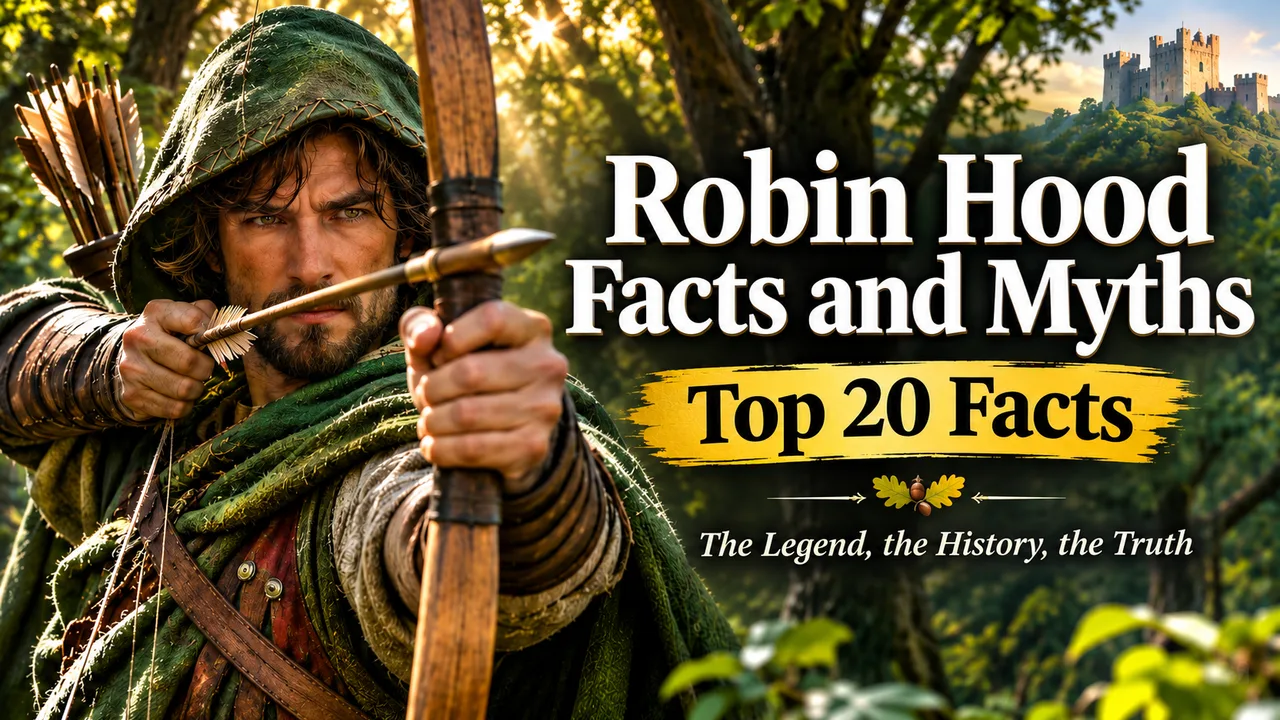
Robin Hood is one of the best-known outlaws in the world. For more than six centuries, ballads, plays, novels and films have told of the archer in Lincoln green who lived in the greenwood with his Merry Men, fought the Sheriff of Nottingham and helped those in need. Yet behind the familiar story lies a long and tangled history.
This Finepedia list brings together the top 20 Robin Hood facts and myths. The first ten entries explain what medieval sources actually tell us about the legend. The second ten look at popular claims about the "real" Robin Hood and weigh them against the evidence.
Historians have searched for a real Robin Hood since at least the 16th century. No single person has ever been proven to be the original, but the history of the legend itself is well documented and just as interesting as any outlaw's life.
Key Facts
The table below sums up all 20 entries on this list, with whether each is a fact or a myth and what the sources show.
The 20 Robin Hood Facts and Myths at a Glance
| No. | Entry | Type | What the sources show |
|---|---|---|---|
| 1 | The legend was known by the 1370s | Fact | Piers Plowman mentions "rhymes of Robin Hood" |
| 2 | The earliest evidence is literary | Fact | Ballads and plays, not records of one man |
| 3 | The stories changed over time | Fact | Each age reshaped Robin to suit itself |
| 4 | Early Robin was a yeoman | Fact | He became an earl only in the 1590s |
| 5 | The name was common | Fact | Robin was a pet form of Robert |
| 6 | Lincoln green is a literary detail | Fact | Named after cloth from Lincoln |
| 7 | Little John is an early companion | Fact | He appears in the oldest ballads |
| 8 | The Merry Men grew in number | Fact | Will Scarlet, Much and others were added |
| 9 | Maid Marian joined later | Fact | She came from French tradition and May games |
| 10 | Friar Tuck was a later addition | Fact | A real outlaw used the name in 1417 |
| 11 | Robin Hood was a real person | Myth | No individual has been proven |
| 12 | He robbed the rich to give to the poor | Myth | Early tales stress robbing corrupt clergy |
| 13 | The Sheriff was one real villain | Myth | The character is a stock enemy |
| 14 | He served Richard the Lionheart | Myth | The link was made in the 16th century |
| 15 | The Major Oak was his hideout | Myth | A folk tradition with no medieval basis |
| 16 | His grave is at Kirklees | Myth | The site is unproven |
| 17 | Little John lies at Hathersage | Myth | The grave claim needs caution |
| 18 | He lived only in Sherwood Forest | Myth | Early ballads also place him in Barnsdale |
| 19 | Robin Hood was one specific outlaw | Myth | The name may have been a stock alias |
| 20 | His biography is clear | Myth | The legend's history is clearer than the man |
1. The Legend Was Known by the 1370s
The first clear reference to Robin Hood comes in Piers Plowman, a long English poem by William Langland usually dated to the 1370s. In it, a lazy priest admits that he does not know his prayers well, but he does know the "rymes of Robyn Hood".[1]
That remark shows that by the late 14th century, stories about Robin were popular enough to be mentioned in passing. The legend was already part of everyday culture, even if none of those early rhymes has survived.[1]
By the 15th century Robin Hood also appears in Scottish chronicles. Writers such as Andrew of Wyntoun and Walter Bower mentioned him and tried to give him a date, a sign that the story had spread well beyond its English origins.[1]
2. The Earliest Evidence Is Literary
Almost everything known about Robin Hood comes from stories, not from legal or administrative records about a single man. The oldest surviving ballad, Robin Hood and the Monk, is preserved in a manuscript of the 15th century.[1]
Other early tales include Robin Hood and the Potter, from a manuscript of about 1503, and A Gest of Robyn Hode, a long poem printed in the early 16th century that combines several adventures into one story.[2] These texts are the foundation of the legend and the main evidence historians use.
The tone of these early tales varies a great deal. The Monk is a tense story of betrayal and rescue, while the Potter is a comic tale in which Robin swaps places with a pot-seller and tricks the Sheriff's wife.[1] Together they show a legend that was already flexible and entertaining for different audiences.
3. The Surviving Tales Changed Over Time
The Robin Hood of the early ballads is rough, quick-tempered and sometimes violent. He robs and kills enemies, plays tricks on the Sheriff and shows great devotion to the Virgin Mary.[1]
Later writers softened and reshaped him. Tudor plays, May Day games, 18th-century ballad collections and Victorian novels each added new characters and values, until Robin became the noble champion of the oppressed familiar today.[1] Each age made Robin Hood into the hero it wanted.
In the 20th and 21st centuries, cinema and television kept the process going. Actors from Douglas Fairbanks and Errol Flynn to Kevin Costner and Russell Crowe played Robin, and each production brought its own style and politics to the old story.[1]
4. Early Ballads Portray a Yeoman
In the earliest stories Robin is described as a yeoman, a man of middling rank below the gentry. He is not a lord in disguise but an outlaw of ordinary status with exceptional skill as an archer.[1]
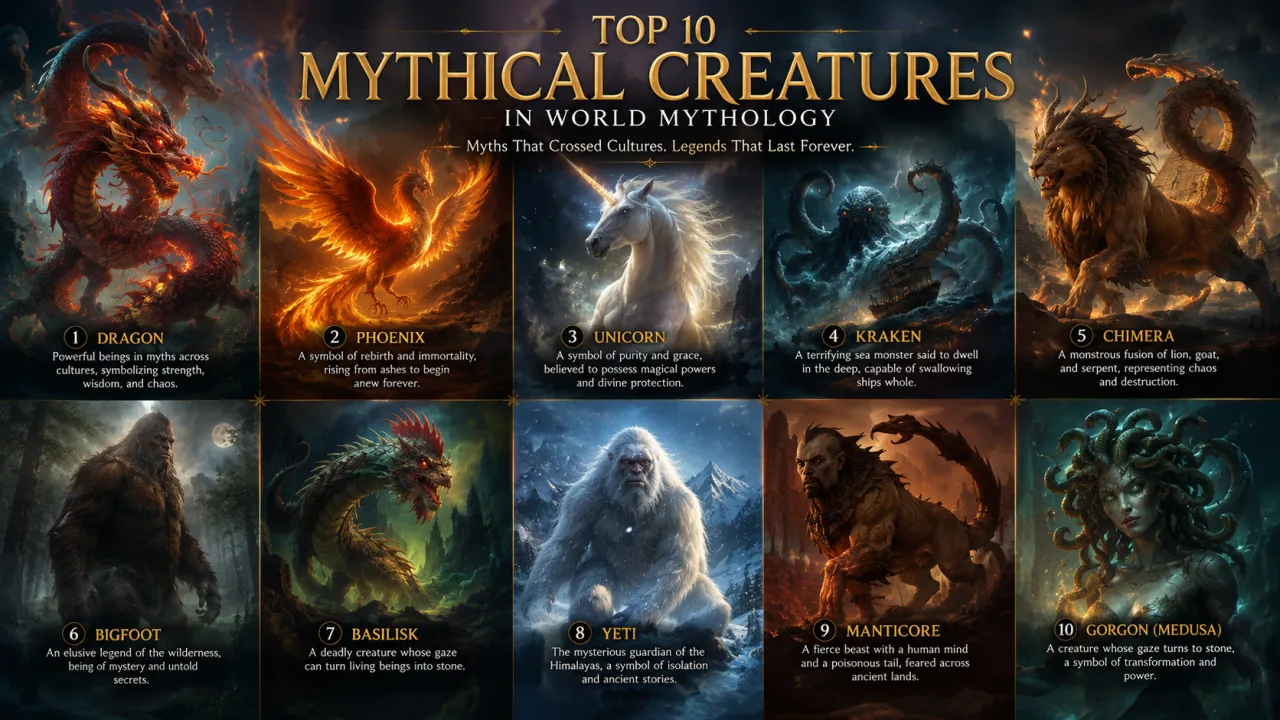
Related: Top 10 Mythical Creatures in World Mythology - That Inspired Myths Across Civilizations (unchanged)
From the 16th century writers tried to raise his rank. The playwright Anthony Munday, in two plays of the late 1590s, made him the Earl of Huntingdon, an idea that has stayed with the legend ever since.[1] This noble Robin is a later invention, not part of the original tales.
5. The Name Does Not Identify One Person by Itself
Robin was a common pet form of Robert, and Hood or Hod was an ordinary surname or nickname. Many men in medieval England could have been called Robin Hood.[1]
The earliest legal record of a person with the name dates from 1226, when the goods of a Robert Hod were seized in the York Assizes after he became a fugitive.[1] Whether he had anything to do with the legend is unknown. Finding the name in a record proves only that the name existed.
6. Lincoln Green Is a Literary Detail
Robin and his men are traditionally dressed in Lincoln green, a cloth associated with the English city of Lincoln, which was known in the Middle Ages for its dyed woollens.[3]
The colour suits life in the forest and appears in early ballads, but it is a storytelling detail rather than proof of a historical uniform. Lincoln was also famous for a scarlet cloth, and some tales dress the outlaws in other colours.[3]
7. Little John Is an Early Companion
Little John is one of the oldest members of Robin's band and appears in the earliest ballads, including Robin Hood and the Monk. His name is a joke, since he is usually described as a very large man.[4]
In many stories he is Robin's closest friend and right-hand man, and in some versions he is present at Robin's death.[4] The famous fight with quarterstaffs on a narrow bridge, where the two first meet, comes from a later ballad.
8. The Merry Men Group Expanded
The early ballads name only a few companions, including Little John, Much the Miller's son and Will Scarlet or Scathlock.[1] The phrase "merry men" referred generally to an outlaw's followers.
Over the centuries the group grew. Later writers added figures such as Alan-a-Dale, a minstrel, and, in modern times, new characters created for television and film.[1] The Merry Men became a flexible cast that each storyteller could adapt.
9. Maid Marian Joined the Story Later
Maid Marian does not appear in the earliest Robin Hood ballads. She seems to come from a separate tradition, including Adam de la Halle's French pastoral play Le Jeu de Robin et Marion, written around 1283, about a shepherdess and her shepherd lover.[5]
Related: Martin Luther King Jr.: The Legacy of a Civil Rights Icon
In England, Robin and Marian were paired in May Day games and festivities in the 15th and 16th centuries, and Marian then entered the plays and ballads.[5] By the time of Munday's plays she had become Robin's beloved, and the romance became central to modern versions.
10. Friar Tuck Was a Later Addition
Friar Tuck, the jolly fighting friar, also joined the legend through the May games and early plays. The earliest reference to him in a Robin Hood text appears in a play fragment of the 15th century.[1]
Interestingly, the name was used by a real outlaw. Royal writs of 1417 refer to Robert Stafford, a chaplain from Sussex who had taken the alias Frere Tuk and led a gang of robbers.[6] The connection to Robin Hood's band, however, belongs to the storytellers.
11. Myth: A Historical Robin Hood Has Been Proven
Many candidates have been proposed as the "real" Robin Hood, from Robert Hod of 1226 to men living in the reigns of Edward I and Edward II. Historians have suggested at least eight possible origins for the story.[1]
None of these theories has been proven, and the evidence for each is thin. It is possible that the legend grew around one forgotten outlaw, but it is just as possible that it was built from many stories and that no single original ever existed.[1]
12. Myth: Robin Always Robbed the Rich to Give to the Poor
The idea of Robin Hood as the man who robs the rich to feed the poor is a later summary. In the early ballads he does help a poor knight and is courteous to ordinary travellers, but his main targets are corrupt clergy and officials.[2]
The Gest ends with advice that Robin did poor men much good, and later tradition built on that idea.[2] The full picture of Robin as a social reformer who redistributes wealth owes much to 19th- and 20th-century retellings.
13. Myth: The Sheriff of Nottingham Was One Real Villain
The Sheriff of Nottingham is Robin's main enemy in the early tales, but the ballads never give him a name. He represents unjust local authority rather than a specific person.[7]
Nottingham did have real sheriffs, and historians have suggested several as possible models. But the character works as a stock villain, and later stories added new enemies such as Guy of Gisborne and Prince John.[7]
Related: Top 10 Most Bizarre Phobias: Strange Fears That Exist
14. Myth: Robin Hood Served Richard the Lionheart
Many modern versions show Robin as a loyal supporter of King Richard I, who returns from the Crusades at the end of the story. The early ballads, however, mention a king named Edward, not Richard.[1]
The Scottish historian John Major proposed in 1521 that Robin lived in the 1190s, and Munday's plays later fixed the story in Richard's reign.[1] From there the link passed into the novels of Walter Scott and many films. It is a later adaptation, not part of the original legend.
15. Myth: The Major Oak Was Robin's Hideout
The Major Oak near Edwinstowe in Sherwood Forest is famous as the tree where Robin and his men are said to have sheltered. It is thought to have been between 800 and 1,200 years old.[8]
The connection to Robin Hood comes from local folklore, not medieval sources. The tree was named after the antiquarian Major Hayman Rooke, who described it in 1790.[8] In June 2026, the RSPB, which manages the forest, announced that the tree had died, though it remains a powerful symbol of the legend.
16. Myth: Robin Hood's Grave Proves His Burial
The Gest says that Robin died at Kirklees Priory in Yorkshire, bled to death by a treacherous prioress. A grave said to be his still stands in the grounds of the former priory.[9]
The monument is later and has been altered over time, and no excavation has confirmed a medieval burial there.[9] The site reflects how the legend's ending was turned into a physical place of pilgrimage, not proof that a historical Robin lies beneath it.
17. Myth: Little John's Grave Settles His Existence
Little John is said to be buried in the churchyard of Hathersage in Derbyshire, where a long grave is marked by a modern tombstone.[4]
Stories claim that a very large thigh bone was dug up there in the 18th century, but there is no reliable evidence linking the grave to the legend's character.[4] Like Robin's grave, it shows the power of local tradition to give the legend a home.
18. Myth: Robin Lived Only in Sherwood Forest
Today Robin Hood is firmly linked with Sherwood Forest and Nottingham. Yet several early ballads place him in Barnsdale, an area in south Yorkshire, and some combine the two settings.[1]
Related: The Evolution of Stranger Things: Seasons, Themes, and Characters
Over time Nottinghamshire claimed the legend, helped by its famous forest and the Sheriff's role. Other places across England also have Robin Hood sites, from wells and stones to bays and hills.[1] The legend has spread across the map as widely as it has through time.
19. Myth: Robin Hood Was Always One Specific Outlaw
Some historians suggest that "Robin Hood" became a stock name for outlaws in general. Legal records from the late 13th century onwards include men with versions of the name who were criminals, possibly as nicknames.[1]
If so, the name may have spread because it was already famous, not because each record refers to the same man. This makes searching for one original even harder, since the name itself may have been part of the story's spread.[1]
20. Myth: The Hero's Biography Is Clear
Unlike the hero, the history of the legend is well documented. Scholars can trace it from rhymes in the 1370s, through the ballads and Gest, to Tudor plays, ballad collections and modern films.[1]
That history shows how the story was shaped by May games, printers, playwrights, antiquarians and filmmakers. It is a better guide to what Robin Hood has meant to people than any attempt to find a single outlaw behind the tale.[1]
The outlaw has stood for many things over the centuries: a defender of the common people, a symbol of English freedom, a romantic hero and a rebel against unfair taxes and corrupt power.[1] These shifting meanings are themselves part of the historical record.
Conclusion
The top 20 Robin Hood facts and myths show that the famous outlaw lives most clearly in stories rather than records. The yeoman of the early ballads became an earl, a supporter of King Richard and a champion of the poor as each generation retold his adventures.
No historical Robin Hood has been proven, and his grave, his tree and his famous companions are all better understood as parts of a growing legend. That legend, however, is a genuine piece of history, and its long journey from medieval rhymes to modern screens is the true story of Robin Hood. Reading the ballads themselves, many of which are freely available in modern editions, is the best way to meet the original outlaw.
- ^ [1] "Robin Hood". Wikipedia. Wikipedia
- ^ [2] "A Gest of Robyn Hode". Wikipedia. Wikipedia
- ^ [3] "Lincoln green". Wikipedia. Wikipedia
- ^ [4] "Little John". Wikipedia. Wikipedia
- ^ [5] "Maid Marian". Wikipedia. Wikipedia
- ^ [6] "Friar Tuck". Wikipedia. Wikipedia
- ^ [7] "Sheriff of Nottingham". Wikipedia. Wikipedia
- ^ [8] "Major Oak". Wikipedia. Wikipedia
- ^ [9] "Kirklees Priory". Wikipedia. Wikipedia



















Discussion
Log in with