





Some true stories from history sound so strange that they are easy to dismiss as internet inventions. A queen who lived nearer in time to the Moon landing than to the building of the pyramids, a war named after a sailor's ear, or a soft drink that once contained cocaine all seem too odd to be real. Yet each can be traced through reliable records.
This Finepedia list brings together the top 10 historical facts that sound fake but are true. Each entry explains the surprising claim, then adds the context that makes it make sense, because the best strange facts reveal something real about how the past worked.
Several of these facts also come with popular exaggerations attached. Where that is the case, the entry separates what the evidence shows from the version that tends to circulate online.
Key Facts
The table below sums up all 10 facts on this list, with the key dates behind each one.
The 10 Facts That Sound Fake at a Glance
| No. | Fact | Key dates | Why it is true |
|---|---|---|---|
| 1 | Oxford was teaching before the Aztec capital existed | 1096 and about 1325 | Teaching at Oxford is recorded more than two centuries earlier |
| 2 | Cleopatra lived closer to the Moon landing than to the Great Pyramid | About 2600 BC, 30 BC, 1969 AD | The pyramid was already ancient in her time |
| 3 | An ancient machine sold holy water for a coin | 1st century AD | Hero of Alexandria described it |
| 4 | Marie Curie's papers are still radioactive | 1890s to today | Radium contamination lasts for centuries |
| 5 | Nintendo began by making playing cards | 1889 | Fusajiro Yamauchi made hanafuda cards |
| 6 | The Great Fire of London had few recorded deaths | 1666 | Only six deaths were recorded, though the true toll is unknown |
| 7 | A war was named after a captain's ear | 1739 to 1748 | Robert Jenkins showed his ear to Parliament |
| 8 | Lincoln approved the Secret Service on the day he was shot | 14 April 1865 | The agency was founded months later |
| 9 | Washington's dentures were not wooden | 18th century | They used ivory, metal and human teeth |
| 10 | Coca-Cola once contained cocaine | 1886 to 1903 | Fresh coca leaves were removed in 1903 |
1. Oxford Was Teaching Before the Aztec Capital Was Founded
The University of Oxford has no single founding date, but there is evidence of teaching there as early as 1096. That makes it the oldest university in the English-speaking world.[1] Oxford grew rapidly after 1167, when King Henry II banned English students from attending the University of Paris.
Tenochtitlan, the island capital of the Mexica, often called the Aztecs, is traditionally said to have been founded around 1325 on Lake Texcoco.[2] By then, Oxford had been teaching students for more than two centuries.
The comparison sounds strange because people tend to think of the Aztecs as ancient and of Oxford as modern. In fact, Tenochtitlan grew into one of the largest cities in the world in only two centuries before the Spanish conquest of 1521, which shows how quickly the Mexica built their empire.[2]
2. Cleopatra Lived Closer to the Moon Landing Than to the Great Pyramid
The Great Pyramid of Giza was built as the tomb of the pharaoh Khufu around 2600 BC, over a period of about 26 years.[12] Cleopatra VII, the last active ruler of the Ptolemaic Kingdom of Egypt, died in August 30 BC, roughly 2,500 years later.[3]
The first crewed Moon landing took place in 1969, about 2,000 years after Cleopatra's death. That means she lived closer in time to Apollo 11 than to the construction of the pyramid that still stands outside Cairo.
The fact highlights how long ancient Egyptian civilisation lasted. To Cleopatra, the pyramids were already ancient monuments, older to her than Roman ruins are to us.[12] Ancient Egypt was not one short period but a history spanning thousands of years.
3. An Ancient Device Dispensed Holy Water for a Coin
The earliest known reference to a vending machine comes from Hero of Alexandria, an engineer and mathematician in Roman Egypt in the 1st century AD. He described a device that released a measured amount of holy water when a coin was dropped into it.[4]
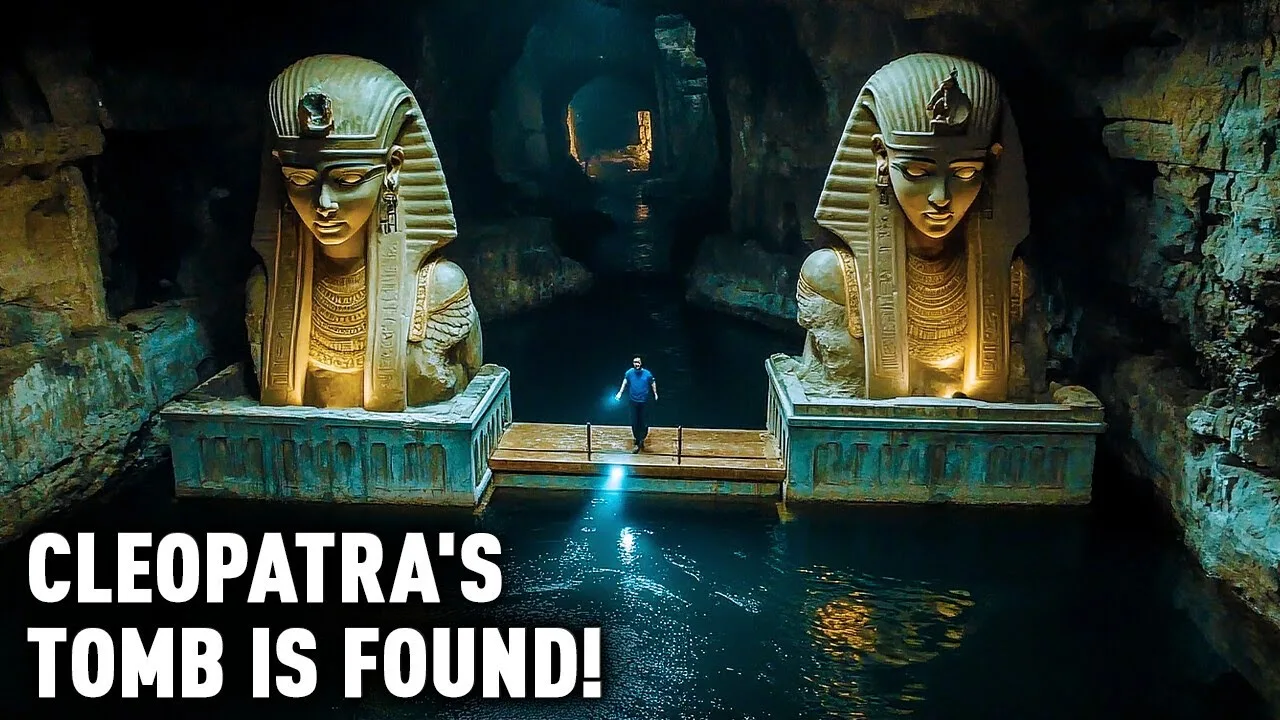
Related: Cleopatra's Tomb: History, Theories and the Search at Taposiris Magna
The coin fell onto a pan attached to a lever. Its weight tipped the lever and opened a valve, letting water flow out until the coin slid off and the valve closed again.[4] The design used simple mechanics but worked on the same principle as later coin-operated machines.
Hero is also known for describing the aeolipile, an early steam-powered device, and many automata. His writings show that ancient engineers understood pressure, levers and automatic control, even if they rarely applied them to industry.[4]
4. Marie Curie's Papers Still Carry Radioactive Contamination
Marie Curie and Pierre Curie discovered polonium and radium in 1898, and Marie spent years isolating radium. She worked without modern safety protection, and her notes, books and belongings became contaminated with radioactive material.[5]
Because of their contamination, her papers from the 1890s are considered too dangerous to handle without precautions. Even her cookbooks are highly radioactive. The papers are kept in lead-lined boxes, and those who wish to consult them must wear protective clothing.[5]
Radium-226 has a half-life of about 1,600 years, so the contamination will remain for a very long time. Curie herself died in 1934, aged 66, of aplastic anaemia, likely caused by her long exposure to radiation during her research.[5]
5. Nintendo Began by Making Japanese Playing Cards
Long before video games, Nintendo was a card company. Craftsman Fusajiro Yamauchi founded it in Kyoto in 1889 to make hanafuda, traditional Japanese playing cards decorated with flowers.[6]
The company remained in the card business for decades. In the 1960s and 1970s it experimented with other businesses, including toys, before developing its first arcade games in the 1970s and releasing the Color TV-Game console in 1977.[6]
Nintendo became internationally dominant in the 1980s, and it still makes hanafuda cards today, a link to its origins as a 19th-century craft workshop.[6]
Related: Top 10 Things That Existed While Woolly Mammoths Were Still Alive
6. The Great Fire of London Had a Tiny Recorded Death Toll
The Great Fire of London burned from 2 to 5 September 1666, gutting the medieval City of London. It destroyed an estimated 13,200 to 13,500 houses, 86 or 87 parish churches, the Royal Exchange and St Paul's Cathedral, leaving most of the City's inhabitants homeless.[7]
The fire started in a bakery in Pudding Lane shortly after midnight on Sunday 2 September and spread rapidly. The main firefighting method of the time was to pull down buildings in the fire's path to create firebreaks, but delays in doing so allowed the flames to grow.[7]
The death toll is generally thought to have been small, and only six deaths were recorded. Historians caution that the real number was probably higher, and one modern estimate suggests several hundred or even several thousand deaths.[7] Deaths of poor or unrecorded people may have gone unnoticed, and some refugees likely died in the makeshift camps outside the city.
The contrast between enormous destruction and few recorded deaths shows how records worked at the time. The fire spread relatively slowly, giving many people time to escape, but the true human cost will never be known exactly.[7]
7. A War Was Named After a Captain's Severed Ear
In 1731 Spanish coastguards boarded a British ship commanded by Robert Jenkins off the coast of Cuba. According to Jenkins, a Spanish officer cut off his ear.[8]
Jenkins later showed what he said was his severed ear to the House of Commons in 1738, at a time of rising tension between Britain and Spain over trade in the Caribbean. The incident became a rallying point for those who wanted war.[8]
Britain declared war on Spain in 1739, and the conflict that lasted until 1748 later became known as the War of Jenkins' Ear. Most of the fighting took place in New Granada and the Caribbean Sea.[8]
Related: History of Human Civilization: From Ancient Times to the Modern Age
The underlying causes were commercial, not the ear itself. The 1713 Treaty of Utrecht had given British merchants limited access to markets in Spanish America, and disputes over trade and smuggling grew in the following decades. Opposition politicians used the ear story to pressure the government of Robert Walpole into war.[8]
8. Lincoln Approved the Secret Service on the Day He Was Shot
During the Civil War, counterfeit money was a serious problem in the United States. President Abraham Lincoln set up a commission to recommend a solution, and a plan for a new agency took shape.[9]
According to a White House archive, Lincoln approved the creation of the agency on the same day that he was shot, 14 April 1865.[9] The Secret Service was established soon afterwards, in July 1865, as a division of the Treasury Department to combat counterfeiting.
The agency did not protect presidents at first. It took on that role only after the assassination of William McKinley in 1901.[9] The coincidence with Lincoln's death is striking, but the original mission had nothing to do with protection.
9. George Washington's Dentures Were Not Made of Wood
George Washington suffered from dental problems throughout his life and had only one of his own teeth left by the time he became president. He used several sets of false teeth.[10]
Contrary to legend, none of them were wooden. His dentures were made of materials including brass, lead, gold, animal teeth and human teeth, some of which were purchased from enslaved people.[10] They were made and maintained mainly by the dentist John Greenwood.
The wooden-teeth story has no basis in the surviving dentures. The truth is less charming but tells us more about dentistry, and about slavery, in the 18th century, when wealthy patients could buy teeth taken from poorer or enslaved people.[10]
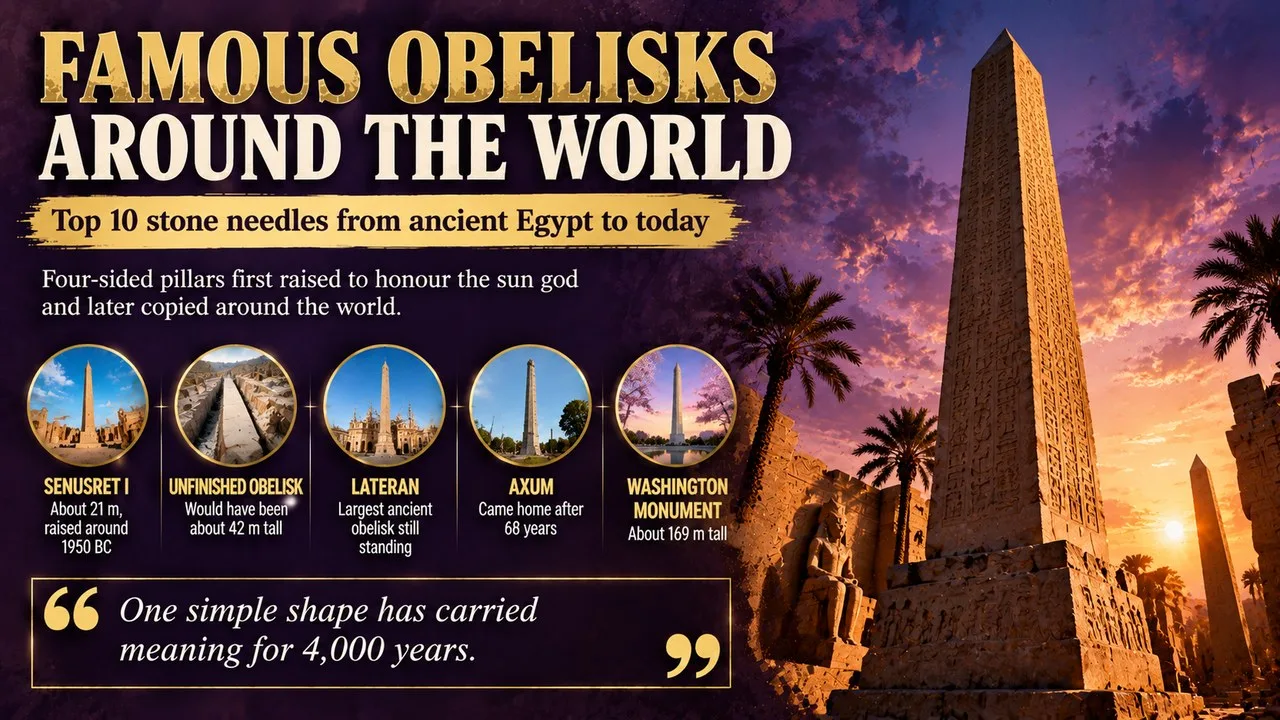
Related: Top 10 Famous Obelisks Around the World
10. Early Coca-Cola Was Connected to Coca Leaf Extract
When John Pemberton launched Coca-Cola in 1886, its two key ingredients were cocaine, from coca leaves, and caffeine, from kola nuts. The drink was promoted as a medicinal tonic.[11]
The amount of cocaine was small, estimated at about nine milligrams per glass. In 1903 fresh coca leaves were removed from the formula, and from 1904 the company used "spent" leaves left over after the cocaine had been extracted.[11]
Coca-Cola still uses a coca leaf extract with the cocaine removed, prepared under special government permission.[11] The name of the drink is a reminder of its two original ingredients.
Conclusion
The top 10 historical facts that sound fake but are true show how surprising the past can be. Long timelines, unusual inventions and strange names often make true stories seem unbelievable until the context is filled in.
Checking each claim against good evidence matters, because some of these facts have exaggerated versions online. The real stories, from radioactive notebooks to coin-operated holy water, are interesting enough without embellishment.
The next time a historical fact sounds too strange to be true, it is worth looking for the dates and the original records. Often the surprise comes not from the fact itself, but from how little we usually know about the order in which events happened.
- ^ [1] "University of Oxford". Wikipedia. Wikipedia
- ^ [2] "Tenochtitlan". Wikipedia. Wikipedia
- ^ [3] "Cleopatra". Wikipedia. Wikipedia
- ^ [4] "Vending machine". Wikipedia. Wikipedia
- ^ [5] "Marie Curie". Wikipedia. Wikipedia
- ^ [6] "Nintendo". Wikipedia. Wikipedia
- ^ [7] "Great Fire of London". Wikipedia. Wikipedia
- ^ [8] "War of Jenkins' Ear". Wikipedia. Wikipedia
- ^ [9] "United States Secret Service". Wikipedia. Wikipedia
- ^ [10] "George Washington's teeth". Wikipedia. Wikipedia
- ^ [11] "Coca-Cola". Wikipedia. Wikipedia
- ^ [12] "Great Pyramid of Giza". Wikipedia. Wikipedia
















Discussion
Log in with