




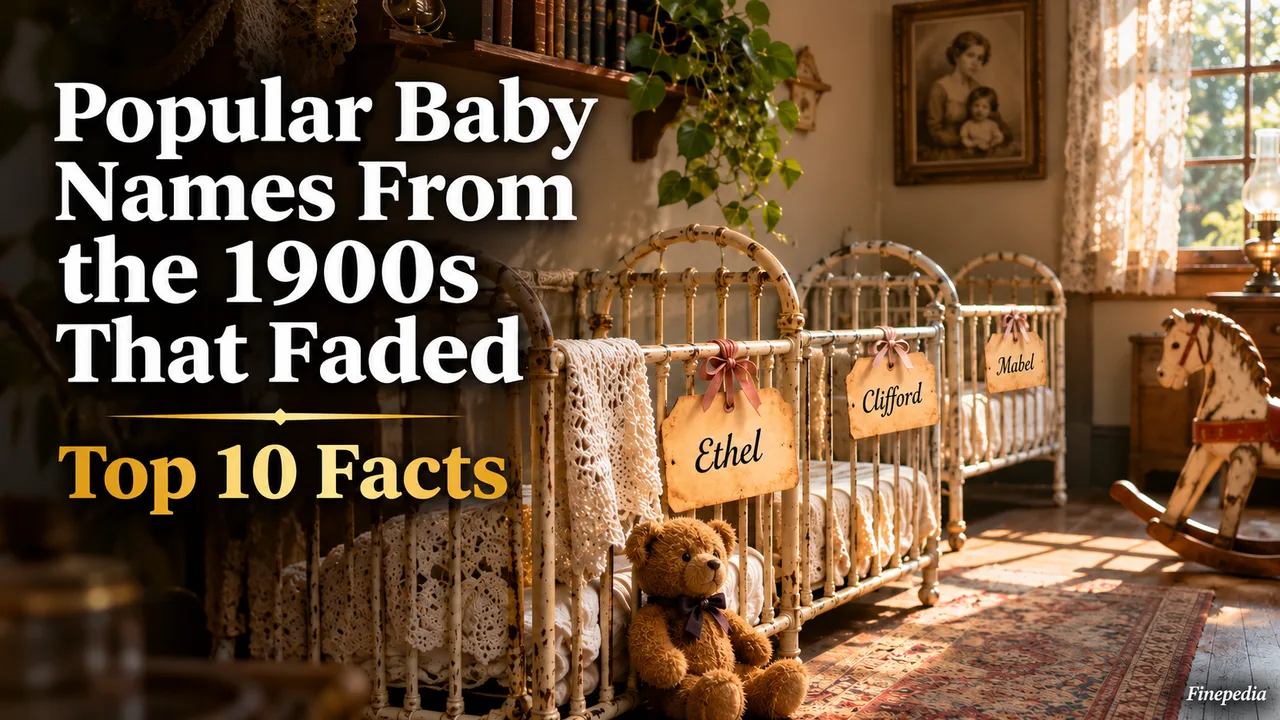
Baby names work like small time capsules. In the first decade of the 20th century, names such as Mildred, Ethel, Clarence and Floyd were familiar choices across the United States. More than a century later, many of them sound unmistakably old-fashioned, even though they were once ordinary.
This Finepedia list looks at the top 10 popular baby names from the 1900s that are rarely used today. The rankings come from the US Social Security Administration (SSA), which publishes a table of the 200 most popular names for babies born in each decade, ranking boys' and girls' names separately.[1]
None of the ten names on this list appears in the SSA's top 200 for babies born in the 2010s.[2] That does not mean the names have disappeared. It means fashions changed around them, and the names that once filled classrooms became associated with grandparents and great-grandparents.
Key Facts
The table below lists the 10 names with their rank and number of births in the SSA's 1900s decade table.
The 10 Faded 1900s Baby Names at a Glance
| No. | Name | Sex in SSA table | 1900s rank | Births recorded in the 1900s |
|---|---|---|---|---|
| 1 | Mildred | Girls | 10 | 36,173 |
| 2 | Clarence | Boys | 17 | 13,573 |
| 3 | Ethel | Girls | 12 | 34,868 |
| 4 | Wilbur | Boys | 117 | 1,839 |
| 5 | Gertrude | Girls | 26 | 23,607 |
| 6 | Floyd | Boys | 51 | 4,968 |
| 7 | Bertha | Girls | 20 | 24,247 |
| 8 | Roscoe | Boys | 199 | 916 |
| 9 | Edna | Girls | 15 | 29,832 |
| 10 | Otis | Boys | 113 | 1,966 |
The decline of these names reflects broad changes in American life, including immigration, new media, and a growing wish among parents for names that sounded modern or distinctive. The SSA tables let us measure that change with real numbers rather than impressions.
The SSA's 1900s figures come from Social Security card applications, so they undercount people born in that decade who never applied for a card. The 1900s table is drawn from records covering 1,467,399 boys and 3,106,277 girls, a much smaller total than the more than 39 million births in the 2010s table.[1][2] The figures are best used to compare names with one another rather than as complete birth totals.
1. Mildred
Mildred ranked 10th among girls' names in the SSA's 1900s table, with 36,173 recorded births.[1] It was more common than many names that are popular again today, such as Alice and Lillian. Lillian ranked 26th and Alice 96th among girls born in the 2010s, while Mildred was absent from the top 200.[2]
Mildred is an Anglo-Saxon name of Old English origin. It combines "mild" with "þryð", meaning power or strength, so it can be read as "gentle strength".[3]
Mildred reached sixth place among American baby girl names in 1912 and stayed near that level until 1920, then dropped quickly. It left the list of the 1,000 most common girls' names in 1985.[3] Its familiar short forms, Milly and Midge, have sometimes fared better than the full name.
2. Clarence
Clarence ranked 17th among boys' names in the 1900s, with 13,573 recorded births.[1] That placed it ahead of names such as Harold, Paul and Richard. Richard and Paul were still in the boys' top 200 in the 2010s, while Clarence was not.[2]
The name came from the title Duke of Clarence, given to sons or younger brothers of English and British monarchs. The title itself derives from the estate name Honour of Clare.[4]
Related: Top 10 Most Bizarre Phobias: Strange Fears That Exist
Its popularity as a first name increased in the second half of the 19th century in tribute to Prince Albert Victor, Duke of Clarence and Avondale, the eldest son of the future Edward VII.[4] Royal fashions like this often travelled quickly, and they could fade just as fast once the connection was forgotten. In the 2010s top 200 for boys, the royal-sounding names that remained were older standards such as William, Henry and George, not Clarence.[2]
3. Ethel
Ethel ranked 12th among girls' names in the 1900s, with 34,868 recorded births.[1] It was a familiar name for a generation of American women.
The name comes from the Old English word æthel, meaning "noble". It was a common first element in Anglo-Saxon names for both men and women, such as Æthelred, Æthelflæd and Æthelthryth.[5] Ethel began as a short form of names like these and later became a name in its own right.
The same root appears in continental European names such as Adolf, Albert and Adelaide.[5] Ethel's history shows how a revival of old English names helped produce some of the most popular choices of the early 20th century.
In the SSA's 1900s table, Ethel sat between Alice and Lillian, two names that have since returned to fashion.[1] Ethel has not followed them. Its sound, ending in a soft "-el", was once fashionable but has given way to names ending in "-a" and "-ie", such as Ella and Ellie, both in the 2010s top 100.[2]
4. Wilbur
Wilbur ranked 117th among boys' names in the SSA's 1900s table, with 1,839 recorded births.[1] It was less common than most names on this list, but it was a recognisable name of its time.
Wilbur is an English and German masculine name of Germanic origin. Its etymology is disputed, but the most accepted theory links it to Germanic words for "wild" and "boar". Another suggestion connects it to words for "will" and "fortress".[6]
The most famous bearer of the period was Wilbur Wright, who with his brother Orville made the first powered aeroplane flights in 1903. Orville also appears in the SSA's 1900s top 200, ranked 149th among boys.[1] Both names now sound firmly tied to that era, and neither appears in the SSA's 2010s top 200.[2]
Related: The Evolution of Stranger Things: Seasons, Themes, and Characters
5. Gertrude
Gertrude ranked 26th among girls' names in the 1900s, with 23,607 recorded births.[1] It was more popular than names such as Louise, Catherine and Martha in that decade.
The name comes from Germanic roots meaning "spear" and "strength". Its short form, Trudy, later developed into a name in its own right.[7] Variations include Gertrud and the German Gertraud.
Well-known bearers include Gertrude of Nivelles, a 7th-century saint and abbess, and the American writer and art collector Gertrude Stein.[7] Despite this rich history, Gertrude came to sound formal and old-fashioned, and parents later turned to softer-sounding choices. Neither Gertrude nor Trudy appears among the 200 most popular girls' names of the 2010s.[2]
6. Floyd
Floyd ranked 51st among boys' names in the SSA's 1900s table, with 4,968 recorded births.[1] It was just behind Leonard and ahead of Donald and Kenneth.
Floyd is an Anglo-Welsh name derived from the Welsh Llwyd, meaning "grey" or "grey-haired". That makes it a close relative of the name Lloyd.[8]
Lloyd was also popular in the 1900s, ranking 72nd among boys.[1] Both names began as surnames and became first names. That pattern has returned in modern naming, but with different surnames in fashion. The 2010s top 200 includes surname-style names such as Carter, Parker, Cooper and Bennett instead.[2]
7. Bertha
Bertha ranked 20th among girls' names in the 1900s, with 24,247 recorded births.[1] For a generation, it was one of the most familiar names in American classrooms.
Bertha is a Germanic name from Old High German berhta, meaning "bright one". It was often a short form of Anglo-Saxon names such as Beorhtgifu, "bright gift", and Beorhtwynn, "bright joy".[9] It appears as a Frankish given name as early as the 6th century.
Related: Chernobyl Miniseries: Stories of Tragedy of a Nuclear Catastrophe, Heroism and Sacrifice
The name also has a connection to Berchta, a figure in Alpine folklore.[9] In the 1900s it sat just ahead of Emma, Bessie and Clara in the SSA table.[1] Emma, ranked 21st then, became the most popular girls' name of the 2010s, while Bertha did not return to the top 200.[2] The contrast shows how two names of similar standing can follow completely different paths.
8. Roscoe
Roscoe ranked 199th among boys' names in the SSA's 1900s table, with 916 recorded births.[1] It only just made the top 200, but it was distinctive enough to be remembered as a name of its era.
Roscoe is a name of Cornish origin, said to come from Old Norse words meaning "doe wood" or "roebuck copse". It is also an Americanised spelling of the French name Racicot.[10]
One of the best-known bearers of the period was Roscoe Arbuckle, the silent film star who lived from 1877 to 1933.[10] Roscoe has a playful, informal sound that some modern parents may find appealing, but it has not returned to the 2010s top 200.[2] Its spelling variants, including Rosco, Roscow and Ruscoe, show how fluid name spellings could be before birth registration became standardised.[10]
9. Edna
Edna ranked 15th among girls' names in the 1900s, with 29,832 recorded births.[1] It was more popular than Frances, Rose and Grace in that decade.
In Hebrew, Edna means "pleasure" or "delight". It appears in the Book of Tobit, part of the biblical Apocrypha, as the mother of Sarah. In Ireland, Edna has also been used as an anglicised form of the Irish name Eithne.[11]
The name has been used in English-speaking countries since the 1600s, when it was often spelled Ednah. It was particularly popular in the late 19th and early 20th centuries but has since declined.[11] It is related to the name Eden, which ranked 162nd among girls born in the 2010s.[2]
Related: The Family Man: A Spy Thriller of Modern India Balancing Family Life and National Security
10. Otis
Otis ranked 113th among boys' names in the SSA's 1900s table, with 1,966 recorded births.[1] It was a steady, familiar choice in many parts of the country.
Otis is a male given name derived from an English surname, which in turn came from Ode, a variant of Odo and Otto.[12] Otto itself was also popular in the 1900s, ranking 125th among boys.[1] In Kenya, Otis is also used as a nickname for the Luo name Otieno, a reminder that the same name can have unrelated origins in different cultures.[12]
Later bearers include the American singer and songwriter Otis Redding, who lived from 1941 to 1967.[12] Like several names on this list, Otis has a short, friendly sound that fits current fashions for vintage names, even though it has not returned to the top of the charts.
Conclusion
The top 10 popular baby names from the 1900s that faded show how quickly naming fashions change. Names that ranked among the most common in the country, such as Mildred, Ethel and Edna, are now rare, while other names from the same era have returned to fashion.
These names were never wrong or unattractive. They simply belonged to a particular generation, and in time, some may come back as parents look for names that sound both familiar and fresh.
Many names that were rare a few decades ago, such as Hazel, Violet and Eleanor, have returned to the SSA's 2010s top 100, showing how often old names are rediscovered.[2] Mildred, Clarence and the rest of this list may still have their turn.
- ^ [1] "Top Names of the 1900s". Social Security Administration. SSA
- ^ [2] "Top Names of the 2010s". Social Security Administration. SSA
- ^ [3] "Mildred (name)". Wikipedia. Wikipedia
- ^ [4] "Clarence (given name)". Wikipedia. Wikipedia
- ^ [5] "Ethel". Wikipedia. Wikipedia
- ^ [6] "Wilbur (name)". Wikipedia. Wikipedia
- ^ [7] "Gertrude (given name)". Wikipedia. Wikipedia
- ^ [8] "Floyd (given name)". Wikipedia. Wikipedia
- ^ [9] "Bertha". Wikipedia. Wikipedia
- ^ [10] "Roscoe (name)". Wikipedia. Wikipedia
- ^ [11] "Edna (given name)". Wikipedia. Wikipedia
- ^ [12] "Otis (given name)". Wikipedia. Wikipedia





















Discussion
Log in with