



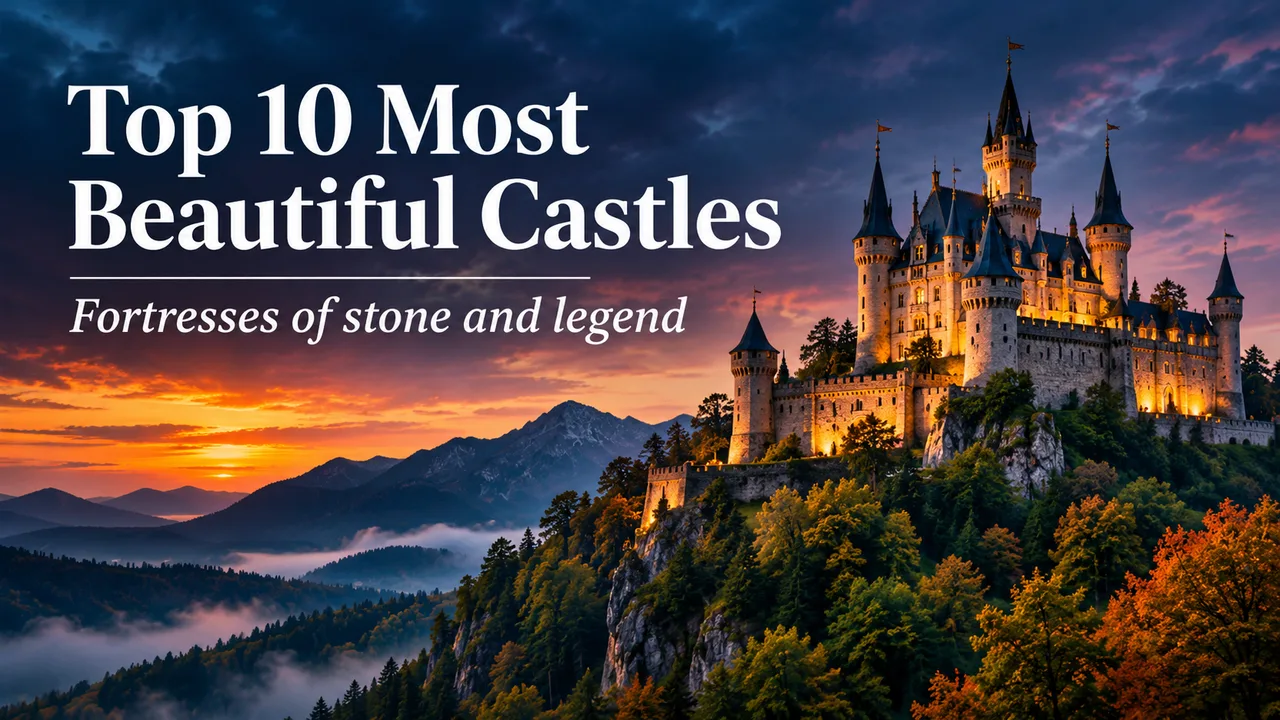
The most beautiful castles in the world began as fortresses, royal homes and symbols of power, yet many now stand as some of the most admired buildings on the planet. Their towers, walls and settings tell stories of medieval warfare, royal ambition and romantic revival [1].
Castles were first built in large numbers in Europe from the ninth and tenth centuries, when lords needed defensible bases from which to control land. Over time, the arrival of gunpowder made high stone walls less useful, and many castles were rebuilt as palaces or abandoned. In the nineteenth century, a romantic fascination with the Middle Ages led to restorations and even new castles built purely for beauty [1].
This Finepedia list picks ten castles for their architecture, setting and historical importance. It includes medieval fortresses, Renaissance chateaux, a Japanese masterpiece and a nineteenth-century dream palace, so readers can compare very different ideas of what a castle can be.
Key Facts
Here is a quick overview of the ten castles in this list, with their country, construction period and one defining feature.
Beautiful Castles at a Glance
| Rank | Name | Location/Country | Key figure | Notable fact |
|---|---|---|---|---|
| 1 | Neuschwanstein Castle | Bavaria, Germany | Begun 1869 | Inspired Disney's Sleeping Beauty Castle |
| 2 | Himeji Castle | Hyogo, Japan | Main keep 1609 | UNESCO World Heritage Site since 1993 |
| 3 | Chateau de Chambord | Loire Valley, France | Begun 1519 | Famous double-helix staircase |
| 4 | Edinburgh Castle | Scotland, UK | Castle Rock site used for about 3,000 years | Home of the Honours of Scotland |
| 5 | Pena Palace | Sintra, Portugal | Completed 1854 | Brightly painted Romanticist palace |
| 6 | Alhambra | Granada, Spain | Mainly 13th-14th century | Masterpiece of Nasrid Islamic art |
| 7 | Bran Castle | Transylvania, Romania | Completed 1388 | Linked in legend to Dracula |
| 8 | Windsor Castle | Berkshire, England | Founded 11th century | Oldest occupied castle in the world |
| 9 | Eilean Donan | Scottish Highlands, UK | Rebuilt 1912-1932 | Island castle at three sea lochs |
| 10 | Hohenzollern Castle | Baden-Wurttemberg, Germany | Rebuilt 1850-1867 | Mountaintop seat of the Hohenzollern dynasty |
1. Neuschwanstein Castle
Neuschwanstein Castle sits on a rugged hill above the village of Hohenschwangau in Bavaria. King Ludwig II of Bavaria ordered it in 1869 as a private retreat inspired by medieval legends and the operas of Richard Wagner [2].
Ludwig did not live to see it finished. He died in 1886, only months after moving in, and the castle opened to the public soon afterwards. Its white limestone walls, slender towers and mountain backdrop make it one of the most photographed buildings in Europe.
Today well over a million people visit each year. Walt Disney's designers used Neuschwanstein as an inspiration for Sleeping Beauty Castle at Disneyland, which helped turn it into a global symbol of the fairy-tale castle [2].
The castle sits inside a landscape of lakes and Alpine peaks, and the nearby Marienbrucke footbridge gives the classic view across the Pollat gorge. Interiors are visited only on timed guided tours, and the throne room, the Singers' Hall and an artificial grotto show how Ludwig used art and theatre design to create a private world of legend. Tickets often sell out in summer, so many travellers book well ahead.
2. Himeji Castle
Himeji Castle in Hyogo Prefecture is the finest surviving example of a Japanese feudal castle. Its brilliant white plastered walls and layered roofs earned it the nickname White Heron Castle [3].
A fort stood on the site from the fourteenth century, but the main complex was expanded into its present form by Ikeda Terumasa, with the great keep completed around 1609. The castle contains more than 80 buildings linked by winding paths and gates designed to confuse attackers.
Himeji survived wars, earthquakes and the bombing of the city in 1945 almost untouched. It became one of Japan's first UNESCO World Heritage Sites in 1993 and reopened in 2015 after a major restoration [3].
Related: Top 10 Most Bizarre Phobias: Strange Fears That Exist
Visitors climb through a series of gates and baileys before reaching the six-storey main keep, and the route reveals loopholes, stone drop chutes and hidden storerooms prepared for a siege that never came. In spring the grounds fill with cherry blossom, and the view of the white keep above pink trees is one of the most celebrated seasonal sights in Japan.
3. Chateau de Chambord
The Chateau de Chambord in France's Loire Valley is the largest of the region's famous chateaux. King Francis I began it in 1519 as a hunting lodge, and its design blends French medieval forms with Italian Renaissance ideas [4].
The chateau's roofline is a forest of chimneys, lanterns and turrets. Inside, a double-helix staircase allows two people to climb at the same time without meeting, and many historians believe Leonardo da Vinci influenced its design.
Chambord is surrounded by a walled park of more than 5,000 hectares, one of the largest enclosed forest parks in Europe. It is part of the Loire Valley UNESCO World Heritage Site [4].
The rooftop terraces let visitors walk among the chimneys and turrets, which were designed to be seen and admired as much as used. Although the chateau was rarely lived in for long periods, it later served kings such as Louis XIV, and today it hosts exhibitions, horse shows and guided tours that explain its links to Renaissance court life.
4. Edinburgh Castle
Edinburgh Castle crowns Castle Rock, the plug of an extinct volcano that dominates the Scottish capital. People have used the rock for around 3,000 years, and a royal castle has stood there since at least the twelfth century [5].
The oldest surviving building is St Margaret's Chapel, dating from the early 1100s. The castle also holds the Honours of Scotland, the oldest crown jewels in the British Isles, and the Stone of Destiny used in coronations.
Each August the esplanade hosts the Royal Edinburgh Military Tattoo. With more than two million visitors a year, it is one of Scotland's most popular paid attractions [5].
The castle has been besieged many times, changing hands between Scots and English forces through the medieval wars. Visitors today can see the One O'Clock Gun, fired every day except Sunday, the Great Hall built for James IV, and the Scottish National War Memorial. The view from the battlements across the city and the Firth of Forth is one of the finest in Scotland.
5. Pena Palace
Pena Palace stands on a hilltop in the Sintra Mountains near Lisbon. King Ferdinand II transformed the ruins of a monastery into a colourful royal summer residence, completing it around 1854 [6].
Related: The Evolution of Stranger Things: Seasons, Themes, and Characters
The palace mixes Gothic, Manueline, Moorish and Renaissance styles, painted in bright yellow and red. It is considered one of the great examples of nineteenth-century Romanticism in architecture.
Pena is part of the Cultural Landscape of Sintra, a UNESCO World Heritage Site since 1995. Its lush park, filled with exotic trees, adds to the sense of a palace from a storybook [6].
The interior has been preserved as it was when the royal family last lived there in the early twentieth century, so rooms still show furniture, porcelain and decoration chosen by the monarchs. Mist often rolls over the hills of Sintra, adding to the palace's dreamlike mood and making it a favourite of photographers who arrive early before crowds gather.
6. Alhambra
The Alhambra in Granada, Spain, is a palace and fortress complex built mainly by the Nasrid rulers in the thirteenth and fourteenth centuries. Its name comes from Arabic words meaning "the red one", a reference to the colour of its walls [7].
Behind plain defensive walls lie intricate courtyards, carved plaster, tiled panels and calm pools. The Court of the Lions and the Generalife gardens are among the most celebrated spaces in Islamic architecture.
After 1492 the Catholic Monarchs made the Alhambra a royal court, and Charles V later added a Renaissance palace. The site is a UNESCO World Heritage Site and one of Spain's most visited monuments [7].
The complex also includes the Alcazaba, the oldest fortified part, whose watchtowers overlook Granada and the Sierra Nevada mountains. Daily visitor numbers are limited to protect the delicate decoration, and timed entry to the Nasrid Palaces is required. Writers such as Washington Irving helped make the Alhambra famous across the world in the nineteenth century.
7. Bran Castle
Bran Castle rises on a rock near Brasov in Transylvania, Romania. It was completed in 1388 to guard a mountain pass between Transylvania and Wallachia [8].
Related: Chernobyl Miniseries: Stories of Tragedy of a Nuclear Catastrophe, Heroism and Sacrifice
The castle is marketed as Dracula's Castle, although historians note that Vlad the Impaler has only a weak link to it and that Bram Stoker never visited. The legend, however, has made it Romania's best-known tourist site.
In the twentieth century Bran became a residence of Queen Marie of Romania, who decorated it in a homely style. It now operates as a museum displaying furniture and art collected by the queen [8].
Visitors walk through narrow corridors, steep staircases and a central courtyard that give the building an intimate, maze-like feel. Exhibits explain both the real history of the region and the vampire legends that grew around it. The castle is especially busy around Halloween, when themed events attract visitors from across Europe and beyond.
8. Windsor Castle
Windsor Castle in Berkshire was founded by William the Conqueror in the eleventh century. It is often described as the oldest and largest occupied castle in the world [9].
Successive monarchs have rebuilt and enlarged it. St George's Chapel, a masterpiece of Gothic architecture, hosts royal weddings and funerals, and the State Apartments hold paintings from the Royal Collection.
A serious fire in 1992 damaged parts of the castle, and restoration was finished in 1997. Windsor remains a working royal residence and a major visitor attraction [9].
The castle covers about 5 hectares and includes the Round Tower, built on an artificial mound, along with elegant State Apartments and Queen Mary's Dolls' House. The Changing of the Guard ceremony takes place regularly and draws crowds. Its long royal history makes Windsor a living link between medieval England and the modern monarchy.
9. Eilean Donan
Eilean Donan stands on a small tidal island where three sea lochs meet in the western Scottish Highlands. A castle has occupied the island since the thirteenth century [10].
The original building was destroyed in 1719 during a Jacobite rising. It lay in ruins until Lieutenant Colonel John MacRae-Gilstrap rebuilt it between 1912 and 1932, linked to the shore by a stone footbridge.
Related: The Family Man: A Spy Thriller of Modern India Balancing Family Life and National Security
Its setting has made it one of Scotland's most photographed landmarks, and it has appeared in films including Highlander and The World Is Not Enough [10].
The interior holds Jacobite relics, period furniture and displays about the MacRae clan, whose members have long been associated with the castle. Mountains frame the loch on all sides, and the view of the castle at sunset with the bridge reflected in still water is a classic image of the Highlands, used on countless postcards and calendars.
10. Hohenzollern Castle
Hohenzollern Castle sits on top of Mount Hohenzollern in southern Germany, about 855 metres above sea level. It is the ancestral seat of the Hohenzollern family, which produced kings of Prussia and German emperors [11].
The present castle is the third on the site. It was built between 1850 and 1867 under King Frederick William IV of Prussia in the Gothic Revival style. On misty mornings it appears to float above the clouds.
The castle is still privately owned by the family and displays historical treasures, including the crown of the Prussian kings [11].
Hohenzollern is visible from many kilometres away across the Swabian Jura, and visitors can reach it by shuttle bus or a steep walk through the woods. Inside, the treasury, the library and the Count's Hall display portraits, armour and royal relics, while the ramparts provide sweeping views over the surrounding countryside.
Conclusion
The world's most beautiful castles range from defensive strongholds to romantic palaces built for pleasure. Each reflects the ambitions and tastes of the people who built it, as well as the landscape around it.
Whether perched on a mountain, surrounded by water or hidden in a forest park, these castles continue to draw millions of visitors and remind us how architecture can turn history into lasting beauty.
- ^ [1] "Castle". Wikipedia. Wikipedia: Castle
- ^ [2] "Neuschwanstein Castle". Wikipedia. Wikipedia: Neuschwanstein
- ^ [3] "Himeji-jo". UNESCO World Heritage Centre. UNESCO: Himeji-jo
- ^ [4] "Chateau de Chambord". Wikipedia. Wikipedia: Chambord
- ^ [5] "Edinburgh Castle". Wikipedia. Wikipedia: Edinburgh Castle
- ^ [6] "Pena Palace". Wikipedia. Wikipedia: Pena Palace
- ^ [7] "Alhambra". Wikipedia. Wikipedia: Alhambra
- ^ [8] "Bran Castle". Wikipedia. Wikipedia: Bran Castle
- ^ [9] "Windsor Castle". Royal Collection Trust. RCT: Windsor Castle
- ^ [10] "Eilean Donan". Wikipedia. Wikipedia: Eilean Donan
- ^ [11] "Hohenzollern Castle". Wikipedia. Wikipedia: Hohenzollern Castle



















Discussion
Log in with