


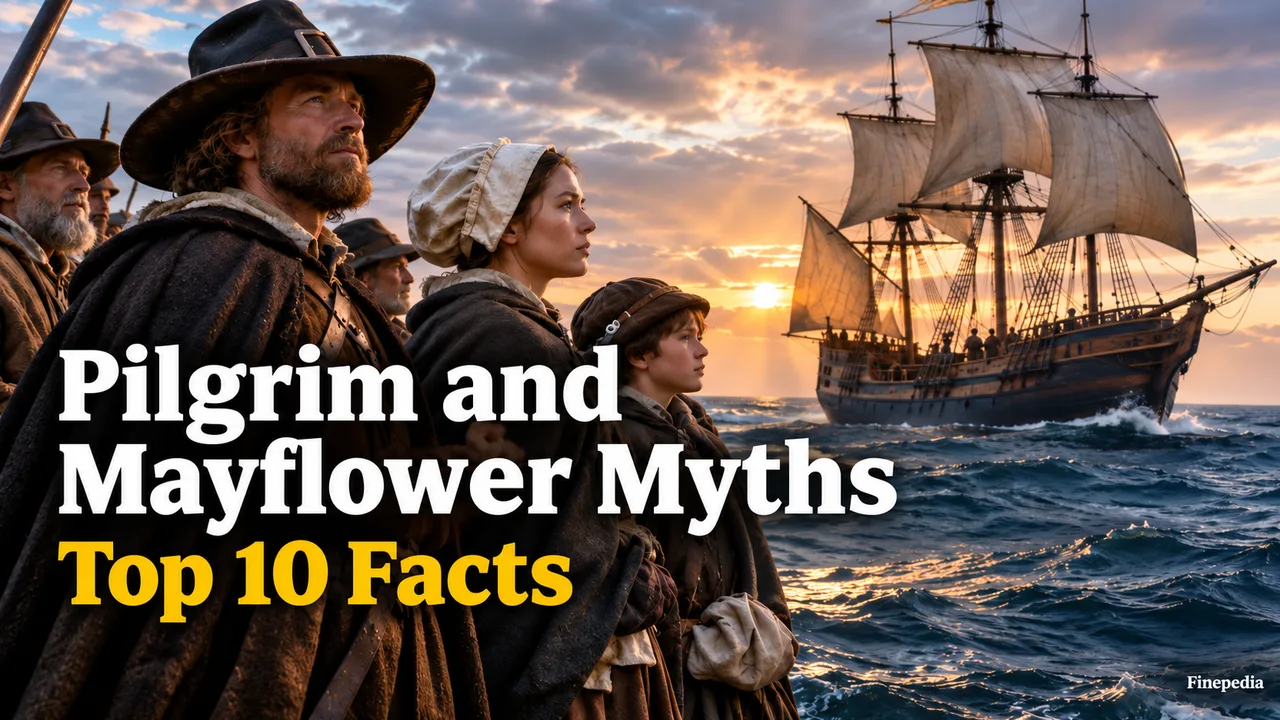
The story of the Pilgrims and the Mayflower is one of the best-known founding tales in American history. In its familiar form, a small band of religious refugees sails from England, steps onto Plymouth Rock, signs the first democratic constitution and shares a turkey dinner with friendly Native neighbours at the first Thanksgiving. Much of that picture is simplified, and some of it is simply wrong.
This Finepedia list brings together the top 10 Pilgrim and Mayflower myths. Each entry sets out a common belief, then explains what the surviving records, letters and archaeological work actually show about the Plymouth Colony founded in 1620 and its relationship with the Wampanoag people.
The main early sources are the writings of William Bradford, the colony's long-serving governor, and Mourt's Relation, a 1622 account partly written by Edward Winslow. Read alongside Wampanoag history, they reveal a story shaped by migration, disease, diplomacy and survival.
Key Facts
The table below sums up all 10 myths on this list and the historical facts behind each one.
The 10 Pilgrim Myths at a Glance
| No. | Myth | What the record shows |
|---|---|---|
| 1 | The Pilgrims were the first European settlers | Spanish, French and English settlements came earlier |
| 2 | They sailed straight from England to Plymouth | Many came from the Netherlands and landed first on Cape Cod |
| 3 | They wanted religious freedom for everyone | They sought freedom for their own form of worship |
| 4 | Plymouth Rock is a documented landing spot | It was first identified 121 years later, in 1741 |
| 5 | The Mayflower Compact created modern democracy | It was a short agreement to govern under the king |
| 6 | The 1621 feast started Thanksgiving | The national holiday dates from 1863 |
| 7 | The Wampanoag were simply friendly guests | The meeting followed a political alliance |
| 8 | They ate a modern Thanksgiving dinner | Venison and wild fowl, not pies or cranberry sauce |
| 9 | Squanto was a friendly guide who appeared by chance | Tisquantum had been kidnapped and taken to Europe |
| 10 | Pilgrims wore black clothes and buckled hats | Inventories list reds, greens, blues and violets |
1. Myth: The Pilgrims Were the First European Settlers in North America
The Mayflower passengers were far from the first Europeans to settle in North America. Norse explorers had built a short-lived settlement at L'Anse aux Meadows in Newfoundland around the year 1000, more than six centuries earlier.[1]
The Spanish founded St. Augustine in Florida in 1565, which is the oldest continuously inhabited European-founded city in the continental United States. The English established Jamestown in Virginia in 1607, thirteen years before Plymouth.[1]
French fishermen, traders and explorers were also active along the northern coasts long before 1620. Plymouth was an important early English colony in New England, but it was one part of a much larger story of European contact with the Americas.[2]
2. Myth: They Sailed Directly from England to Plymouth
Many of the Pilgrims had already left England years before. The core group were English Separatists who had moved to the Netherlands and lived for about a decade in the city of Leiden, where they could worship freely.[1]
In 1620 they sailed from the Netherlands on a smaller ship, the Speedwell, to join the Mayflower in England. The Speedwell leaked badly, so after two false starts the Mayflower left Plymouth, England, alone in September 1620 with about 102 passengers.[2]
The ship reached Cape Cod in November 1620, far north of the intended destination near the Hudson River. The passengers explored the coast for weeks before choosing the site of their settlement at Plymouth in December.[2] About half of them died during the first hard winter. Many passengers lived aboard the ship through that winter while houses were built, and illness spread quickly in the cold, crowded conditions.
3. Myth: The Pilgrims Sought Religious Freedom for Everyone
The Pilgrims did leave England to escape persecution, but their goal was to worship in their own way, not to create a society of religious tolerance. Separatists believed the Church of England was beyond reform and wanted a separate, purified church.[1]
Related: History of Bombay: From Seven Islands to Mumbai
Once in America, they built a community based on their own beliefs. Plymouth and its neighbour, the Massachusetts Bay Colony, punished dissenters, and later Quakers and others faced fines, banishment or worse in New England.[3]
The modern idea of religious freedom for all, enshrined in the First Amendment, developed later and owed more to figures such as Roger Williams, who was banished from Massachusetts and founded Rhode Island.[3] The Pilgrims are part of that history, but they were not its champions.
4. Myth: Plymouth Rock Is a Documented Landing Spot
None of the contemporary accounts of the landing mention a rock. William Bradford and Mourt's Relation describe exploring the coast and choosing the site, but say nothing about stepping onto a boulder.[4]
The first documented claim came in 1741, when 94-year-old Thomas Faunce identified the rock as the landing place, 121 years after the event. His father had arrived in Plymouth in 1623, and he said he had been told the story as a child.[4]
The rock became a patriotic symbol in the years around the American Revolution. It was moved, split and chipped by souvenir hunters, and today a much smaller piece sits under a portico on the waterfront.[4] Whether the Pilgrims ever stepped on it remains unknown.
5. Myth: The Mayflower Compact Created Modern Democracy
The Mayflower Compact was signed aboard the ship on 11 November 1620 by the male passengers. It was a short agreement in which they promised to form a "civil body politic" and obey laws made for the general good of the colony.[5]
The compact was created partly because the ship had landed outside the area covered by the colonists' patent, and some passengers suggested they would be free of any authority.[5] It was a practical measure to keep order, made in the name of King James.
Related: Top 10 Historical Facts That Sound Fake but Are True
Later generations celebrated it as a founding document of American self-government, and it does reflect the idea of government by consent. But it gave no votes to women or servants and was not a constitution.[5] Its importance grew in memory more than in its own time.
6. Myth: The 1621 Harvest Feast Was the First Thanksgiving Holiday
In the autumn of 1621, the colonists held a harvest celebration that lasted several days. Edward Winslow described it in a letter published in Mourt's Relation, the only surviving eyewitness account.[6]
The colonists did not call this event a thanksgiving. For them, a thanksgiving was a religious day of prayer, often with fasting, held in response to a particular blessing.[6] The 1621 gathering was closer to an English harvest festival.
The modern national holiday dates from 1863, when President Abraham Lincoln proclaimed a national day of thanksgiving during the Civil War, after a long campaign by the writer Sarah Josepha Hale.[6] The link to 1621 became popular in the late 19th century.
7. Myth: The Wampanoag Attended Simply as Friendly Guests
The Wampanoag leader Massasoit, also known as Ousamequin, arrived at the 1621 celebration with about 90 men. Winslow records that they stayed for three days and contributed five deer to the feast.[6]
The visit followed a formal alliance made in March 1621 between Massasoit and the colonists, promising mutual defence.[7] The Wampanoag had been devastated by epidemics brought by Europeans and faced pressure from the rival Narragansett, so the alliance served their own interests.
Relations later broke down. As English settlement expanded, conflicts over land led to King Philip's War of 1675 to 1676, led by Massasoit's son Metacom, one of the deadliest wars in colonial American history.[7] The friendly feast is only one moment in a complex relationship.
Related: Top 10 Most Bizarre Phobias: Strange Fears That Exist
8. Myth: The Meal Was a Modern Thanksgiving Dinner
The only food items mentioned in Winslow's account are wild fowl, collected by colonists on a hunting trip, and the five deer brought by the Wampanoag.[6] Fowl might have included turkey, but also ducks or geese.
Other foods probably included corn, fish, shellfish, and local fruits and vegetables. Some favourites of the modern holiday were almost certainly missing, since the colonists had little or no sugar for cranberry sauce and no ovens for baking pies.[6]
Potatoes were not yet common in New England, and many modern Thanksgiving dishes became traditional only in the 19th century.[6] The menu of today reflects later American tastes more than the food of 1621.
9. Myth: Squanto Was Simply a Friendly Guide
Tisquantum, often called Squanto, was a Patuxet man whose life had already been shaped by Europeans. In 1614 he was kidnapped by the English captain Thomas Hunt and taken to Spain to be sold, but he escaped and eventually reached England.[8]
When he returned home in 1619, he found that his village had been wiped out by an epidemic. The Pilgrims built Plymouth on the site of that former village.[8] Because he spoke English, he became a key interpreter and adviser to the colonists.
Tisquantum also pursued his own aims, using his position to gain influence among the Wampanoag, which caused tension with Massasoit.[8] He died in 1622. His story is one of survival and diplomacy, not of a helper who appeared by luck.
Related: Top 10 Facts About Dogs
He was not even the first Native person to greet the colonists in English. That was Samoset, an Abenaki sachem from Maine, who walked into the settlement in March 1621 and introduced the colonists to Tisquantum a few days later.[8]
10. Myth: Pilgrims Wore Black Clothes, White Collars and Buckles
The familiar costume of black clothes, white collars and buckled hats and shoes comes mainly from 19th- and early 20th-century paintings and illustrations. Probate inventories, made when colonists died, tell a different story by listing the colours of their clothing.[9]
Elder William Brewster, who died in 1644, owned green drawers, a violet coat and a blue suit, and Governor William Bradford left a red waistcoat, a green gown and a violet cloak at his death in 1657.[9] Deep, true black was an expensive dye in the early 17th century, so everyday clothes were more often in muted reds, greens, blues, browns and greys.
Buckles on shoes and hats were not fashionable in the 1620s. Shoes were usually tied with laces or ribbons.[9] The costume myth helped turn the Pilgrims into stern, simple symbols of piety, when they were in fact ordinary people dressed in the varied clothing of their time.
Conclusion
The top 10 Pilgrim and Mayflower myths show how a complex colonial history was simplified into a national legend. The real story involves exile in the Netherlands, a hard voyage, a deadly first winter, and an alliance with Wampanoag leaders who had their own reasons for helping the newcomers.
Separating myth from evidence does not make the Pilgrims less important. It shows them more clearly as one part of a larger history that includes Native nations, earlier settlers and the long struggle over land and power in New England.
- ^ [1] "Pilgrims (Plymouth Colony)". Wikipedia. Wikipedia
- ^ [2] "Mayflower". Wikipedia. Wikipedia
- ^ [3] "Plymouth Colony". Wikipedia. Wikipedia
- ^ [4] "Plymouth Rock". Wikipedia. Wikipedia
- ^ [5] "Mayflower Compact". Wikipedia. Wikipedia
- ^ [6] "Thanksgiving (United States)". Wikipedia. Wikipedia
- ^ [7] "Massasoit". Wikipedia. Wikipedia
- ^ [8] "Tisquantum". Wikipedia. Wikipedia
- ^ [9] "Dress Like a Pilgrim". General Society of Mayflower Descendants. Mayflower Society















Discussion
Log in with