






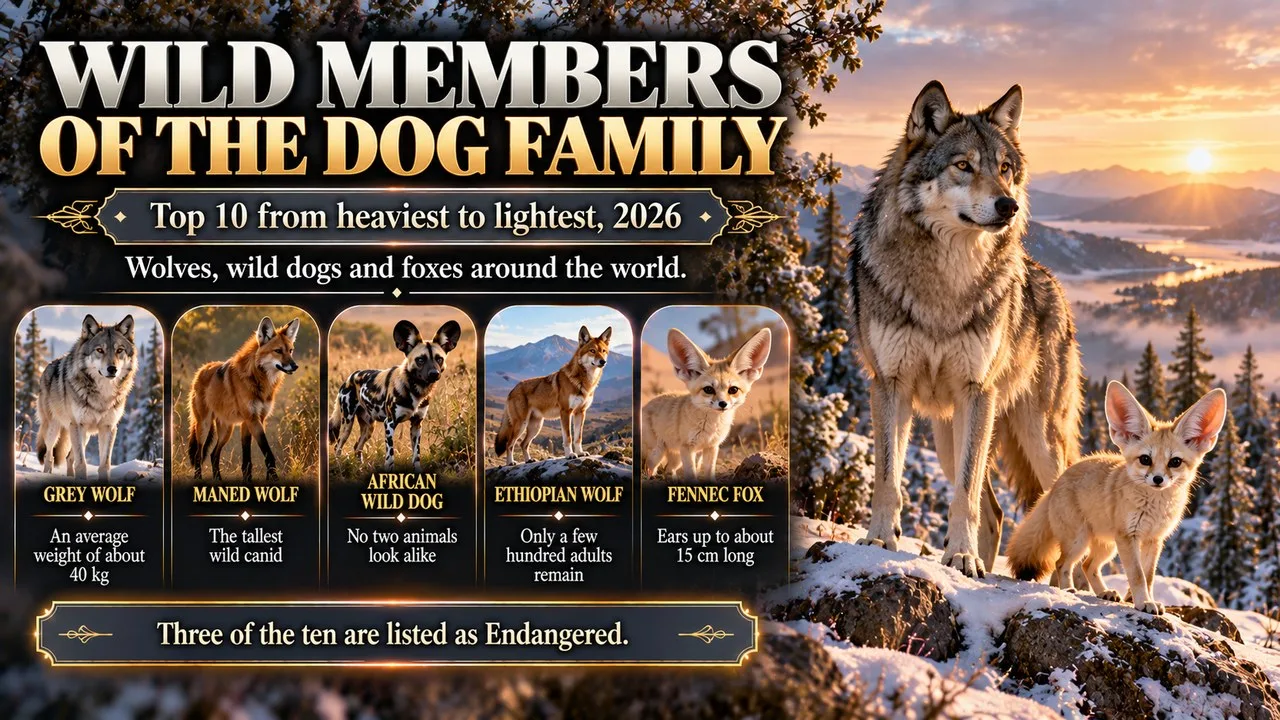
Wild members of the dog family range from the grey wolf, the largest at about 40 kg, to the 1 kg fennec fox, with rare hunters such as the Ethiopian wolf.[1][2]
This Finepedia guide, written in October 2026, introduces ten wild canids, the family that also gave us the pet dog. Each entry covers the animal's size, where it lives, how it hunts and its conservation status on the international Red List. For more about wildlife, see the Finepedia guides Top 10 Unique Animals Found Only in Africa and Top 10 Most Dangerous Wild Animals in Canada.
How We Chose These
The dog family, Canidae, includes wolves, coyotes, jackals, foxes and wild dogs on every continent except Antarctica. We picked ten wild species that show the family's range in size, shape and lifestyle, from pack hunters of the savanna to solitary desert foxes. Domestic dogs and dingoes are left out. The list runs from heaviest to lightest, and three of the ten are listed as Endangered.
The 10 Wild Members of the Dog Family at a Glance
| No. | Animal | Home range | Typical weight | Red List status |
|---|---|---|---|---|
| 1 | Grey wolf | North America, Europe, Asia | about 40 kg | Least Concern |
| 2 | Maned wolf | Central South America | 20 to 30 kg | Near Threatened |
| 3 | African wild dog | Africa south of the Sahara | 18 to 36 kg | Endangered |
| 4 | Coyote | North and Central America | 7 to 20 kg | Least Concern |
| 5 | Ethiopian wolf | Ethiopian highlands | 11 to 19 kg | Endangered |
| 6 | Dhole | South and South-East Asia | 10 to 21 kg | Endangered |
| 7 | Red fox | Northern Hemisphere and Australia | 3 to 14 kg | Least Concern |
| 8 | Common raccoon dog | East Asia, spread to Europe | 3 to 10 kg, by season | Least Concern |
| 9 | Arctic fox | Arctic tundra | about 3.5 kg | Least Concern |
| 10 | Fennec fox | Sahara and North Africa | about 1 to 1.9 kg | Least Concern |
1. The Grey Wolf Is the Biggest Wild Canid
The grey wolf is the largest wild member of the dog family, with an average weight of about 40 kg, and the heaviest on record reached nearly 80 kg.[3] Wolves live in family packs that work together to hunt large prey such as deer, elk and moose across North America, Europe and Asia.
Key Facts
- Average weight: about 40 kg
- Wild population: roughly 200,000 to 250,000
- Status: Least Concern
- Close relative: the pet dog descends from an ancient wolf population
Did You Know?
Wolves tend to be larger the farther north they live, which helps them hold in body heat. A typical pack is a breeding pair and their young of the last few years, and young wolves often leave to start packs of their own.
2. The Maned Wolf Walks on Stilts
The maned wolf of South America looks like a fox on stilts, with red fur, a black mane and very long black legs. It is the tallest wild canid and the biggest member of the family in South America. Despite its name, it is neither a true wolf nor a fox, but the only species in its own genus.
Key Facts
- Weight: 20 to 30 kg
- Home: grasslands and scrub of Brazil, Paraguay, Bolivia and Argentina
- Diet: small animals plus large amounts of fruit
- Status: Near Threatened
Why It Matters
The maned wolf eats so much of the wolf apple, a tomato-like fruit, that it helps spread the plant's seeds across the savanna. Its long legs let it see over tall grass. Its urine has such a strong smell that some people compare it to hops.
3. Africa's Painted Wolf Is a Team Hunter
The African wild dog, also called the painted wolf, has a patchy coat of black, brown, yellow and white, and no two animals look alike. No wild canine in Africa is bigger, and it hunts in tight-knit packs that chase antelope over long distances.
Key Facts
- Weight: 18 to 36 kg
- Adults left: about 6,600, in 39 separate groups
- Status: Endangered since 1990
- Unusual trait: only four toes on each front foot
Did You Know?
Wild dogs share food generously, bringing up meat not only for pups but also for adults that stayed behind at the den. Researchers in Botswana have even found that pack members seem to vote on when to set off on a hunt by sneezing, with more sneezes making a departure more likely. Their packs are among the most cooperative of any meat-eating mammal, and each hunt involves the whole group.
4. The Coyote Has Spread Across a Continent
The coyote is a medium-sized wild dog of North and Central America. As people wiped out wolves across much of the continent in the 1800s and 1900s, coyotes moved in, and they now live everywhere from Alaska to Panama, including big cities such as Chicago and Los Angeles.[4]
Related: Top 10 Extraordinary Lizards of the World
Key Facts
- Weight: about 7 to 20 kg
- Range: from Alaska to Central America
- First seen in eastern Panama: 2013
- Status: Least Concern
Why It Matters
Coyotes are among the most adaptable mammals on Earth, eating almost anything from rodents and deer to fruit and rubbish. Their spread shows how removing a top predator, the wolf, can reshape a whole food web.
5. The Ethiopian Wolf Is the Rarest Canid
The Ethiopian wolf lives only in the highlands of Ethiopia, on seven isolated mountain ranges between 3,000 and 4,500 m.[5] With a bright red coat and slender muzzle, it hunts alone for giant mole rats and other rodents, though it lives in close family packs.
Key Facts
- Weight: about 11 to 19 kg
- Adults: estimated at a few hundred, with more than half in the Bale Mountains
- Main food: Afroalpine rodents
- Status: Endangered, the most threatened carnivore in Africa
Did You Know?
The biggest danger to Ethiopian wolves is disease from village dogs, especially rabies. Conservation teams vaccinate local dogs and some wolves to protect the last populations from outbreaks.
6. The Dhole Is Asia's Whistling Dog
The dhole is a reddish wild dog of the forests of South and South-East Asia, and the only living member of its genus.[6] Packs of dholes hunt deer and wild pigs by day. They keep in touch with high-pitched calls, earning them the name whistling dog.
Related: Top 10 Remarkable Frogs of the World
Key Facts
- Weight: about 10 to 21 kg, males larger
- Home: forests from India to Indonesia
- Mature adults: fewer than 2,500
- Status: Endangered
Why It Matters
Dholes were once found across much of Asia, but loss of forest and prey has left them in scattered pockets. Tiger reserves in India are now some of their strongest refuges, where packs share the forest with tigers and leopards. A dhole pack can bring down prey many times the weight of a single dog, such as a sambar deer.
7. The Red Fox Lives Almost Everywhere
No true fox grows bigger than the red fox, and it has the widest natural range of any meat-eating mammal, covering most of the Northern Hemisphere.[7] People also brought it to Australia, where it has become a serious threat to native wildlife. It thrives in farmland, forests and city suburbs.
Key Facts
- Weight: about 3 to 14 kg
- Range: Europe, Asia, North America, North Africa and Australia
- Origin: Eurasia, about 400,000 years ago
- Status: Least Concern
Did You Know?
Red foxes can hear small rodents moving under snow and catch them with a high pouncing leap. Studies suggest they often jump facing north-east, possibly using Earth's magnetic field to judge distance.
8. The Raccoon Dog Hibernates in Winter
The common raccoon dog of East Asia looks like a raccoon, with a dark face mask, but it is a true member of the dog family. It is unusual among canids because it can climb trees and becomes dormant during cold winters. It was brought to Europe for fur farming and has since spread widely there.
Key Facts
- Weight: about 3 kg in spring, rising to 6 to 10 kg before winter
- Native range: China, Korea, Russian Far East and Vietnam
- Pairs: usually stay together for life
- Status: Least Concern
Why It Matters
The raccoon dog is the only canid known to hibernate, living off fat stored in autumn while it rests in a den during the coldest weeks. In milder winters it may stay active the whole year. In Europe it is treated as an invasive species because it competes with native animals and can spread disease.
Related: Top 10 Animals That Can Live Without Food for Months
9. The Arctic Fox Changes Colour With the Seasons
The Arctic fox lives across the tundra of the far north, from Alaska and Canada to Greenland, Scandinavia and Siberia.[2] Its thick fur, short legs and small rounded ears help it hold heat in some of the coldest places on Earth.
Key Facts
- Weight: about 3.5 kg on average
- Body length: 46 to 68 cm
- Colour forms: white and blue
- Status: Least Concern
Did You Know?
The white form is brown in summer and turns fully white in winter, blending into the snow. Arctic foxes often follow polar bears to feed on the leftovers of their seal kills. In summer they store extra food, such as lemmings and bird eggs, to eat later in the year.
10. The Fennec Fox Has the Biggest Ears for Its Size
The fennec fox of the Sahara is the smallest fox in the world, weighing only about 1 to 1.9 kg.[8] Its huge ears, up to about 15 cm long, help release heat and pick up the sounds of insects and rodents moving under the sand.
Key Facts
- Weight: about 1 to 1.9 kg
- Home: deserts of North Africa
- Life span: up to about 10 years in nature, 14 in zoos
- Status: Least Concern
Why It Matters
The fennec is perfectly built for the desert. Furry soles protect its feet from hot sand, and its kidneys save water so well that it can go a long time without drinking, getting most of its moisture from food.
Related: Top 10 Amazing Animals of the Amazon Rainforest
Frequently Asked Questions
How many species are in the dog family?
The family Canidae has about 35 to 37 living species, depending on how scientists divide them. They include wolves, coyotes, jackals, foxes, the dhole, Africa's painted wolf and several South American canids.
Are foxes dogs?
Foxes are not dogs in the everyday sense, but they belong to the same family, Canidae. Foxes and dogs split from a common ancestor millions of years ago, and they cannot interbreed.
Conclusion
From the grey wolf of the northern forests to the tiny fennec of the Sahara, wild canids have adapted to almost every habitat on Earth. Several, like the Ethiopian wolf and the dhole, now need careful protection to survive. For more about wildlife, read the Finepedia guides Top 10 Unique Animals Found Only in Africa and Top 10 Most Dangerous Wild Animals in Canada.























Discussion
Log in with