



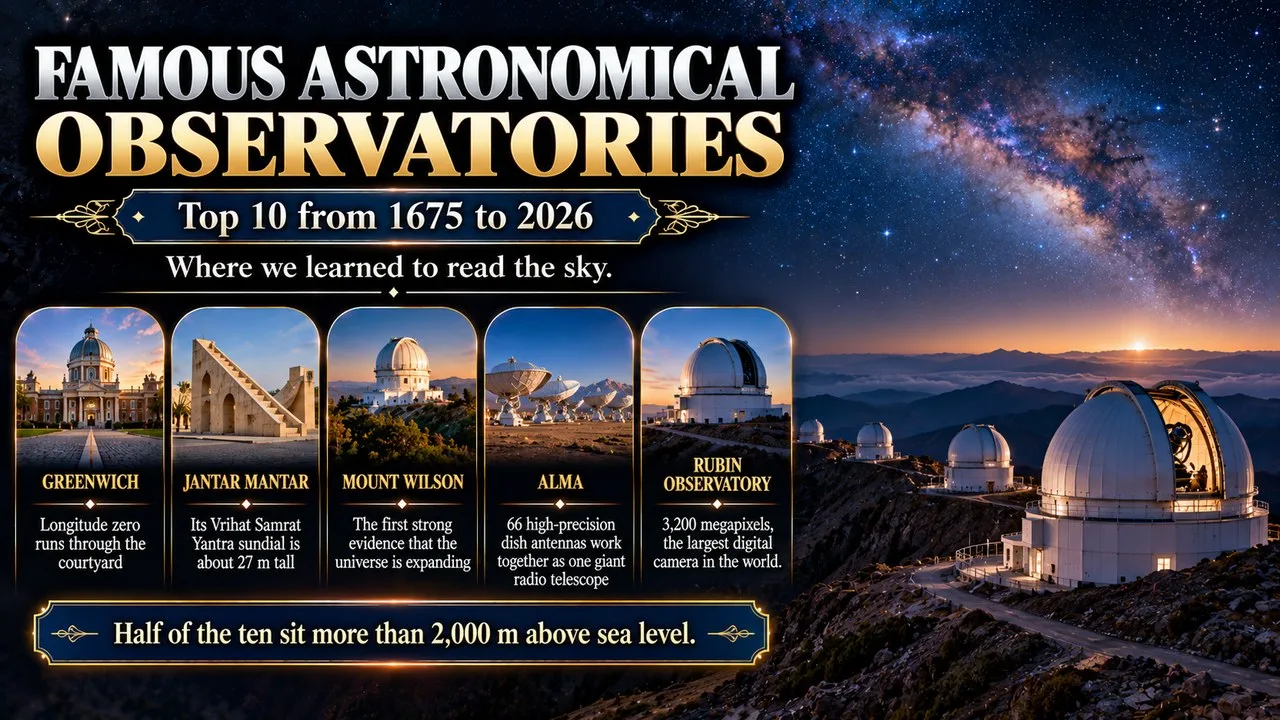
Famous astronomical observatories range from Greenwich, home of the prime meridian, and Jaipur's giant stone sundial to Chile's desert telescopes.
This Finepedia guide, written in October 2026, visits ten observatories that changed how we see the sky, from royal buildings of the 17th century to a survey telescope that began its main work in 2026. Each entry explains where the observatory stands, what its instruments do and one discovery or story linked to it. For more on space, see the Finepedia guides Top 25 Interesting Facts About the Universe and Interesting Facts About the Moon.
How We Chose These
We looked for observatories that are famous for major discoveries, record-breaking telescopes, striking architecture or their role in public science. We mixed historic sites, which now welcome visitors, with working mountaintop observatories that lead modern astronomy. The list runs in order of when each one began work. Half of the ten sit more than 2,000 m above sea level, where the air is thin, dry and steady.
The 10 Famous Observatories at a Glance
| No. | Observatory | Location | Began work | Best known for |
|---|---|---|---|---|
| 1 | Royal Observatory, Greenwich | London, UK | 1676 | The prime meridian |
| 2 | Jantar Mantar | Jaipur, India | 1734 | A 27 m stone sundial |
| 3 | Yerkes Observatory | Wisconsin, US | 1897 | A 40-inch lens telescope |
| 4 | Mount Wilson Observatory | California, US | 1904 | Hubble's galaxy discoveries |
| 5 | Griffith Observatory | Los Angeles, US | 1935 | Free public stargazing |
| 6 | Mauna Kea Observatories | Hawaii, US | 1970 | Twin 10 m Keck telescopes |
| 7 | Roque de los Muchachos | La Palma, Spain | 1985 | A 10.4 m mirror telescope |
| 8 | Paranal Observatory | Atacama Desert, Chile | 1998 | The Very Large Telescope |
| 9 | ALMA | Chajnantor plateau, Chile | 2011 | 66 radio antennas |
| 10 | Vera C. Rubin Observatory | Cerro Pachón, Chile | 2025 | The largest digital camera |
1. Greenwich Gave the World Its Prime Meridian
The Royal Observatory in Greenwich, south-east London, was founded by King Charles II in 1675 to improve navigation at sea.[1] Its first building, designed by Christopher Wren, was finished in 1676, and John Flamsteed became the first Astronomer Royal. Today it is a museum on a hill above the River Thames.
Key Facts
- Founded: 1675, by Charles II
- First Astronomer Royal: John Flamsteed
- Prime meridian: chosen at an international conference in 1884
- Time ball: lowered every day since 1833 as a time signal for ships
Did You Know?
Longitude zero runs through the courtyard, and visitors can stand with one foot in the eastern hemisphere and one in the western. Greenwich Mean Time, measured here, became the basis for time zones around the world.
2. Jaipur's Jantar Mantar Has the Largest Stone Sundial
The Jantar Mantar in Jaipur, India, was built by Maharaja Sawai Jai Singh II and completed in 1734.[2] It holds about 20 fixed instruments made of stone, brick and metal for tracking the Sun, Moon, planets and stars. UNESCO added it to the World Heritage List in 2010.
Key Facts
- Completed: 1734
- Builder: Sawai Jai Singh II, founder of Jaipur
- Star instrument: the Vrihat Samrat Yantra, about 27 m tall
- World Heritage: since 2010
Why It Matters
The great sundial's shadow moves about 6 cm every minute, letting local time be read to within a couple of seconds. Jai Singh built five such observatories across northern India, and the Jaipur site is the largest and best preserved.
3. Yerkes Observatory Holds a Record Lens Telescope
Yerkes Observatory, at Williams Bay in Wisconsin, was founded by the astronomer George Ellery Hale and paid for by the businessman Charles Yerkes.[3] It was dedicated in 1897. Its main dome holds a telescope with a 40-inch (102 cm) lens, the largest refracting telescope ever used successfully for astronomy.
Key Facts
- Dedicated: 1897
- Main telescope: a 40-inch refractor
- Nickname: the birthplace of modern astrophysics
- Today: run by the Yerkes Future Foundation, open again since May 2022
Did You Know?
Lens telescopes much bigger than the Yerkes refractor are not practical, because a huge lens sags under its own weight and can only be held at its edge. After Yerkes, large telescopes switched to mirrors, which can be supported from behind.
4. Mount Wilson Showed That the Universe Is Expanding
Mount Wilson Observatory, in the San Gabriel Mountains above Los Angeles, was also founded by George Ellery Hale, with funding from the Carnegie Institution in 1904.[4] Its 100-inch Hooker telescope, completed in 1917, was the largest in the world until 1949.
Related: Quasars: Distant Beacons or Local Oddballs?
Key Facts
- Founded: 1904
- Hooker telescope: 100-inch (2.5 m) mirror, finished in 1917
- Earlier giant: a 60-inch telescope, the largest working one in 1908
- Solar towers: built in 1908 and 1912
Why It Matters
Using the Hooker telescope in the 1920s, Edwin Hubble showed that the Andromeda Nebula is a separate galaxy far beyond the Milky Way. He then found that distant galaxies are moving away from us, the first strong evidence that the universe is expanding.
5. Griffith Observatory Brings the Stars to Everyone
Griffith Observatory sits on Mount Hollywood above Los Angeles and opened to the public on 14 May 1935. The mining businessman Griffith J. Griffith left money for it, insisting that entry should always be free, and it still is. More than 13,000 people came in its first five days.
Key Facts
- Opened: 14 May 1935
- Admission: free, as Griffith's will required
- Planetarium: the third to open in the United States
- Famous visitors: Apollo astronauts trained in its planetarium in the 1960s
Did You Know?
Griffith Observatory has appeared in many films, most famously Rebel Without a Cause in 1955 and La La Land in 2016.[5] Millions of people have peered through its main public telescope, a 12-inch Zeiss refractor.
6. Mauna Kea Is the World's Top Mountain for Telescopes
The Mauna Kea Observatories stand near the summit of a dormant volcano on Hawaii's Big Island, at about 4,207 m.[6] Above much of the moisture in the air and far from city lights, the site has some of the clearest skies on Earth. Building began in 1967, and the first telescope saw first light in 1970.
Related: Top 10 Interesting Facts About the Milky Way Galaxy
Key Facts
- Height: about 4,207 m above sea level
- Science reserve: set up in 1967
- Famous telescopes: the twin 10 m Keck telescopes and the Subaru telescope
- Partners: research groups from about a dozen countries
Why It Matters
By total light-collecting area, no observatory site for optical and infrared work anywhere beats Mauna Kea. The mountain is also sacred to Native Hawaiians, and protests over new telescopes, especially the planned Thirty Meter Telescope, have made it a centre of debate about science and culture.
7. Roque de los Muchachos Hosts a Giant Mirror
The Roque de los Muchachos Observatory sits at about 2,396 m on La Palma, one of Spain's Canary Islands.[7] At its formal opening on 29 June 1985, Spain's king and queen were joined by six other European heads of state. The island has strict laws to keep its night skies dark.
Key Facts
- Opened: 29 June 1985
- Height: about 2,396 m
- Largest telescope: the Gran Telescopio Canarias, with a 10.4 m mirror
- Other giants: the William Herschel Telescope, at work since 1987
Did You Know?
The Gran Telescopio Canarias, which began work in 2009, has the largest single-aperture optical telescope mirror in the world. Its mirror is made of 36 six-sided segments fitted together like a honeycomb.
8. Paranal's Very Large Telescope Lives Up to Its Name
Paranal Observatory stands on Cerro Paranal, a 2,635 m mountain in Chile's Atacama Desert, run by the European Southern Observatory.[8] Its flagship, the Very Large Telescope, is made of four 8.2 m main telescopes that can work alone or be linked together to see finer detail.
Key Facts
- Height: about 2,635 m
- First main telescope: saw first light in 1998
- Main mirrors: four, each 8.2 m across
- Nearest town: Paposo, about 38 km away
Why It Matters
The Very Large Telescope helped track stars orbiting the giant black hole at the centre of the Milky Way, work that shared the 2020 Nobel Prize in Physics. The observatory's staff hotel, the Residencia, appeared in Quantum of Solace, a James Bond film from 2008.
Related: Top 10 Famous Planetariums of the World
9. ALMA Listens to the Cold Universe
ALMA, short for Atacama Large Millimeter/submillimeter Array, sits on the Chajnantor plateau in northern Chile at about 5,000 m.[9] Its 66 high-precision dish antennas work together as one giant radio telescope, studying cold gas and dust where stars and planets are born. Its first images were released in October 2011.
Key Facts
- Height: about 5,000 m
- Antennas: 66, most of them 12 m across
- Full operations: since March 2013
- Partners: groups from Europe, East Asia and North America, hosted by Chile
Did You Know?
The antennas can be moved by giant transporter vehicles and spread up to 16 km apart, which works like a zoom lens for sharper views. ALMA also took part in the Event Horizon Telescope network that made the first image of a black hole in 2019.
10. Rubin Observatory Is Filming the Southern Sky
The Vera C. Rubin Observatory sits on Cerro Pachón in Chile and is named after Vera Rubin, who found strong evidence for dark matter.[10] It released its first images in June 2025, and on the night of 29 June 2026 it officially began a ten-year survey known as the LSST.
Key Facts
- First images: June 2025
- Survey start: night of 29 June 2026
- Camera: 3,200 megapixels, the largest digital camera in the world
- Pace: a new image about every 40 seconds
Why It Matters
Rubin will photograph the whole southern sky every few nights, returning to each spot about 800 times in ten years. During early test surveys it found more than 11,000 new asteroids in about six weeks, and it is expected to find millions more.
Related: Top 10 Most Bizarre Phobias: Strange Fears That Exist
Frequently Asked Questions
Why are most big observatories built on mountains?
High mountains sit above much of the water vapour and turbulence in the lower air, so starlight arrives sharper and less blurred. Remote peaks are also far from city lights, which would otherwise brighten the night sky.
Can the public visit these observatories?
Many can be visited. Greenwich, Jantar Mantar, Griffith and Yerkes welcome the public, and several mountaintop sites, including Paranal and Roque de los Muchachos, offer guided tours on set days.[2][11][12]
Conclusion
From a stone sundial in Jaipur to a giant digital camera in the Chilean Andes, these ten observatories trace more than 350 years of looking up.[13] Each one helped answer big questions about time, distance and the nature of the universe. For more on space, read the Finepedia guides Top 25 Interesting Facts About the Universe and Interesting Facts About the Moon.
- ^ [1] "Royal Observatory". Wikipedia. Wikipedia
- ^ [2] "Jantar Mantar, Jaipur". Wikipedia. Wikipedia
- ^ [3] "Yerkes Observatory". Wikipedia. Wikipedia
- ^ [4] "Mount Wilson Observatory". Wikipedia. Wikipedia
- ^ [5] "Griffith Observatory". Wikipedia. Wikipedia
- ^ [6] "Mauna Kea". Wikipedia. Wikipedia
- ^ [7] "Roque de los Muchachos Observatory". Wikipedia. Wikipedia
- ^ [8] "Paranal Observatory". Wikipedia. Wikipedia
- ^ [9] "Atacama Large Millimeter Array". Wikipedia. Wikipedia
- ^ [10] "Vera C. Rubin Observatory". Wikipedia. Wikipedia
- ^ [11] "Greenwich". Wikipedia. Wikipedia
- ^ [12] "Jantar Mantar". Wikipedia. Wikipedia
- ^ [13] "Jaipur". Wikipedia. Wikipedia


















Discussion
Log in with