








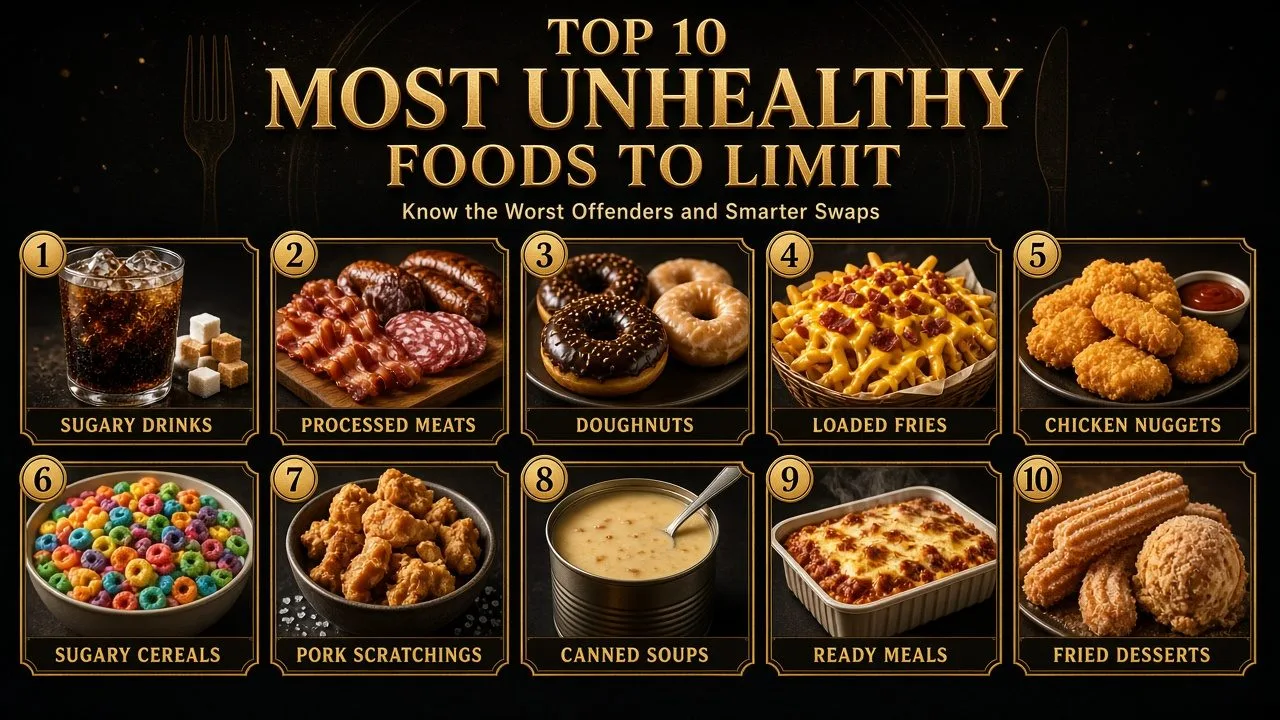
The most unhealthy foods to eat regularly are sugary drinks, processed meats, doughnuts, loaded fries, nuggets, sugary cereals and salty, fried snacks.
None of them is poison, and almost everyone eats some of them. What they share is a poor trade: plenty of sugar, salt, saturated fat or calories, and very little fibre, vitamins or protein in return. Eaten every day rather than now and then, they make it hard to stay within the limits set by the World Health Organization (WHO) and national health services.
This guide ranks ten everyday foods that people tend to eat too much of and that quietly strain the heart, teeth and waistline when they become a habit. For each one it explains what makes it a poor choice, what the evidence actually says, and a simple swap that keeps most of the pleasure with less of the harm.
How We Ranked the Most Unhealthy Foods
There is no official league table of unhealthy foods, so this list is an editorial ranking. Each food was judged against five practical tests drawn from WHO and UK National Health Service (NHS) guidance.
- Nutrient trade-off: how much sugar, salt or saturated fat it delivers compared with the fibre, protein and vitamins it offers.
- Strength of evidence: whether major health bodies have linked it, or its main ingredient, to a specific disease.
- How often it is eaten: everyday staples and habits rank above occasional treats.
- How easy it is to overeat: foods that are cheap, soft, sweet or salty and quick to finish score worse.
- Hidden content: foods that look harmless, or even healthy, but carry more salt or sugar than people expect.
The order is our own judgement, not a scientific ranking. It is general information, not personal medical advice; anyone with diabetes, heart disease, kidney disease or another condition should follow the guidance of their own doctor or dietitian.
The Most Unhealthy Foods at a Glance
| Rank | Food | Main Concern | Linked Health Risks | Easy Swap |
|---|---|---|---|---|
| 1 | Sugary drinks | Free sugars in liquid form | Weight gain, type 2 diabetes, tooth decay | Water, sparkling water, unsweetened tea or coffee |
| 2 | Processed meats | Salt, curing, saturated fat | Bowel (colorectal) cancer, high blood pressure | Fresh chicken, fish, eggs, beans |
| 3 | Doughnuts | Refined flour, sugar and frying fat | Weight gain, raised cholesterol | Fruit with yoghurt, a plain scone, a small homemade bake |
| 4 | Loaded cheesy fries | Calories, salt, saturated fat | Weight gain, high blood pressure | Oven-baked potato wedges, a smaller portion |
| 5 | Fried chicken nuggets | Breading, frying oil, salt | Weight gain, raised cholesterol | Homemade oven-baked chicken strips |
| 6 | Sugary breakfast cereals | Added sugar, low fibre | Tooth decay, energy dips, weight gain | Plain oats, wholegrain wheat biscuits |
| 7 | Pork scratchings and fried salty snacks | Salt and saturated fat in small portions | High blood pressure, weight gain | Unsalted nuts, plain popcorn |
| 8 | Canned soups | Hidden salt | High blood pressure, stroke risk | Reduced-salt versions or homemade soup |
| 9 | Frozen ready meals | Salt, fat, low vegetable content | High blood pressure, weight gain | Batch-cooked meals frozen at home |
| 10 | Fried desserts | Sugar plus frying fat | Weight gain, raised cholesterol | Baked fruit desserts |
What Makes a Food Unhealthy
Nutrition scientists rarely call a single food good or bad. The real problem is a diet in which a few nutrients are far above recommended limits and others are far below. The WHO says a healthy diet is built on a variety of minimally processed foods that are low in unhealthy fats, free sugars and sodium.
Four ingredients do most of the damage in the foods on this list. The table below shows the main adult limits that health bodies recommend.
| Nutrient | WHO Adult Guidance | UK NHS Adult Guidance | Main Health Concern |
|---|---|---|---|
| Free sugars | Less than 10% of daily energy, about 50 g (around 12 level teaspoons) on a 2,000-calorie diet; 5% or less may bring extra benefits | No more than 30 g a day (about 7 sugar cubes) | Weight gain, tooth decay, type 2 diabetes |
| Salt (sodium) | Less than 5 g of salt a day (under 2,000 mg sodium), about one teaspoon | No more than 6 g a day, about one level teaspoon | High blood pressure, heart disease, stroke |
| Saturated fat | No more than 10% of daily energy | No more than 30 g a day for men and 20 g for women | Raised cholesterol, heart disease |
| Trans fat | Less than 1% of daily energy, under 2.2 g a day on a 2,000-calorie diet | No more than about 5 g a day | Heart disease and early death |
Most people go well past these limits without ever picking up a salt shaker or a sugar bowl. The WHO estimates that the average adult worldwide consumed about 4,278 mg of sodium a day in 2021, the equivalent of roughly 11 g of salt and more than double its recommendation. The NHS says around three quarters of the salt people eat in the UK is already in packaged and everyday foods such as bread, breakfast cereals, meat products and ready meals.
Reading a Food Label
The NHS gives simple per-100 g thresholds for spotting foods that are high or low in the problem nutrients. They are worth remembering when comparing products on a supermarket shelf.
| Nutrient | High (per 100 g) | Low (per 100 g) |
|---|---|---|
| Total fat | More than 17.5 g | 3 g or less |
| Saturated fat | More than 5 g | 1.5 g or less |
| Total sugars | More than 22.5 g | 5 g or less |
| Salt | More than 1.5 g (0.6 g sodium) | 0.3 g or less (0.1 g sodium) |
1. Sugary Drinks
| Attribute | Details |
|---|---|
| Examples | Regular cola and fizzy drinks, energy drinks, sweetened iced tea, fruit punch, sports drinks |
| Main concern | Free sugars that are easy to drink in large amounts |
| Typical sugar | About 7 to 10 teaspoons of added sugar in a typical 12-ounce (355 ml) can of soda (Harvard T.H. Chan School of Public Health) |
| Linked risks | Weight gain, type 2 diabetes, heart disease, tooth decay |
| Better swap | Water, sparkling water with fruit slices, unsweetened tea or coffee, milk |
Why It Ranks First
Sugary drinks top this list because they combine a large dose of sugar with almost nothing else, and because they are drunk so often. The Harvard T.H. Chan School of Public Health describes sugar-sweetened beverages as the single largest source of calories and added sugar in the American diet, and notes that consumption is rising fast in many developing countries.
Liquid sugar is also easy to overlook. A can or bottle is finished in minutes, does little to curb hunger, and is rarely balanced by eating less at the next meal. At 4.2 g of sugar per teaspoon, one typical can holds roughly 29 to 42 g of sugar, enough to take an adult close to or past the NHS daily limit of 30 g of free sugars.
What Makes It Unhealthy
- Harvard researchers report that people who drink one to two sugary drinks a day or more have a 26% greater risk of developing type 2 diabetes than people who rarely drink them.
- Drinking one sugary drink a day without cutting calories elsewhere could add up to about 5 pounds (around 2.3 kg) of weight gain in a year, according to the same Harvard source.
- Frequent sugar contact feeds the bacteria that cause tooth decay, and acidic fizzy drinks can also wear away enamel.
- Fruit juices and smoothies count as free sugars too; the NHS advises keeping them to no more than 150 ml a day in total.
Healthier Swaps
Plain or sparkling water is the best everyday drink. For flavour, add slices of lemon, lime or cucumber, or dilute a no-added-sugar squash with sparkling water, as the NHS suggests. Sugar-free and diet drinks cut the sugar, though they are still acidic and are best kept to mealtimes.
Interesting Facts
- One teaspoon holds about 4.2 g of sugar, a handy figure for turning label grams into spoonfuls.
- The UK has charged a Soft Drinks Industry Levy on sugary soft drinks since 2018, a tax paid by producers and importers based on sugar content.
- Energy drinks often pair high sugar with caffeine, so they are not recommended for children.
2. Processed Meats
| Attribute | Details |
|---|---|
| Examples | Bacon, ham, sausages, hot dogs, salami, corned beef, beef jerky, canned meat |
| Main concern | Curing, smoking and salting, plus salt and saturated fat |
| Official classification | Group 1, carcinogenic to humans (International Agency for Research on Cancer, 2015) |
| Linked risks | Bowel (colorectal) cancer, high blood pressure, heart disease |
| Better swap | Fresh chicken or turkey, fish, eggs, beans, lentils |
Why It Ranks Here
Processed meat is the only food on this list with a formal cancer classification. In October 2015 the International Agency for Research on Cancer (IARC), the WHO's cancer agency, convened 22 experts from 10 countries who reviewed more than 800 studies. They classified processed meat as carcinogenic to humans (Group 1) based on sufficient evidence that it causes colorectal cancer, and classified red meat as probably carcinogenic (Group 2A).
The WHO defines processed meat as meat changed by salting, curing, fermentation, smoking or other processes to add flavour or extend shelf life. That covers hot dogs, ham, sausages, corned beef, biltong and beef jerky, as well as canned meat and meat-based sauces.
What Makes It Unhealthy
- The IARC experts concluded that each 50 g portion of processed meat eaten daily raises the risk of colorectal cancer by about 18%.
- Most processed meats are high in salt, one of the main drivers of high blood pressure.
- Many, especially bacon, salami and sausages, are also high in saturated fat.
Putting the Risk in Context
Group 1 describes how strong the evidence is, not how dangerous something is. Processed meat sits in the same group as tobacco smoking, but the WHO stresses that this does not mean the two are equally harmful. The IARC itself said the risk for any individual remains small, though it grows with the amount eaten and matters for public health because so many people eat processed meat.
Healthier Swaps
Fill sandwiches with leftover roast chicken, tinned fish, egg, hummus or falafel instead of ham or salami. When you do eat bacon or sausages, treat them as an occasional weekend meal rather than a daily breakfast.
Interesting Facts
- Red meat in the IARC review means mammalian muscle meat such as beef, pork, lamb and goat; poultry and fish are not included.
- Data from the same studies suggested colorectal cancer risk could rise by 17% for every 100 g of red meat eaten daily, if the link were proven causal.
- The 2015 evaluations were published as Volume 114 of the IARC Monographs.
3. Doughnuts
| Attribute | Details |
|---|---|
| Examples | Glazed, iced, jam-filled and cream-filled doughnuts |
| Main concern | Refined flour and sugar, deep-fried in fat |
| Nutrient profile | High in calories and sugar, low in fibre and protein |
| Linked risks | Weight gain, raised cholesterol, tooth decay |
| Better swap | Fruit with plain yoghurt, a wholemeal fruit muffin made at home |
Why It Ranks Here
A doughnut packs most of the problem ingredients into one soft, sweet bite. The dough is made from refined white flour, it is deep-fried, and it is then glazed, iced or filled with sugar. Because doughnuts are cheap, easy to eat on the move and often sold in boxes, it is easy to eat more than one.
What Makes It Unhealthy
- Deep-frying soaks fat into the dough, and fat provides 9 kcal per gram compared with 4 kcal for carbohydrate or protein, according to the NHS.
- Sugar glazes and fillings add free sugars that count towards the daily limit.
- Doughnuts offer very little fibre, so they digest quickly and do little to keep hunger away.
- Baked and fried goods are among the foods where the WHO says industrially produced trans fat can still be found, particularly from street and restaurant vendors in countries without strict limits.
Healthier Swaps
If the craving is for something sweet with coffee, try a piece of fruit with yoghurt, a slice of malt loaf or a small homemade bake with less sugar. When you do have a doughnut, choose a plain ring rather than a cream-filled or heavily iced one, and share a box rather than finishing it.
Interesting Facts
- Fried dough sweets exist in almost every food culture, from churros and beignets to jalebi and loukoumades.
- A doughnut is mostly refined white flour, which contains far less fibre than wholemeal flour.
- Many countries now limit industrial trans fat; the WHO says almost half the world's population is covered by best-practice policies to eliminate it.
4. Loaded Cheesy Fries
| Attribute | Details |
|---|---|
| Examples | Cheese fries, chilli cheese fries, poutine, bacon-loaded fries |
| Main concern | Fried potato topped with cheese, sauces and often meat |
| Nutrient profile | High in calories, salt and saturated fat |
| Linked risks | Weight gain, high blood pressure, raised cholesterol |
| Better swap | Oven-baked wedges with herbs, or a small plain portion |
Why It Ranks Here
Plain fries are already fried and usually salted. Loading them with melted cheese, cheese sauce, bacon or gravy turns a side dish into a meal-sized serving with a large dose of saturated fat and salt. They are often eaten alongside a burger or fried chicken, which multiplies the effect.
What Makes It Unhealthy
- Cheese is listed by the WHO among the main sources of saturated fat, alongside fatty meat, butter, cream and lard.
- Fries, cheese, bacon and sauces all add salt, making it easy to pass the daily limit in one meal.
- Frying potatoes at high temperatures can form acrylamide, a chemical that caused cancer in animal studies, according to the US Food and Drug Administration (FDA).
- Large sharing portions encourage eating well past fullness.
Healthier Swaps
Cut potatoes into wedges with the skin on, toss them in a little olive oil and bake them. A sprinkle of strong-flavoured cheese, such as mature cheddar or parmesan, gives plenty of taste with less fat than a cheese sauce. Pairing fries with a salad instead of a second fried item also helps.
Interesting Facts
- The FDA notes that boiling and steaming do not typically form acrylamide; frying, roasting and baking do.
- According to the FDA, acrylamide forms from sugars and an amino acid naturally present in food, not from packaging or the environment.
- Acrylamide forms mainly in plant foods such as potato and grain products and coffee, and little or none forms in meat, dairy and fish, says the FDA.
5. Fried Chicken Nuggets
| Attribute | Details |
|---|---|
| Examples | Fast-food nuggets, frozen breaded chicken bites, popcorn chicken |
| Main concern | Breaded, reformed chicken that is deep-fried and salted |
| Nutrient profile | Higher in fat and salt than plain chicken, low in fibre |
| Linked risks | Weight gain, high blood pressure, raised cholesterol |
| Better swap | Homemade chicken strips coated in wholemeal breadcrumbs and baked |
Why It Ranks Here
Chicken is a good source of protein, so nuggets can seem like a sensible choice, especially for children. Many shop-bought and fast-food versions, however, are made from minced or reformed chicken, coated in batter or breadcrumbs and deep-fried. The coating absorbs oil, and added salt and flavourings make them easy to eat in large numbers.
What Makes It Unhealthy
- The breadcrumb or batter coating absorbs frying oil, raising the fat and calorie content well above that of plain grilled chicken.
- Many products contain added salt, flavour enhancers, starches and other additives typical of ultra-processed foods.
- Dipping sauces such as barbecue sauce and sweet chilli add extra sugar and salt.
- Nuggets are usually served with fries and a fizzy drink, combining three items from this list in one meal.
Healthier Swaps
Slice chicken breast into strips, dip them in beaten egg and wholemeal breadcrumbs, and bake them in a hot oven until golden. Check that the inside is no longer pink before serving. Serve with a yoghurt dip and vegetable sticks instead of fries.
Interesting Facts
- Under the NOVA food classification system, used in research worldwide, reformed meat products with additives are classed as ultra-processed.
- Comparing labels matters: nuggets vary widely in how much chicken, fat and salt they contain.
- Baking at home lets you control both the salt and the type of oil used.
6. Sugary Breakfast Cereals
| Attribute | Details |
|---|---|
| Examples | Frosted, chocolate, honey-coated and marshmallow cereals, many granolas |
| Main concern | Added sugar and low fibre in a daily food |
| Label check | More than 22.5 g of total sugars per 100 g counts as high (NHS) |
| Linked risks | Tooth decay, weight gain, mid-morning energy dips |
| Better swap | Plain porridge oats, wholegrain wheat biscuits, shredded wholegrain |
Why It Ranks Here
Breakfast cereal is eaten every day in many homes, often by children, which makes its sugar content matter more than that of an occasional treat. Many cereals are coated in sugar, honey or syrup, and even products marketed as healthy, such as some granolas, can be high in sugar. The NHS lists breakfast cereals among the everyday foods that carry hidden salt as well.
What Makes It Unhealthy
- Sugar-coated cereals can carry a large share of a child's daily free-sugar limit in one bowl; the NHS limit for children aged 7 to 10 is 24 g a day.
- Refined cereals low in fibre are digested quickly, so hunger can return within a couple of hours.
- Adding sugar or honey at the table, or pouring fruit juice alongside, pushes the total higher.
- Frequent sugary breakfasts expose teeth to sugar at the start of every day.
Healthier Swaps
Plain porridge oats, wholegrain wheat biscuits or shredded wholegrain cereals are low in sugar and higher in fibre. Add sweetness with sliced banana, berries or a few raisins instead of sugar. Use the NHS label thresholds to compare boxes: 5 g of total sugars per 100 g or less counts as low.
Interesting Facts
- The WHO advises that everyone over 10 eat at least 25 g of naturally occurring fibre a day, and wholegrain cereals are an easy way to start.
- Ingredients are listed by weight, so a cereal with sugar near the top of the list is mostly sugar.
- Sugar can appear under several names on a label, including glucose syrup, honey, dextrose and invert sugar.
7. Pork Scratchings and Fried Salty Snacks
| Attribute | Details |
|---|---|
| Examples | Pork scratchings, pork rinds, crisps, salted crackers, fried snack mixes |
| Main concern | Concentrated salt and fat in a small, moreish portion |
| Label check | More than 1.5 g of salt or 5 g of saturated fat per 100 g counts as high (NHS) |
| Linked risks | High blood pressure, weight gain, raised cholesterol |
| Better swap | Unsalted nuts, plain popcorn, roasted chickpeas, vegetable sticks |
Why It Ranks Here
Pork scratchings are pieces of pork skin and fat that are deep-fried or roasted until crisp, then salted. Like many fried snacks, they are very calorie-dense for their size, and a small bag can disappear quickly while watching television or having a drink. Their main problems are salt and saturated fat, both of which most adults already eat too much of.
What Makes It Unhealthy
- Pork fat is an animal fat, and the WHO lists lard and fatty meat among the main sources of saturated fat.
- Heavy salting makes these snacks a significant source of sodium, the main dietary cause of raised blood pressure.
- Fat-rich snacks are energy-dense, so a small portion delivers a large number of calories.
- Salty snacks often encourage drinking more, including sugary or alcoholic drinks.
Healthier Swaps
Unsalted nuts and seeds give crunch with healthier unsaturated fats. Air-popped popcorn with a little seasoning, roasted chickpeas and vegetable sticks with hummus are lower-salt options. If you do buy crisps, choose a small single-serve bag rather than eating from a large sharing pack.
Interesting Facts
- Pork rinds are sometimes promoted as a low-carbohydrate snack, but low carbohydrate does not mean low salt or low fat.
- The WHO estimates about 1.7 million deaths in 2023 were associated with eating too much sodium.
- Reducing sodium intake is described by the WHO as one of the most cost-effective ways to improve health.
8. Canned Soups
| Attribute | Details |
|---|---|
| Examples | Cream soups, chunky meat soups, instant cup soups, condensed soups |
| Main concern | Hidden salt in a food that looks wholesome |
| Label check | More than 1.5 g of salt per 100 g counts as high (NHS) |
| Linked risks | High blood pressure, heart disease, stroke |
| Better swap | Reduced-salt varieties or homemade vegetable and lentil soup |
Why It Ranks Here
Soup has a healthy image, and many canned soups do contain vegetables, beans and lentils. The catch is salt, which manufacturers use for flavour and preservation. A whole can is often eaten as one meal, so the salt can add up to a large part of the daily limit before any bread or toppings are added.
What Makes It Unhealthy
- High-salt diets are the main dietary cause of raised blood pressure, which the WHO links to cardiovascular disease, stomach cancer and kidney disease.
- Cream-based soups can also be high in saturated fat.
- Instant cup soups are often low in vegetables and fibre despite their pictures.
- Serving sizes on labels may be half a can, so the salt in a full can is double the figure shown per portion.
Healthier Swaps
Look for reduced-salt or low-salt versions and compare the salt per 100 g. Better still, make a large pot of soup at home with vegetables, lentils or beans and herbs, then freeze it in portions. Adding a squeeze of lemon or black pepper gives flavour without salt.
Interesting Facts
- Canning itself is a safe and useful way to preserve food; the problem is the added salt, not the can.
- The WHO's adult limit of under 5 g of salt a day is about one teaspoon in total, from all foods.
- The NHS limit for children aged 7 to 10 is no more than 5 g of salt a day, so a salty can of soup matters even more for them.
9. Frozen Ready Meals
| Attribute | Details |
|---|---|
| Examples | Frozen lasagne, pizza, pies, macaroni cheese, microwave curries |
| Main concern | Salt and saturated fat, with few vegetables |
| Label check | Use the NHS per-100 g thresholds and front-of-pack colour labels |
| Linked risks | High blood pressure, weight gain, raised cholesterol |
| Better swap | Home-cooked meals frozen in portions |
Why It Ranks Here
Ready meals are convenient, and not all are unhealthy. Many, however, rely on salt, cheese, cream and fatty meat for flavour, and contain fewer vegetables than a home-cooked plate. The NHS names ready meals among the foods responsible for most of the salt people eat, and lists them among common ultra-processed foods.
What Makes It Unhealthy
- Salt, saturated fat and sugar levels vary widely between brands and recipes.
- Portions may be too small to satisfy, leading to extra snacks, or too large, leading to overeating.
- Vegetable content is often low, so it is hard to reach the WHO's goal of at least 400 g of fruit and vegetables a day.
- Frozen pizzas and pies are among the baked foods where the WHO says industrial trans fat may be found where it is not yet restricted.
What the Research Says About Ultra-Processed Foods
A 2024 umbrella review in The BMJ analysed 45 pooled analyses covering almost 9.9 million participants. It found that higher intake of ultra-processed foods was associated with higher risks of 32 health outcomes, with the strongest evidence for cardiovascular deaths, type 2 diabetes, anxiety and common mental disorders. The authors noted that much of the evidence was rated low quality, and that the studies show associations rather than proof of cause.
Healthier Swaps
Cook double portions of chilli, curry, stew or pasta sauce and freeze the extras for busy days. When buying ready meals, choose ones with green or amber front-of-pack labels and add a side of frozen vegetables or salad.
Interesting Facts
- Frozen vegetables and fruit are minimally processed and can be just as nutritious as fresh.
- Harvard researchers cite US data showing ultra-processed foods made up about 60% of total calories in the American diet.
- The NOVA system that defines ultra-processed foods was introduced in 2009.
10. Fried Desserts
| Attribute | Details |
|---|---|
| Examples | Deep-fried ice cream, battered chocolate bars, funnel cakes, churros with sugar |
| Main concern | Sugar combined with frying fat |
| Nutrient profile | Very high in calories, sugar and fat |
| Linked risks | Weight gain, raised cholesterol, tooth decay |
| Better swap | Baked apples or pears, fruit crumble with oats, frozen yoghurt |
Why It Ranks Here
Fried desserts take a sweet food that is already high in sugar and add batter and deep-frying fat. They are usually eaten as a treat at fairs, festivals or restaurants rather than every day, which is why they sit at number ten rather than higher. Eaten often, though, they would rank near the top.
What Makes It Unhealthy
- They pair free sugars with saturated or trans fats from frying oil.
- Batter and coatings add refined flour and absorb extra oil.
- Portions are often large and served with cream, syrup or ice cream.
- There is little fibre, protein or vitamin content to balance the calories.
Healthier Swaps
Baked apples or pears with cinnamon, a fruit crumble with an oat topping, or frozen yoghurt with berries all satisfy a sweet tooth with less fat. If you want a fried dessert, share one between several people and make it an occasional treat.
Interesting Facts
- Churros are often served with thick hot chocolate for dipping, which adds even more sugar.
- Both industrially produced and naturally occurring trans fats are equally harmful, according to the WHO.
- High trans fat intake raises the risk of death from any cause by 34% and of coronary heart disease deaths by 28%, according to WHO figures.
Comparing the Most Unhealthy Foods
| Food | Too Much Sugar | Too Much Salt | Too Much Saturated Fat | Usually Fried | Eaten Often |
|---|---|---|---|---|---|
| Sugary drinks | Yes | No | No | No | Yes |
| Processed meats | No | Yes | Yes | Sometimes | Yes |
| Doughnuts | Yes | No | Yes | Yes | Sometimes |
| Loaded cheesy fries | No | Yes | Yes | Yes | Sometimes |
| Fried chicken nuggets | No | Yes | Sometimes | Yes | Yes |
| Sugary breakfast cereals | Yes | Sometimes | No | No | Yes |
| Pork scratchings and fried snacks | No | Yes | Yes | Yes | Sometimes |
| Canned soups | No | Yes | Sometimes | No | Yes |
| Frozen ready meals | Sometimes | Yes | Sometimes | No | Yes |
| Fried desserts | Yes | No | Yes | Yes | Rarely |
How to Eat Less of the Most Unhealthy Foods
Cutting back works better than banning favourite foods outright. Small, steady changes are easier to keep up and still make a real difference over months and years.
- Swap drinks first: replacing one sugary drink a day with water removes a large amount of free sugar with little effort.
- Read the label: use the NHS per-100 g thresholds to compare similar products and pick the lower one.
- Cook in batches: a freezer full of home-cooked meals makes ready meals and takeaways less tempting.
- Keep treats as treats: plan doughnuts, fried desserts and loaded fries for occasions rather than everyday habits.
- Fill half the plate with vegetables: it leaves less room for fried and processed foods and helps reach the WHO's 400 g a day.
- Shop with a list: impulse buys near the checkout are often sweets, crisps and fizzy drinks.
Frequently Asked Questions
What is the most unhealthy food in the world?
There is no single most unhealthy food, because health depends on the whole diet and how often something is eaten. Sugary drinks and processed meats have the strongest evidence of harm when consumed regularly: sugary drinks are linked to type 2 diabetes and weight gain, and processed meat is classified by the WHO's cancer agency as a cause of colorectal cancer.
Is it okay to eat unhealthy food sometimes?
Yes. Health bodies focus on overall eating patterns rather than individual meals. An occasional doughnut, portion of fries or slice of pizza will not undo an otherwise balanced diet. Problems build up when these foods are eaten daily and push sugar, salt and saturated fat well above recommended limits for months or years.
Why is processed meat in the same group as smoking?
The IARC groups agents by how strong the evidence is that they cause cancer, not by how much risk they carry. Processed meat and tobacco smoking are both in Group 1 because the evidence for each is convincing. The WHO stresses that this does not mean they are equally dangerous; smoking carries a far larger risk.
How much sugar should I have in a day?
The WHO advises adults to keep free sugars below 10% of daily energy, about 50 g or 12 teaspoons on a 2,000-calorie diet, and suggests 5% or less for extra benefit. The NHS sets a stricter limit of no more than 30 g of free sugars a day for adults, roughly seven sugar cubes.
Are diet or sugar-free drinks a healthy alternative?
Sugar-free drinks avoid the free sugars that make regular fizzy drinks so harmful, so they are a better choice than full-sugar versions for people trying to cut down. They are still acidic, which can wear tooth enamel, so water, milk and unsweetened tea or coffee remain the best everyday options.
Are all processed foods unhealthy?
No. The NHS points out that most foods are processed in some way, such as pasteurised milk, frozen vegetables, canned beans and wholemeal bread. Many ultra-processed foods are high in calories, saturated fat, salt or sugar, but the label tells you more than the word processed does. Compare products using the per-100 g thresholds.
What are the healthiest swaps for junk food?
Good swaps include water or sparkling water instead of fizzy drinks, unsalted nuts or plain popcorn instead of crisps, porridge instead of sugary cereal, oven-baked wedges instead of loaded fries, and home-cooked meals frozen in portions instead of ready meals. Fruit with yoghurt makes an easy replacement for doughnuts and fried desserts.
Conclusion
The most unhealthy foods on this list are not dangerous in a single serving, but they make it very easy to eat far more sugar, salt and saturated fat than the body needs. Sugary drinks and processed meats lead the ranking because the evidence against them is strongest and they are consumed so often, while fried snacks, cereals, soups and ready meals hide more salt and sugar than most people expect.
The practical answer is moderation and simple swaps rather than strict bans. Drinking water, reading labels, cooking in batches and saving fried treats for special occasions keep the pleasure of food while lowering the long-term risks.
- World Health Organization, Healthy diet fact sheet (free sugars, fats, fruit, vegetables and fibre)
- World Health Organization, Sodium reduction fact sheet, May 2026
- World Health Organization, Trans fat fact sheet, January 2024
- World Health Organization, Q&A on the carcinogenicity of the consumption of red meat and processed meat
- International Agency for Research on Cancer, Press Release No. 240, 26 October 2015
- NHS, Sugar: the facts; Salt: the facts; Fat: the facts; How to read food labels; Processed foods
- Harvard T.H. Chan School of Public Health, The Nutrition Source: Sugary Drinks and Processed Foods
- US Food and Drug Administration, Acrylamide Questions and Answers
- Lane MM et al., Ultra-processed food exposure and adverse health outcomes: umbrella review of epidemiological meta-analyses, The BMJ, 2024

















Log in with