








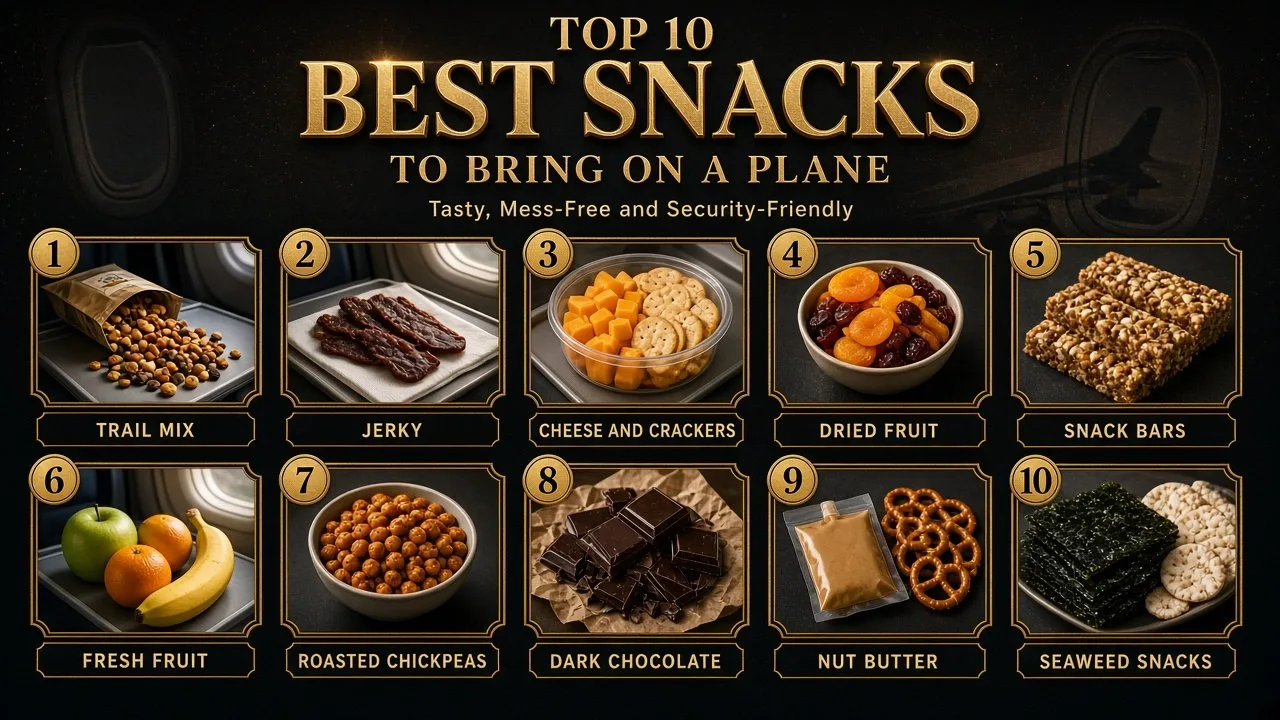
The best snacks to bring on a plane are solid, mess-free and full of flavour: trail mix, jerky, hard cheese, dried fruit, bars, whole fruit and dark chocolate.
Airport kiosks are expensive, in-flight menus run out, and a delayed departure can stretch a two-hour hop into a six-hour wait. A small bag of well-chosen snacks solves all three problems, but only if it gets through security, survives hours without a fridge and still tastes good at 35,000 feet.
This guide ranks ten snack types against those practical tests. It also explains, with research from Fraunhofer and Cornell University, why airline food tastes flat, which snacks count as liquids at the checkpoint, and which foods you must declare or throw away before you land in another country.
How We Chose the Best Plane Snacks
Every snack on this list had to meet five tests. Taste matters, but a snack that is confiscated at security or smells out an entire row is not a good plane snack, however delicious it is at home.
- Security: the snack is a solid food, or it comes in a container small enough for the liquids bag.
- No fridge needed: it stays safe and pleasant at room temperature for a full travel day.
- Low mess: no crumbs everywhere, no sticky fingers and no strong smell in a closed cabin.
- Flavour at altitude: it holds up when dry air and low cabin pressure dull the senses.
- Staying power: it offers protein, fibre or healthy fat, so one portion keeps hunger away for a while.
The order below is our own judgement based on those tests, not a sales chart or a scientific ranking. Security rules quoted are from the US Transportation Security Administration (TSA) and the UK government unless stated, and the final decision at any checkpoint always rests with the officer on duty.
Best Snacks to Bring on a Plane at a Glance
| Rank | Snack | Main Strength | Security Status (US) | Watch Out For |
|---|---|---|---|---|
| 1 | Trail mix and roasted nuts | Filling, compact, endlessly customisable | Solid food, allowed | Nut allergies on board |
| 2 | Jerky and meat sticks | High protein, savoury umami flavour | Solid food, allowed | Meat rules when entering another country |
| 3 | Hard cheese and crackers | Satisfying and familiar | Solid cheese allowed; creamy cheese counts as a liquid | Soft cheese and long hot journeys |
| 4 | Dried fruit | Naturally sweet, light and long-lasting | Solid food, allowed | Sugar content; some countries restrict it |
| 5 | Granola and protein bars | Individually wrapped, no mess | Solid food, allowed | Chocolate coatings melting |
| 6 | Whole fresh fruit | Hydrating and fresh | Allowed on domestic flights, with exceptions | Must be eaten or binned before international arrival |
| 7 | Roasted chickpeas and veggie crisps | Crunchy, high in fibre | Solid food, allowed | Strong seasonings and crumbs |
| 8 | Dark chocolate | Small portion, big flavour | Solid food, allowed | Melting in warm bags |
| 9 | Nut butter pouches with apple or pretzels | Protein-rich and filling | Counts as a liquid or gel; 3.4 oz (100 ml) or less | Larger jars are taken at security |
| 10 | Popcorn, rice crackers and seaweed snacks | Light, low-calorie, savoury | Solid food, allowed | Crumbs and very salty varieties |
Why Food Tastes Different on a Plane
If airline meals taste bland, the cabin, not just the cooking, is partly to blame. Planes are pressurised, but not to sea level: US aviation rules (14 CFR 25.841) require passenger cabins to be kept at a cabin pressure altitude of no more than 8,000 feet in normal operation. The air is also extremely dry. The World Health Organization notes that cabin humidity is usually between 10 and 20 percent, similar to a desert and far below the 40 to 60 percent typical of homes and offices.
Research commissioned by Lufthansa at the Fraunhofer Institute for Building Physics tested food inside an Airbus A310 fuselage placed in a low-pressure chamber. Under simulated cruising conditions, Fraunhofer reported that salt was perceived as 20 to 30 percent less intense and sugar as 15 to 20 percent less intense than on the ground, while fruity aromas and acids were more stable. Taste and smell thresholds rose, which is why the researchers compared eating in flight to eating with a cold.
Noise plays a part too. In a 2015 study published in the Journal of Experimental Psychology: Human Perception and Performance, Cornell University food scientists Kimberly Yan and Robin Dando played simulated cabin noise of about 80 to 85 decibels to 48 participants. Sweet tastes were rated weaker under the noise, while umami, the savoury taste found in foods such as tomatoes, cured meats, aged cheese and seaweed, was rated stronger at higher concentrations. Salty, sour and bitter ratings did not change.
What This Means for Your Snack Bag
| Cabin Condition | Effect on Taste | Snack Strategy |
|---|---|---|
| Low cabin pressure | Salt and sugar taste weaker | Choose boldly seasoned snacks over mild ones |
| Dry air (about 10–20% humidity) | Dry nose dulls aroma and flavour | Pair snacks with water; add juicy fruit |
| Engine noise (around 85 dB) | Sweetness suppressed, umami enhanced | Lean on savoury umami snacks such as jerky, aged cheese and seaweed |
| Gas expansion at altitude | Sealed bags puff up; some foods cause bloating | Avoid fizzy drinks and large portions of gassy foods |
Plane Snack Security Rules You Should Know
The single most useful rule to remember is that solid foods are generally fine and anything spreadable, pourable or scoopable is treated like a liquid. The TSA allows a quart-sized bag of liquids, aerosols, gels, creams and pastes in carry-on bags, with each container limited to 3.4 ounces (100 millilitres). Many countries use the same 100 ml limit, although the UK government warns that liquid rules have changed at some UK airports and that travellers should check with their airport before flying.
| Snack Item | TSA Carry-On Rule | Notes |
|---|---|---|
| Solid cheese | Allowed | Hard cheeses such as cheddar or parmesan |
| Creamy cheese | 3.4 oz (100 ml) or less | Cream cheese and soft spreads count as gels |
| Peanut butter | 3.4 oz (100 ml) or less | Single-serve pouches fit the liquids bag |
| Hummus | 3.4 oz (100 ml) or less | Treated as a gel or paste |
| Cookies | Allowed | May be separated for X-ray screening |
| Fresh fruit and vegetables | Allowed within the continental US | Restricted from Hawaii, Puerto Rico and the US Virgin Islands to the mainland |
| Powders over 12 oz (350 ml) | Allowed but screened separately | Protein powder may need extra checks; checked bags are easier |
Food can also clutter X-ray images. The TSA says officers may ask travellers to take food, powders and other cluttering items out of their bags, and the UK government notes that food and powders in hand luggage can lead to a manual bag check. Packing snacks together in one clear pouch at the top of your bag makes this quick.
1. Trail Mix and Roasted Nuts
| Attribute | Details |
|---|---|
| Best for | Long-haul flights and long delays |
| Security | Solid food, allowed in carry-on bags |
| Fridge needed | No |
| Flavour at altitude | Good; salted and spiced mixes hold up best |
| Main caution | Some passengers have severe nut allergies |
Why It Works
Trail mix earns the top spot because it does almost everything a plane snack should. A handful of nuts provides protein, fat and fibre, which digest slowly and help you stay full between meals or through a long delay. It is dense, so a small bag carries a lot of energy without taking up space in a crowded carry-on.
It is also completely customisable. You can combine almonds, cashews, walnuts or peanuts with seeds, dried fruit, cereal pieces or a few chocolate chips, and adjust the balance of sweet and salty to your taste. Because cabin conditions dull salt perception, a lightly salted or spiced mix usually tastes better in the air than a plain one.
Key Features
- Compact and calorie-dense for its size
- Keeps for days at room temperature
- Easy to portion into small resealable bags
- Works for breakfast, a snack or an emergency meal replacement
- Combines savoury and sweet in a single bag
Tips for Packing It
Pre-portion trail mix into several small bags rather than one large one, so you can eat a measured amount and keep the rest sealed. Choose mixes without yoghurt-coated or heavily chocolate-coated pieces if you are flying somewhere hot, because those melt and stick together.
Interesting Facts
- Nuts are among the most common food allergens, and airline policies on serving or announcing nut snacks vary, so check your carrier's allergy policy if you or a fellow traveller is affected.
- Australia's biosecurity authority lists grains, seeds and nuts among the foods that may be restricted, even when commercially packaged, so declare them on arrival.
- Roasted nuts travel better than raw sprouted ones, which are more perishable.
2. Jerky and Meat Sticks
| Attribute | Details |
|---|---|
| Best for | Protein lovers and low-carb travellers |
| Security | Solid food, allowed in carry-on bags |
| Fridge needed | No, while the pack is sealed |
| Flavour at altitude | Excellent; rich in savoury umami |
| Main caution | Meat products are restricted entering many countries |
Why It Works
Dried meat is one of the oldest travel foods in the world, and it still suits modern flying remarkably well. Jerky and shelf-stable meat sticks are light, high in protein and need no refrigeration while sealed, so they last through connections and delays without any special care.
Jerky also plays to the strengths of the cabin. Cured and dried meats are rich in umami, the savoury taste that Cornell's research found was enhanced, not dulled, by loud cabin noise. That makes jerky one of the few snacks that may taste as good on a plane as it does on the ground. Beef is the classic choice, but turkey, chicken and plant-based mushroom or soy jerky are widely available.
Key Features
- High in protein, which helps you feel full
- Very light to carry
- Shelf-stable until opened
- Strong, savoury flavour suited to cabin conditions
- Comes in many meats and seasonings
The International Catch
Jerky is the snack most likely to cause trouble at your destination. US Customs and Border Protection says that many fresh, dried and some canned meats are prohibited from entering the United States from foreign countries because of animal disease risks, and all travellers must declare meats on arrival. Australia treats unretorted meat and meat products as category 1 goods, its highest biosecurity risk class. The simplest rule is to finish meat snacks in the air or leave them behind before you land.
Interesting Facts
- The word jerky comes from charqui, a Quechua word from the Andes for dried meat.
- Jerky tends to be salty, so drinking water alongside it is especially important in a dry cabin.
- Plant-based jerky made from mushrooms, soy or jackfruit avoids most meat import restrictions, but check labels for animal ingredients.
3. Hard Cheese and Crackers
| Attribute | Details |
|---|---|
| Best for | A familiar, satisfying mini meal |
| Security | Solid cheese allowed; creamy cheese limited to 3.4 oz (100 ml) |
| Fridge needed | Not for a few hours with hard cheese |
| Flavour at altitude | Very good with aged cheeses |
| Main caution | Soft cheese spoils quickly and counts as a gel |
Why It Works
Cheese and crackers feel like a proper snack rather than a compromise, and they cost far less when packed at home than when bought on board. The key is choosing the right cheese. The TSA allows solid cheese in carry-on bags without applying the liquids limit, but creamy cheese falls under the liquids rule, so a wedge of cheddar travels freely while a tub of cream cheese must fit in your liquids bag.
Aged hard cheeses such as cheddar, gouda, parmesan and gruyere are lower in moisture than soft cheeses, so they cope better with a few hours at room temperature. They are also naturally rich in umami flavour, which helps them stand out against the muting effect of cabin noise and pressure.
Key Features
- Hard cheese is not subject to the US liquids limit
- Pairs well with sturdy crackers, oatcakes or breadsticks
- Protein and fat make it filling
- Pre-sliced cheese saves needing a knife
- Wax-coated mini cheeses come individually wrapped
Tips for Packing It
Slice the cheese at home and wrap it in wax paper or a small container, then keep crackers in a rigid box so they do not crush in an overhead bin. On a long journey, eat the cheese first and keep the crackers for later. Because security rules only cover what you carry on board, you cannot take knives through the checkpoint, so prepare everything before you leave.
Interesting Facts
- Dairy products are on Australia's list of foods that may be restricted at the border, so declare cheese when arriving there.
- Wax coatings on small cheeses help keep out air and moisture, which is one reason they travel well.
- Strong blue and washed-rind cheeses taste great but can make you unpopular in a closed cabin.
4. Dried Fruit
| Attribute | Details |
|---|---|
| Best for | A natural sweet fix |
| Security | Solid food, allowed in carry-on bags |
| Fridge needed | No |
| Flavour at altitude | Good; tart fruits keep their brightness |
| Main caution | Concentrated sugar and calories |
Why It Works
Dried fruit packs the flavour of fresh fruit into a light, shelf-stable form that will not bruise, leak or spoil in your bag. Apricots, mango, figs, dates, raisins, cranberries and apple rings are all easy to find, and mixing several types turns a plain bag into something more interesting.
Fraunhofer's tests found that fruity aromas and acidity stay relatively stable under low cabin pressure, while plain sweetness is dulled. That suggests tart dried fruits, such as apricots, cherries and cranberries, may hold their flavour better in the air than very sweet ones. Dried fruit also adds fibre, which many travel snacks lack.
Key Features
- Lasts for weeks without refrigeration
- Light and compact
- Provides fibre and natural sugars for quick energy
- No peeling, cutting or washing needed
- Easy to mix into trail mix or eat with nuts
Things to Keep in Mind
Drying removes water, so the sugar and calories are concentrated into a much smaller portion than fresh fruit. A small handful is a sensible serving. Some dried fruits are treated with sulphites to keep their colour, which a minority of people are sensitive to, so check labels if that applies to you.
Interesting Facts
- Commercially packaged dried fruit is usually less restricted than fresh fruit at borders, but Australia still requires travellers to declare all food.
- Dried apricots, figs and dates are good sources of fibre, which many packaged travel snacks lack.
- Freeze-dried fruit is even lighter than traditional dried fruit and has a crisp, crunchy texture.
5. Granola and Protein Bars
| Attribute | Details |
|---|---|
| Best for | Early flights and grab-and-go breakfasts |
| Security | Solid food, allowed in carry-on bags |
| Fridge needed | No |
| Flavour at altitude | Fair to good; nut and spice flavours work best |
| Main caution | Chocolate coatings melt; some bars are very sugary |
Why It Works
Bars are the most convenient snack on this list. Each one is individually wrapped, portioned and shelf-stable, so there is nothing to measure, spill or clean up. They fit in a jacket pocket or seat-back pouch and make an easy breakfast when an early flight means skipping a proper meal.
The range is huge, from oat-based granola bars to high-protein bars, fruit-and-nut bars and savoury bars made with seeds or vegetables. For flying, bars with plenty of nuts, seeds and fibre tend to be more filling than those built mainly on sugar and syrup.
Key Features
- Individually wrapped and mess-free
- Long shelf life
- Wide choice of flavours and diets, including vegan and gluten-free options
- Easy to eat in a cramped seat
- Ideal as a backup snack for delays
How to Choose a Good One
Read the label rather than the front of the pack. Bars with a short ingredient list built around nuts, oats, seeds and fruit usually keep you full longer than bars with sugar or syrup listed first. If you are travelling somewhere warm, avoid bars with a thick chocolate or yoghurt coating, which can melt in a bag left in the sun or near a heater.
Interesting Facts
- Keeping one spare bar in a jacket pocket means you still have food if your carry-on ends up in an overhead bin rows away.
- Savoury bars with herbs, seeds or vegetables are a good way to get umami and salt flavours in bar form.
- Bars made with whole nuts and seeds are less likely to crumble than those made with puffed grains.
6. Whole Fresh Fruit
| Attribute | Details |
|---|---|
| Best for | Freshness and hydration on short flights |
| Security | Allowed within the continental US; limited elsewhere |
| Fridge needed | No, for a day of travel |
| Flavour at altitude | Very good; juicy, acidic fruits stay bright |
| Main caution | Must be eaten or binned before international arrival |
Why It Works
After hours of dry, salty snacks, a crisp apple or a sweet clementine feels like a luxury. Fresh fruit is one of the few snacks that adds moisture back while you fly, which matters in a cabin where humidity is often far below what you are used to at home. Fruits with natural acidity, such as citrus and green apples, may also suit the cabin, since Fraunhofer found acids and fruity aromas less affected by low pressure.
The best travel fruits have a protective skin and will not bruise easily. Apples, clementines, mandarins, grapes, bananas and firm pears are good choices. Berries and soft stone fruit are more fragile, so pack them in a rigid container if you take them.
Key Features
- Adds moisture and freshness in a dry cabin
- Naturally packaged in its own skin
- No preparation needed for whole fruit
- Provides fibre and vitamins
- Easy to find in airports and stations if you forget to pack it
Where Fresh Fruit Gets Tricky
The TSA says solid foods can be carried in carry-on or checked bags within the continental United States, but passengers flying from Hawaii, Puerto Rico or the US Virgin Islands to the US mainland cannot take most fresh fruits and vegetables because of the risk of spreading invasive plant pests. Internationally, the rules are stricter. US travellers arriving from abroad must declare all fruits and vegetables, and Australia classes fresh fruit as a category 2 high-risk biosecurity good. Plan to eat fresh fruit during the flight or throw it in the amnesty bins before passport control.
Interesting Facts
- Australia's biosecurity guidance says travellers who declare all goods will not face a penalty, even if the goods are not allowed in.
- Bananas bruise easily in a packed bag; a hard banana case or the top of your bag keeps them intact.
- A whole fruit stays fresh far longer than pre-cut slices, which brown and dry out quickly.
7. Roasted Chickpeas and Crunchy Veggie Snacks
| Attribute | Details |
|---|---|
| Best for | A healthier alternative to crisps |
| Security | Solid food, allowed in carry-on bags |
| Fridge needed | No |
| Flavour at altitude | Good when well seasoned |
| Main caution | Strong seasonings can smell; large portions can cause bloating |
Why It Works
Roasted chickpeas, crunchy broad beans, edamame, kale chips and baked vegetable crisps give you the satisfying crunch of crisps with more fibre and, in the case of legumes, more protein. They are light and shelf-stable, and most come in resealable bags that are easy to manage on a tray table.
Because cabin pressure dulls salt and herbs, these snacks are at their best when boldly seasoned. Smoked paprika, chilli, garlic and herb blends all come through better than plain sea salt. Keep strong garlic or onion flavours modest, though, as your neighbours share the same air.
Key Features
- Crunchy texture without deep-fried crisps
- Good source of plant protein and fibre
- Vegan and usually gluten-free
- Long shelf life
- Wide range of flavours
A Note on Digestion
Pulses and some vegetables are known to cause gas, and gas expands at altitude. At a cabin altitude of 8,000 feet, air pressure is roughly three quarters of sea-level pressure, so by Boyle's law a fixed amount of gas takes up about a third more space. That is why sealed snack bags puff up in flight, and why some people feel bloated. Enjoying chickpea and bean snacks in moderate portions helps.
Interesting Facts
- Roasted chickpeas keep their crunch far longer than baked crisps once the bag is open, provided you reseal it.
- Seaweed and mushroom seasonings add natural umami to vegetable snacks.
- Seasoning tends to collect at the bottom of the bag, so shake it before opening to spread the flavour.
8. Dark Chocolate
| Attribute | Details |
|---|---|
| Best for | A small treat to end a meal or lift a long flight |
| Security | Solid food, allowed in carry-on bags |
| Fridge needed | No, though it melts in heat |
| Flavour at altitude | Good; bitter and roasted notes stay strong |
| Main caution | Melting in warm bags or hot climates |
Why It Works
Chocolate is a favourite travel treat, and dark chocolate may be the smartest version for flying. Its flavour depends less on sweetness and more on bitter, roasted and fruity notes, and Fraunhofer's research found that bitter and acidic tastes were less affected by cabin conditions than sweetness. A couple of squares go a long way, so a single bar can last an entire trip.
Dark chocolate also tends to contain less sugar than milk chocolate, and it pairs well with nuts and dried fruit if you want to build your own simple trail mix on board.
Key Features
- Intense flavour in a small portion
- Bitter and fruity notes cope well with cabin conditions
- Pairs with nuts, dried fruit and coffee
- Easy to share
- Lasts a long time if kept cool
Keeping It From Melting
Chocolate begins to soften in warm conditions, so keep it out of direct sunlight and away from hot cars and checked luggage left on a sunny apron. Packing it in the centre of your carry-on, surrounded by clothes, insulates it. Individually wrapped squares are less messy than a large bar if softening does happen.
Interesting Facts
- Dark chocolate contains a small amount of caffeine, so very large portions late at night may affect sleep on overnight flights.
- Where all food must be declared on arrival, such as in Australia, chocolate should be declared too.
- Chocolate-covered nuts combine two items on this list in one snack.
9. Nut Butter Pouches with Apple or Pretzels
| Attribute | Details |
|---|---|
| Best for | A filling, protein-rich snack |
| Security | Counts as a liquid or gel; 3.4 oz (100 ml) or less |
| Fridge needed | No |
| Flavour at altitude | Good, especially with a salty dipper |
| Main caution | Full-size jars are confiscated at security |
Why It Works
Peanut, almond and cashew butters are filling, rich in protein and healthy fats, and they taste good with almost anything. Paired with apple slices, pretzels, rice cakes or crackers, a small pouch turns a light snack into something close to a meal.
The catch is the security rule. The TSA lists peanut butter as allowed in carry-on bags only in containers of 3.4 ounces (100 ml) or less, because spreads are treated like gels. Single-serve squeeze pouches are made for exactly this and fit easily in your liquids bag.
Key Features
- High in protein and fat, so very satisfying
- Single-serve pouches need no knife or spoon
- Shelf-stable before and after opening for a travel day
- Pairs with fruit, pretzels or crackers
- Available in many nut and seed varieties
Packing Tips
Place nut butter pouches in your liquids bag along with toiletries so they can be screened together. Pretzels are the sturdiest dipper; they do not crumble like crackers and their saltiness helps against the cabin's muting effect. If you prefer apple, take a whole apple and eat it on its own between bites of nut butter, rather than pre-cutting slices that brown.
Interesting Facts
- Sunflower seed butter is a nut-free alternative that may suit travellers with allergies, although it still contains seeds.
- Hummus follows the same rule as nut butter at TSA checkpoints, so it must also be 3.4 oz (100 ml) or less.
- Larger jars of nut butter can travel in checked baggage.
10. Popcorn, Rice Crackers and Seaweed Snacks
| Attribute | Details |
|---|---|
| Best for | Light grazing during a film |
| Security | Solid food, allowed in carry-on bags |
| Fridge needed | No |
| Flavour at altitude | Good; seaweed adds natural umami |
| Main caution | Crumbs and very salty varieties |
Why It Works
Sometimes you want something to nibble while watching a film rather than a full snack. Popcorn, rice crackers and roasted seaweed sheets are light, low in calories per handful and satisfying to graze on slowly, which makes them ideal for in-flight entertainment.
Seaweed snacks deserve special mention. Seaweed is naturally rich in glutamate, the compound behind umami taste, so roasted seaweed sheets fit neatly with Cornell's finding that umami holds up well in a noisy cabin. Rice crackers flavoured with soy sauce or seaweed work in the same way.
Key Features
- Light and low in calories per serving
- Good for slow snacking during films
- Seaweed and soy flavours bring umami
- Gluten-free options are widely available
- Usually sold in small, resealable packs
Keeping It Tidy
Popcorn and rice crackers can leave crumbs, so eat them over a napkin on your tray table and choose bigger pieces over fine, powdery flavourings. Seaweed sheets are very salty for their size and make you thirsty, so keep a refilled water bottle nearby. Some airports have water refill stations after security, and empty bottles pass through checkpoints without issue.
Interesting Facts
- Kombu seaweed was the ingredient Japanese chemist Kikunae Ikeda studied when he identified umami in 1908.
- Popcorn kernels pop because water inside them turns to steam and bursts the hull.
- Lightly flavoured popcorn is a much lighter choice than butter-drenched cinema popcorn.
Snacks to Avoid on a Plane
Some foods are fine at home but cause problems in a crowded metal tube. Leaving these behind will make the flight easier for you and the people around you.
| Food | Why to Avoid It on a Plane |
|---|---|
| Large tubs of yoghurt, soup or dips | Count as liquids or gels; over 3.4 oz (100 ml) is not allowed in US carry-on bags |
| Strong-smelling foods (tuna, boiled eggs, durian, pungent cheese) | Odours spread quickly in a closed cabin |
| Fizzy drinks and very gassy foods | Gas expands at cabin altitude and can cause bloating |
| Very salty snacks in large amounts | Increase thirst in an already dry cabin |
| Messy or saucy foods | Hard to eat in a small seat and risk spills |
| Frozen items and ice packs | The UK government says you cannot usually carry frozen items in hand luggage |
| Fresh meat, fruit and vegetables on international trips | Often prohibited or must be declared on arrival |
Smart Packing Tips for Plane Snacks
A little planning makes in-flight snacking easier, especially on long or connecting journeys.
- Pack snacks in one clear pouch near the top of your bag so they are easy to remove at security.
- Put nut butters, hummus, soft cheese and other spreads in your liquids bag, in containers of 3.4 oz (100 ml) or less.
- Pre-portion large bags into smaller ones to avoid overeating and keep the rest fresh.
- Pack more than you expect to need, so a long delay does not leave you hungry.
- Bring an empty water bottle to refill after security, because dry cabin air makes you thirsty.
- Mix savoury and sweet snacks, and favour bold, savoury flavours that survive cabin conditions.
- Finish or bin fresh produce and meat before landing in another country, and declare any food you still carry.
Customs and Food: What to Know Before You Land
Getting snacks through security is only half the journey. Your destination may have its own rules, and they are often stricter than the rules at departure.
| Destination | Key Rule | Penalty Risk |
|---|---|---|
| United States | All travellers must declare meats, fruits, vegetables, plants and animal products, including in carry-on bags | CBP says civil penalties for failing to declare prohibited items can reach $1,000 for a first non-commercial offence |
| Australia | Declare food, plant material and animal products, or dispose of them in airport bins | Infringement notices start at $728 (AUD) and can reach $7,280 for concealed goods |
| US mainland from Hawaii, Puerto Rico or US Virgin Islands | Most fresh fruits and vegetables cannot be taken | Items are removed at inspection |
Australia's agriculture department sums up the safest approach: if you are unsure, just declare it. Declared items are inspected and either returned, treated or destroyed, but declaring everything means you will not face a penalty.
Frequently Asked Questions
Can I bring my own snacks on a plane?
Yes. Solid snacks such as nuts, crackers, chocolate, bars, jerky, dried fruit and hard cheese are allowed in carry-on bags through TSA checkpoints and at most airports worldwide. Spreads and dips count as liquids, so they must be in containers of 3.4 ounces (100 millilitres) or less. The final decision always rests with the security officer.
Is peanut butter allowed in carry-on luggage?
Peanut butter is allowed in carry-on bags only in containers of 3.4 ounces (100 millilitres) or less, because the TSA treats it like a gel. Single-serve squeeze pouches are the easiest option and fit in your liquids bag. Larger jars can travel in checked baggage instead, which the TSA also allows.
Can I take fruit on an international flight?
You can usually carry fresh fruit onto the plane, but you may not be able to take it off at your destination. The US requires travellers to declare all fruits and vegetables, and Australia treats fresh fruit as a high-risk biosecurity good. Eat it during the flight or dispose of it in the amnesty bins before arrival.
Why does food taste bland on a plane?
Low cabin pressure and very dry air raise the thresholds for taste and smell. Fraunhofer research for Lufthansa found salt tasted 20 to 30 percent weaker and sugar 15 to 20 percent weaker under simulated flight conditions. Cornell University research also found that loud cabin noise suppressed sweetness while enhancing savoury umami flavours.
What are the healthiest snacks to bring on a plane?
Nuts, whole fruit, roasted chickpeas, plain popcorn, hard cheese and bars made mainly from nuts, oats and seeds are good choices. They provide protein, fibre or healthy fats that keep you full. Drink water alongside them, because cabin humidity is often only 10 to 20 percent and salty snacks increase thirst.
Can I bring snacks for a baby or toddler?
Yes. The TSA allows baby food in reasonable quantities in carry-on bags, and it is exempt from the usual 3.4-ounce liquids limit. Remove these items from your bag so they can be screened separately. Solid toddler snacks such as crackers, rice cakes and soft bars follow the normal solid food rules.
Conclusion
The best snacks to bring on a plane share a few simple qualities: they are solid or small enough for the liquids bag, they need no fridge, they make little mess or smell, and they have enough flavour to survive dry air, low pressure and engine noise. Trail mix, jerky, hard cheese, dried fruit and bars cover most needs, while fresh fruit and nut butter pouches add freshness and protein.
Pack them in one easy-to-reach pouch, lean towards bold and savoury flavours, bring an empty bottle to refill with water, and remember that your destination's customs rules matter as much as airport security. With a well-planned snack bag, delays and long flights become far easier to handle.
- Transportation Security Administration, What Can I Bring? item pages: Peanut Butter, Cheese (Solid), Cheese (Creamy), Hummus, Cookies, Fresh Fruits and Vegetables, Baby Food, Protein or Energy Powders; and Liquids, Aerosols and Gels Rule
- UK Government, Hand luggage restrictions at UK airports: food and powders, frozen items and liquids
- US Customs and Border Protection, Bringing Agricultural Products Into the United States
- Australian Government Department of Agriculture, Fisheries and Forestry, Travelling to Australia; International travel; Infringement notices at the airport; Biosecurity (Category 1 and Category 2 goods) instrument, 2022
- Fraunhofer Institute for Building Physics (IBP), A feast for research; Burdack-Freitag et al., Odor and taste perception at normal and low atmospheric pressure in a simulated aircraft cabin (2011)
- Yan, K. S. and Dando, R. (2015), A crossmodal role for audition in taste perception, Journal of Experimental Psychology: Human Perception and Performance 41(3); Cornell Chronicle, On planes, savory tomato becomes favored flavor (May 2015)
- World Health Organization, Travel by air: health considerations (cabin humidity)
- US Code of Federal Regulations, 14 CFR 25.841, Pressurized cabins
















Log in with