









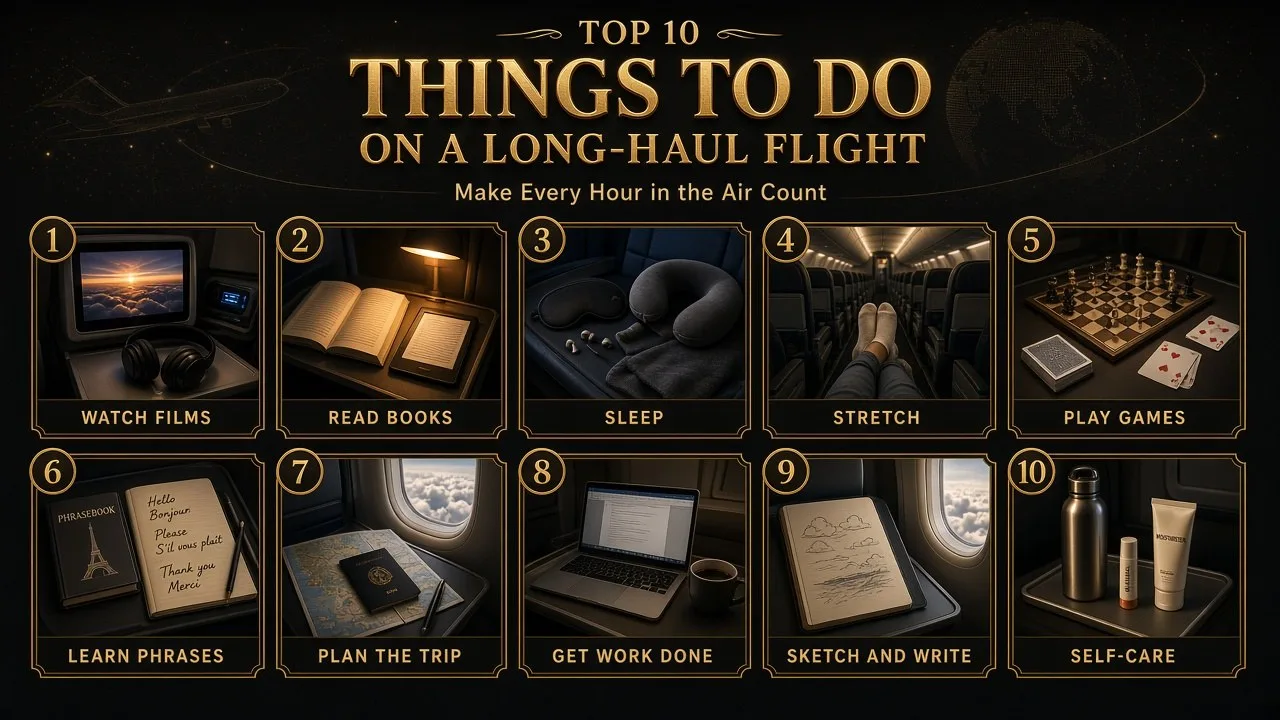
The best things to do on a long-haul flight are watching films, reading, sleeping on destination time, stretching, playing games and planning the trip ahead.
A flight of ten, fourteen or even nineteen hours can feel endless if you board with nothing but a phone at 40 percent battery. With a little planning, though, those hours become rare uninterrupted time: no meetings, no chores and, on many routes, no internet unless you choose to pay for it.
This guide ranks ten activities that genuinely help the hours pass, explains what makes long flights physically different from a short hop, and draws on health advice from the World Health Organization (WHO), the US Centers for Disease Control and Prevention (CDC) and the UK's National Health Service (NHS) so you land feeling better, not just less bored.
How We Chose These Long-Haul Flight Activities
Plenty of things can fill an hour. Far fewer still work in a narrow economy seat, in a dim cabin, beside a stranger, with patchy or no Wi-Fi. Every activity on this list had to pass five practical tests.
- Seat-friendly: it fits on a tray table or in your lap, and it does not spill into your neighbour's space.
- Works offline: it does not depend on in-flight Wi-Fi, which is not offered on every aircraft and can be slow or costly where it is.
- Quiet: it creates no noise or light that would disturb a sleeping row.
- Repeatable: it can fill more than a few minutes and be picked up again later.
- Good for you: it helps you arrive rested, healthy or better prepared, rather than simply numbing the time.
The order below is our own editorial judgement against those tests, not a survey or a scientific ranking. Health guidance quoted comes from the WHO, CDC, NHS and UK Civil Aviation Authority, and battery rules come from the US Federal Aviation Administration (FAA). Your airline's own rules always take priority.
Things to Do on a Long-Haul Flight at a Glance
| Rank | Activity | Best Moment in the Flight | Needs Wi-Fi? | Main Benefit |
|---|---|---|---|---|
| 1 | Watch films and box sets | After the first meal service | No, with seatback screens or downloads | Hours pass quickly with little effort |
| 2 | Read books, audiobooks and podcasts | Any time, including dimmed-cabin hours | No, if downloaded or printed | Absorbing, low-screen-strain entertainment |
| 3 | Sleep on destination time | When it is night where you are going | No | Softer jet lag on arrival |
| 4 | Walk, stretch and move | Every hour or so while awake | No | Comfort and lower blood-clot risk |
| 5 | Play games and puzzles | Long middle stretch of the flight | No, for offline games | Shared fun with family or friends |
| 6 | Learn useful phrases | First half of the flight, while alert | No, if lessons are downloaded | Arrive able to greet, thank and ask |
| 7 | Plan the trip | Final few hours before landing | No, if maps and documents are saved | A calmer, smoother arrival |
| 8 | Get focused work done | Early in the flight, before fatigue sets in | Optional | Lighter workload at the destination |
| 9 | Write, sketch or craft | Any quiet stretch | No | Creative, screen-free downtime |
| 10 | Self-care and mindfulness | Throughout, little and often | No | Feeling fresher in dry cabin air |
What Makes a Long-Haul Flight Different
There is no single official definition of a long-haul flight, but health authorities draw useful lines. The WHO's research on travel and blood clots looked at journeys of four hours or more, and the NHS uses the same four-hour mark for its travel advice. Clinical guidance quoted by the CDC uses six hours for its long-distance traveller recommendations.
At the far end of the scale, Singapore Airlines' nonstop service between New York and Singapore was the world's longest scheduled passenger flight as of late 2026, covering roughly 15,300 kilometres in about 18 to 19 hours depending on direction and winds. Qantas is working on even longer nonstop routes from Sydney to London and New York under a programme it calls Project Sunrise.
The cabin itself also changes how you feel over many hours. These conditions explain why some activities on this list matter more than they would on the ground.
| Cabin Condition | Typical Level | What It Means for You |
|---|---|---|
| Cabin pressure | Equivalent to about 1,830 to 2,440 m (6,000 to 8,000 ft) above sea level (CDC) | Slightly less oxygen; most healthy travellers notice little, but tiredness can build |
| Humidity | Usually 10 to 20 percent (CDC), sometimes below 10 percent on long flights (WHO) | Dry eyes, nose, lips and skin |
| Noise | Simulated cabin noise of about 80 to 85 decibels was used in a Cornell University taste study | Constant engine sound; headphones and earplugs help |
| Movement | Long periods seated in a small space | Stiffness and a raised risk of blood clots on journeys over four hours |
| Time zones | Several zones crossed on many routes | Jet lag on arrival unless you plan rest and light |
1. Watch Films and Box Sets
| Attribute | Details |
|---|---|
| Best for | Almost everyone, especially on the first long stretch after take-off |
| What to pack | Comfortable headphones, an adapter if needed, downloaded shows |
| Wi-Fi needed | No, if your seat has a screen or your downloads are ready |
| Battery use | High on personal devices; none on a seatback screen |
| Time it fills | Two to eight hours, depending on your appetite for a series |
Why It Works
Watching a film is the classic long-haul pastime for a reason: it demands almost nothing from a tired brain and fills two hours at a time. Most long-haul aircraft operated by major airlines carry seatback screens with a library of new releases, classic films, television series and music, so you may not need your own device at all.
A long flight is also one of the few times when you can binge a whole season without guilt. Many people use it to catch up on a series everyone at work has been discussing, or to watch the films they missed at the cinema.
Key Features
- Airlines refresh their seatback libraries regularly, so frequent flyers often find new titles.
- Streaming apps let you download episodes before you leave home; check that downloads have not expired.
- A flight map channel is a quiet alternative when you want to see where you are without starting a film.
- Many systems let you queue several titles, so the next one starts while you doze.
Tips for Better Viewing
Bring your own headphones. Free airline earphones are often thin, and over constant engine noise people tend to turn the volume up to compensate, which is tiring for the ears. Noise-cancelling or well-sealed headphones let you listen at a lower, more comfortable volume. Some older seat systems use a two-pin socket, so a small adapter is worth carrying, and wireless headphones may need a plug-in Bluetooth transmitter to work with a seatback screen.
If you plan to watch on your own tablet, download more than you think you need, keep it charged on the seat's power outlet where one exists, and choose a brightness level that will not light up the whole row when the cabin is dimmed.
Interesting Facts
- Films shown on airlines are often edited versions, with some scenes trimmed for a shared, all-ages cabin.
- Seatback entertainment usually pauses automatically for crew announcements.
- Watching on a seatback screen saves your phone battery for arrival, when you may need maps and messages.
2. Read Books, Audiobooks and Podcasts
| Attribute | Details |
|---|---|
| Best for | Readers, learners and anyone who wants a break from bright screens |
| What to pack | A paperback, an e-reader, or downloaded audiobooks and podcasts |
| Wi-Fi needed | No, if everything is downloaded or printed |
| Battery use | Very low for e-readers and audio; none for print |
| Time it fills | As long as the book lasts |
Why It Works
A long flight is the ideal setting for the thick novel you have been saving or the non-fiction book you keep meaning to finish. Without notifications pulling you away, it is easier to sink into a story for hours at a time.
Audiobooks and podcasts add a second option for when your eyes are tired, the reading light feels too bright, or you want to listen with your eyes closed. An absorbing audiobook can also help you drift off without staring at a screen.
Key Features
- Paper books never run out of battery, and a travel guide or phrasebook in print is useful on arrival.
- E-readers hold thousands of titles, are light, and their screens are easy on the eyes in a dim cabin.
- Audiobooks and podcasts pair well with eye masks and rest.
- Library apps in many countries let members borrow e-books and audiobooks free before travelling.
Choosing What to Bring
Pack a mix. A gripping novel suits the alert early hours, while lighter reading or a familiar podcast works better during the drowsy middle of a night flight. Reading about your destination, its history, a travel memoir set there or a local author in translation, turns flight time into part of the trip itself.
Download everything at home on a fast connection. In-flight Wi-Fi, where it exists, is rarely quick enough to stream audio reliably for hours, and some airlines charge for it.
Interesting Facts
- Reading lights above each seat let you read without lighting the whole cabin.
- Audio is ideal for listening with your eyes closed, which can help you rest even if you do not fully sleep.
- A paperback can be the only entertainment that is welcome during take-off and landing, when some devices must be stowed.
3. Sleep on Destination Time
| Attribute | Details |
|---|---|
| Best for | Anyone crossing several time zones, especially on overnight flights |
| What to pack | Eye mask, earplugs, travel pillow, warm layer, socks |
| Wi-Fi needed | No |
| Battery use | None |
| Time it fills | Several hours, ideally matched to night at your destination |
Why It Works
Sleeping is not just a way to make the hours vanish. Timed well, it is one of the most effective ways to reduce jet lag. The NHS advises travellers to try to sleep on the plane if it is night-time at the destination, to use an eye mask and earplugs if they help, and to avoid drinking too much caffeine or alcohol, which can make jet lag worse.
The trick is to switch your watch to destination time as soon as you board and plan around it. If it is the middle of the night where you are going, aim to rest. If it is daytime there, try to stay awake with the activities on this list, even if your body disagrees.
Key Features
- An eye mask blocks cabin lights and screens; earplugs or noise-cancelling headphones soften engine noise.
- A supportive neck pillow helps keep your head from falling sideways in an upright seat.
- Cabins can feel cool once the lights go down, so a jumper or light blanket helps.
- A window seat gives you something to lean against; an aisle seat makes it easier to get up without waking anyone.
What the Evidence Says About Sleep Aids
The NHS says medicines are not usually needed for jet lag, that sleeping tablets can be addictive and should only be used briefly for severe symptoms, and that melatonin is not recommended on the NHS for jet lag because there is not enough evidence that it works. If you are considering any sleep medicine for a flight, speak to a doctor first, since being heavily sedated also means moving less, which matters for circulation.
Interesting Facts
- The NHS notes that jet lag usually improves within a few days as the body clock adjusts.
- Getting outside in natural daylight after arrival helps reset your body clock, according to the NHS.
- On very short trips of two to three days, the NHS suggests you might keep your home sleeping times instead of adjusting.
4. Walk, Stretch and Move
| Attribute | Details |
|---|---|
| Best for | Every passenger, but especially those at higher risk of blood clots |
| What to pack | Loose clothing, comfortable shoes or socks, a water bottle to refill |
| Wi-Fi needed | No |
| Battery use | None |
| Time it fills | A few minutes every hour or so |
Why It Works
Moving is the one activity on this list that is genuinely about health. In 2007 the WHO released the first results of its Research Into Global Hazards of Travel (WRIGHT) project, which found that the risk of venous thromboembolism, a blood clot in the veins, roughly doubles after travel lasting four hours or more. The WHO stressed that the absolute risk stays relatively low, at about 1 in 6,000 for a seated, immobile traveller, and that the risk applies to long car, bus and train journeys as well as flights.
Because sitting still slows blood flow in the legs, the NHS advises people travelling for four hours or more not to sit still for long periods and to get up and move around every hour or so. Walking to the galley or the toilet, standing at the back of the cabin for a few minutes, and simple seat exercises all count.
Key Features
- Ankle circles, heel raises and toe lifts can be done in your seat without disturbing anyone.
- Gentle shoulder rolls and neck stretches ease stiffness from sleeping upright.
- Choosing an aisle seat makes regular walks easier.
- Always follow the seat-belt sign; move only when the crew say it is safe.
Who Needs to Take Extra Care
The CDC's travel guidance notes that, for long-distance travellers of more than six hours who are at increased risk of clots, clinical guidelines recommend frequent walking, calf exercises, an aisle seat and properly fitted below-the-knee compression stockings. The same guidance advises against aspirin or blood thinners purely to prevent travel clots in ordinary travellers. Risk factors named in the WRIGHT research include obesity, oral contraceptive use, inherited clotting disorders and being very tall or very short. Anyone with a history of clots, recent surgery or pregnancy should ask a doctor before a long flight.
Interesting Facts
- The CDC says there is no evidence linking dehydration directly to travel-related clots, although staying hydrated is reasonable.
- The NHS warns people already on treatment for a clot to delay long journeys until at least two weeks after starting blood-thinning medicine.
- Many airlines show in-seat exercise routines on their entertainment systems or in their in-flight magazines.
5. Play Games and Puzzles
| Attribute | Details |
|---|---|
| Best for | Families, couples and friends travelling together |
| What to pack | A deck of cards, a magnetic travel set, a puzzle book, offline phone games |
| Wi-Fi needed | No, for physical and offline games |
| Battery use | None to moderate |
| Time it fills | One to several hours |
Why It Works
Games turn dead time into shared time. A deck of cards weighs almost nothing and offers dozens of games for two or more players. Compact magnetic travel sets for chess, draughts and backgammon stop pieces from sliding off the tray table when the aircraft bumps through turbulence.
For solo travellers, crosswords, sudoku, word searches and logic puzzles are absorbing and screen-free. Many seatback entertainment systems also include simple built-in games, and offline puzzle apps work well on a phone.
Key Features
- Magnetic boards and pegged games keep pieces in place on a small, moving surface.
- Card games such as rummy or cribbage need no table larger than a tray.
- Puzzle books and a pencil cost little and need no charging.
- Spot-the-difference and memory games work well for mixed ages.
Games for Children
For young travellers, the best games are small, quiet and new. Sticker books, reusable activity pads, small travel games and a couple of surprise items wrapped in advance can buy hours of calm. Releasing them one at a time, rather than all at once, keeps the novelty going. Avoid toys that make noise or have many tiny parts that can disappear under seats.
Interesting Facts
- Travel versions of classic board games have been sold for decades, many with pegs or magnets for use on the move.
- Puzzle games keep the mind engaged without the blue-light glare of a phone held close to the face.
- A simple game of cards is often the easiest way to break the ice with a travelling companion.
6. Learn Useful Phrases
| Attribute | Details |
|---|---|
| Best for | Travellers flying somewhere another language is spoken |
| What to pack | A phrasebook or downloaded language lessons, a small notebook |
| Wi-Fi needed | No, if lessons are downloaded in advance |
| Battery use | Low to moderate |
| Time it fills | Thirty minutes to a few hours |
Why It Works
A long flight to another country is the perfect moment to learn the handful of phrases that make the first days easier. You will not become fluent between take-off and landing, but greetings, thank you, please, numbers, and how to ask for directions or the bill are very achievable, and locals usually appreciate the effort.
Because the language is new, short and focused sessions work best. Twenty minutes of practice, a film or a nap, then another session, helps the phrases stick better than one long cram.
Key Features
- Many language-learning apps let you download lessons for offline use.
- A pocket phrasebook works without battery and is handy in shops and taxis.
- Writing new words by hand in a notebook helps fix them in memory.
- Downloading an offline translation pack for your destination language gives you a backup on arrival.
The Phrases Worth Learning First
Start with hello, goodbye, please, thank you, excuse me and sorry. Next, learn numbers one to ten, yes and no, and how to say you do not understand. Finally, add practical questions: where is the station, how much does this cost, and the bill, please. If you have food allergies, learn or write down how to explain them in the local language.
Interesting Facts
- Watching a film from your destination country with subtitles is an easy way to hear how the language sounds.
- Learning to read a few signs, such as entrance, exit and toilets, can be as useful as speaking.
7. Plan the Trip
| Attribute | Details |
|---|---|
| Best for | Holidaymakers and anyone landing somewhere unfamiliar |
| What to pack | A guidebook, saved offline maps, booking confirmations and a pen |
| Wi-Fi needed | No, if documents and maps are saved |
| Battery use | Low to moderate |
| Time it fills | One to two hours |
Why It Works
The last few hours of a long flight are a good time to turn loose plans into a clear arrival. Knowing exactly how you will get from the airport to your hotel, what the local currency is, and where you will eat that first night takes a lot of stress out of landing tired in a new place.
It is also time to check the practical details that are easy to forget: your accommodation address written down, the time difference, whether you need to fill in an arrival card or customs form, and which items in your bag you may need to declare.
Key Features
- Offline maps let you navigate from the airport even before you buy a local SIM or find Wi-Fi.
- A printed or saved copy of bookings is useful if your phone battery fails.
- A short list of must-see sights and restaurants keeps your first days focused.
- Many airlines show destination guides and arrival information on their entertainment systems.
A Quick Arrival Checklist
Before you land, confirm transport from the airport, your accommodation address and check-in time, the local emergency number, how you will pay for your first purchases, and your plan for staying awake or sleeping on arrival. Crossing several time zones makes it easy to misread booking times, so double-check dates in local time.
Interesting Facts
- Arrival cards are often handed out by cabin crew before landing; having a pen ready saves time.
- Many countries have strict rules on bringing in food, so finish or bin fresh produce before arrival.
- Writing your plan on paper means it is still there if your phone needs charging.
8. Get Focused Work Done
| Attribute | Details |
|---|---|
| Best for | Business travellers, students and anyone with a deadline |
| What to pack | A charged laptop, a privacy screen, offline copies of files, a power bank |
| Wi-Fi needed | Optional; offline work is often more focused |
| Battery use | High |
| Time it fills | One to several hours |
Why It Works
With no colleagues interrupting and no inbox pinging, a long flight can be surprisingly productive. Writers, students and professionals often save tasks that need deep concentration, such as drafting a report, editing a presentation or reading a long document, for the plane.
Even on holiday, an hour clearing small tasks can mean you do not have to think about work once you arrive. The key is to work early in the flight, while you are still alert, and stop before tiredness makes the effort pointless.
Key Features
- Saving files for offline use avoids depending on in-flight Wi-Fi.
- A privacy filter on your laptop screen keeps confidential work away from neighbours.
- A compact, foldable keyboard or a small tablet suits narrow economy tray tables better than a large laptop.
- Seat power outlets are common on long-haul aircraft but not guaranteed, so start fully charged.
Battery and Power Bank Rules
According to the FAA, spare lithium batteries and power banks must travel in carry-on baggage only, never in checked bags. Lithium-ion batteries are limited to 100 watt-hours each, and with airline approval passengers may carry up to two larger spares of 101 to 160 watt-hours. The FAA also notes that many airlines set stricter limits on how many power banks each passenger may bring, so check your airline's rules before you pack. If your carry-on is checked at the gate, take spare batteries out and keep them with you in the cabin.
Interesting Facts
- The FAA says its size limits cover nearly all lithium batteries the average person uses in personal electronics.
- Battery terminals on spares should be protected from short circuits, for example by keeping them in their original packaging or a case.
- Working with headphones playing quiet background sound can help block out cabin noise.
9. Write, Sketch or Craft
| Attribute | Details |
|---|---|
| Best for | Creative people and anyone who wants time away from screens |
| What to pack | A notebook, pencils or pens, a colouring book or a small craft kit |
| Wi-Fi needed | No |
| Battery use | None |
| Time it fills | One to several hours |
Why It Works
A long flight offers a rare stretch of unstructured time, which suits creative work. Keeping a travel journal, writing letters you will post from your destination, sketching the view from the window or the people-free details of the cabin, or simply colouring in can be relaxing for adults and children alike.
These are also some of the few activities that use no battery at all, which matters when you are saving your phone for arrival.
Key Features
- A travel journal records first impressions that are easily forgotten later.
- Adult colouring books and simple sketching need only a few pencils.
- Small, quiet crafts such as cross-stitch suit a tray table, as long as they do not spread into a neighbour's space.
- Writing down goals for the trip can make the holiday feel more purposeful.
What You Can Bring
Rules on sharp items, such as scissors, craft blades and some needles, differ between countries and airports. Check the security guidance of your departure airport and any connecting airports before you pack craft tools, and choose blunt-tipped scissors or thread cutters where possible. Liquids such as paints count towards the carry-on liquids limit.
Interesting Facts
- Pencils are a safe choice, since some pens can leak as cabin pressure changes.
- A journal started on the outbound flight can be finished on the way home, bookending the whole trip.
- Sketching cloud formations from a window seat is a calm, absorbing way to pass an hour.
10. Practise Self-Care and Mindfulness
| Attribute | Details |
|---|---|
| Best for | Everyone, especially on overnight and ultra-long flights |
| What to pack | Moisturiser, lip balm, eye drops, glasses, a toothbrush, a refillable bottle |
| Wi-Fi needed | No |
| Battery use | None, unless you use a downloaded meditation app |
| Time it fills | A few minutes at a time, repeated through the flight |
Why It Works
Dry cabin air is one of the main reasons people step off long flights feeling worn out. The CDC says cabin humidity is usually 10 to 20 percent, and the WHO notes it can fall below 10 percent on long, high-altitude flights. The UK Civil Aviation Authority compares that with about 40 to 60 percent in a typical office.
The good news, according to both the WHO and the UK Civil Aviation Authority, is that this dry air does not dehydrate the body as a whole; the discomfort is mostly in the eyes, nose, lips and skin. The WHO says there is no need to drink more than usual, but regular water and a skin moisturiser reduce the symptoms.
Key Features
- Moisturiser and lip balm counter dry skin and lips.
- Lubricating eye drops help dry eyes, and the WHO notes some contact-lens wearers may need to switch to glasses.
- Brushing your teeth and washing your face before landing make you feel noticeably fresher.
- Breathing exercises or a downloaded meditation track can calm nerves and help you rest.
A Simple Mindful Routine
Every couple of hours, try a short reset: sit upright, roll your shoulders, take several slow breaths in through the nose and out through the mouth, drink some water, and apply moisturiser or eye drops if needed. Combined with a short walk when the seat-belt sign is off, this small routine covers comfort, circulation and calm in a few minutes.
For nervous flyers, slow breathing and a familiar podcast or calming music can make turbulence feel more manageable. Reminding yourself that turbulence is a normal part of flying, and keeping your seat belt fastened while seated, also helps.
Interesting Facts
- The UK Civil Aviation Authority notes that drinking a lot of tea, coffee and alcohol can make cabin dryness feel worse.
- Wearing loose, layered clothing makes it easier to stay comfortable as cabin temperatures change.
- A refillable bottle can be filled after security, and cabin crew can usually top it up during the flight.
A Sample Plan for a 14-Hour Flight
The timeline below is an example only, for an overnight flight where it is night at the destination during the middle of the journey. Adjust it to your own departure time and time-zone change.
| Flight Time | Activity | Why |
|---|---|---|
| 0:00 to 1:00 | Settle in, set your watch to destination time, start a film | Easy, low-effort start while meals are prepared |
| 1:00 to 2:00 | Meal, then a short walk and stretch | Movement after a meal eases stiffness |
| 2:00 to 3:00 | Focused work or language practice | You are still alert |
| 3:00 to 9:00 | Sleep or rest with eye mask, earplugs and audio | Matches night-time at the destination |
| 9:00 to 10:00 | Walk, drink water, moisturise | Comfort and circulation after a long rest |
| 10:00 to 12:00 | Reading, games or creative time | Light activities as the body wakes |
| 12:00 to 13:00 | Breakfast and trip planning | Prepare for arrival |
| 13:00 to 14:00 | Freshen up, pack away, fill in arrival forms | Land organised and ready |
What to Pack for a Long-Haul Flight
A well-packed personal item makes every activity on this list possible. Keep these within reach under the seat in front rather than in the overhead locker.
- Entertainment: headphones, an adapter, downloaded films, books, podcasts and lessons.
- Rest: eye mask, earplugs, neck pillow, warm layer and socks.
- Comfort: moisturiser, lip balm, eye drops, glasses, toothbrush and toothpaste within liquid limits.
- Power: a charging cable and a power bank within airline limits, carried in the cabin.
- Paper: a pen, a notebook, printed bookings and your accommodation address.
- Snacks and water: a refillable bottle and a few solid snacks in case meal times do not suit you.
Frequently Asked Questions
What is the best thing to do on a long-haul flight?
The best mix is a little of everything: a film or book for entertainment, sleep timed to night at your destination, and a short walk every hour or so while awake. Combining rest, movement and light entertainment helps the hours pass and leaves you in better shape when you land.
How do you pass time on a 15-hour flight?
Break the flight into blocks rather than seeing it as one long stretch. Plan two or three films or episodes, a long rest period on destination time, some reading or games, a work or learning session, and regular short walks. Switching activities every hour or two stops boredom building up.
Should I sleep on a long-haul flight?
Sleep if it is night-time at your destination, as the NHS advises, and try to stay awake if it is daytime there. This helps your body clock adjust and can reduce jet lag. An eye mask, earplugs and a neck pillow make sleeping upright much easier.
How often should you walk on a long flight?
The NHS advises people on journeys of four hours or more not to sit still for long periods and to get up and move around every hour or so. When the seat-belt sign is on, simple ankle circles and heel raises in your seat help keep blood moving in your legs.
Do I need to drink extra water on a plane?
According to the WHO, there is no need to drink more than usual, because dry cabin air does not dehydrate the body as a whole. Regular water does ease dry eyes, nose and throat, and the UK Civil Aviation Authority notes that too much tea, coffee or alcohol can make dryness worse.
Can I bring a power bank on a long-haul flight?
Yes, but only in your carry-on. The FAA says spare lithium batteries and power banks must not go in checked baggage, are limited to 100 watt-hours each without airline approval, and that many airlines have stricter limits on how many you can carry. Check your airline before you fly.
What is the longest flight in the world?
As of late 2026, Singapore Airlines' nonstop service between New York and Singapore was the longest scheduled passenger flight, covering roughly 15,300 kilometres in about 18 to 19 hours. Qantas is preparing even longer nonstop routes from Sydney under its Project Sunrise programme.
Conclusion
The best things to do on a long-haul flight combine entertainment, rest and a little care for your body. Films, books, games and creative projects make the hours pass, while sleeping on destination time, moving every hour or so and looking after your skin and eyes in the dry cabin help you arrive ready to enjoy the trip.
A small amount of preparation before you leave home, downloading shows and lessons, packing an eye mask and headphones, and charging everything, makes the difference between a flight you endure and one you almost enjoy.
- World Health Organization, Study results released on travel and blood clots (WRIGHT project, 29 June 2007)
- WHO, Guide to Hygiene and Sanitation in Aviation (cabin humidity and water intake)
- US Centers for Disease Control and Prevention, Yellow Book: Air Travel; Deep Vein Thrombosis and Pulmonary Embolism
- NHS, Jet lag; Deep vein thrombosis (DVT)
- UK Civil Aviation Authority, Passenger health FAQs: the aircraft cabin, your health and comfort
- US Federal Aviation Administration, PackSafe: Lithium Batteries
- Yan and Dando (2015), Journal of Experimental Psychology: Human Perception and Performance, via Cornell University
- Reference used for topic only: 10mosttoday.com, 10 Great Activities to Help You Kill the Time During Long-Haul Flights















Log in with