







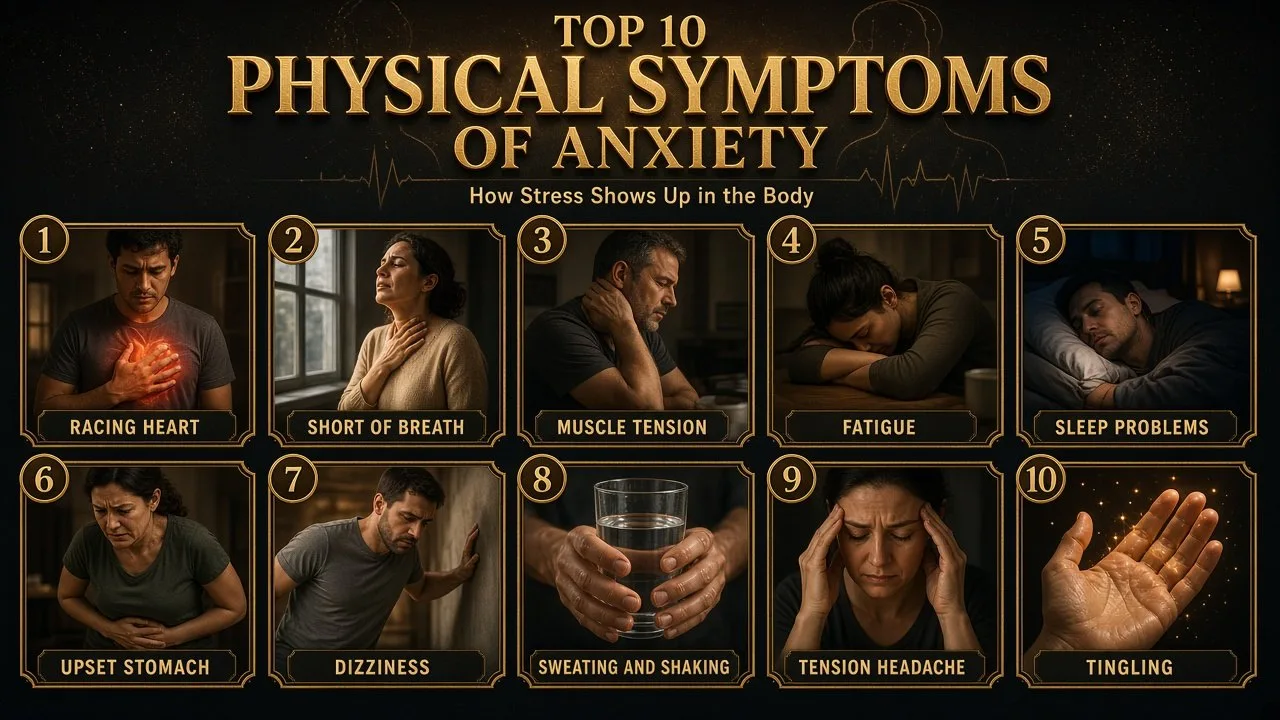
The most common physical symptoms of anxiety are a racing heart, shortness of breath, muscle tension, fatigue, poor sleep, stomach upset and dizziness.
Anxiety is usually described as a feeling, but for many people it shows up first in the body. A pounding chest before a meeting, a knotted stomach on the way to an exam, or a tight band of pain around the head after a stressful week can all come from the same alarm system that once helped our ancestors escape predators.
These sensations are real, not imagined, and they can be frightening enough to send people to an emergency department convinced something is seriously wrong. This guide explains the ten physical symptoms of anxiety that health bodies such as the World Health Organization (WHO), the US National Institute of Mental Health (NIMH) and the UK National Health Service (NHS) list most often, why each one happens, what tends to help and when a symptom needs a doctor rather than reassurance.
This article is for general information only. Many of these symptoms can also be caused by heart, lung, thyroid or other medical conditions, so new, severe or unexplained symptoms should always be checked by a qualified health professional.
How We Chose These Physical Symptoms of Anxiety
There is no single official ranking of anxiety symptoms, so this list is an editorial selection rather than a frequency chart. We compared the symptom lists published by the WHO, NIMH, the NHS and Harvard Health Publishing, and chose the physical signs that appear repeatedly across them.
- Recognised: each symptom appears in at least one major health authority's description of generalised anxiety disorder or panic attacks.
- Physical: the list focuses on body sensations, not on worry, irritability or poor concentration, which are mental symptoms.
- Explainable: each one can be traced to a known part of the stress response, such as adrenaline, rapid breathing or muscle tension.
- Commonly misread: most of these symptoms are often mistaken for a physical illness, which is exactly why understanding them helps.
Several closely related sensations are grouped together. A pounding heartbeat and a fast pulse, for example, share one entry, and trembling, sweating and shaky legs share another.
Physical Symptoms of Anxiety at a Glance
| Rank | Symptom | Main Cause in the Body | Often Mistaken For | Seek Urgent Help If |
|---|---|---|---|---|
| 1 | Racing or pounding heart | Adrenaline speeds up the heart | A heart attack or heart rhythm problem | There is chest pain, fainting or breathlessness |
| 2 | Shortness of breath | Fast, shallow breathing lowers carbon dioxide | Asthma or a lung problem | Lips turn blue or breathing does not settle |
| 3 | Muscle tension and aches | Muscles brace for action and stay tight | Injury or arthritis | Pain follows an injury or comes with a fever |
| 4 | Fatigue | A body kept on high alert uses up energy | Anaemia or thyroid problems | Exhaustion is sudden, severe or unexplained |
| 5 | Sleep problems | A busy, alert brain resists switching off | Insomnia from other causes | Poor sleep comes with thoughts of self-harm |
| 6 | Stomach and digestive problems | Stress signals reach the gut directly | Food poisoning or bowel disease | There is blood, weight loss or severe pain |
| 7 | Dizziness and lightheadedness | Overbreathing and tension affect balance | Inner ear or blood pressure problems | There is fainting, slurred speech or weakness on one side |
| 8 | Sweating, trembling and shaking | Adrenaline primes muscles and skin | Low blood sugar or an overactive thyroid | Shaking is constant or comes with confusion |
| 9 | Tension headaches | Tight muscles in the neck, scalp and jaw | Migraine or a serious head condition | A headache is sudden and severe or follows a head injury |
| 10 | Tingling and numbness | Low carbon dioxide from overbreathing | Nerve damage or a stroke | Numbness affects one side of the body or the face |
Why Anxiety Causes Physical Symptoms
Almost every symptom on this list comes from the fight-or-flight response, the body's built-in reaction to danger. The American physiologist Walter Cannon described it in the early 20th century, and the basic mechanism is now well understood.
According to Harvard Health Publishing, the process starts in the brain. The amygdala, an area that processes emotion, spots a possible threat and signals the hypothalamus, which acts like a command centre. The hypothalamus switches on the sympathetic nervous system and tells the adrenal glands to release epinephrine, better known as adrenaline.
Adrenaline then changes the body within moments:
- The heart beats faster and blood pressure rises, pushing blood to the muscles and vital organs.
- Breathing speeds up and the small airways in the lungs open wider.
- The senses become sharper and the brain more alert.
- Stored sugar and fat are released into the blood for quick energy.
- Muscles tense, ready to run or fight, and sweating increases.
If the brain still senses danger after this first surge, a second system called the HPA axis (hypothalamus, pituitary gland and adrenal glands) keeps the body on alert by releasing the stress hormone cortisol. When the threat passes, the parasympathetic nervous system, often called the rest-and-digest system, acts as a brake and calms everything down.
When the Alarm Goes Off Too Often
In a real emergency, this reaction is useful and short-lived. With an anxiety disorder, the alarm can fire when there is no physical danger at all, or it can stay switched on at a low level for weeks. NIMH researchers describe panic attacks as being like false alarms, where the body's normal survival instincts become active too often or too strongly.
That creates a cycle many people recognise. A physical sensation, such as a skipped heartbeat, is read as a sign of danger, which triggers more adrenaline, which makes the sensation stronger. Learning what each symptom really means is one of the simplest ways to break that loop.
How Common Is Anxiety?
Anxiety disorders are the most common mental health conditions in the world. The WHO estimates that 470 million people had an anxiety disorder in 2023, about 5.8% of the global population, and that only about 1 in 4 people who need treatment receive any.
| Measure | Figure | Source |
|---|---|---|
| People worldwide with an anxiety disorder (2023) | 470 million | WHO, from the Global Burden of Disease study |
| Share of the world population currently affected | About 5.8% | WHO |
| People in need who receive any treatment | About 1 in 4 (27.6%) | WHO, World Mental Health Surveys |
| US adults with any anxiety disorder in the past year | 19.1% | NIMH, National Comorbidity Survey Replication |
| US adults affected at some point in their lives | 31.1% | NIMH |
| Past-year prevalence in US women and men | 23.4% and 14.3% | NIMH |
Both the WHO and NIMH note that women are more likely than men to experience anxiety disorders, and that symptoms often begin in childhood, adolescence or early adulthood.
1. Racing or Pounding Heart
| Attribute | Details |
|---|---|
| What it feels like | A fast, pounding, fluttering or skipping heartbeat |
| Main cause | A surge of adrenaline from the stress response |
| Common in | Panic attacks and generalised anxiety disorder |
| Usually lasts | Seconds to minutes, easing as the body calms down |
| Red flag | Chest pain, fainting or severe breathlessness |
A racing or pounding heart is one of the most recognisable physical symptoms of anxiety, and one of the most alarming. The NHS lists a more noticeable or unusual heartbeat, known as palpitations, among the symptoms of generalised anxiety disorder, and a racing heartbeat is one of the first signs listed for a panic attack.
Why It Happens
Adrenaline tells the heart to beat faster and harder so that more blood reaches the muscles. In a genuine emergency that extra blood flow helps you move quickly. During anxiety the same thing happens while you are sitting still, so you notice every beat, and the sudden change can feel like the heart is out of control.
What It Feels Like
- A thumping or pounding sensation in the chest, throat or neck.
- A heartbeat that seems to flutter, race or skip.
- Feeling the pulse in the ears, especially when lying down at night.
- A sense of tightness or pressure in the chest alongside the fast heartbeat.
What Helps
Slow breathing is the most practical first step, because a calmer breathing rhythm signals the rest-and-digest system to slow the heart. The NHS advises that avoiding common triggers, such as stress, smoking, caffeine and alcohol, can help when palpitations are not caused by a health condition. For some people with panic disorder, NIMH notes that doctors may use beta-blockers to control rapid heart rate in specific situations.
When to See a Doctor
The NHS describes palpitations as usually harmless but advises getting medical help if they keep happening, last longer than a few minutes or come with other symptoms. Chest pain, fainting or severe breathlessness alongside a racing heart needs emergency help straight away, whether or not you have a history of anxiety.
Interesting Facts
- NIMH notes that the physical symptoms of a panic attack can feel so much like a heart attack that many people first seek help in emergency care.
- Feeling your own heartbeat more clearly is part of the experience: anxiety tends to focus attention on body sensations that normally go unnoticed.
- Caffeine from coffee, tea, cola and energy drinks can make palpitations more noticeable, which is one reason the NHS suggests cutting back.
2. Shortness of Breath
| Attribute | Details |
|---|---|
| What it feels like | Not getting enough air, a tight chest or a need to sigh or gasp |
| Main cause | Fast, shallow breathing that upsets the balance of blood gases |
| Linked symptoms | Dizziness, tingling, chest tightness and bloating |
| Usually lasts | Minutes, settling as breathing slows |
| Red flag | Blue lips, breathlessness at rest that does not settle, or chest pain |
Feeling short of breath is one of the cruellest anxiety symptoms, because the sense of not getting enough air naturally makes people more frightened. NIMH lists feeling out of breath among the symptoms of generalised anxiety disorder, and the NHS includes shortness of breath and a choking sensation in its list of panic attack symptoms.
Why It Happens
During the stress response, breathing speeds up to bring in more oxygen. When there is no physical exertion to use that oxygen, people can start overbreathing, also called hyperventilation. MedlinePlus, the US National Library of Medicine's health service, explains that excessive breathing lowers the level of carbon dioxide in the blood, and it is this drop that causes many of the uncomfortable symptoms that follow.
The odd part is that overbreathing often feels like underbreathing. People feel they cannot get a satisfying breath, so they breathe even faster, which makes the problem worse.
What It Feels Like
- A feeling that the lungs will not fill properly, or a need to take deep sighing breaths.
- Tightness or pressure across the chest.
- A lump in the throat or a choking sensation.
- Yawning or gulping air, sometimes with belching or bloating afterwards.
What Helps
The aim is to slow breathing down so carbon dioxide levels can recover. MedlinePlus recommends learning breathing exercises that use the diaphragm and abdomen rather than the chest wall. A simple version is to breathe in gently through the nose, let the stomach rise, and breathe out slowly for longer than you breathed in.
The NHS advice for a panic attack is to stay where you are if possible, breathe slowly and deeply, and remind yourself that the attack will pass.
When to See a Doctor
Breathlessness can also be caused by asthma, infections, blood clots and heart problems, so new or unexplained shortness of breath should always be checked. Get emergency help for blue or grey lips, breathlessness that does not ease with rest, or breathing problems with chest pain.
Interesting Facts
- Hyperventilation can cause chest pain, a pounding heartbeat, dizziness and tingling all at once, which is why one panic attack can feel like several illnesses.
- MedlinePlus lists belching and bloating among hyperventilation symptoms, because people swallow air while breathing fast.
- Breathing out slowly is one of the quickest ways to engage the body's calming system, which is why so many relaxation methods focus on the exhale.
3. Muscle Tension and Aches
| Attribute | Details |
|---|---|
| What it feels like | Tight, stiff or aching muscles, often in the neck, shoulders, back and jaw |
| Main cause | Muscles bracing for action and staying tense |
| Diagnostic role | One of the six symptoms doctors look for in generalised anxiety disorder |
| Usually lasts | Can persist for days or weeks with ongoing anxiety |
| Red flag | Pain after an injury, swelling, fever or numbness |
Muscle tension is so closely tied to anxiety that it is part of the formal description of generalised anxiety disorder. NIMH explains that to be diagnosed, a person must find worry hard to control on most days for at least six months and have at least three of six symptoms, one of which is muscle tension.
Why It Happens
When the body expects danger, muscles tighten in preparation for action. This is useful for a short burst, but with ongoing anxiety the muscles never fully let go. Over time, that constant low-level bracing leaves them tired, stiff and sore, much like holding a heavy bag for hours.
What It Feels Like
- Stiffness or aching in the neck, shoulders and upper back.
- A clenched jaw or teeth grinding, sometimes noticed only in the morning.
- General soreness, as though you have exercised without actually doing so.
- Twitching muscles, which NIMH also lists among anxiety symptoms.
What Helps
Harvard Health notes that exercise, such as a brisk walk shortly after feeling stressed, both deepens breathing and helps relieve muscle tension. Progressive muscle relaxation, where you tense and then release each muscle group in turn, is recommended by the WHO as a self-care technique for anxiety. Gentle stretching, yoga, warm baths and regular breaks from screens can also help.
When to See a Doctor
See a doctor if pain began after an injury, is getting steadily worse, wakes you at night, or comes with swelling, redness, fever or numbness. These signs suggest a cause other than anxiety.
Interesting Facts
- The six symptoms used in the diagnosis of generalised anxiety disorder are feeling restless or on edge, fatigue, trouble concentrating, irritability, muscle tension and sleep problems.
- Tension in the jaw and neck is a common trigger for headaches, which is why muscle tension and tension headaches often appear together.
- Many people only realise how tense they are when they deliberately relax a muscle and feel the difference.
4. Fatigue
| Attribute | Details |
|---|---|
| What it feels like | Tiredness or exhaustion that rest does not fully fix |
| Main cause | A body and mind kept on alert for long periods |
| Diagnostic role | Listed by both the NHS and NIMH as a symptom of generalised anxiety disorder |
| Often worsened by | Poor sleep, low activity and high caffeine intake |
| Red flag | Sudden, severe or unexplained exhaustion, weight loss or breathlessness |
Fatigue may seem like an odd anxiety symptom, since anxiety often feels like having too much energy rather than too little. Yet the NHS lists getting tired easily as a symptom of generalised anxiety disorder, and fatigue is one of the six core symptoms NIMH describes.
Why It Happens
Staying on high alert takes effort. Tense muscles, a faster heartbeat and a mind that keeps scanning for problems all use energy. When the stress response runs for days at a time, the body has little chance to recover. Anxiety also tends to disturb sleep, so many people start each day already short of rest.
There is often a crash after an intense spell of anxiety, too. After a panic attack or a stressful event, many people feel completely drained once the adrenaline wears off.
What It Feels Like
- Waking up unrefreshed after what should have been enough sleep.
- Feeling heavy, slow or worn out during the day.
- A drained, washed-out feeling after a panic attack.
- Finding it hard to concentrate because the mind feels foggy.
What Helps
Regular sleep and meal times, gentle daily exercise and cutting back on caffeine and alcohol are all part of the self-care advice from the WHO and the NHS. It can seem backwards, but light activity such as walking usually improves energy more than extra rest on the sofa.
When to See a Doctor
Fatigue is one of the most common symptoms in medicine, with causes ranging from anaemia and thyroid problems to infections and depression. See a doctor if tiredness lasts for weeks, comes on suddenly, or appears alongside weight loss, breathlessness or low mood.
Interesting Facts
- Fatigue is listed as a symptom of both anxiety and depression, and the two conditions often occur together.
- The tiredness after a panic attack is a normal part of the body returning to its resting state.
- Because anxiety can feel like restlessness and exhaustion at the same time, people often describe it as feeling tired but wired.
5. Sleep Problems
| Attribute | Details |
|---|---|
| What it feels like | Trouble falling asleep, waking in the night or waking too early |
| Main cause | An alert brain and body that resist switching off |
| Diagnostic role | One of the six core symptoms of generalised anxiety disorder |
| Related problems | Night-time panic attacks and racing thoughts in bed |
| Red flag | Poor sleep combined with low mood or thoughts of self-harm |
Trouble sleeping appears in the anxiety symptom lists of the WHO, the NHS and NIMH. It is one of the most common reasons people with anxiety first speak to a doctor, because the effects of poor sleep spill into every part of the day.
Why It Happens
Sleep requires the body to shift into its calm, rest-and-digest mode. Anxiety keeps the alarm system partly switched on, so the heart rate, muscle tension and mental alertness stay higher than sleep needs. Lying in a quiet, dark room also removes distractions, which leaves space for worries to take over.
NIMH notes that panic attacks can even occur during sleep, waking people suddenly with a pounding heart and a sense of fear.
What It Feels Like
- Lying awake for a long time with a busy mind.
- Waking repeatedly through the night, or very early in the morning.
- Light, unrefreshing sleep, followed by tiredness during the day.
- Waking suddenly with a racing heart, sweating or breathlessness.
What Helps
The NHS advises trying to get enough sleep and avoiding large amounts of coffee, tea, cola and energy drinks, because caffeine can disrupt sleep and make anxiety harder to control. A regular bedtime, a wind-down routine without screens, and keeping the bedroom cool and dark all support better sleep. Talking therapies based on cognitive behavioural therapy can help with both anxiety and long-term insomnia.
When to See a Doctor
See a doctor if poor sleep lasts for weeks or is affecting your work, relationships or safety, for example when driving. Seek help urgently if poor sleep comes with very low mood or any thoughts of harming yourself.
Interesting Facts
- Poor sleep and anxiety can feed each other: anxiety disturbs sleep, and lack of sleep makes the brain more sensitive to stress.
- NIMH reports that reducing caffeine and getting enough sleep can reduce anxiety symptoms when combined with standard treatment.
- Night-time panic attacks can be especially frightening because they strike without any obvious trigger.
6. Stomach and Digestive Problems
| Attribute | Details |
|---|---|
| What it feels like | Butterflies, nausea, cramps, heartburn, diarrhoea or constipation |
| Main cause | Two-way signalling between the brain and the gut |
| Listed by | WHO, NHS and NIMH |
| Linked conditions | Irritable bowel syndrome and other functional gut disorders |
| Red flag | Blood in stool or vomit, weight loss, or severe or constant pain |
The stomach is one of the first places many people feel anxiety. The WHO lists nausea and abdominal distress among anxiety symptoms, the NHS includes stomach problems in its description of generalised anxiety disorder, and NIMH mentions stomach aches and frequent trips to the bathroom.
Why It Happens
Harvard Health explains that the brain and the digestive system are closely connected, and that the link works in both directions. Emotions such as anxiety can affect how the stomach and intestines move and contract, and a troubled gut can in turn send signals that affect the brain.
During the fight-or-flight response, digestion is also pushed down the priority list. Blood and energy are directed to the muscles, which can leave the stomach feeling unsettled, queasy or tight.
What It Feels Like
- Butterflies or a knot in the stomach before a stressful event.
- Nausea, sometimes with loss of appetite.
- Stomach cramps, bloating or heartburn.
- Sudden diarrhoea or, for some people, constipation.
What Helps
Regular meals, plenty of water and limits on caffeine and alcohol help many people. Harvard Health reports that several studies have found psychologically based approaches, such as stress management and cognitive behavioural therapy, lead to greater improvement in digestive symptoms than conventional medical treatment alone. Gentle exercise and slow breathing before meals may also calm the gut.
When to See a Doctor
See a doctor about any lasting change in bowel habits. Get prompt medical advice for blood in stool or vomit, unexplained weight loss, difficulty swallowing that keeps getting worse, or severe or constant stomach pain.
Interesting Facts
- Everyday phrases such as gut-wrenching and butterflies in the stomach reflect how strongly emotion and digestion are linked.
- Harvard Health notes that just thinking about food can release stomach juices before you eat, a clear sign of the brain controlling the gut.
- People with irritable bowel syndrome often find that stress makes their symptoms noticeably worse.
7. Dizziness and Lightheadedness
| Attribute | Details |
|---|---|
| What it feels like | Feeling faint, woozy, unsteady or detached from your surroundings |
| Main cause | Overbreathing and muscle tension |
| Listed by | NHS for generalised anxiety disorder and panic attacks |
| Linked symptoms | Shortness of breath, tingling and blurred focus |
| Red flag | Actual fainting, slurred speech, weakness on one side or a severe headache |
The NHS lists feeling lightheaded or dizzy as a symptom of generalised anxiety disorder, and dizziness and feeling faint are among its panic attack symptoms. Many people describe a fear that they will pass out during a panic attack.
Why It Happens
The main driver is overbreathing. MedlinePlus explains that the drop in carbon dioxide caused by hyperventilation can leave people feeling lightheaded, dizzy, weak or unable to think straight. Tense neck and shoulder muscles can add to a sense of unsteadiness, and standing up quickly when already anxious can make it stronger.
What It Feels Like
- A floating or swaying feeling, as though the floor is moving.
- Feeling woozy or faint, especially in crowded or hot places.
- A sense of unreality, as if you are watching yourself from outside.
- Difficulty focusing the eyes or thinking clearly.
What Helps
Sit down, rest your feet flat on the floor and slow your breathing, making each breath out longer than each breath in. Focusing on a fixed point and noticing solid things around you, such as the feel of a chair, can reduce the floating feeling. Drinking water and eating regularly help, because dehydration and low blood sugar can make dizziness worse.
When to See a Doctor
Dizziness can come from inner ear problems, low blood pressure, anaemia, medication side effects and heart conditions. See a doctor if it keeps happening. Call emergency services if dizziness comes with fainting, chest pain, slurred speech, a drooping face, weakness on one side of the body or a sudden severe headache.
Interesting Facts
- The NHS notes that most of the symptoms of a panic attack can also be caused by other conditions, which is why medical checks matter.
- Many people fear they will faint during a panic attack, and naming that fear out loud to someone nearby can make it easier to ride out.
- The sense of unreality that can come with dizziness is a recognised anxiety experience and usually fades as anxiety settles.
8. Sweating, Trembling and Shaking
| Attribute | Details |
|---|---|
| What it feels like | Clammy skin, shaky hands, trembling, hot flushes, chills or jelly legs |
| Main cause | Adrenaline priming the muscles and skin for action |
| Listed by | WHO, NHS and NIMH |
| Usually lasts | Minutes, fading as the adrenaline surge passes |
| Red flag | Constant tremor, confusion, or shaking with fever or weight loss |
Sweating, trembling and shaking are among the most visible physical symptoms of anxiety, which can make them especially distressing in social situations. The WHO lists sweating, trembling or shaking as anxiety symptoms, and the NHS includes sweating, trembling, hot flushes, chills and shaky limbs in its list of panic attack symptoms.
Why It Happens
Adrenaline prepares the muscles for sudden action, and this readiness can show up as fine trembling, especially in the hands. Sweating increases to cool a body that is expecting to run or fight. Because blood is directed towards the large muscles, many people also feel weak or wobbly in the arms and legs during a surge of anxiety.
What It Feels Like
- Shaky hands, a trembling voice or a quivering feeling inside the body.
- Sweaty palms, underarms or forehead, even in a cool room.
- Waves of heat followed by chills.
- Legs that feel weak, heavy or like jelly.
What Helps
Slow breathing and gently tensing and releasing the hands or legs can help use up the extra muscle readiness. Light layers of clothing and cool water can ease sweating and flushes. For people with panic disorder, NIMH notes that beta-blockers can help control physical symptoms such as sweating and tremors in certain situations, although they are not commonly prescribed for the disorder itself.
When to See a Doctor
See a doctor if trembling is constant, gets steadily worse, or comes with weight loss, a fast heartbeat at rest, heat intolerance, confusion or fever. Low blood sugar, an overactive thyroid, some medicines and withdrawal from alcohol can all cause similar symptoms.
Interesting Facts
- Trembling and twitching are both listed by NIMH as signs of generalised anxiety disorder.
- Visible shaking can create its own worry, especially with social anxiety, where people fear others will notice.
- The wobbly legs many people feel during panic are a temporary effect and usually ease once the body calms down.
9. Tension Headaches
| Attribute | Details |
|---|---|
| What it feels like | A dull, pressing ache, as if the head is being squeezed |
| Main cause | Tight muscles in the scalp, neck, shoulders and jaw |
| Duration | At least 30 minutes, sometimes several days, according to the NHS |
| Common triggers | Stress, poor posture, missed meals and lack of sleep |
| Red flag | A sudden severe headache, or one after a head injury or with a stiff neck and fever |
Headaches are listed by NIMH as one of the physical pains linked with generalised anxiety disorder. The most common type is the tension headache, which the NHS describes as very common and names stress as one of its main causes.
Why It Happens
Anxiety keeps the muscles of the scalp, neck, shoulders and jaw tight for long periods. That steady tension can produce a dull, pressing pain that spreads across the head. Poor sleep, skipped meals, dehydration and hunched posture, all of which tend to come with anxiety, make these headaches more likely.
What It Feels Like
- A pressing or squeezing feeling, as though a band is tightening around the head.
- Pain on both sides of the head, the forehead or the back of the head.
- Tender, tight muscles in the neck and shoulders.
- A dull ache rather than a throbbing pain, usually without vomiting.
What Helps
The NHS says tension headaches can usually be treated at home with ordinary painkillers. Regular exercise, relaxation techniques, good posture, regular meals and enough water and sleep can reduce how often they happen. Gentle neck stretches and applying warmth to the shoulders can ease the muscle tension behind the pain.
When to See a Doctor
The NHS advises seeing a GP if you have several headaches a week or if they are severe. Get emergency help for a sudden, very severe headache, a headache after a head injury, or a headache with a stiff neck, fever, confusion, weakness or problems with vision or speech.
Interesting Facts
- According to the NHS, tension headaches last at least 30 minutes but can continue for several days.
- Using painkillers too often for headaches can itself cause more frequent headaches, so regular use should be discussed with a doctor or pharmacist.
- Teeth grinding at night, which is linked to stress, can leave people waking with a headache and a sore jaw.
10. Tingling and Numbness
| Attribute | Details |
|---|---|
| What it feels like | A prickling, pins-and-needles or numb feeling in the fingers, toes or lips |
| Main cause | Low carbon dioxide from overbreathing |
| Listed by | NHS and NIMH as a panic attack symptom |
| Usually lasts | Minutes, easing as breathing returns to normal |
| Red flag | Numbness or weakness on one side of the body, or a drooping face |
Tingling and numbness are among the strangest physical symptoms of anxiety, and among the most likely to cause fears of a stroke or nerve damage. The NHS lists numbness or pins and needles as panic attack symptoms, and NIMH mentions tingly or numb hands.
Why It Happens
Tingling is closely linked to overbreathing. MedlinePlus lists numbness and tingling among the symptoms caused by the low carbon dioxide levels that come with hyperventilation. Changes in blood flow during the stress response and tense muscles pressing on nerves can add to the sensation.
What It Feels Like
- Pins and needles in the fingers, hands, toes or feet.
- Tingling or numbness around the lips and mouth.
- A cold or buzzing feeling in the hands.
- Stiff or cramping fingers during a strong panic attack.
What Helps
Because tingling usually comes from overbreathing, the most effective step is slowing the breath. Breathe gently through the nose into the stomach and make each out-breath long and slow. As carbon dioxide levels return to normal, the tingling usually fades within minutes.
When to See a Doctor
Call emergency services straight away if numbness or weakness affects one side of the body, the face droops, speech becomes slurred or vision changes, as these can be signs of a stroke. See a doctor about tingling that is constant, keeps returning without anxiety, or affects the same area each time.
Interesting Facts
- Tingling around the mouth and in the fingers is a classic sign of overbreathing.
- The symptom often appears together with dizziness and breathlessness, because all three share the same cause.
- Knowing that tingling comes from breathing too fast often reduces the fear, and with it the overbreathing.
Other Physical Symptoms of Anxiety
Anxiety can affect almost any part of the body. Health authorities also list these less common physical signs:
- Chest pain or tightness, which always needs medical checking if it is new or severe.
- Difficulty swallowing or a lump in the throat, listed by NIMH.
- Needing to urinate more often, also noted by NIMH as frequent trips to the bathroom.
- Hot flushes and chills, listed by the NHS as panic attack symptoms.
- Dry mouth, as digestion and saliva are reduced during the stress response.
- Restlessness or feeling on edge, one of the six core symptoms of generalised anxiety disorder.
Anxiety Symptoms or Something Else?
The physical symptoms of anxiety overlap with many medical conditions. The NHS points out that most panic attack symptoms can also be signs of other problems, and that a doctor may carry out a physical examination to rule them out. The table below shows some common overlaps.
| Symptom | Possible Anxiety Cause | Other Possible Causes to Rule Out |
|---|---|---|
| Racing heart | Adrenaline surge | Heart rhythm problems, overactive thyroid, anaemia |
| Shortness of breath | Overbreathing | Asthma, chest infection, blood clot, heart problems |
| Dizziness | Low carbon dioxide, tension | Inner ear problems, low blood pressure, dehydration |
| Tingling | Overbreathing | Low vitamin B12, nerve problems, stroke |
| Trembling and sweating | Adrenaline | Low blood sugar, overactive thyroid, medicines, alcohol withdrawal |
| Fatigue | Long-term stress response | Anaemia, underactive thyroid, depression, infections |
A key difference is pattern. Anxiety symptoms tend to rise with stress, peak and then settle, while symptoms from many physical conditions follow their own course. A doctor is the right person to tell the difference, and a clear check-up can itself reduce health worries.
How to Manage the Physical Symptoms of Anxiety
The WHO stresses that there are highly effective treatments for anxiety disorders. Treatment usually works on both the mind and the body.
Psychological Treatment
The WHO describes psychological interventions as essential treatments for anxiety, with the strongest evidence for approaches based on cognitive behavioural therapy (CBT), including exposure therapy. In England, adults aged 18 and over can refer themselves directly to NHS talking therapies services without seeing a GP first.
Medication
Antidepressants such as selective serotonin reuptake inhibitors (SSRIs) can be useful for adults with anxiety disorders, according to the WHO. The NHS notes that antidepressants can take 2 to 4 weeks to start working and up to 8 weeks to work fully. The WHO says benzodiazepines are generally not recommended for anxiety disorders because of their high risk of dependence and limited long-term benefit.
Self-Care Steps
The WHO and NHS recommend several everyday habits that support treatment:
- Exercise regularly, even if it is just a short walk.
- Keep regular eating and sleeping habits.
- Cut down on caffeine and alcohol, and avoid illicit drugs.
- Practise slow breathing and progressive muscle relaxation.
- Try a few minutes of mindfulness meditation each day.
- Talk about your feelings with someone you trust or a health professional.
Frequently Asked Questions
What are the most common physical symptoms of anxiety?
The most common physical symptoms of anxiety include a racing or pounding heart, shortness of breath, muscle tension, fatigue, sleep problems, stomach upset, dizziness, sweating and trembling, tension headaches, and tingling or numbness. They come from the body's fight-or-flight response, which releases adrenaline and changes breathing, heart rate and muscle tension.
Can anxiety cause physical symptoms without feeling anxious?
Yes. Some people notice body symptoms such as a fast heartbeat, stomach problems or muscle tension before they recognise any worry. Long-term stress can also run in the background, so the physical signs feel as though they come from nowhere. A doctor can check for other causes and help identify whether anxiety is involved.
How long do physical anxiety symptoms last?
It depends on the type of anxiety. The NHS says most panic attacks last between 5 and 20 minutes, with some reported to last up to an hour. With generalised anxiety disorder, symptoms such as muscle tension, fatigue and poor sleep can last for weeks or months until the anxiety is treated.
How can I tell anxiety chest pain from a heart attack?
You cannot safely tell the difference on your own, and neither can most people. Chest pain, especially with breathlessness, sweating, nausea or pain spreading to the arm, jaw or back, needs emergency help immediately. Doctors would much rather check and find anxiety than miss a heart problem.
Can anxiety make you feel physically ill?
Yes. Anxiety can cause nausea, stomach cramps, diarrhoea, headaches, aches, exhaustion and a general feeling of being unwell. Harvard Health explains that the gut and brain are closely connected, so emotional stress can directly change how the digestive system works. These effects are real, even when tests show no physical disease.
What is the fastest way to calm physical anxiety symptoms?
Slow breathing is usually the quickest tool. Breathe gently into the stomach and make each breath out longer than the breath in. The NHS also advises staying where you are during a panic attack, reminding yourself that it will pass, and focusing on calm images. Regular practice makes these techniques work faster.
When should I see a doctor about anxiety symptoms?
See a doctor if symptoms are new, severe, frequent or affecting daily life, or if you are unsure what is causing them. The NHS suggests seeing a GP if you think you might have generalised anxiety disorder or panic disorder. Seek urgent help for chest pain, fainting, stroke signs or thoughts of self-harm.
Conclusion
The physical symptoms of anxiety, from a racing heart and breathlessness to tingling fingers and a churning stomach, are the body's alarm system doing its job at the wrong time. Each one can be traced to the fight-or-flight response, and understanding that link often takes away much of the fear that keeps the cycle going.
These sensations are common, real and treatable. The WHO estimates that hundreds of millions of people live with an anxiety disorder, yet most never receive care. If physical symptoms of anxiety are affecting your daily life, a doctor can check for other causes and point you towards talking therapies, medication or self-help that works.
- World Health Organization, Anxiety disorders fact sheet (2026 update).
- National Institute of Mental Health, Anxiety Disorders; Generalized Anxiety Disorder: When Worry Gets Out of Control; Panic Disorder: When Fear Overwhelms; Any Anxiety Disorder statistics.
- NHS, Symptoms of generalised anxiety disorder; Panic disorder; Heart palpitations; Tension headaches.
- Harvard Health Publishing, Understanding the stress response; The gut-brain connection.
- MedlinePlus (US National Library of Medicine), Rapid shallow breathing and hyperventilation.














Log in with