





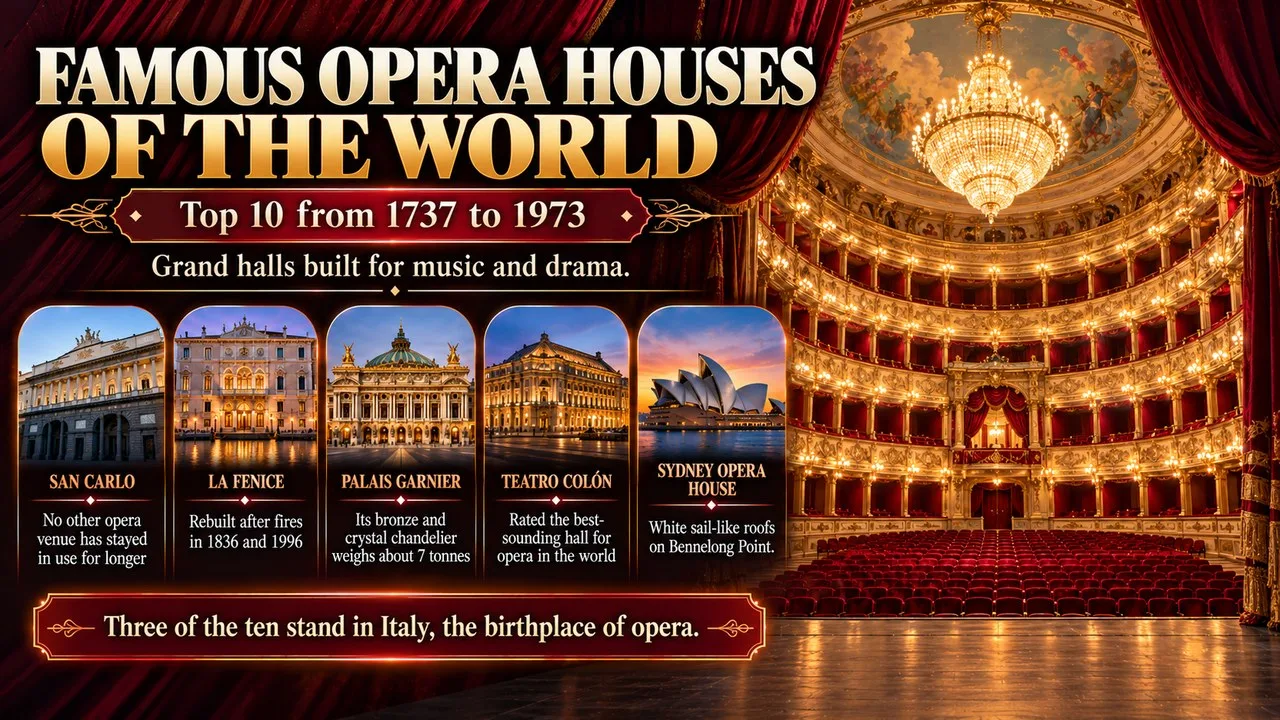
Famous opera houses of the world range from Naples's San Carlo, opened in 1737, and Milan's La Scala to the Palais Garnier and Sydney's harbour icon.[1]
This Finepedia guide, written in October 2026, tours ten of the most celebrated opera houses on Earth, from Baroque Italy to modern Australia. Each entry gives the year the house opened, its size and one story behind the stage. For more great buildings, see the Finepedia guides Top 10 Magnificent Libraries of the World and Top 10 Famous City Squares Around the World.
How We Chose These
We picked opera houses that are famous for their history, architecture, sound and the stars who have performed in them, and that still stage opera today. The list runs in order of the year each company first opened its doors, from 1737 to 1973. Three of the ten stand in Italy, the birthplace of opera, and several have risen again after fire or wartime bombing.
The 10 Famous Opera Houses at a Glance
| No. | Opera house | City | First opened | Seats today |
|---|---|---|---|---|
| 1 | San Carlo | Naples, Italy | 1737 | about 1,380 |
| 2 | La Scala | Milan, Italy | 1778 | about 2,000 |
| 3 | La Fenice | Venice, Italy | 1792 | about 1,000 |
| 4 | Bolshoi Theatre | Moscow, Russia | 1825 | about 1,700 |
| 5 | Royal Opera House | London, UK | 1858 (present building) | 2,256 |
| 6 | Vienna State Opera | Vienna, Austria | 1869 | about 2,280 with standing places |
| 7 | Palais Garnier | Paris, France | 1875 | about 1,980 |
| 8 | Teatro Colón | Buenos Aires, Argentina | 1908 | about 2,500 |
| 9 | Metropolitan Opera House | New York, US | 1966 | 3,975 with standing places |
| 10 | Sydney Opera House | Sydney, Australia | 1973 | 1,507 in its opera theatre |
1. Naples's San Carlo Is the Oldest Working Opera House
Naples's Teatro di San Carlo welcomed its first audience on 4 November 1737, the name day of King Charles of Bourbon, who ordered it built.[2] It came decades before La Scala and La Fenice, and no other opera venue has stayed in use for longer. Its gold and red horseshoe-shaped hall is the oldest of its type anywhere.
Key Facts
- Opened: 4 November 1737
- Seats: about 1,380, down from over 3,000 in its early years
- Boxes: 184, in six tiers, plus a royal box
- World Heritage: part of the historic centre of Naples
Did You Know?
A fire badly damaged the theatre in February 1816, during a rehearsal for a ballet, but it reopened less than a year later. The French writer Stendhal was so dazzled by the rebuilt hall that he said nothing in Europe came close to it.
2. La Scala Is Opera's Most Famous Stage
La Scala in Milan opened on 3 August 1778, after fire destroyed the city's earlier court theatre.[3] Many of the best-known Italian operas had their first nights here, including works by Verdi and Puccini. Its audiences are famous for loudly cheering great singers and booing those who fall short.
Key Facts
- Opened: 3 August 1778
- Seats today: about 2,000
- Wartime damage: bombed in 1943
- Reopened: 11 May 1946, with a concert led by Arturo Toscanini
Why It Matters
La Scala's season traditionally begins on 7 December, the feast of Milan's patron saint, Ambrose, and the opening night ranks among Italy's most watched cultural events. The house set the standard for Italian opera for more than two centuries.
3. La Fenice Keeps Rising From the Ashes
La Fenice in Venice opened in 1792, and its name means the phoenix.[4] It has lived up to that name, being rebuilt after fires in 1836 and 1996. The second blaze was started on purpose, and it left only the outer walls standing. A faithful rebuild based on old plans and photographs reopened in December 2003.
Key Facts
- Opened: 1792
- Big fires: 1836 and 1996
- Reopened: 14 December 2003, after the rebuild
- Premieres: including Verdi's Rigoletto and La traviata
Did You Know?
After the fire of 1836, the Venetians worked so quickly that the new house opened again within about a year. The fire of 1996 was set by two electricians whose firm was running late on repair work and faced fines.
4. The Bolshoi Theatre Is a Symbol of Moscow
The Bolshoi Theatre in Moscow is home to two of the world's best-known companies, the Bolshoi Ballet and the Bolshoi Opera.[5] Its present building opened in January 1825 and has been rebuilt more than once after fires. Its grand columned front is pictured on Russia's 100-ruble banknote.
Related: Top 10 Famous Stone Bridges of the World
Key Facts
- Present building opened: 18 January 1825
- Major fire: 1853, followed by a rebuild
- Renovation: six years, completed on 28 October 2011
- Landmark: an eight-column front topped by a bronze chariot
Why It Matters
The six-year renovation brought back the hall's original imperial decoration and restored the acoustics, which had been dulled by earlier changes. Bolshoi means big or grand in Russian, and the theatre remains a must-see for visitors to the capital.
5. The Royal Opera House Sits in Covent Garden
Standing in Covent Garden, London's Royal Opera House is the third theatre on its site, after the first two were lost to fires in 1808 and 1856.[6] The present building opened on 15 May 1858. It is home to the Royal Opera and the Royal Ballet, and its main hall seats 2,256 people.
Key Facts
- Present building opened: 15 May 1858
- Earlier fires: 1808 and 1856
- Seats: 2,256 in four tiers plus a gallery
- Major rebuild: completed in 1999
Did You Know?
In the Second World War years the building served as a dance hall, and it went back to staging opera and ballet in 1946. Its glass and iron Floral Hall, once part of the flower market, is now a grand public foyer.
6. The Vienna State Opera Was Rebuilt After the War
The Vienna State Opera opened on 25 May 1869 as the Court Opera, with Mozart's Don Giovanni, with the Emperor Franz Joseph I and his wife, Empress Elisabeth, in the audience.[7] On 12 March 1945, near the end of the Second World War, American bombs set it on fire, destroying the hall and the stage.
Related: Top 10 Countries with Most Natural World Heritage Sites
Key Facts
- Opened: 25 May 1869
- Destroyed by fire: 12 March 1945
- Reopened: 5 November 1955, with Beethoven's Fidelio
- Capacity: about 2,280, including more than 560 standing places
Why It Matters
The reopening in 1955 came soon after Austria regained full independence, and it became a symbol of the country's recovery. The house stages more than 50 different operas and ballets each season, and every winter it hosts the famous Vienna Opera Ball.
7. The Palais Garnier Has a Famous Chandelier
The Palais Garnier in Paris, designed by Charles Garnier, opened on 5 January 1875.[8] It was the main home of the Paris Opera until the modern Opéra Bastille opened in 1989, and it is now used mostly for ballet. Few stages in Europe are bigger, with room for about 450 performers.
Key Facts
- Opened: 5 January 1875
- Chandelier: bronze and crystal, weighing about 7 tonnes
- Ceiling: a colourful painting by Marc Chagall, added in 1964
- Hidden feature: an underground water tank below the stage
Did You Know?
In 1896 a counterweight from the great chandelier fell into the audience, killing one person. That accident and the building's watery basement helped inspire the 1910 Gaston Leroux novel about a phantom haunting the opera.
8. Teatro Colón Has World-Class Acoustics
Teatro Colón in Buenos Aires raised its curtain on 25 May 1908, staging Verdi's Aida, after about 20 years of building.[9] When the sound expert Leo Beranek surveyed leading conductors and orchestra directors, it was rated the best-sounding hall for opera in the world.
Key Facts
- Opened: 25 May 1908
- Building time: about 20 years
- Seats: about 2,500, with standing room for hundreds more
- Restoration: reopened on 24 May 2010
Why It Matters
The Colón shows how rich Buenos Aires was in the early 20th century, when great European singers sailed across the Atlantic to perform there. Its horseshoe-shaped hall is one of the largest of its kind, yet even quiet notes carry clearly to the top galleries.
Related: Top 10 Historic Prisons That Became Landmarks
9. The Metropolitan Opera House Is the Biggest of Its Kind
The Metropolitan Opera House at Lincoln Center in New York opened on 16 September 1966, replacing the company's older home on Broadway.[10] With 3,975 places, including 175 for standing, it is the largest opera house in the world that stages a changing programme of operas through the season.
Key Facts
- Opened: 16 September 1966
- Capacity: 3,975, including 175 standing places
- Lobby art: two huge murals by Marc Chagall
- Chandeliers: a gift from Austria after the Second World War
Did You Know?
The crystal chandeliers rise up to the ceiling just before each performance begins, one of the best-loved moments for audiences. Its backstage areas and moving stages are large enough to hold the sets for several operas at once.
10. Sydney's Opera House Is a Modern World Heritage Icon
The Sydney Opera House, designed by the Danish architect Jørn Utzon, was formally opened on 20 October 1973 by Queen Elizabeth II, 16 years after his design won an international competition.[11] Its white sail-like roofs on Bennelong Point have made it one of the most recognised buildings of the 20th century.
Key Facts
- Opened: 20 October 1973
- Architect: Jørn Utzon, with the work finished by an Australian team
- Opera venue: the Joan Sutherland Theatre, with 1,507 seats
- World Heritage: listed in 2007
Why It Matters
The Opera House was hit by huge delays and cost overruns, and Utzon left the project in 1966 before it was finished. Today it hosts well over a thousand performances a year, and its Concert Hall holds a giant pipe organ with more than 10,000 pipes, the biggest of its mechanical type.
Related: Top 10 Famous Churches of the World
Frequently Asked Questions
What is the oldest opera house in the world?
Naples's San Carlo, opened in 1737, is the oldest opera house that is still in use. Some older theatres survive, such as the Teatro Olimpico in Vicenza, but they were not built mainly for opera.
What is the largest opera house in the world?
By capacity, the Metropolitan Opera House in New York, with 3,975 places, is the largest opera house that runs a full season of changing productions.
Conclusion
From a Bourbon king's theatre in Naples to a sail-roofed landmark in Sydney, these ten opera houses show how much cities have invested in music and drama. Many have burned, been bombed or fallen silent, yet each has come back to life. For more great buildings, read the Finepedia guides Top 10 Magnificent Libraries of the World and Top 10 Famous City Squares Around the World.
- ^ [1] "Opera house". Wikipedia. Wikipedia
- ^ [2] "San Carlo". Wikipedia. Wikipedia
- ^ [3] "La Scala". Wikipedia. Wikipedia
- ^ [4] "La Fenice". Wikipedia. Wikipedia
- ^ [5] "Bolshoi Theatre". Wikipedia. Wikipedia
- ^ [6] "Royal Opera House". Wikipedia. Wikipedia
- ^ [7] "Vienna State Opera". Wikipedia. Wikipedia
- ^ [8] "Palais Garnier". Wikipedia. Wikipedia
- ^ [9] "Teatro Colón". Wikipedia. Wikipedia
- ^ [10] "Metropolitan Opera House". Wikipedia. Wikipedia
- ^ [11] "Sydney Opera House". Wikipedia. Wikipedia


















Discussion
Log in with