






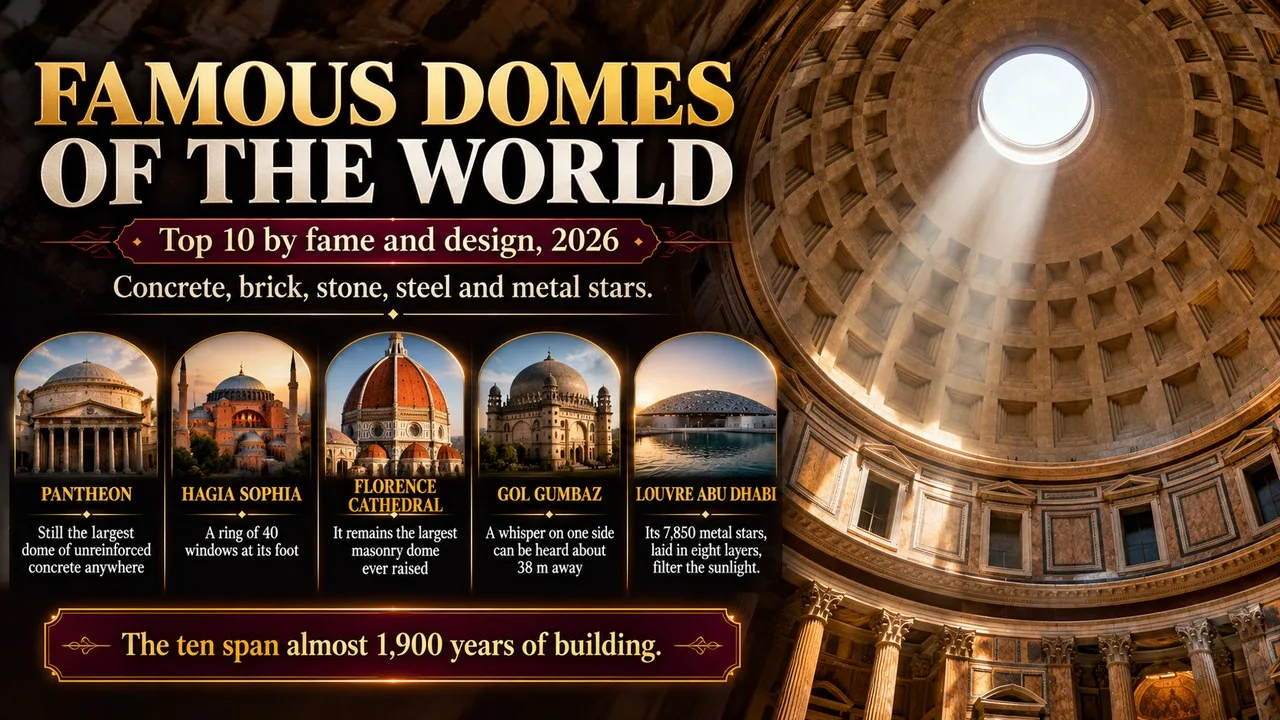
Famous domes of the world range from the Pantheon in Rome, roofed in ancient concrete, to the golden Dome of the Rock and a star-filled dome in Abu Dhabi.
This Finepedia guide, written in October 2026, looks at ten domes that changed what builders thought was possible, from Roman concrete and Byzantine brick to steel lattice and aluminium stars. Sizes come from official sites, UNESCO and encyclopaedias, rounded where sources differ. For more great buildings, see the Finepedia guides Top 10 Famous Churches of the World and Top 10 Famous Tombs and Mausoleums.
How We Chose These
We looked for domes that are famous in their own right, not just buildings that happen to have one, and we wanted a spread of faiths, regions and building methods. To avoid repeating other Finepedia lists, we left out the Taj Mahal, St Peter's Basilica, the United States Capitol and the Reichstag, which already appear in our guides to tombs, churches and parliament buildings. The list runs in order of completion, so the ten span almost 1,900 years of building, from the reign of Hadrian to the 21st century.
The 10 Famous Domes at a Glance
| No. | Dome | City | Completed | Standout fact |
|---|---|---|---|---|
| 1 | Pantheon | Rome, Italy | about AD 126 | largest unreinforced concrete dome |
| 2 | Hagia Sophia | Istanbul, Turkey | 537 | early dome on pendentives |
| 3 | Dome of the Rock | Jerusalem | 691 to 692 | oldest surviving Islamic monument |
| 4 | Florence Cathedral | Florence, Italy | 1436 | largest masonry dome |
| 5 | Sheikh Lotfollah Mosque | Isfahan, Iran | about 1619 | tilework that changes colour |
| 6 | Gol Gumbaz | Vijayapura, India | work stopped in 1656 | famous whispering gallery |
| 7 | Dôme des Invalides | Paris, France | 1706 | tomb of Napoleon |
| 8 | St Paul's Cathedral | London, UK | 1710 | dome of three layers |
| 9 | Montreal Biosphère | Montreal, Canada | 1967 | Buckminster Fuller geodesic sphere |
| 10 | Louvre Abu Dhabi | Abu Dhabi, UAE | 2017 | 7,850 metal stars |
1. The Pantheon Still Has the Biggest Unreinforced Concrete Dome
The Pantheon in Rome took its present form under Hadrian, with a likely dedication around AD 126, after an earlier temple on the site burned down. Its coffered dome is made of Roman concrete, and almost 1,900 years later it is still the largest dome of unreinforced concrete anywhere.[1] The only light enters through the oculus, a round opening at the top that is open to the sky.
Key Facts
- Inner diameter: 43 m, the same as the height from floor to oculus
- Material: Roman concrete, lighter towards the top
- Use: a church since AD 609
- Burials: the painter Raphael lies inside
Did You Know?
Large letters over the porch name Marcus Agrippa, who built the first temple here under Augustus, so for centuries people credited him, but brick stamps point to Hadrian. Rain does fall through the oculus, and small holes in the marble floor carry it away.
2. Hagia Sophia Seemed to Hang From Heaven
Hagia Sophia in Istanbul was built for the Byzantine emperor Justinian I between 532 and 537, to plans by two scholars, Anthemius of Tralles and Isidore of Miletus. Its great dome rests on pendentives, curved triangles that let a round dome sit on a square base, and a ring of 40 windows at its foot makes it look as if it floats on light.
Key Facts
- Height: about 55.6 m from the floor to the crown
- Diameter: roughly 31 to 33 m, as later repairs left it slightly oval
- Roles: church, mosque, museum from 1935, and a mosque again since 2020
- Status: part of the Historic Areas of Istanbul World Heritage Site[2]
Why It Matters
For about a thousand years it had the largest interior of any church. The first dome fell after earthquakes in 558, and the rebuilt one was raised by about 6 m to make it steadier. Ottoman architects later copied its form in Istanbul's great mosques.
3. The Dome of the Rock Crowns Jerusalem in Gold
The Dome of the Rock stands on the Temple Mount, known to Muslims as the Haram al-Sharif, inside Jerusalem's walled Old City. Abd al-Malik, the Umayyad caliph, ordered it built, and it was finished in 691 or 692, making it the oldest Islamic monument still standing. Its golden dome is the most recognisable sight on the city's skyline.
Key Facts
- Plan: an eight-sided building around a central rock
- Dome: about 20 m across, set on a drum with 16 supports
- Mosaics: covering about 1,200 square metres inside
- Rebuilt dome: after a collapse in 1015, it was rebuilt in 1022 to 1023
Did You Know?
The dome is sacred to Muslims, who believe the Prophet Muhammad's Night Journey began from the rock, and the site is also holy to Jews and Christians. Its gleaming gold covering is modern, added in 1959 to 1964 and renewed in the 1990s, while the bright blue tiles on the outer walls date back to the Ottoman period.
4. Florence Cathedral Proved a Giant Dome Could Be Built
When Florence began its new cathedral in 1296, nobody knew how to roof the huge eight-sided gap at its crossing.[3] Filippo Brunelleschi solved the puzzle, building the dome from 1420 to 1436 without the usual wooden frame from the ground. It remains the largest masonry dome ever raised, and the cathedral itself appears in our churches guide.
Related: Top 10 Most Remarkable Elevators in the World
Key Facts
- Span: about 44 m across the octagon
- Height of the cathedral to the lantern top: about 114 m
- Bricks: more than 4 million
- Consecrated: 25 March 1436 by Pope Eugene IV
Why It Matters
Brunelleschi built two domes, one inside the other, and laid the bricks in a herringbone pattern so each ring held itself up as it rose. He also invented hoisting machines driven by oxen to lift around 37,000 tonnes of material. The dome became a symbol of the Renaissance, and visitors still climb more than 400 steps between its two layers.
5. Sheikh Lotfollah Mosque Glows With Changing Colour
Facing the great Naqsh-e Jahan Square in Isfahan from the east, the Sheikh Lotfollah Mosque was built for Shah Abbas I and finished in about 1619. It has no minarets or courtyard, because it was a private royal mosque, linked to the Ali Qapu palace across the square by a tunnel, so the court could pray there unseen.
Key Facts
- Dome diameter: about 13 m, with a single layer
- Prayer hall: a single square chamber about 19 m on each side
- Decoration: tiles in cream, turquoise and deep blue
- Status: part of the Meidan Emam World Heritage Site, listed in 1979
Did You Know?
The dome's tiles look cream in strong sunlight and pinkish at sunset, so the building seems to change colour through the day.
6. Gol Gumbaz Carries a Whisper Around Its Walls
Gol Gumbaz, meaning "round dome", is the tomb of Mohammed Adil Shah, ruler of the Bijapur Sultanate, in present-day Vijayapura in Karnataka.[4] Work went on through his reign and stopped at his death in 1656, leaving some decoration unfinished. The giant dome sits on a cube of dark grey basalt with an eight-sided tower at each corner.
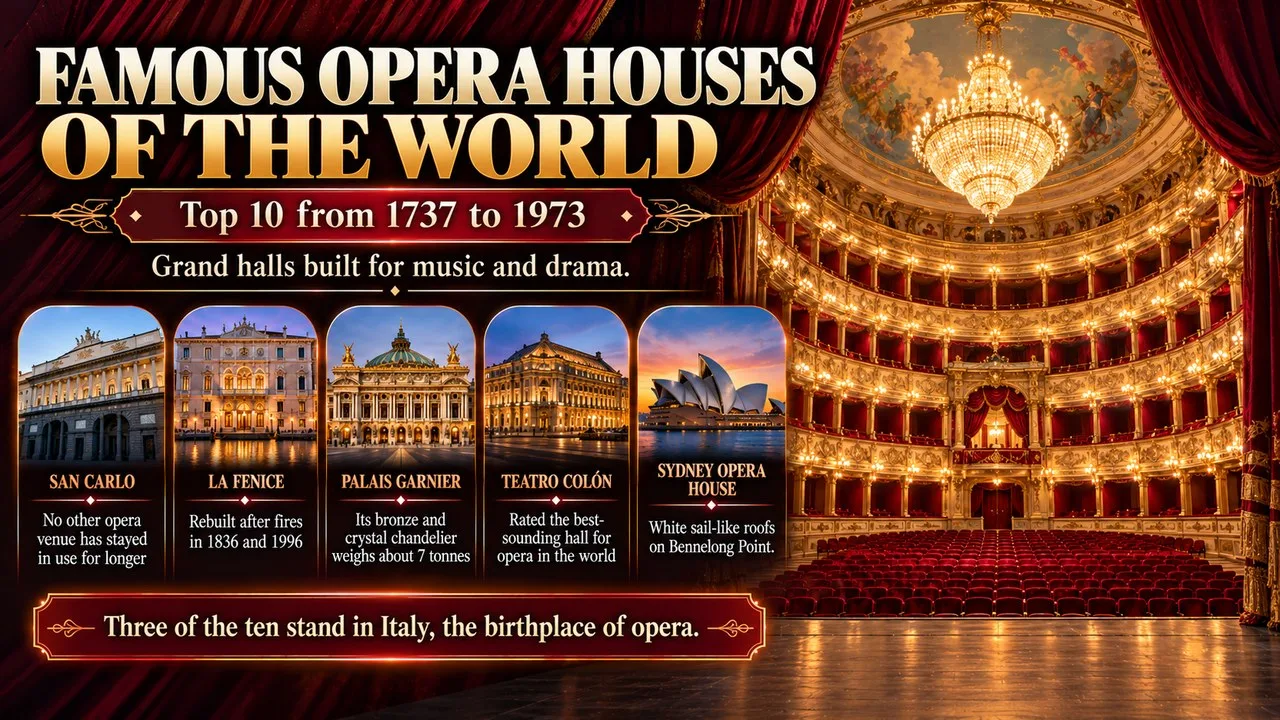
Related: Top 10 Famous Opera Houses of the World
Key Facts
- Outer diameter of the dome: about 44 m
- Width with corner towers: about 62 m
- Material of the dome: brick and lime mortar
- Heritage: on UNESCO's tentative list since 2014, with other Deccan Sultanate sites
Why It Matters
A gallery circles the inside of the dome, and even a whisper or the rustle of paper on one side can be heard about 38 m away on the other. When it was finished, the dome ranked among the largest in the world and was the biggest in India.
7. The Dôme des Invalides Shelters Napoleon
The Dôme des Invalides in Paris was built as a royal chapel for Louis XIV, designed by Jules Hardouin-Mansart and finished in 1706. It stands beside the Hôtel des Invalides, which the king founded as a home for old and wounded soldiers. Its gilded dome no church in Paris stands taller.
Key Facts
- Total height: about 107 m including the lantern
- Style: French Baroque on a Greek-cross plan
- Famous tomb: Napoleon Bonaparte, placed in the crypt in 1861
- Other burials: generals including Turenne and Vauban
Did You Know?
Napoleon's remains came back from the island of Saint Helena in 1840, but his giant red stone sarcophagus took about 20 years to finish. Visitors look down at it from a circular opening in the floor beneath the dome, so every visitor has to look down to see it.
8. St Paul's Cathedral Hides a Brick Cone Inside Its Dome
Sir Christopher Wren designed St Paul's Cathedral once the fire of 1666 had ruined the old church. The first stone was laid in 1675, the last stone went onto the lantern in 1708, and the building was declared complete in 1710. At 111 m to its cross, it stayed London's tallest building until 1963.
Key Facts
- Height: 111 m, or 365 feet, one for each day of the year
- Structure: an inner dome, a hidden brick cone and an outer dome
- Galleries: the Whispering Gallery, Stone Gallery and Golden Gallery
- Cost: paid for largely by a tax on coal
Why It Matters
Wren needed a dome that looked grand from the streets but did not feel too tall from inside, so he built three layers, with a brick cone holding up the heavy stone lantern. During the Blitz in 1940, firefighters and volunteers saved the cathedral, and the photograph of its dome rising above the smoke became a symbol of London's survival.
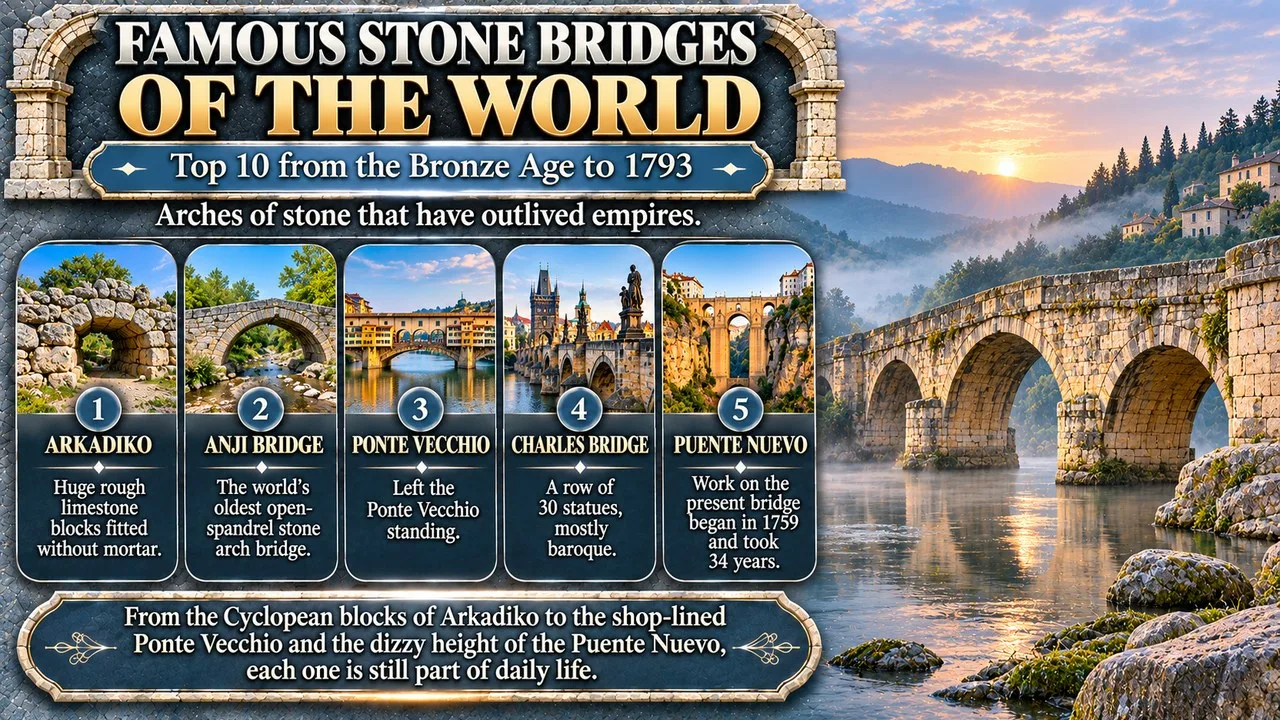
Related: Top 10 Famous Stone Bridges of the World
9. Montreal Biosphère Turned a Dome Into a Sphere
The Biosphère in Montreal began life as the American pavilion at Expo 67, designed by the inventor R.[5] Buckminster Fuller. It is a geodesic dome, made of a lattice of triangles that spreads loads across the whole frame, and it forms most of a complete sphere on Saint Helen's Island.
Key Facts
- Diameter: 76 m
- Height: 62 m
- Frame: two layers of steel linked by struts
- Today: a museum about the environment
Did You Know?
The dome was first covered with clear acrylic cells. On 20 May 1976 a fire started by welders burned away the whole covering in minutes, but the steel frame survived. The lattice was left bare, and a museum opened inside in 1995.
10. The Louvre Abu Dhabi Makes It Rain Light
The Louvre Abu Dhabi, on Saadiyat Island, opened in November 2017 under a deal that lets it use the name of the Paris museum.[6] The French architect Jean Nouvel covered its galleries with a vast flat dome that seems to float above the water. Its 7,850 metal stars, laid in eight layers, filter the sunlight onto the floors below.
Key Facts
- Diameter: 180 m
- Weight: about 7,500 tonnes, close to that of the Eiffel Tower
- Supports: four hidden piers, each 110 m apart
- Largest star: 13 m across
Why It Matters
The museum calls the effect a "rain of light", inspired by sunlight falling through the leaves of palm trees. Nouvel drew on the cupola, a feature of Arab architecture, but made it light and open instead of solid. It is the widest dome on this list.
Related: Top 10 Tallest Buildings in the World
Frequently Asked Questions
Which is the biggest dome on Earth?
It depends on how you measure. Among historic masonry domes, Brunelleschi's dome in Florence is the biggest.[7] Modern steel roofs are far wider, such as the 180 m Louvre Abu Dhabi dome, which is a shallow frame rather than a round vault.[8]
What is a whispering gallery?
A whispering gallery is a circular walkway under a dome where sound travels along the curved wall. A whisper on one side can be heard clearly on the far side. Gol Gumbaz in India and St Paul's in London have two of the best-known examples.
Conclusion
From the Pantheon's concrete vault to the steel stars of Abu Dhabi, these ten domes trace almost two thousand years of builders reaching for wider and higher spaces. Some were raised for worship, some for kings and one for a world's fair. For more great buildings, read the Finepedia guides Top 10 Famous Churches of the World and Top 10 Famous Tombs and Mausoleums.
- ^ [1] "Pantheon". Wikipedia. Wikipedia
- ^ [2] "UNESCO World Heritage Centre - World Heritage List". UNESCO World Heritage Centre. UNESCO World Heritage Centre
- ^ [3] "Dome". Wikipedia. Wikipedia
- ^ [4] "Gol Gumbaz". Wikipedia. Wikipedia
- ^ [5] "Montreal". Wikipedia. Wikipedia
- ^ [6] "Louvre Abu Dhabi". Wikipedia. Wikipedia
- ^ [7] "Historic Centre of Florence". UNESCO World Heritage Centre. UNESCO World Heritage Centre
- ^ [8] "LOUVRE ABU DHABI". Fabricate 2011. DOI


















Discussion
Log in with