






 By
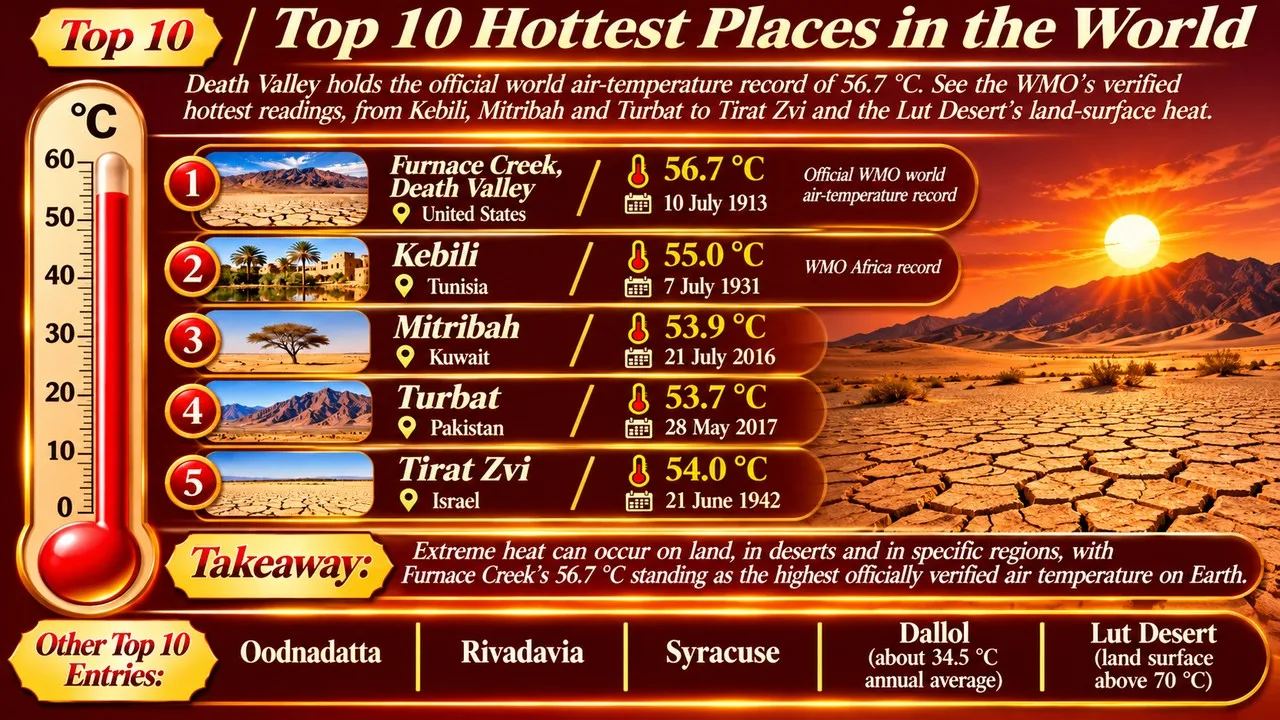
Death Valley holds the official world air-temperature record of 56.7 degrees Celsius, set at Furnace Creek on 10 July 1913. The World Meteorological Organization (WMO) still recognises that reading as the highest reliably recorded air temperature on Earth, after a 2012 review rejected a higher 1922 claim from Libya [1][2].
This list covers ten of the hottest places on the planet, led by official WMO air-temperature records for each region and closed by two sites that are extreme in a different way: Dallol in Ethiopia, often cited for the highest year-round average, and Iran's Lut Desert, where satellites have measured the highest land-surface temperatures [3][5]. Air temperature, which is taken in the shade in a standard screen, should not be confused with the temperature of bare ground in the sun.
Some early records are still debated by climate historians, and the WMO has said it is willing to re-examine them if new evidence appears. Modern readings from Kuwait, Pakistan and Death Valley itself show that extreme heat is not only a story from the early twentieth century [2][4]. Figures below are as of November 2026.
Key Facts
The table gives each place's headline temperature, the date or type of measurement, and why it belongs on a list of the world's hottest climates.
Hottest Places at a Glance
| Rank | Place | Location | Headline temperature | Notable fact |
|---|---|---|---|---|
| 1 | Furnace Creek | Death Valley, California, United States | 56.7 C, 10 July 1913 | Official WMO world record for air temperature |
| 2 | Kebili | Tunisia | 55.0 C, 7 July 1931 | Official WMO record for Africa |
| 3 | Mitribah | Kuwait | 53.9 C, 21 July 2016 | Official WMO record for Asia; third-highest verified global reading |
| 4 | Turbat | Pakistan | 53.7 C, 28 May 2017 | Fourth-highest WMO-verified air temperature |
| 5 | Tirat Zvi | Israel | 54.0 C, 21 June 1942 | Official WMO record for Region VI, including the Middle East |
| 6 | Oodnadatta | South Australia | 50.7 C, 2 January 1960 | Official WMO record for the South-West Pacific |
| 7 | Rivadavia | Argentina | 48.9 C, 11 December 1905 | Official WMO record for South America |
| 8 | Syracuse | Sicily, Italy | 48.8 C, 11 August 2021 | Official WMO record for continental Europe |
| 9 | Dallol | Danakil Depression, Ethiopia | About 34.5 C annual average | Among the highest year-round averages for an inhabited place |
| 10 | Lut Desert | Iran | Land surface above 70 C | Satellite measurements of ground temperature, not shade-air records |
1. Furnace Creek
Furnace Creek, in Death Valley National Park, California, is the site of the official world record for air temperature: 56.7 degrees Celsius (134 degrees Fahrenheit) on 10 July 1913, at an elevation of about 54 metres below sea level [1][2]. The WMO confirmed the record after a review in 2010-2012, at the same time as it rejected the former world-record claim of 58 degrees Celsius at El Azizia, Libya, on 13 September 1922, citing instrument and observer problems [2].
Death Valley is a long, narrow basin that sits below sea level and is boxed in by high ranges, so incoming air can heat and pool. Furnace Creek has a continuous observing record from 1911, which is one reason the 1913 reading could be reviewed in detail. Some weather historians still question whether the 1913 extreme was inflated by a sandstorm or exposure problems, and the WMO has said it will look again if strong new evidence is offered [2].
More recently, a weather station at Furnace Creek recorded 54.4 degrees Celsius (130 degrees Fahrenheit) on 16 August 2020 and again on 9 July 2021. The WMO has been evaluating those readings; if accepted, they would be the highest temperatures verified anywhere on Earth since 1931 [4]. Even without that decision, Death Valley remains the world's benchmark for extreme desert heat.
2. Kebili
Kebili, in southern Tunisia, holds the official WMO record for Africa: 55.0 degrees Celsius (131 degrees Fahrenheit) on 7 July 1931 [1][2]. After the Libyan 1922 figure was set aside, this became the highest recognised air temperature in the Eastern Hemisphere and the second-highest on the WMO's global list.
The town stands on the edge of the Sahara, near salt chotts and palmeraies of the Djerid region. Summers are long and extremely hot, and the 1931 reading has stood for more than ninety years as Africa's official extreme. As with other early records, some researchers have asked whether older African maxima should be re-checked, but the WMO still lists Kebili as the continental record [1].
Related: Top 10 Extremes and Records on Planet Earth
For travellers, the figure is a warning rather than an invitation. Shade temperatures of this kind are rare, but ordinary summer days in southern Tunisia can still climb well above 40 degrees Celsius.
3. Mitribah
Mitribah, in the north-west of Kuwait, recorded 53.9 degrees Celsius, with an uncertainty of 0.1 degrees, on 21 July 2016 [2]. After an intensive WMO investigation, the reading was accepted as the official record for Asia and as the third-highest verified air temperature on Earth, tied within uncertainty limits with the next entry [2].
The observation mattered because it was modern, well documented and taken in a region that had not previously held a formal continental extreme in the WMO archive. Kuwait and the northern Arabian Peninsula often combine clear skies, dry winds and long days in midsummer, and several stations in the region have approached 50 degrees Celsius in recent heatwaves.
The Mitribah record, together with the reading at Turbat the following year, showed that the highest temperatures of the last few decades have been in south-western Asia, even if they still fall short of the 1913 and 1931 marks [2].
4. Turbat
Turbat, in Pakistan's Balochistan province, reached 53.7 degrees Celsius, with an uncertainty of 0.4 degrees, on 28 May 2017 [2]. The WMO accepted the figure as the second official record for Asia and the fourth-highest verified air temperature worldwide. The date is notable: the extreme arrived in late spring, not in the middle of summer, during a severe heatwave over southern Pakistan and neighbouring Iran.
Turbat lies inland from the Arabian Sea in a low, arid basin. Cities such as Jacobabad and Sibi, also in Pakistan, are often listed among the hottest inhabited places on Earth because they repeatedly see temperatures near 50 degrees Celsius, even if they do not hold the official national or continental record.
The WMO described the Mitribah and Turbat evaluations as among the most thorough it had ever carried out for a temperature extreme, which is why both appear near the top of this list [2].
5. Tirat Zvi
Tirat Zvi, a community in the Beit She'an Valley of Israel, holds the official WMO record for Region VI, which covers Europe and the Middle East: 54.0 degrees Celsius (129 degrees Fahrenheit) on 21 June 1942, at an elevation of about 220 metres below sea level [1]. The Jordan Valley's below-sea-level setting helps air heat in summer in a way that is similar, on a smaller scale, to Death Valley.
Related: Ball Lightning: The Mysterious Spherical Phenomenon
The WMO's public discussion of the "third and fourth" highest temperatures has focused on the recently verified 2016 and 2017 readings in Kuwait and Pakistan, so the 1942 Tirat Zvi figure is best read as the official regional record rather than as a rank that everyone places in the same way on a global table [1][2]. It remains, however, one of the highest air temperatures the WMO lists.
The site is well below the level of the Mediterranean, in a densely farmed valley where extreme summer heat is a practical concern for agriculture and public health, not only a line in an archive [1].
6. Oodnadatta
Oodnadatta, a small town in the far north of South Australia, holds the official WMO record for the South-West Pacific: 50.7 degrees Celsius (123 degrees Fahrenheit) on 2 January 1960 [1]. The town sits on the edge of the Simpson Desert, along a historic railway and cattle route, and is used to long stretches of very hot, dry weather.
Australia has several other desert stations with maxima close to 50 degrees Celsius, and the country as a whole is one of the main centres of extreme heat in the Southern Hemisphere. The 1960 Oodnadatta reading has remained the regional official record for more than sixty years [1].
Because the Australian summer falls in January, this extreme happened at the opposite time of year from the midsummer peaks of the Northern Hemisphere deserts, a useful reminder that "hottest places" are not confined to July in the Sahara or the American Southwest [1].
7. Rivadavia
Rivadavia, in the province of Salta in northern Argentina, holds the official WMO record for South America: 48.9 degrees Celsius (120 degrees Fahrenheit) on 11 December 1905 [1]. The town lies in a low, hot region of the Gran Chaco, far from the Andes and the cooling influence of the ocean.
Related: Top 10 Most Destructive Typhoons in Recorded History
South America's official maximum is lower than the records of North America, Africa and Asia, but it is still extreme. Heatwaves in northern Argentina, Paraguay and parts of Brazil have pushed modern stations close to this mark, though the WMO still lists the 1905 Rivadavia reading as the continental record [1].
As with other early twentieth-century extremes, the figure depends on historic instruments and notes, and it is kept on the official table pending any later review [1].
8. Syracuse
Syracuse (Siracusa) on the island of Sicily recorded 48.8 degrees Celsius (119.8 degrees Fahrenheit) on 11 August 2021, a reading the WMO has accepted as the official record for continental Europe [1]. The station elevation was about 80 metres. The measurement came during a severe Mediterranean heatwave that also affected Greece, Spain and other parts of southern Europe.
For a long time, Europe's highest temperatures were associated with older, less well documented claims. The 2021 Syracuse record is modern, formally evaluated and a sign of how intense recent southern European summers have become [1].
Sicily's interior and other Mediterranean basins can now reach levels that, a few decades ago, were discussed mainly in the context of North Africa and the Middle East. The official European record is still several degrees below the Asian and North American extremes, but it belongs on any current list of the world's hottest recorded places [1].
9. Dallol
Dallol, in Ethiopia's Danakil Depression, is famous not for a single official daily maximum in the WMO table, but for heat that lasts all year. It is widely cited as having one of the highest average annual temperatures of any inhabited place, around 34.5 degrees Celsius, in a basin that lies more than 100 metres below sea level [5]. Rain is scarce, and the landscape of salt flats, colourful hydrothermal deposits and active volcanism is one of the most hostile on Earth.
A high average can be as important as a record peak. Many desert towns that have recorded 50 degrees Celsius also have cooler seasons. Dallol's reputation comes from heat that barely lets up, which puts severe stress on the human body and on any equipment taken into the depression [5].
Related: Top 10 Surprising Microclimates Around the World
The settlement has been occupied only at times, often in connection with salt and later with potash works. It is a scientific and travel destination today, but only with careful support, because the climate itself is the main hazard [5].
10. Lut Desert
The Lut Desert, or Dasht-e Lut, in south-eastern Iran, has produced some of the highest land-surface temperatures ever measured by satellite, with readings of the ground itself rising above 70 degrees Celsius in several studies [3]. Those figures are not air temperatures and cannot be compared directly with the WMO shade records at Furnace Creek or Mitribah. They show how hot bare rock and sand can become under a clear desert sun.
The Lut is a hyper-arid basin of yardangs, dunes and dark, heat-absorbing surfaces. UNESCO has listed it as a World Heritage site for its desert landforms. Parts of the desert are so dry and hot that they have been used as examples of landscapes at the edge of what life can tolerate.
Including the Lut in this list is a way of being precise about what "hottest" means. For official air temperature, Death Valley still leads. For the temperature of the ground, satellite data have repeatedly pointed to the Lut, and to a few other dark desert surfaces, as the planet's extremes [3].
Conclusion
The official air-temperature record remains the 56.7 degrees Celsius reading at Furnace Creek in 1913, with Kebili, Mitribah and Turbat next on the WMO's verified global list. Around them are continental records from Australia, South America, Europe and the Jordan Valley, plus places such as Dallol and the Lut Desert that are extreme by average climate or by ground temperature.
A former world-record claim from El Azizia in Libya is no longer accepted. Any new peak, including the 54.4 degrees Celsius readings at Death Valley in 2020 and 2021, will need the same kind of formal review. For the opposite end of the scale, see the coldest places in the world.
- ^ [1] "Records of Weather and Climate Extremes". World Meteorological Organization. WMO: Records table, 25 July 2025
- ^ [2] "WMO verifies 3rd and 4th hottest temperature recorded on Earth". World Meteorological Organization. WMO: Mitribah and Turbat verification
- ^ [3] "Lut Desert". Wikipedia. Wikipedia: Lut Desert
- ^ [4] "WMO is monitoring potential new temperature records". World Meteorological Organization. WMO: Death Valley 54.4 C readings
- ^ [5] "Dallol (geothermal area)". Wikipedia. Wikipedia: Dallol
























Discussion
Log in with