






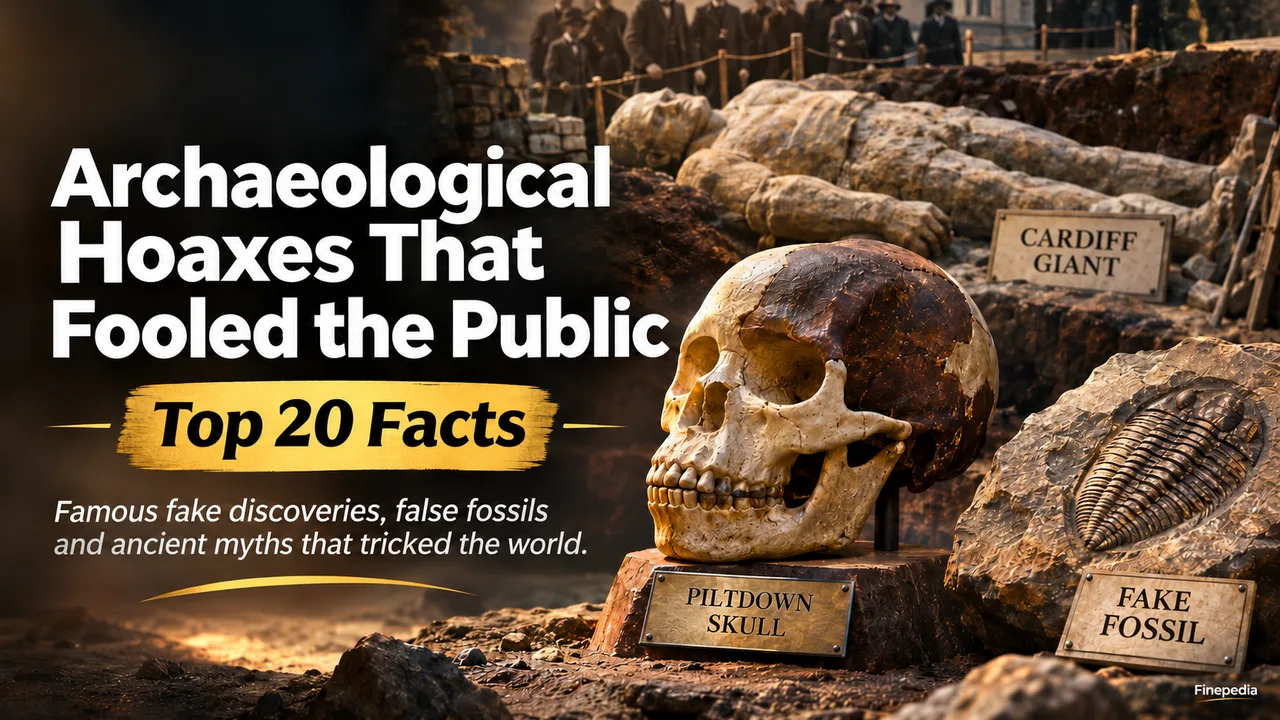
Archaeology depends on trust. When an object comes out of the ground, researchers have to believe that it was found where the finder says, in the layer the finder describes, and that nobody shaped it last week. Most of the time that trust is justified. Occasionally it is not, and a forged skull, a planted stone tool or a carved giant can mislead experts, museums and the public for years or even decades.
This Finepedia list collects the top 20 archaeological hoaxes and disputed finds that fooled the public. It covers deliberate forgeries such as Piltdown Man and the Cardiff Giant, frauds that rewrote a national prehistory, objects sold to great museums, and claims that collapsed because no one could check where they came from. Each entry explains what was claimed, how the truth came out and why the case still matters.
The cases are not all equal. Some are proven fakes with confessions or laboratory results behind them, while a few remain argued over. Where the verdict is still debated, the article says so rather than calling every unusual object a fraud.
Key Facts
The table below sums up all 20 cases on this list, with where each one surfaced, when it appeared and how it was exposed.
The 20 Archaeological Hoaxes at a Glance
| No. | Case | Location | Appeared | How it was exposed |
|---|---|---|---|---|
| 1 | Piltdown Man | Sussex, England | 1912 | Fluorine dating and anatomy, 1953 |
| 2 | Cardiff Giant | New York, United States | 1869 | Maker George Hull admitted the carving |
| 3 | Calaveras Skull | California, United States | 1866 | Radiocarbon dating, 1992 |
| 4 | Beringer's lying stones | Würzburg, Germany | 1725 | Colleagues behind the carvings were identified |
| 5 | Japanese Paleolithic hoax | Japan | 1970s to 2000 | Newspaper photographs, 2000 |
| 6 | Crystal skulls | Mexico and Europe | 19th century | Microscopy showed rotary-tool marks |
| 7 | Persian Princess mummy | Pakistan | 2000 | Forensic examination |
| 8 | Tiara of Saitaphernes | Paris, France | 1896 | Goldsmith Israel Rouchomovsky proved he made it |
| 9 | Etruscan terracotta warriors | New York, United States | 1915 to 1921 | Glaze analysis and a confession, 1961 |
| 10 | Drake's Plate of Brass | California, United States | 1936 | Metal analysis, 1977 |
| 11 | Kensington Runestone | Minnesota, United States | 1898 | Runic and linguistic study |
| 12 | Grave Creek Stone | West Virginia, United States | 1838 | Doubts over the script and the find |
| 13 | Davenport tablets | Iowa, United States | 1877 | Fresh condition and a disturbed mound |
| 14 | Tucson lead artifacts | Arizona, United States | 1924 | Archaeologists rejected the context and texts |
| 15 | Michigan relics | Michigan, United States | 1890 to 1920 | Testimony and manufacturing traces |
| 16 | Kinderhook plates | Illinois, United States | 1843 | Confession in 1879 and metal tests in 1980 |
| 17 | Glozel finds | Allier, France | 1924 | International commission and later dating |
| 18 | Jehoash Inscription | Jerusalem | 2003 | Israel Antiquities Authority report |
| 19 | Archaeoraptor | China | 1999 | CT scans and fossil comparison |
| 20 | Burrows Cave | Illinois, United States | 1982 | Site never opened to scientists |
1. Piltdown Man
In 1912 the amateur collector Charles Dawson announced that gravel pits at Piltdown in Sussex had produced pieces of a skull and a jaw from an early human. Arthur Smith Woodward of the British Museum (Natural History) backed the find, and "Eoanthropus dawsoni" became a celebrated missing link with a large brain and an ape-like jaw.[1] It fitted what many British scientists expected human evolution to look like, and that expectation helped it survive for four decades.
The fraud unravelled in 1953, when Kenneth Oakley, Joseph Weiner and Wilfrid Le Gros Clark applied fluorine absorption tests and close anatomical study. The cranium was from a modern human, the jaw came from an orangutan, the teeth had been filed down, and the bones had been stained to look old.[1][2] A 2016 study of the remains concluded that one person, almost certainly Dawson, made the fakes. Piltdown remains the classic warning about how easily science can accept evidence that confirms what it already believes.[1]
2. The Cardiff Giant
On 16 October 1869, workers digging a well on William Newell's farm in Cardiff, New York, struck what looked like a stone man about three metres tall. Crowds paid to see the "petrified giant", and some visitors saw it as proof of the giants mentioned in the Book of Genesis.[3] Within weeks Newell had sold a share in the figure to a syndicate of businessmen for 23,000 dollars.
The giant was the idea of George Hull, a New York tobacconist who had argued with a revivalist preacher about biblical giants. Hull had a block of gypsum carved in Chicago, shipped it to his cousin Newell's farm and buried it a year before the "discovery".[3] The palaeontologist Othniel Charles Marsh called it "a most decided humbug", and P. T. Barnum exhibited his own copy, which drew bigger crowds than the original. The figure is now displayed at the Farmers' Museum in Cooperstown, New York.[3]
3. The Calaveras Skull
In February 1866 miners in Calaveras County, California, reported finding a human skull about 40 metres below the surface, under a layer of volcanic material. It reached Josiah Whitney, the state geologist, who argued that it proved humans had lived in North America during the Pliocene, millions of years earlier than anyone else accepted.[4] The writer Bret Harte mocked the claim in a poem about the skull.
Later investigators heard from locals that miners had planted the skull as a prank, and that it may have come from a nearby Native American burial. Radiocarbon dating in 1992 showed it to be only about 1,000 years old.[4] The skull shows why archaeologists insist on knowing the exact context of a find: a genuine old bone placed in the wrong layer can tell a completely false story.
4. Beringer's Lying Stones
Johann Bartholomeus Adam Beringer was a physician and dean of the medical faculty at the University of Würzburg. In 1725 he began receiving limestone pieces from a nearby hill, carved with lizards, frogs, birds, stars, comets and even Hebrew letters. He believed they were natural fossils and in 1726 published a lavish book about them.[5]
The stones had been carved and planted by two colleagues, the geographer J. Ignatz Roderick and the librarian Johann Georg von Eckhart, who reportedly wanted to discredit him. When a stone appeared bearing Beringer's own name, he realised the truth and took the pair to court.[5] The case wrecked the reputations of all three men and is still taught as an early lesson in how an eager collector can be fooled by what he hopes to find.
5. The Japanese Paleolithic Hoax
Shinichi Fujimura was one of Japan's best-known amateur archaeologists. Through the 1980s and 1990s he kept finding stone tools in older and older layers, pushing the human story of Japan back to around 600,000 years ago. His finds made headlines, entered school textbooks, and earned him the nickname "God's Hands".[6]
In November 2000 the Mainichi Shimbun newspaper published photographs of Fujimura burying artifacts at the Kamitakamori site before "finding" them. He admitted planting tools, and reviews of every site he had worked on found that most of his artifacts had been taken from younger Jōmon-era sites and buried where he was digging.[6] Textbooks had to be rewritten and Japan's early prehistory reassessed, making this one of the most damaging frauds in modern archaeology.
Related: Cleopatra's Tomb: History, Theories and the Search at Taposiris Magna
6. The Crystal Skulls
Several skulls carved from clear or milky quartz were sold in the 19th and 20th centuries as ancient Aztec or Maya objects, including examples held by the British Museum and the Smithsonian. The best known, the Mitchell-Hedges skull, gathered legends about healing powers and lost civilisations, and the skulls later inspired films and books.[7]
None of the large skulls has come from a documented excavation. Studies with scanning electron microscopes found cutting marks left by rotary wheels and modern abrasives, tools the pre-Columbian peoples of Mesoamerica did not use.[7] Researchers have traced several of the skulls to the antiquities dealer Eugène Boban and to workshops in 19th-century Europe. They are now seen as modern carvings marketed with an invented past.
7. The Persian Princess Mummy
In October 2000, police in Balochistan, Pakistan, recovered a mummy that a dealer had been trying to sell for hundreds of millions of rupees. It lay in a carved coffin with a gold crown and a cuneiform plate naming her as a daughter of the Persian king Xerxes I, about 2,600 years old. The find made world news and was put on display at the National Museum in Karachi.[8]
Archaeologist Asma Ibrahim and other experts soon noticed errors in the inscription and modern materials in the burial. In April 2001 Ibrahim reported that the body belonged to a woman aged about 21 to 25 who had died around 1996, and that it had been altered after death, including the removal of her teeth, to make it look ancient.[8] The case turned from an antiquities fraud into a possible murder investigation, and it remains one of the darkest stories on this list.
8. The Tiara of Saitaphernes
In 1896 the Louvre paid 200,000 francs for a gold tiara said to have been given to the Scythian king Saitaphernes by the Greek city of Olbia around the third century BC. The crown was richly decorated with scenes from the Iliad, and the museum proudly displayed it as a masterpiece of ancient goldwork.[9]
Doubts grew for years, and in 1903 a goldsmith from Odessa, Israel Rouchomovsky, came forward to say he had made it. He proved his claim by reproducing parts of the tiara from memory in front of experts.[9] Rouchomovsky said dealers had ordered it as a gift and that he did not know it would be sold as an antiquity. The Louvre withdrew the tiara, but the episode made the goldsmith briefly famous for his skill.
9. The Met's Etruscan Warriors
Between 1915 and 1921 the Metropolitan Museum of Art in New York bought three large terracotta figures, including a towering warrior more than two metres tall, believed to be Etruscan works from around the fifth century BC. They were shown to the public in 1933 and admired as rare survivals of Etruscan sculpture.[10]
Scholars gradually raised doubts about their style and firing. In 1960 chemical analysis found manganese in the black glaze, which ancient Etruscans did not use, and in 1961 the Italian craftsman Alfredo Fioravanti confessed that he had helped the Riccardi family make the figures. He produced a missing thumb from one statue as proof.[10] The Met removed the warriors from display, and its own publications now discuss them as forgeries.
10. Drake's Plate of Brass
In 1579 the English explorer Francis Drake landed on the coast of California and, according to accounts of the voyage, left a brass plate claiming the land for Queen Elizabeth I. In 1936 a plate matching that description turned up near San Francisco Bay. The historian Herbert Bolton of the University of California, Berkeley, declared it genuine, and it became a treasured state relic.[11]
Related: Top 10 Famous Shipwrecks That Rewrote History
Metallurgical tests in 1977 showed that the brass had been made by modern methods and was far too pure for Elizabethan metal. In 2003 historians revealed that the plate had begun as a prank by friends of Bolton linked to the fraternal society E Clampus Vitus, who had lost control of the joke once he endorsed it.[11] The plate is still held by the Bancroft Library, now as a famous fake.
11. The Kensington Runestone
In 1898 Olof Ohman, a Swedish immigrant farmer near Kensington, Minnesota, said he had found a slab of stone wrapped in the roots of a tree. Its runic inscription described a party of Swedes and Norwegians who had travelled west from Vinland in 1362 and lost ten companions.[12] For many in the Scandinavian communities of the Midwest, the stone became a source of pride.
Runologists and linguists have long argued that the language and runes reflect 19th-century Swedish rather than medieval Norse, and most scholars regard the stone as a modern creation. Supporters still defend it, and the debate has flared up several times.[12] The stone is now kept in a museum in Alexandria, Minnesota, where it remains both a local symbol and a textbook case of a contested inscription.
12. The Grave Creek Stone
In 1838 workers excavating the large Grave Creek Mound in Moundsville, in what is now West Virginia, reported finding a small inscribed sandstone disc. Its two dozen or so characters were compared to scripts from Europe, North Africa and the Middle East, and different writers produced very different translations.[13]
The stone has not survived in its original form, only in copies and drawings, and the account of where it lay in the mound has been questioned. Most archaeologists consider it a hoax or at best an unexplained object with no reliable context.[13] Like several other American finds of the era, it was used to suggest that someone other than Native Americans had built the great earthen mounds.
13. The Davenport Tablets
In January 1877 and January 1878, the Reverend Jacob Gass, a member of the Davenport Academy of Natural Sciences in Iowa, reported finding three inscribed slate tablets in burial mounds near the city. One showed a cremation scene, another a hunt and the third a calendar, along with letters that could not be read in any order.[14] Supporters argued that a lost civilisation, not the ancestors of Native Americans, had built the mounds.
The tablets looked suspiciously fresh, and the mound showed signs of having been dug into. Opinion turned against them after 1885, and later historians found evidence that members of the academy had planted them, possibly to embarrass Gass.[14] The affair shows how fake finds fed the "Mound Builder" myth, which denied Native Americans credit for their own monuments and was later disproved by archaeology.
14. The Tucson Lead Artifacts
In 1924 Charles Manier and his family stopped near Silverbell Road outside Tucson, Arizona, and dug a lead cross out of the caliche. More finds followed until there were 31 lead objects, including crosses, swords and ceremonial pieces, engraved in Latin and Hebrew with Roman numerals from 790 to 900.[15] One phrase mentioned "Calalus, the unknown land", which believers took as the name of a colony founded by travellers from the Mediterranean.
Related: Top 10 Lost Cities That Were Rediscovered
Archaeologists noted that the site held no pottery, bones, hearths or houses, the ordinary debris any real settlement leaves behind, and one sword even bore the picture of a dinosaur. No trace of Calalus has ever been found.[15] The artifacts are now generally regarded as a hoax, though their maker has never been identified.
15. The Michigan Relics
From about 1890 to 1920, thousands of objects made of clay, copper and slate turned up in Michigan. Many showed biblical scenes such as the Flood, along with symbols and inscriptions that seemed to suggest an ancient Near Eastern people had lived in the Great Lakes region.[16] They were promoted by James Scotford, a sign painter, and Daniel Soper, a former Michigan secretary of state.
Experts questioned them almost from the start. The script was a meaningless mix of alphabets, some copper pieces showed modern manufacturing traces, and Scotford's stepdaughter later signed a statement saying she had seen him making them.[16] The relics are now seen as one of the largest forgery operations in American archaeology.
16. The Kinderhook Plates
In 1843 six small bell-shaped brass plates engraved with strange characters were dug up from a mound near Kinderhook, Illinois. Their discovery attracted attention from leaders of the Latter Day Saint movement, and an account attributed to Joseph Smith said that he had translated part of them.[17]
In 1879 one of the diggers, Wilbur Fugate, wrote that he and two friends had made the plates with acid and beeswax and buried them as a joke. In 1980 scientific analysis of the one surviving plate, held in Chicago, confirmed that it was made with 19th-century tools and materials.[17] The plates are now treated as a deliberate hoax even by historians of the church.
17. The Glozel Finds
In 1924 the young farmer Émile Fradin found a pit while ploughing a field at Glozel, in central France. Over the following years he and the physician Antonin Morlet reported thousands of objects, including clay tablets with an unknown alphabet, carved bones and pottery, which Morlet presented as a lost Neolithic civilisation.[18]
An international commission of archaeologists visited in 1927 and concluded that the finds were not ancient. Later thermoluminescence and radiocarbon tests produced a confusing spread of dates, from the Iron Age to the Middle Ages and later, suggesting that the collection is a mixture.[18] Glozel is still argued over, and many experts believe genuine older material was combined with modern fakes.
18. The Jehoash Inscription
The Jehoash Inscription is a black stone tablet with 15 lines in ancient Hebrew describing repairs to the Temple in Jerusalem by King Jehoash, a story similar to one in the Bible. It came to public attention in 2003 and was promoted as the first archaeological confirmation of the biblical account.[19]
Related: Top 10 Things That Existed While Woolly Mammoths Were Still Alive
The Israel Antiquities Authority declared it a forgery in 2003, citing errors in the language and a patina that appeared to have been added artificially. The collector Oded Golan was put on trial, but in 2012 a court found that forgery had not been proven beyond reasonable doubt.[19] Most scholars still consider the inscription a fake, which shows that a legal verdict and a scholarly verdict are not the same thing.
19. Archaeoraptor
In November 1999 National Geographic announced Archaeoraptor, a fossil from China said to combine the body of a bird with the long tail of a dinosaur. It was hailed as a missing link between dinosaurs and birds and shown to the public before it had been published in a peer-reviewed journal.[20]
Chinese palaeontologist Xu Xing soon recognised that the tail matched a fossil of the small dinosaur Microraptor, and CT scans showed that the slab had been glued together from parts of at least two different animals. The front half belonged to the early bird Yanornis.[20] The case embarrassed the magazine and made researchers far more careful about fossils bought from commercial dealers.
20. Burrows Cave
In 1982 Russell Burrows said he had discovered a cave in southern Illinois full of carved stones, gold objects and burials linked to ancient Egyptians, Romans and other Old World peoples. He sold or showed hundreds of engraved stones, and books promoting the cave claimed it rewrote American history.[21]
Burrows never revealed the location of the cave to independent archaeologists, and the stones that were examined showed modern tool marks and mixed styles.[21] Without a site to excavate, nothing about the claim can be tested, which is why scientists treat Burrows Cave as a hoax. It is a reminder that a find no one else can check is not evidence.
Conclusion
The top 20 archaeological hoaxes show a clear pattern. Fakes succeed when they tell people what they want to hear, whether that is a British missing link, a deep Japanese prehistory, a Roman colony in Arizona or a lost civilisation behind the American mounds. They fall apart when someone checks the context, tests the material or simply asks to see the site.
Modern methods such as radiocarbon dating, microscopy and CT scanning make many of these frauds easier to catch, but the best defence is still careful excavation and honest records. Each hoax on this list cost researchers time and trust, and each one taught archaeology a lesson it still uses today.
- ^ [1] "Piltdown Man". Wikipedia. Wikipedia
- ^ [2] "Piltdown Man". Natural History Museum. Natural History Museum
- ^ [3] "Cardiff Giant". Wikipedia. Wikipedia
- ^ [4] "Calaveras Skull". Wikipedia. Wikipedia
- ^ [5] "Beringer's Lying Stones". Wikipedia. Wikipedia
- ^ [6] "Japanese Paleolithic hoax". Wikipedia. Wikipedia
- ^ [7] "Crystal skull". Wikipedia. Wikipedia
- ^ [8] "Persian Princess". Wikipedia. Wikipedia
- ^ [9] "Tiara of Saitaphernes". Wikipedia. Wikipedia
- ^ [10] "Etruscan terracotta warriors". Wikipedia. Wikipedia
- ^ [11] "Drake's Plate of Brass". Wikipedia. Wikipedia
- ^ [12] "Kensington Runestone". Wikipedia. Wikipedia
- ^ [13] "Grave Creek Stone". Wikipedia. Wikipedia
- ^ [14] "Davenport Tablets". Wikipedia. Wikipedia
- ^ [15] "Tucson artifacts". Wikipedia. Wikipedia
- ^ [16] "Michigan relics". Wikipedia. Wikipedia
- ^ [17] "Kinderhook plates". Wikipedia. Wikipedia
- ^ [18] "Glozel". Wikipedia. Wikipedia
- ^ [19] "Jehoash Inscription". Wikipedia. Wikipedia
- ^ [20] "Archaeoraptor". Wikipedia. Wikipedia
- ^ [21] "Burrows Cave". Wikipedia. Wikipedia























Discussion
Log in with