






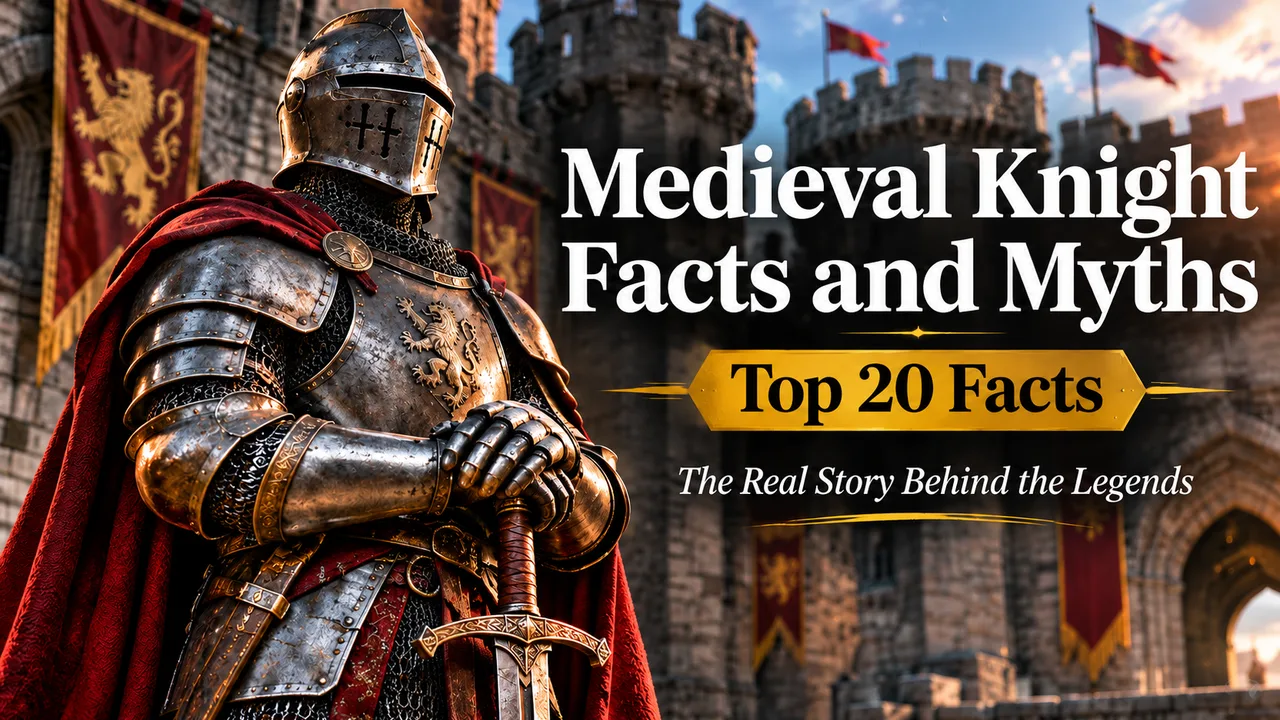
Few figures from the past are as familiar as the medieval knight. Films, novels and games show him in gleaming armour on a giant horse, bound by a strict code of honour and helpless if he ever fell over. The historical record is richer and more surprising. Knights were landholders, administrators, soldiers and courtiers, and the armour, horses and customs they used changed a great deal over the five centuries of their heyday.
This Finepedia list brings together the top 20 medieval knight facts and myths. The first ten entries are well-supported facts about how knights lived, trained and fought. The second ten take on popular myths and explain what surviving armour, horse remains, chronicles and modern experiments really show.
The list draws on museum collections, historical studies and reference works on arms, armour and medieval society. Where historians still debate a point, the entry says so.
Key Facts
The table below sums up all 20 entries on this list, with whether each is a fact or a myth and the evidence behind it.
The 20 Knight Facts and Myths at a Glance
| No. | Entry | Type | What the evidence shows |
|---|---|---|---|
| 1 | Armour was heavy but well balanced | Fact | A full harness weighed about 15 to 25 kg, spread over the body |
| 2 | Warhorses were chosen for training, not size | Fact | Most were coursers and rounceys, not giant horses |
| 3 | Knighthood was a social rank | Fact | It brought land, status and legal duties |
| 4 | Many knights managed estates | Fact | They served as landlords, sheriffs and members of Parliament |
| 5 | Armour was made to measure | Fact | Workshops in Milan, Augsburg and Greenwich fitted their clients |
| 6 | Weapons depended on the job | Fact | Lances, maces, poleaxes and swords all had a role |
| 7 | Tournaments changed over time | Fact | From chaotic mêlées to staged jousts |
| 8 | Chivalry was an ideal | Fact | Writers set out a code that practice often fell short of |
| 9 | Training started in childhood | Fact | Page at about 7, squire at about 14 |
| 10 | Mounted elites existed far beyond Europe | Fact | Similar warrior classes rode in Asia and the Middle East |
| 11 | Knights needed a crane to mount | Myth | Popularised by a 1944 film |
| 12 | A fallen knight could not get up | Myth | Tests show armoured fighters rise and run |
| 13 | Armour weighed over 100 pounds | Myth | Only special jousting armour came close |
| 14 | Every knight wore shining plate | Myth | Mail dominated until the 14th century |
| 15 | Knights always fought on horseback | Myth | Many fought on foot, as at Agincourt |
| 16 | The biggest horse was always best | Myth | Speed, stamina and temper mattered more |
| 17 | Chivalry protected civilians | Myth | Raids on farms and towns were common |
| 18 | Every knight was born noble | Myth | German ministeriales began as unfree servants |
| 19 | The sword was the only important weapon | Myth | The lance was the main weapon of the charge |
| 20 | Knights vanished when guns arrived | Myth | Armoured cavalry lasted into the 17th century |
1. A Knight's Armour Was Heavy but Carefully Balanced
A complete suit of steel plate armour from the 15th century usually weighed about 15 to 25 kilograms.[1] That is a real load, but it is less than the kit many modern infantry soldiers carry, and it was spread over the whole body instead of hanging from the shoulders.
Because each plate was shaped and articulated around the joints, a trained wearer could run, jump, climb and roll.[1] Armourers worked to balance protection against mobility, and the best harnesses were remarkably flexible. The heavy, clumsy image of armour owes more to later imagination than to the objects that survive in museums.[2]
2. Warhorses Were Chosen for Training and Strength, Not Enormous Size
The most famous medieval warhorse was the destrier, called the "great horse" by writers of the time. Yet destriers were rare and very expensive, and most knights and men-at-arms rode other horses such as coursers and rounceys.[3]
Evidence from horse bones, armour for horses and medieval descriptions suggests that warhorses were strong and well muscled but not giants by modern standards. What made a horse valuable was its training, courage and agility. A horse that would charge into a line of men, turn quickly and stay calm amid noise was worth far more than a merely large one.[3]
3. Knighthood Was a Social Status as Well as a Military Role
From the 11th century onwards, being a knight meant more than fighting on horseback. A knight held land, often in return for military service to a lord, and belonged to a recognised social group with its own rituals, such as the ceremony of dubbing.[4]
Over time, knighthood became a mark of rank linked to the nobility, and in many countries it carried legal privileges and duties.[4] By the later Middle Ages some men even paid fines to avoid being knighted, because the honour brought expensive obligations along with the prestige. English kings responded with distraint of knighthood, an order forcing men with land above a set value to accept knighthood or pay a fine, which turned the honour into a useful source of royal income.
4. Many Knights Spent More Time Managing Estates Than Fighting
Wars were frequent, but most knights spent most of their lives at home. They ran manors, collected rents, settled disputes among tenants and looked after their families' interests in local courts.[4]
In England, knights served as sheriffs, justices and commissioners, and from the 13th century "knights of the shire" represented counties in Parliament.[5] This administrative work was as much a part of knightly life as battle, and it gave knights real influence over how their regions were governed.
5. Armour Could Be Made to Fit Its Owner
The finest armour was custom-made. Leading workshops in places such as Milan, Augsburg, Nuremberg and, in the 16th century, Henry VIII's royal armoury at Greenwich, measured their clients and shaped plates to match their bodies.[1]
Not every soldier could afford this. Many men-at-arms bought ready-made "munition" armour or adapted second-hand pieces, and armour was often passed down or captured in war.[1] Even so, surviving suits show that fit was taken seriously, because poorly fitted plates could rub, restrict movement and leave gaps.
Related: Top 10 Most Bizarre Phobias: Strange Fears That Exist
6. Weapons and Fighting Methods Depended on Context
Knights trained with a range of weapons. In a mounted charge the lance came first, and on foot or at close quarters they used swords, maces, axes, war hammers and the long-hafted poleaxe.[6]
As armour improved, weapons changed too. Plate made cutting less effective, so fighters relied more on thrusting points, blunt impact and techniques for grappling and striking at gaps.[1] Surviving fighting manuals show a sophisticated martial art adapted to whatever weapon and situation a knight faced.
7. Tournaments Changed Dramatically Over Time
Early tournaments in the 12th century were rough mass battles, called mêlées, fought across open country by teams of knights. Participants could be wounded or killed, and the Church tried for a long time to ban them.[7]
In the later Middle Ages tournaments became more controlled and theatrical. Single combats such as the joust, fought along a barrier with blunted lances, became the main attraction, and the events were surrounded by heraldry, feasts and spectators.[7] They served both as training for war and as a stage for showing off wealth and status.
8. Chivalry Was an Ideal, Not a Universal Code of Conduct
Chivalry was a set of values described by poets, churchmen and knights themselves. It praised courage, loyalty, generosity, piety and courtesy, and it shaped how knights wanted to be seen.[8]
These ideals were real and influential, but they were aspirations, not rules that every knight followed. Writers often criticised knights for failing to live up to them, and the code mainly governed behaviour toward other members of the elite.[8] Its romantic version owes much to later literature and the Victorian revival of medieval themes.
9. Training Began Long Before Knighthood
A future knight's education usually started in childhood. Boys of the right background were sent to a noble household at around seven as pages, where they learned manners, riding, hunting and the basics of arms.[4]
At around 14 a boy became a squire, serving an experienced knight, caring for horses and armour and accompanying him on campaign.[4] Only after years of service, often around the age of 21, was he formally knighted. By then he had spent most of his life preparing for the role.
10. Mounted Warrior Elites Were Not Only European
The word knight belongs to medieval Europe, but many other societies had elite mounted warriors with similar roles. Byzantine cataphracts, Mamluk cavalry in Egypt and Syria, and the samurai of Japan were all highly trained horsemen tied to land, rank and service.[9]
Related: Top 10 Facts About Dogs
Comparisons have limits, because each group had its own laws, religion and customs. Still, they show that the combination of horse, armour, landholding and an honour code was not unique to Europe. Crusader and military orders such as the Knights Hospitaller also operated far from Europe, in the Levant and the Mediterranean.[4]
11. Myth: Knights Needed a Crane to Mount Their Horses
One of the most persistent images shows a knight being lowered onto his horse by a crane or winch. The scene was made famous by Laurence Olivier's 1944 film Henry V, and it has been repeated in cartoons and comedies ever since.[2]
No medieval evidence supports it. Field armour allowed a knight to mount on his own, usually with a stirrup and sometimes with the help of a squire or a mounting block, as many riders do today.[1] Experiments with reproduction armour show trained people climbing into the saddle without difficulty.
12. Myth: A Knight Who Fell Over Could Not Get Up
Closely linked to the crane myth is the idea of the armoured knight lying helpless on his back like a beetle. Modern experiments with replica armour show this is false: wearers can roll over, stand up, run and even do push-ups.[1]
Studies have found that armour does increase the energy needed to move, especially for breathing and climbing, so fighting in it was exhausting.[2] Knights were also killed when trapped under fallen horses or crushed in packed melees. But in normal conditions a fallen knight could get back on his feet.
13. Myth: Medieval Armour Weighed Well Over 100 Pounds
Popular accounts sometimes claim armour weighed 45 kilograms or more. Field armour designed for battle was usually about 15 to 25 kilograms, which is far lighter.[1]
The heaviest armour was special jousting armour of the late 15th and 16th centuries, which could weigh up to about 50 kilograms.[1] It was built for a single, highly controlled contest on horseback, where mobility mattered less than protection from a lance strike. Mixing up the two has fed the myth that all knights were weighed down.
14. Myth: Every Knight Wore Shining Plate Armour
For much of the Middle Ages, knights did not wear plate at all. From the 11th to the 13th centuries the main protection was mail, a flexible coat of interlinked iron rings, worn over a padded garment.[10]
Related: Top 10 Tallest Buildings in the World
Plate pieces were added gradually during the 13th and 14th centuries, and full plate armour appeared only around 1400.[1] Even then, armour was often covered with cloth, painted or blackened rather than polished to a mirror shine. The gleaming knight of films belongs mainly to the 15th and 16th centuries.
15. Myth: Knights Always Fought on Horseback
The mounted charge was the knight's signature tactic, but knights often fought on foot. In many battles of the Hundred Years' War, English men-at-arms dismounted to fight alongside archers.[11]
At Agincourt in 1415, much of the French army also advanced on foot across muddy ground and was defeated.[11] Knights fought on foot in sieges, on ships and in close terrain. Being able to fight mounted or dismounted was part of their training and made them versatile soldiers.
16. Myth: The Largest Possible Horse Was Always Best
The idea that knights rode huge draught-horse types like modern Shires has little support. Warhorses needed speed, stamina, agility and the right temperament, and size was only one factor.[3]
The most prized horses were well trained and responsive, able to wheel, stop and charge on command. Many knights rode lighter coursers in battle because they were fast and hardy.[3] A horse that was too heavy would tire quickly and be hard to manoeuvre in the press of combat.
17. Myth: Chivalry Meant Knights Never Harmed Civilians
Chivalric writings praised the protection of the weak, but medieval warfare was often brutal for ordinary people. During the Hundred Years' War, armies carried out chevauchées, raids that burned villages, destroyed crops and seized goods to weaken the enemy.[11]
Knights could be courteous to captured nobles, whom they could ransom, while treating commoners harshly.[8] Chroniclers recorded both noble deeds and atrocities. Chivalry influenced behaviour, but it did not prevent violence against civilians.
18. Myth: Every Knight Was a Noble from Birth
Knighthood and nobility became closely linked over time, but the relationship was never simple. In the early period many mounted warriors came from modest backgrounds, and commoners could be knighted for outstanding service.[4]
Related: 10 Sikh Gurus: The Pillars of Sikhism Who Shaped Faith, Equality, Courage, and Humanity
In the Holy Roman Empire, a group called the ministeriales began as unfree servants of lords and bishops, yet they served as knights and many later rose into the lower nobility.[12] Wealth, service and royal favour could open the way to knighthood, and the boundaries of rank shifted from region to region.
19. Myth: The Sword Was a Knight's Only Important Weapon
The sword had great symbolic value. It was used in the dubbing ceremony and often appears in art and literature. But in battle the lance was the primary weapon of the mounted knight, used in the couched position from about the 11th century.[6]
Knights also relied on maces, axes, war hammers and poleaxes, especially against armoured opponents.[6] The sword was a reliable sidearm, comparable to a pistol for a later soldier, but it was one tool among many.
20. Myth: Knights Disappeared as Soon as Firearms Arrived
Gunpowder weapons appeared in Europe in the 14th century, but they did not end knighthood overnight. Early guns were slow and unreliable, and armoured horsemen remained important on battlefields for another two centuries.[1]
Armour was even made thicker and "proofed" against shot in the 16th and 17th centuries, and heavily armoured cuirassiers still fought in the Thirty Years' War.[1] The decline of the knight came gradually, through changes in tactics, the cost of warfare and the rise of professional standing armies.
Conclusion
The top 20 medieval knight facts and myths reveal a figure more practical and more human than the legend. Knights were trained from childhood, wore armour that let them move freely, rode horses chosen for skill, and spent much of their time running estates and serving in local government.
Many popular myths come from films, Victorian romance or the confusion of rare jousting gear with battle armour. Looking at real armour, horses and records helps separate the knight of history from the knight of fiction, and the real story is the more interesting of the two.
- ^ [1] "Plate armour". Wikipedia. Wikipedia
- ^ [2] "Arms and Armor: Common Misconceptions and Frequently Asked Questions". The Metropolitan Museum of Art. The Met
- ^ [3] "Destrier". Wikipedia. Wikipedia
- ^ [4] "Knight". Wikipedia. Wikipedia
- ^ [5] "Knight of the shire". Wikipedia. Wikipedia
- ^ [6] "Lance". Wikipedia. Wikipedia
- ^ [7] "Tournament (medieval)". Wikipedia. Wikipedia
- ^ [8] "Chivalry". Wikipedia. Wikipedia
- ^ [9] "Cataphract". Wikipedia. Wikipedia
- ^ [10] "Mail (armour)". Wikipedia. Wikipedia
- ^ [11] "Battle of Agincourt". Wikipedia. Wikipedia
- ^ [12] "Ministerialis". Wikipedia. Wikipedia






















Discussion
Log in with