




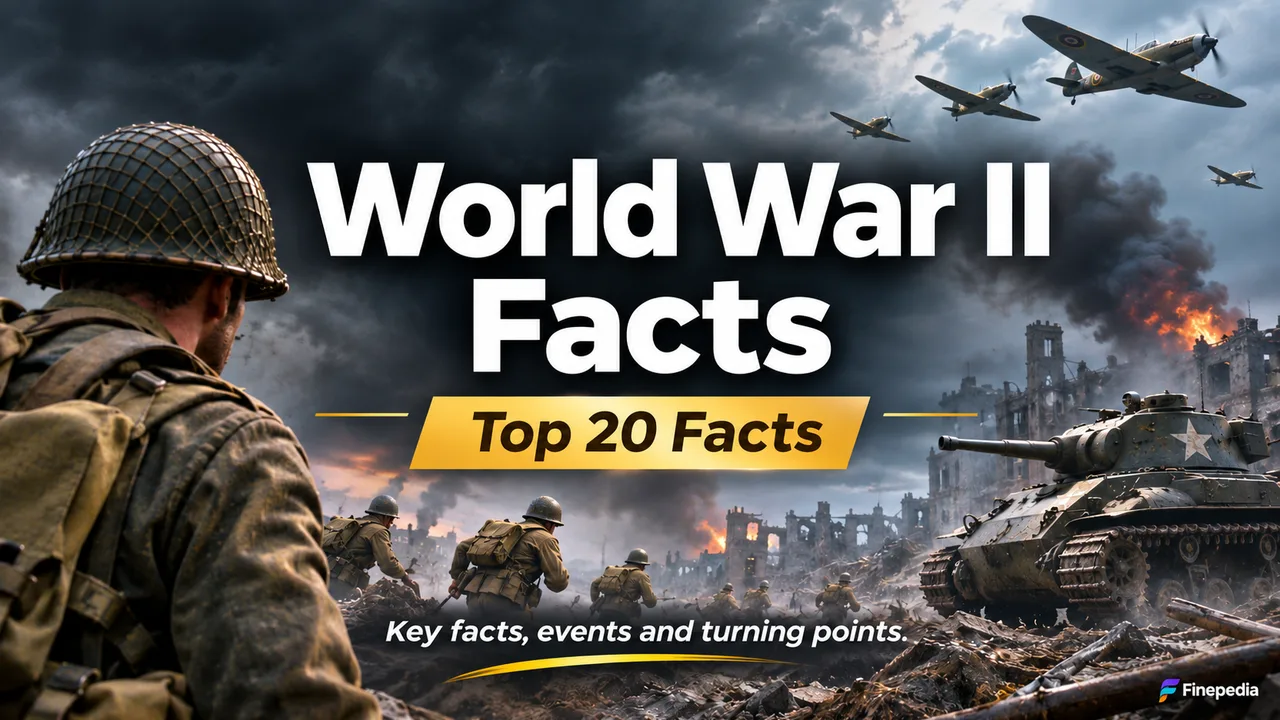
World War II was the largest and deadliest conflict in human history. Fought from 1939 to 1945 across Europe, Asia, Africa and the world's oceans, it involved most of the world's nations and caused an estimated 60 to 75 million deaths. Its battles, crimes and peace settlements still shape the world today.
This Finepedia list brings together the top 20 World War II facts. The first ten are lesser-known details that often surprise readers, from Polish codebreakers to the different end dates of the war. The second ten are essential pieces of context that everyone should know to understand how the war began, how it was fought and how it ended.
Each entry is based on well-established history. Where numbers are estimates, as with casualties, the entry gives the commonly cited range rather than a single exact figure.
Key Facts
The table below sums up all 20 entries on this list, with the key date and why each fact matters.
The 20 World War II Facts at a Glance
| No. | Fact | Key date | Why it matters |
|---|---|---|---|
| 1 | Polish mathematicians broke Enigma | 1932 | Laid the foundation for Allied codebreaking |
| 2 | Poland shared the Enigma secret | July 1939 | Helped Britain and France before the war |
| 3 | Bletchley Park produced Ultra | 1939–1945 | Allied intelligence shaped key campaigns |
| 4 | Women served in huge numbers | 1939–1945 | Factories and armed forces relied on them |
| 5 | The war ended on different dates | May and September 1945 | Europe and Asia surrendered separately |
| 6 | D-Day was part of a bigger plan | 6 June 1944 | Operation Overlord opened a western front |
| 7 | The United Nations was planned in wartime | 1 January 1942 | The Allies called themselves the United Nations |
| 8 | The Battle of the Atlantic never stopped | 1939–1945 | The longest continuous campaign of the war |
| 9 | Germany declared war on the United States | 11 December 1941 | Brought the US into the European war |
| 10 | The Eastern Front was the largest theatre | 1941–1945 | Most German losses happened there |
| 11 | The invasion of Poland began the war in Europe | 1 September 1939 | Britain and France declared war two days later |
| 12 | The alliances changed over time | 1939–1945 | The Soviet Union and Italy switched sides |
| 13 | Pearl Harbor had a long background | 7 December 1941 | Followed years of war in China and sanctions |
| 14 | Midway turned the Pacific war | June 1942 | Japan lost four aircraft carriers |
| 15 | The Holocaust was state-organised genocide | 1941–1945 | About six million Jews were murdered |
| 16 | Stalingrad was a turning point | 1942–1943 | A whole German army was destroyed |
| 17 | Two atomic bombs were used | August 1945 | The only wartime use of nuclear weapons |
| 18 | The UN Charter came before Japan's surrender | 26 June 1945 | Created a new world organisation |
| 19 | War crimes trials followed | 1945–1948 | Nuremberg and Tokyo set legal precedents |
| 20 | The war reshaped the world | 1945 onwards | New borders, the Cold War and decolonisation |
1. Polish Mathematicians Broke Enigma Before the War
Germany's Enigma cipher machine is often linked with British codebreakers at Bletchley Park, but the first breakthrough came in Poland. In late 1932 Marian Rejewski, a mathematician working for the Polish Cipher Bureau, reconstructed the German military Enigma without ever having seen one.[1]
Working with fellow mathematicians Jerzy Różycki and Henryk Zygalski, Rejewski developed methods and devices to read Enigma messages for much of the 1930s.[1] Their success rested on mathematics, especially permutation theory, rather than on the language-based methods of earlier codebreakers.
The Germans kept improving Enigma throughout the 1930s, adding complexity that made the Polish methods harder to use. By 1938 the Poles had built electromechanical devices called bomby to keep up, the forerunners of the later British machines.[1]
2. The Enigma Secret Was Shared Weeks Before the War
As war with Germany approached, Poland decided to share its knowledge. In July 1939, at a secret meeting in the Pyry forest near Warsaw, Polish codebreakers briefed French and British intelligence officers and gave each a reconstructed Enigma machine.[2]
The invasion of Poland began just over a month later. The Polish gift gave Britain and France a crucial head start, and the cryptologists themselves escaped to France to keep working against Germany.[2]
For decades after the war, the Polish contribution was little known outside specialist circles, partly because the whole Enigma story stayed secret until the 1970s. Today Rejewski, Różycki and Zygalski are widely recognised as pioneers of modern cryptology.[2]
3. Bletchley Park Turned Codebreaking into Intelligence
Building on the Polish work, British codebreakers at Bletchley Park in Buckinghamshire, including Alan Turing, designed electromechanical machines called bombes to find daily Enigma settings much faster.[3]
The intelligence they produced, code-named Ultra, helped the Allies in the Battle of the Atlantic, in North Africa and in planning the Normandy landings.[3] Thousands of people worked at Bletchley, many of them women, and the work remained secret for decades after the war.
4. Women Served in Armed Forces and Wartime Industries
World War II mobilised women on an unprecedented scale. Millions worked in factories, farms and offices to replace men who had gone to fight, and the American image of "Rosie the Riveter" became a symbol of this wartime workforce.[4]
Several hundred thousand women served in combat roles, especially in anti-aircraft units, and the Soviet Union integrated women directly into its armed forces as pilots, snipers and soldiers.[4] In Britain and the United States, women's auxiliary services took on roles from radar operation to ferrying aircraft.
The wartime experience changed expectations for many women, although most were pushed out of industrial jobs when men returned. Historians see the war as an important step in the longer story of women's rights and employment in the 20th century.[4]
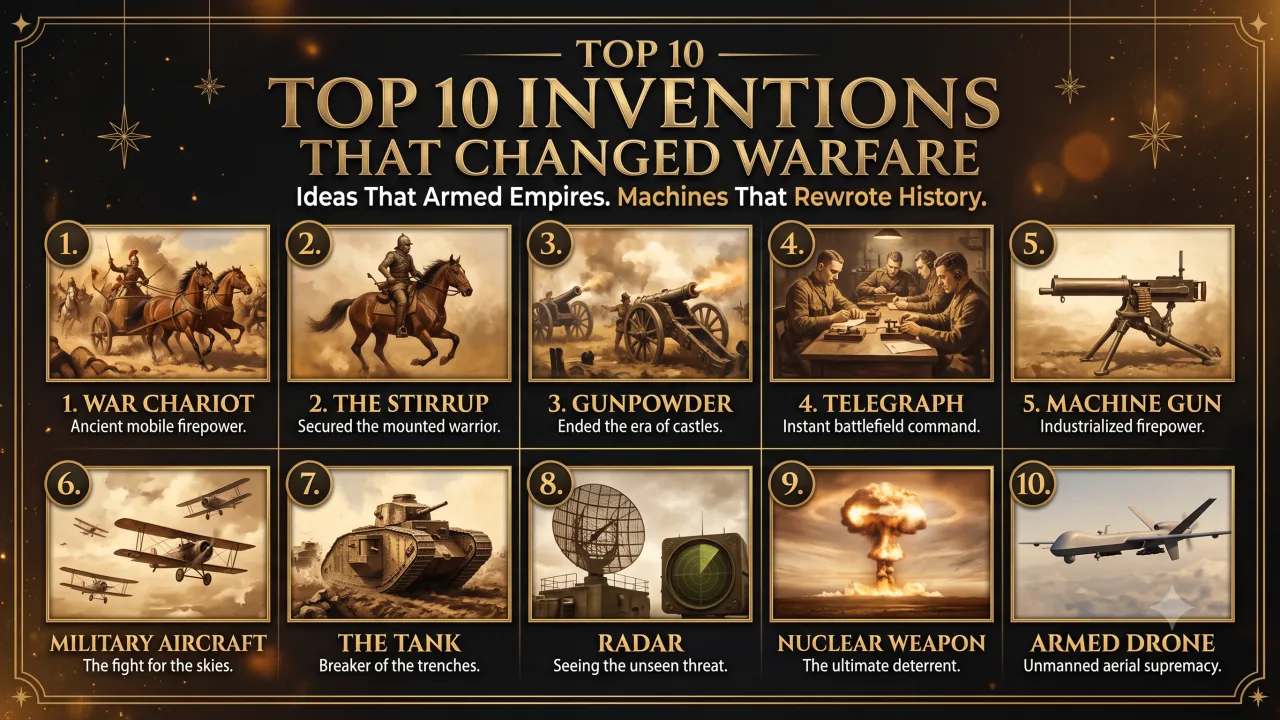
Related: Top 10 Inventions That Changed Warfare: Chariots to Drones
5. The War Ended on Different Dates in Europe and Asia
Germany surrendered unconditionally in early May 1945, and the Allies celebrated Victory in Europe Day on 8 May.[5] For many people in Europe the war was over, but in Asia and the Pacific it continued.
Japan announced its acceptance of the Allied terms on 15 August 1945, and the formal surrender was signed aboard the USS Missouri in Tokyo Bay on 2 September 1945.[6] As a result, different countries commemorate the end of the war on different days.
6. D-Day Was One Phase of a Larger Operation
The Normandy landings of 6 June 1944, known as D-Day, were the largest seaborne invasion in history. They were the opening phase of Operation Overlord, the Allied campaign to liberate north-western Europe.[7]
The assault began shortly after midnight with heavy air and naval bombardment and an airborne landing of about 24,000 American, British and Canadian troops, followed by landings on five beaches.[7] Months of planning, deception operations and the build-up of supplies made the landings possible.
Deception plans such as Operation Fortitude persuaded German commanders that the main attack would come at the Pas-de-Calais. Even after D-Day, Germany held back forces there, which helped the Allies secure their beachhead in Normandy.[7]
7. The United Nations Was Named During the War
The term United Nations was first used for the wartime Allies. On 1 January 1942, during a conference in Washington, the United States, Britain, the Soviet Union and China signed the Declaration by United Nations, and many other Allied governments joined soon after. They pledged to fight together against the Axis and not to make a separate peace.[8]
The name was later carried into the postwar organisation. Planning for that body began during the war at conferences such as Dumbarton Oaks in 1944, long before the fighting ended.[8]
8. The Battle of the Atlantic Lasted the Whole War
The Battle of the Atlantic was the longest continuous military campaign of World War II, running from 1939 to Germany's defeat in 1945.[9] German U-boats tried to cut the shipping routes that carried food, fuel and weapons to Britain.
Allied convoys, air patrols, radar and codebreaking gradually defeated the U-boat threat, especially from 1943 onwards.[9] Victory in the Atlantic made it possible to build up the forces needed for the invasion of Europe.
The cost was high on both sides. Thousands of merchant ships were sunk and tens of thousands of sailors died, while the U-boat arm suffered one of the highest loss rates of any force in the war.[9]
9. Germany Declared War on the United States
After Japan attacked Pearl Harbor on 7 December 1941, the United States declared war on Japan the next day. It was Germany, however, that declared war on the United States on 11 December 1941, followed by Italy.[10]
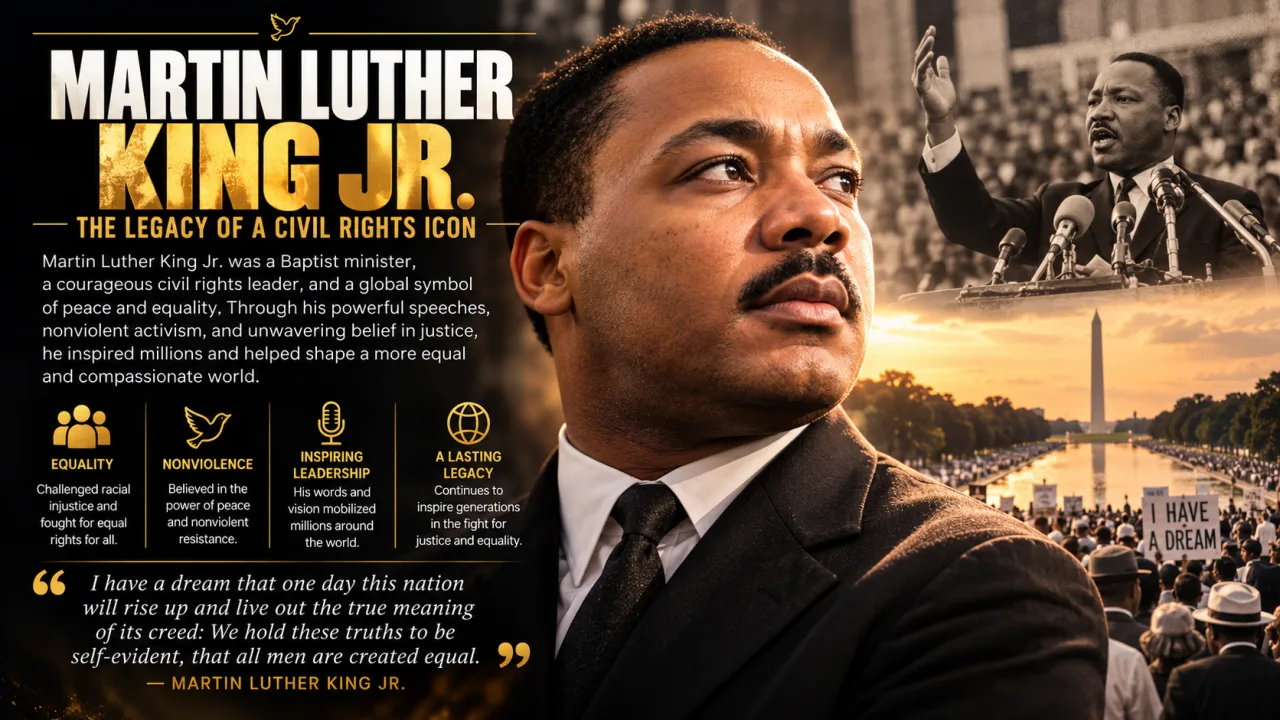
Related: Martin Luther King Jr.: The Legacy of a Civil Rights Icon
Hitler's decision brought the United States fully into the European war. It allowed President Franklin D. Roosevelt to pursue a "Germany first" strategy agreed with Britain, focusing the main effort on defeating Germany.[10]
10. The Eastern Front Was the Largest Theatre of the War
On 22 June 1941, Germany and its allies invaded the Soviet Union in Operation Barbarossa, the largest invasion in history.[11] The war on the Eastern Front that followed involved millions of soldiers on each side.
Fighting there was extremely brutal and included the deliberate killing of civilians and prisoners. Most German military losses of the war occurred on the Eastern Front, and Soviet military and civilian deaths ran into the tens of millions.[11]
11. Germany's Invasion of Poland Began the War in Europe
World War II in Europe began on 1 September 1939, when Germany invaded Poland. Britain and France, which had guaranteed Poland's independence, declared war on Germany on 3 September.[12]
On 17 September the Soviet Union invaded Poland from the east, following a secret agreement with Germany. Poland was divided between the two powers within weeks, though Polish forces continued to fight from abroad throughout the war.[12]
12. The Axis and Allies Were Coalitions That Changed Over Time
The two sides were not fixed. In August 1939 Germany and the Soviet Union signed the Molotov–Ribbentrop Pact, a non-aggression treaty with secret clauses dividing Eastern Europe.[13] The Soviet Union only joined the Allies after Germany invaded it in 1941.
Italy fought alongside Germany until it signed an armistice with the Allies in September 1943, and then declared war on Germany.[13] Other countries, such as Romania and Bulgaria, also changed sides as the war turned against the Axis.
13. Pearl Harbor Did Not Happen in a Vacuum
Japan's attack on the US naval base at Pearl Harbor in Hawaii on 7 December 1941 killed more than 2,400 Americans and brought the United States into the war.[14] It followed years of rising tension.
Japan had been at war with China since 1937 and had moved into French Indochina. In response, the United States and its partners imposed economic sanctions, including an oil embargo in 1941.[14] Japanese leaders decided to strike first to seize resources in Southeast Asia.
Related: Top 10 Lost Cities That Were Rediscovered
The attack was part of a wider offensive. Within hours, Japanese forces also struck British, Dutch and American territories across Asia and the Pacific, including Malaya, Hong Kong and the Philippines.[14]
14. Midway Turned the Tide in the Pacific
In June 1942, six months after Pearl Harbor, the US Navy defeated a Japanese fleet near Midway Atoll. Helped by codebreakers who had uncovered Japan's plans, American aircraft sank four Japanese aircraft carriers.[15]
Japan never fully recovered from the loss of its carriers and experienced pilots. After Midway, the United States and its allies gradually took the offensive across the Pacific.[15]
15. The Holocaust Was a State-Organised Genocide
The Holocaust was the systematic murder of about six million European Jews by Nazi Germany and its collaborators. Jews were persecuted, forced into ghettos, shot in mass killings and deported to extermination camps such as Auschwitz-Birkenau and Treblinka.[16]
The Nazis also murdered millions of other victims, including Roma, disabled people, Soviet prisoners of war and Poles. At the Wannsee Conference in January 1942, senior officials coordinated the "Final Solution", the plan to murder all Jews within reach.[16]
16. Stalingrad Was a Major Turning Point
The Battle of Stalingrad, fought from August 1942 to February 1943, was one of the bloodiest battles in history. German forces tried to capture the city on the Volga and were drawn into savage street fighting.[17]
In November 1942 a Soviet counter-offensive encircled the German Sixth Army. Its surviving troops surrendered in February 1943, and the Soviet victory marked a turning point on the Eastern Front.[17]
17. The Atomic Bombings Occurred in August 1945
On 6 August 1945, the United States dropped an atomic bomb on Hiroshima, and on 9 August a second bomb on Nagasaki. The bombings killed tens of thousands of people immediately and many more from injuries and radiation.[18]
The Soviet Union declared war on Japan on 8 August and invaded Manchuria. Japan announced its surrender days later.[18] These remain the only uses of nuclear weapons in war, and historians continue to debate the decision.
Supporters argued the bombings ended the war quickly and avoided an invasion of Japan, while critics have stressed the civilian toll and the alternatives that may have existed. The debate has shaped thinking about nuclear weapons ever since.[18]
Related: Top 10 Most Bizarre Phobias: Strange Fears That Exist
18. The UN Charter Was Signed Before Japan's Surrender
Delegates from 50 countries met in San Francisco in 1945 and signed the Charter of the United Nations on 26 June 1945, while the war against Japan was still being fought.[19]
The Charter came into force on 24 October 1945, now celebrated as United Nations Day. It set up the General Assembly, the Security Council and other bodies, aiming to prevent another world war.[19]
19. Postwar Trials Addressed Wartime Crimes
After the war, the Allies prosecuted leaders of the defeated powers. The International Military Tribunal at Nuremberg tried senior Nazi leaders between November 1945 and October 1946 for crimes including aggression, war crimes and crimes against humanity.[20]
A similar tribunal in Tokyo tried Japanese leaders from 1946 to 1948. The trials helped establish principles of international criminal law that influenced later courts.[20]
The Nuremberg principles held that individuals could be responsible for crimes under international law even when acting on government orders. These ideas later informed the Genocide Convention and modern bodies such as the International Criminal Court.[20]
20. The War Reshaped Borders and International Institutions
The war left Europe divided between Western and Soviet spheres, a split that grew into the Cold War. Germany was divided, and borders in Central and Eastern Europe were redrawn, forcing millions of people to move.[5]
New institutions emerged, including the United Nations and the international financial bodies agreed at Bretton Woods in 1944. The weakening of European empires also helped speed up decolonisation in Asia and Africa.[5]
Conclusion
The top 20 World War II facts show how much the war involved beyond its famous battles. Codebreakers in Poland and Britain, women in factories and armed forces, and diplomats planning the United Nations all shaped the outcome alongside the soldiers at the front.
The war's crimes, especially the Holocaust, and its terrible human cost remain central to understanding the 20th century. Its end in 1945 created the political and institutional world that followed, from the United Nations to the Cold War. Remembering both the little-known details and the essential facts helps explain why the war still matters, more than eight decades after it began.
- ^ [1] "Marian Rejewski". Wikipedia. Wikipedia
- ^ [2] "Cryptanalysis of the Enigma". Wikipedia. Wikipedia
- ^ [3] "Bletchley Park". Wikipedia. Wikipedia
- ^ [4] "Women in World War II". Wikipedia. Wikipedia
- ^ [5] "World War II". Wikipedia. Wikipedia
- ^ [6] "Surrender of Japan". Wikipedia. Wikipedia
- ^ [7] "Normandy landings". Wikipedia. Wikipedia
- ^ [8] "Declaration by United Nations". Wikipedia. Wikipedia
- ^ [9] "Battle of the Atlantic". Wikipedia. Wikipedia
- ^ [10] "German declaration of war against the United States". Wikipedia. Wikipedia
- ^ [11] "Operation Barbarossa". Wikipedia. Wikipedia
- ^ [12] "Invasion of Poland". Wikipedia. Wikipedia
- ^ [13] "Allies of World War II". Wikipedia. Wikipedia
- ^ [14] "Attack on Pearl Harbor". Wikipedia. Wikipedia
- ^ [15] "Battle of Midway". Wikipedia. Wikipedia
- ^ [16] "The Holocaust". Wikipedia. Wikipedia
- ^ [17] "Battle of Stalingrad". Wikipedia. Wikipedia
- ^ [18] "Atomic bombings of Hiroshima and Nagasaki". Wikipedia. Wikipedia
- ^ [19] "Charter of the United Nations". Wikipedia. Wikipedia
- ^ [20] "Nuremberg trials". Wikipedia. Wikipedia














Discussion
Log in with