







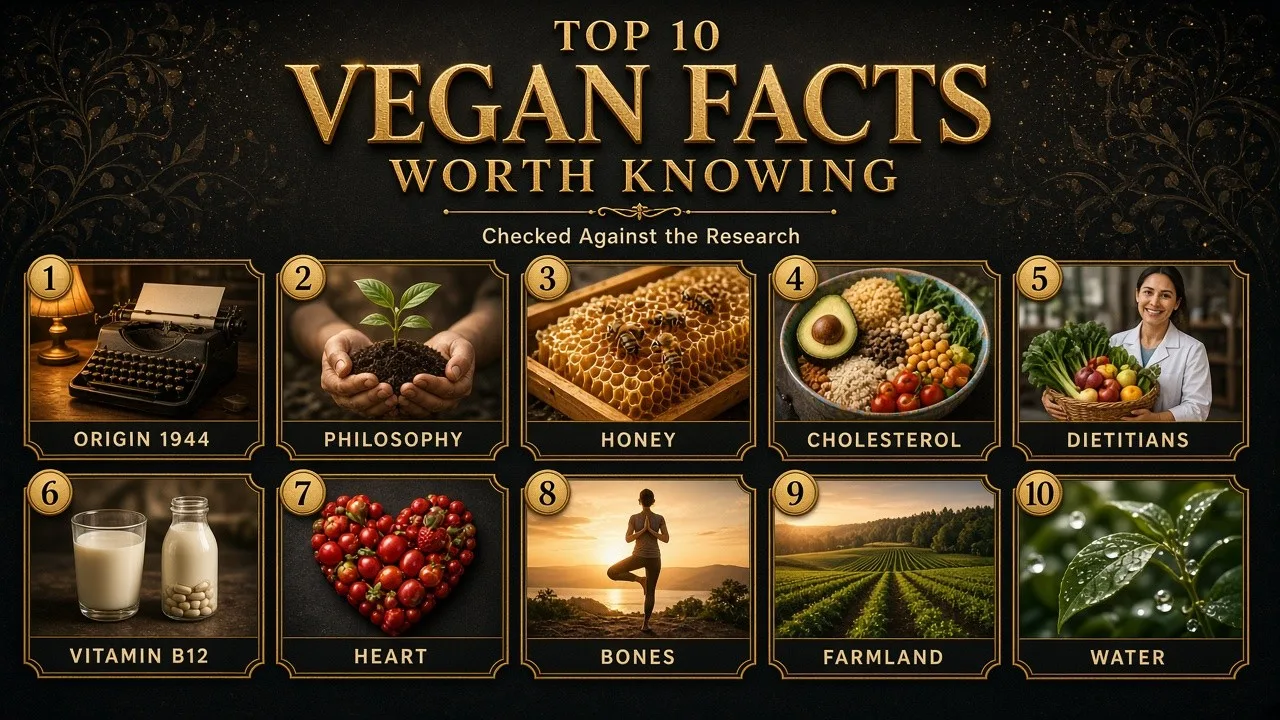
These vegan facts cover where the word came from, what vegans avoid, the nutrients they must plan for and how plant-based eating affects land and water.
Veganism has moved from a small British society of six people to a choice you can find on supermarket shelves, restaurant menus and food labels around the world. It is also surrounded by myths. Some people think vegans cannot get enough protein, others think any product without milk must be vegan, and plenty of claims shared online quote statistics that no one can trace.
This guide sets out ten facts about veganism that hold up when you check them. For each one you will find a Quick Facts table, the background and the research behind it, and a few related details. The sources include The Vegan Society, which coined the word, the Academy of Nutrition and Dietetics, the US National Institutes of Health, the NHS, the Food and Agriculture Organization of the United Nations and peer-reviewed studies from the University of Oxford and elsewhere. It is general information, not medical or dietary advice.
How We Chose These Facts
We started with the facts most often repeated about veganism and kept only those we could confirm from a primary or expert source. Several popular claims did not survive. Numbers such as "one vegan saves an acre of forest a year" or exact counts of animals killed every hour are widely shared but rarely sourced, so we replaced them with figures from published research and international agencies.
The list is grouped in a simple order. The first three facts explain what veganism is and what it excludes. Facts four to eight look at nutrition and health, including the areas where vegans need to take extra care. The last two look at the environmental footprint of food, which is one of the main reasons people give for going vegan.
Vegan Facts at a Glance
| No. | Fact | Key detail | Source |
|---|---|---|---|
| 1 | The word vegan dates from 1944 | Coined by Donald Watson and fellow founders of The Vegan Society | The Vegan Society |
| 2 | Veganism is more than a diet | Seeks to exclude animal exploitation for food, clothing or any other purpose | The Vegan Society |
| 3 | Dairy-free does not always mean vegan | Honey and many processed foods are excluded by vegans | The Vegan Society, Oreo |
| 4 | Plants contain no dietary cholesterol | Cholesterol in food comes from animal sources | MedlinePlus (US NIH) |
| 5 | Dietitians back well-planned vegan diets | Suitable for all stages of life, including pregnancy and childhood | Academy of Nutrition and Dietetics |
| 6 | Vitamin B12 is the nutrient vegans must plan for | Plant foods have none unless fortified | NIH Office of Dietary Supplements |
| 7 | Lower heart disease, but a stroke question | Vegetarians and vegans had 22 percent lower ischaemic heart disease rates | EPIC-Oxford, The BMJ 2019 |
| 8 | Bone health needs attention | Vegans had a higher risk of hip fracture | EPIC-Oxford, BMC Medicine 2020 |
| 9 | A vegan world would need far less farmland | Agricultural land could shrink by about 75 percent | Poore and Nemecek, Science 2018 |
| 10 | Beef has a huge water footprint | About 15,400 litres of water per kilogram | Mekonnen and Hoekstra 2012 |
What Does Vegan Mean?
A vegan does not eat meat, fish, seafood, dairy, eggs, honey or any other food made wholly or partly from animals. Many vegans also avoid animal products outside the kitchen, such as leather, wool, silk and cosmetics tested on animals. A vegetarian, by contrast, avoids meat and fish but usually still eats dairy and eggs.
| Diet | Meat and fish | Dairy | Eggs | Honey |
|---|---|---|---|---|
| Vegan | No | No | No | No |
| Lacto-ovo vegetarian | No | Yes | Yes | Usually yes |
| Pescatarian | Fish only | Yes | Yes | Usually yes |
| Plant-based (informal) | Mostly no | Mostly no | Mostly no | Varies |
The term plant-based is often used interchangeably with vegan, but it usually describes a way of eating rather than a wider ethical position. Someone can eat a mostly plant-based diet for health reasons and still wear leather shoes, while a vegan in the full sense of The Vegan Society definition would try to avoid both.
1. The Word Vegan Was Invented in 1944
| Attribute | Details |
|---|---|
| Year coined | 1944 |
| Where | United Kingdom |
| Coined by | Donald Watson, with fellow founders of The Vegan Society |
| Founding meeting | Six non-dairy vegetarians, including Elsie Shrigley |
| Rejected names | Dairyban, vitan and benevore |
The Story
In November 1944 Donald Watson called a meeting with five other non-dairy vegetarians, including Elsie Shrigley, to talk about diets and lifestyles that avoided dairy as well as meat. The group decided they needed a shorter word than non-dairy vegetarian to describe themselves, and that meeting led to the founding of The Vegan Society.
According to The Vegan Society, the group considered and rejected several alternatives, including dairyban, vitan and benevore. They settled on vegan, a word Watson later described as containing the first three and last two letters of vegetarian. The society also credits early members George and Fay Henderson, who had suggested the names Allvega and Allvegan.
Why It Matters
Before 1944, people who avoided all animal products had no simple label. The new word helped turn a scattered set of personal choices into an organised movement with its own magazine, membership and campaigns. The Vegan Society describes the six founders as the first to actively start a new movement, despite opposition at the time.
Interesting Facts
- Donald Watson lived from 1910 to 2005, so he saw the word he helped create spread around the world.
- The Vegan Society promotes November as World Vegan Month, the same month the society was founded.
- The society was first registered as a charity in August 1964 and became a limited company in December 1979.
2. Veganism Is a Philosophy, Not Just a Diet
| Attribute | Details |
|---|---|
| First definition proposed | 1949, by Leslie J Cross |
| Current definition in use since | By winter 1988 |
| Core idea | Exclude animal exploitation and cruelty as far as possible and practicable |
| Scope | Food, clothing and any other purpose |
| Dietary meaning | No products derived wholly or partly from animals |
The Definition
Although the vegan diet was set out in 1944, The Vegan Society notes that it was not until 1949 that member Leslie J Cross pointed out the society lacked a definition of veganism. He suggested the principle of the emancipation of animals from exploitation by man, later clarified to include food, commodities, work, hunting, vivisection and other uses.
The definition used today was in place by 1988. It describes veganism as a philosophy and way of living which seeks to exclude, as far as is possible and practicable, all forms of exploitation of, and cruelty to, animals for food, clothing or any other purpose. It also promotes animal-free alternatives for the benefit of animals, humans and the environment.
What This Means in Practice
The phrase "as far as is possible and practicable" is important. It accepts that complete avoidance of animal products is not always possible in the modern world, for example with some medicines. Vegans are asked to do what they reasonably can rather than meet an impossible standard.
Interesting Facts
- In dietary terms, the definition means dispensing with all products derived wholly or partly from animals.
- Many vegans extend the principle to clothing, avoiding leather, fur, wool and silk.
- Cosmetics and household products are often checked for animal testing and animal-derived ingredients.
3. Dairy-Free Does Not Always Mean Vegan
| Attribute | Details |
|---|---|
| Most commonly mistaken product | Honey, according to The Vegan Society |
| Why honey is excluded | Bees make it as their own food store |
| A surprising non-vegan snack | Oreo cookies, according to the brand |
| Common hidden ingredients | Gelatin, whey, casein, carmine |
| Best check | The full ingredients list and any vegan certification |
Honey
The Vegan Society says honey is probably the product most frequently mistaken as vegan-friendly. Honey is the energy source of the hive and helps bees survive poor weather and winter. When beekeepers remove it, they often replace it with a sugar substitute that lacks honey's micronutrients. The society also notes that each honey bee produces only about a twelfth of a teaspoon of honey in its lifetime.
Processed Foods
Many people believe that well-known cookies such as Oreos are vegan because the recipe does not list milk as a main ingredient. The official Oreo FAQ says the opposite: the brand states that Oreo cookies are not kosher or vegan and that it cannot guarantee they are free of allergens. This is a good example of why a product without obvious dairy still needs checking.
Hidden Animal Ingredients
- Gelatin, made from animal collagen, is used in many sweets, desserts and capsules.
- Whey and casein are milk proteins found in breads, snacks and protein powders.
- Carmine is a red colouring made from insects.
- Some wines and beers are clarified with animal-derived fining agents.
Interesting Facts
- The Vegan Society says honey bees visit up to 1,500 flowers to fill their honey stomach once.
- There are only seven recognised species of honey bee, while thousands of other bee species pollinate plants.
4. Plant Foods Contain No Dietary Cholesterol
| Attribute | Details |
|---|---|
| Where food cholesterol comes from | Animal sources such as egg yolks, meat and cheese |
| Does the body need food cholesterol? | No, the body makes all it needs |
| Plant foods | Contain no cholesterol |
| What still affects blood cholesterol | Saturated fat, genetics, weight and activity |
| Source | MedlinePlus, US National Library of Medicine |
The Science
MedlinePlus, the consumer health service of the US National Institutes of Health, explains that your body makes all the cholesterol it needs and that cholesterol is also found in foods from animal sources, such as egg yolks, meat and cheese. Because a vegan diet contains no animal foods, it contains no dietary cholesterol at all.
The reference article behind this topic suggested using "cholesterol-free" labels as a shortcut to find vegan products. That shortcut is not reliable. A product can be cholesterol-free and still contain honey, gelatin or other animal-derived ingredients that carry little or no cholesterol.
Why It Matters
The Academy of Nutrition and Dietetics notes that vegetarian and vegan diets, with low intakes of saturated fat and high intakes of vegetables, fruits, whole grains, legumes, soy, nuts and seeds, are linked to lower total and LDL cholesterol. That is one reason plant-based diets are often recommended for heart health.
Interesting Facts
- Coconut oil and palm oil are plant foods with no cholesterol but are high in saturated fat.
- A vegan diet built on processed snacks and refined carbohydrates will not deliver the same benefits as one built on whole foods.
5. Leading Dietitians Say Well-Planned Vegan Diets Suit All Ages
| Attribute | Details |
|---|---|
| Organisation | Academy of Nutrition and Dietetics (US) |
| Position paper | Vegetarian Diets, published December 2016 |
| Verdict | Appropriately planned vegan diets are healthful and nutritionally adequate |
| Suitable for | Pregnancy, lactation, infancy, childhood, adolescence, older adults and athletes |
| Key condition | Reliable vitamin B12 from fortified foods or supplements |
What the Experts Say
The Academy of Nutrition and Dietetics, the largest organisation of food and nutrition professionals in the United States, published its position on vegetarian diets in its journal in 2016. It states that appropriately planned vegetarian diets, including vegan diets, are healthful, nutritionally adequate and may provide health benefits for the prevention and treatment of certain diseases.
The paper says these diets are appropriate for all stages of the life cycle, including pregnancy, lactation, infancy, childhood, adolescence, older adulthood and for athletes. It links vegetarian and vegan diets with reduced risk of ischaemic heart disease, type 2 diabetes, high blood pressure, certain types of cancer and obesity.
Caveats
- The key words are "appropriately planned". A vegan diet that leaves out whole food groups without replacing their nutrients can fall short.
- Pregnant and breastfeeding women, babies and young children have higher needs, so expert guidance is especially useful.
- The same paper stresses that vegans need reliable sources of vitamin B12.
Interesting Facts
- The position paper also says plant-based diets are more environmentally sustainable because they use fewer natural resources.
- The NHS similarly says that with good planning you can get all the nutrients your body needs on a vegan diet.
6. Vitamin B12 Is the One Nutrient Vegans Must Plan For
| Attribute | Details |
|---|---|
| Adult daily recommendation | 2.4 mcg |
| Natural sources | Animal foods only |
| Vegan sources | Fortified foods and supplements |
| Higher risk groups | Vegans, older adults, babies of vegan mothers |
| Other nutrients to watch (NHS) | Vitamin D, iodine, selenium, calcium, iron and omega-3 fats |
Why B12 Is Different
The NIH Office of Dietary Supplements states that only animal foods have vitamin B12 naturally and that plant foods have no vitamin B12 unless they are fortified. The recommended amount for adults is 2.4 micrograms a day. Vegans can meet this with fortified foods, such as some plant milks, breakfast cereals and nutritional yeast, or with a supplement.
The NIH also warns that when pregnant or breastfeeding women follow a vegan diet, their babies might not get enough vitamin B12 either. This is why every major guideline on vegan eating singles out B12 as non-negotiable.
Other Nutrients to Watch
| Nutrient | Why it matters | Vegan sources (NHS) |
|---|---|---|
| Calcium | Bones and teeth | Calcium-set tofu, fortified plant drinks, green leafy vegetables such as broccoli and cabbage |
| Vitamin D | Absorbing calcium | Sunlight, fortified foods, supplements |
| Iron | Healthy blood | Pulses, wholemeal bread, dark green vegetables, dried fruit |
| Iodine | Thyroid function | Fortified foods or supplements |
| Omega-3 fats | Eyes, skin, immune system and brain | Walnuts, ground linseed (flaxseed) oil, chia seeds |
Interesting Facts
- The NHS notes that spinach is high in calcium but the body cannot absorb it all, so it is not a good calcium source.
- In the UK, calcium is added to white and brown flour by law, which helps vegans who eat bread.
- The NIH notes many older adults struggle to absorb B12 from food, so it advises people over 50 to rely mainly on fortified foods or supplements.
7. Vegetarians and Vegans Have Lower Heart Disease Rates, but Higher Stroke Rates
| Attribute | Details |
|---|---|
| Study | EPIC-Oxford, published in The BMJ in 2019 |
| Participants | 48,188 adults in the UK |
| Follow-up | 18.1 years |
| Ischaemic heart disease | 22 percent lower in vegetarians, including vegans |
| Total stroke | 20 percent higher in vegetarians, including vegans |
What the Research Shows
The EPIC-Oxford study, led by researchers at the University of Oxford, followed 48,188 people with no history of heart disease or stroke for an average of 18.1 years. After adjusting for lifestyle and social factors, vegetarians, a group that included vegans, had 22 percent lower rates of ischaemic heart disease than meat eaters. That equalled about 10 fewer cases per 1,000 people over 10 years.
The same study found vegetarians had 20 percent higher rates of total stroke, equal to about three more cases per 1,000 people over 10 years. Most of the difference came from haemorrhagic stroke, the type caused by bleeding in the brain.
Caveats
- This is an observational study, so it shows associations rather than proof of cause and effect.
- The heart disease benefit was partly explained by lower cholesterol, blood pressure, diabetes and body weight in vegetarians.
- Stroke rates did not change much when the researchers also adjusted for blood pressure, cholesterol and other risk factors.
Interesting Facts
- Fish eaters in the same study had 13 percent lower rates of ischaemic heart disease than meat eaters.
- EPIC-Oxford was recruited between 1993 and 2001 and is one of the largest studies anywhere with many non-meat eaters.
8. Vegans Need to Pay Attention to Bone Health
| Attribute | Details |
|---|---|
| Study | EPIC-Oxford, published in BMC Medicine in 2020 |
| Vegans at baseline | 1,982 |
| Follow-up | 17.6 years on average |
| Hip fracture risk in vegans | 2.31 times that of meat eaters |
| Total fracture risk in vegans | 43 percent higher than meat eaters |
What the Research Shows
A 2020 analysis of the EPIC-Oxford cohort compared fracture risks across meat eaters, fish eaters, vegetarians and vegans over an average of 17.6 years. After adjusting for social and lifestyle factors and body mass index, vegans had a hazard ratio of 2.31 for hip fracture compared with meat eaters, equal to about 14.9 more cases for every 1,000 people over 10 years.
Vegans also had higher risks of total fractures, leg fractures and fractures at other main sites such as the collarbone, ribs and spine. The differences were slightly reduced, but remained significant, after accounting for calcium and protein intake.
What This Means
The authors concluded that bone health in vegans requires further research. In practical terms, it is a reminder that a vegan diet needs enough calcium, vitamin D and protein, along with weight-bearing exercise. Fortified plant drinks, calcium-set tofu and pulses all help.
Interesting Facts
- No significant differences were found for wrist or ankle fractures in the study.
- Lower body weight in vegans appeared to explain part, but not all, of the higher risk.
9. A Vegan World Would Need About 75 Percent Less Farmland
| Attribute | Details |
|---|---|
| Study | Poore and Nemecek, Science, 2018 |
| Data covered | 38,700 farms and 1,600 processors, packaging types and retailers |
| Current agricultural land | About 4.1 billion hectares |
| Land needed in an all-vegan world | About 1 billion hectares |
| Reduction | About 75 percent |
What the Research Shows
In 2018 Joseph Poore of the University of Oxford and Thomas Nemecek of the Swiss research centre Agroscope published one of the largest analyses ever made of food's environmental impact. It pooled data from about 38,700 farms and 1,600 processors, packaging types and retailers. A key finding was that the impacts of the lowest-impact animal products typically exceed those of vegetable substitutes.
Our World in Data, which summarises the study, reports that if the whole world adopted a vegan diet, total agricultural land use would shrink from about 4.1 billion hectares to about 1 billion hectares, a reduction of roughly 75 percent. That is an area about the size of North America and Brazil combined.
Why It Matters
Our World in Data notes that almost half of the world's ice-free and desert-free land is used for agriculture, and most of that is used for livestock. Land use for meat and dairy adds up to about 37 million square kilometres, roughly the size of the Americas. Freeing even part of this land could allow forests and wildlife habitats to recover.
Interesting Facts
- The same research found that environmental impact can vary 50-fold between producers of the same food.
- Our World in Data says it takes almost 50 to 100 times as much land to produce a gram of protein from beef or lamb as from peas or tofu.
10. Beef Uses About 15,400 Litres of Water per Kilogram
| Food | Average water footprint (litres per kilogram) |
|---|---|
| Beef | 15,400 |
| Sheep meat | 10,400 |
| Pig meat | 6,000 |
| Goat meat | 5,500 |
| Chicken meat | 4,300 |
What the Research Shows
A widely cited 2012 study by Mesfin Mekonnen and Arjen Hoekstra of the University of Twente, published in the journal Ecosystems, calculated the global water footprint of farm animal products. It found an average of about 15,400 cubic metres of water per tonne of beef, which is the same as about 15,400 litres per kilogram. Most of this water is used to grow the animals' feed.
The study also found that the average water footprint per calorie for beef is 20 times larger than for cereals and starchy roots. Per gram of protein, milk, eggs and chicken need about 1.5 times as much water as pulses such as beans and lentils.
Correcting a Popular Claim
The reference article behind this topic said a pound of meat needs 2,500 gallons of water and a pound of wheat only 25 gallons. We could not find a reliable source for the wheat figure, which is far lower than published estimates. The study above is a more reliable guide and still shows a large gap between animal and plant foods.
Interesting Facts
- The researchers found that nearly one-third of the total water footprint of world agriculture is related to animal products.
- The Water Footprint Network says that if a couple ate chicken instead of beef, they could reduce their water footprint by as much as 450,000 litres a year.
More Vegan Facts in Numbers
| Fact | Figure | Source |
|---|---|---|
| Share of human-caused greenhouse gas emissions from livestock supply chains | 14.5 percent (7.1 gigatonnes CO2-equivalent a year) | FAO |
| Chickens slaughtered for meat every day | About 202 million (2021 data) | Our World in Data |
| Cows slaughtered every day | About 900,000 (2021 data) | Our World in Data |
| Pigs slaughtered every day | About 3.8 million (2021 data) | Our World in Data |
| Antimicrobial use in animals compared with humans | About three times as much | Van Boeckel et al., Science 2019 |
These figures help explain why animal welfare, climate change and antibiotic resistance are among the most common reasons people give for choosing a vegan diet. The 2019 study in Science also found that, between 2000 and 2018, the share of antimicrobials showing resistance above 50 percent rose from 0.15 to 0.41 in chickens and from 0.13 to 0.34 in pigs in low- and middle-income countries.
Tips for Eating a Balanced Vegan Diet
- Eat a wide variety of vegetables, fruit, whole grains, pulses, nuts and seeds every day.
- Take a vitamin B12 supplement or eat B12-fortified foods regularly.
- Choose fortified plant drinks and calcium-set tofu for calcium.
- Consider vitamin D, especially in autumn and winter if you live far from the equator.
- Read labels for hidden animal ingredients such as gelatin, whey, casein and carmine.
- Speak to a doctor or registered dietitian before making big diet changes, especially during pregnancy or for children.
Frequently Asked Questions
What is the difference between vegan and vegetarian?
A vegetarian avoids meat and fish but usually still eats dairy products and eggs. A vegan avoids all animal-derived foods, including dairy, eggs and honey. Many vegans also avoid leather, wool, silk and products tested on animals, because The Vegan Society defines veganism as a way of living, not only a diet.
Who invented the word vegan?
The word was coined in November 1944 in the United Kingdom by Donald Watson and fellow founders of The Vegan Society, building on a suggestion from early members George and Fay Henderson. Watson said vegan used the first three and last two letters of vegetarian. Rejected names included dairyban, vitan and benevore.
Can vegans get enough protein?
Yes, with a varied diet. Pulses such as beans, lentils and chickpeas, along with tofu, tempeh, soya drinks, nuts, seeds and whole grains, all provide protein. The Academy of Nutrition and Dietetics says appropriately planned vegan diets are nutritionally adequate, including for athletes, so long as meals include a good range of protein-rich plant foods.
Do vegans need supplements?
Vegans need a reliable source of vitamin B12, either fortified foods or a supplement, because plant foods contain none unless fortified. The NHS also suggests fortified foods or supplements for nutrients that are harder to get on a vegan diet, including vitamin D, iodine, selenium and calcium. A doctor can advise on individual needs.
Why is honey not vegan?
Honey is made by bees as their own food store to survive poor weather and winter. The Vegan Society says it is the product most often mistaken as vegan, and that harvesting it does not fit the vegan principle of avoiding animal exploitation. Vegans use alternatives such as maple syrup, date syrup or agave syrup instead.
Is a vegan diet healthy for children?
The Academy of Nutrition and Dietetics says appropriately planned vegan diets are suitable for infancy, childhood and adolescence. Children have high nutrient needs for their size, so careful planning matters, especially for vitamin B12, calcium, iron, iodine and vitamin D. Parents should seek advice from a doctor or registered dietitian.
Are vegan diets better for the environment?
Research suggests they usually are. A 2018 study in Science found the lowest-impact animal products typically have higher impacts than vegetable substitutes, and an all-vegan world could cut agricultural land use by about 75 percent. Plant foods also tend to need far less water than beef per kilogram or per calorie.
Conclusion
Veganism began with six people and a new word in 1944, and it has grown into one of the most discussed ways of eating in the world. The facts show that it is a wider philosophy than a diet, that dairy-free products are not automatically vegan and that plant foods contain no dietary cholesterol. Leading dietitians agree that a well-planned vegan diet can be healthy at every stage of life.
The research also shows where vegans need to be careful. Vitamin B12 must come from fortified foods or supplements, and long-term studies point to questions about stroke and bone health that good planning can help address. On the environmental side, the evidence is clear that plant-based diets use far less land and water than diets rich in meat and dairy.
- The Vegan Society, History: https://www.vegansociety.com/about-us/history
- The Vegan Society, Definition of veganism: https://www.vegansociety.com/go-vegan/definition-veganism
- The Vegan Society, The honey industry: https://www.vegansociety.com/go-vegan/honey-industry
- Oreo, Frequently asked questions: https://www.oreo.com/faq
- MedlinePlus, Cholesterol: https://medlineplus.gov/cholesterol.html
- Melina V, Craig W, Levin S. Position of the Academy of Nutrition and Dietetics: Vegetarian Diets. J Acad Nutr Diet. 2016;116(12):1970-1980.
- NIH Office of Dietary Supplements, Vitamin B12 fact sheet for consumers: https://ods.od.nih.gov/factsheets/VitaminB12-Consumer/
- NHS, The vegan diet: https://www.nhs.uk/live-well/eat-well/how-to-eat-a-balanced-diet/the-vegan-diet/
- Tong TYN et al. Risks of ischaemic heart disease and stroke in meat eaters, fish eaters, and vegetarians over 18 years of follow-up. BMJ. 2019;366:l4897.
- Tong TYN et al. Vegetarian and vegan diets and risks of total and site-specific fractures. BMC Med. 2020;18(1):353.
- Poore J, Nemecek T. Reducing food's environmental impacts through producers and consumers. Science. 2018;360(6392):987-992.
- Our World in Data, The environmental impacts of food and diets: https://ourworldindata.org/land-use-diets
- Our World in Data, How many animals get slaughtered every day?: https://ourworldindata.org/how-many-animals-get-slaughtered-every-day
- Mekonnen MM, Hoekstra AY. A global assessment of the water footprint of farm animal products. Ecosystems. 2012;15:401-415.
- Water Footprint Network, What can consumers do?: https://www.waterfootprint.org/time-for-action/what-can-consumers-do/
- FAO, Major cuts of greenhouse gas emissions from livestock within reach: https://www.fao.org/newsroom/detail/Major-cuts-of-greenhouse-gas-emissions-from-livestock-within-reach/en
- Van Boeckel TP et al. Global trends in antimicrobial resistance in animals in low- and middle-income countries. Science. 2019;365(6459):eaaw1944.


















Log in with