










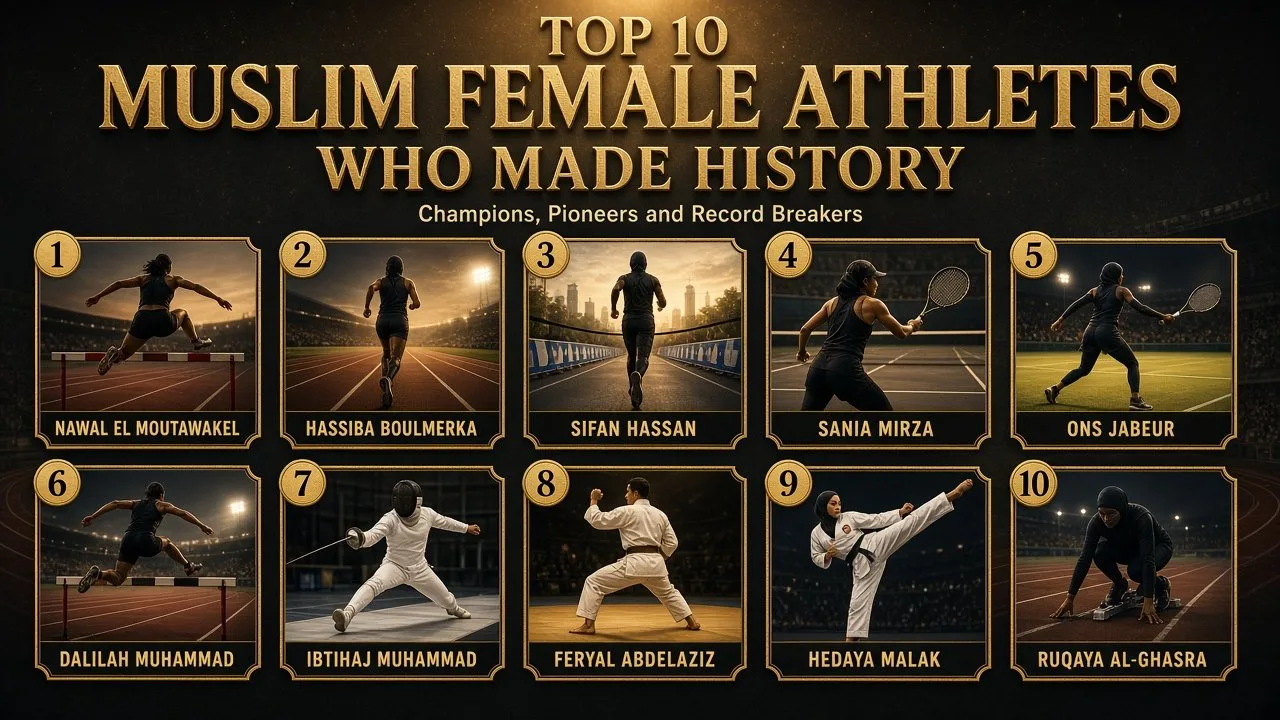
Famous Muslim female athletes include Olympic champions Nawal El Moutawakel and Sifan Hassan, tennis stars Sania Mirza and Ons Jabeur, and Ibtihaj Muhammad.
Their stories cover four decades, five continents and almost every kind of sport, from the 400 metres hurdles to karate. Some of these women won the first Olympic gold medal their country had ever seen. Others broke world records, reached the top of the world rankings or changed the rules of their sport so that athletes who wear a headscarf could compete. Several did all of this while facing criticism at home, death threats or doubts about whether women from their background belonged in elite sport at all.
This guide profiles ten of the most influential Muslim women in sporting history. For each athlete you will find a Quick Facts table, a short history of her career, her key achievements, why she matters and a few facts that many readers do not know. Results and dates come from Olympic and governing-body records and are given as of October 2026.
How We Chose These Muslim Female Athletes
There is no official ranking of Muslim sportswomen, so this list is built on clear, checkable criteria rather than popularity. Every athlete here meets at least two of these tests:
- She won an Olympic medal, a world championship or reached world No. 1 or No. 2 in her sport.
- She achieved a recognised first for her country, region or community.
- Her career changed opportunities for other women, through rule changes, sports administration, role-model impact or public advocacy.
- Her Muslim identity is documented in reliable sources, either through her own statements, her family background or public acts such as competing in a hijab.
Athletes are ordered by a mix of sporting achievement and lasting influence. The list was also checked for accuracy against older lists of this kind that circulate online. Two names often found on them were left out because they do not fit the topic: heptathlon champion Ghada Shouaa of Syria was born into a Greek Orthodox Christian family, and boxer Laila Ali has said publicly that she is not Muslim, although her father Muhammad Ali was.
Muslim Female Athletes at a Glance
| No. | Athlete | Country | Sport | Signature achievement |
|---|---|---|---|---|
| 1 | Nawal El Moutawakel | Morocco | Athletics (400 m hurdles) | 1984 Olympic champion, first Muslim woman to win Olympic gold |
| 2 | Hassiba Boulmerka | Algeria | Athletics (1500 m) | 1992 Olympic champion, Algeria's first Olympic gold |
| 3 | Sifan Hassan | Netherlands | Athletics (distance running) | Olympic gold in 5000 m, 10,000 m and marathon |
| 4 | Sania Mirza | India | Tennis | Six Grand Slam titles, former doubles world No. 1 |
| 5 | Ons Jabeur | Tunisia | Tennis | World No. 2 and three Grand Slam singles finals |
| 6 | Dalilah Muhammad | United States | Athletics (400 m hurdles) | 2016 Olympic champion and former world record holder |
| 7 | Ibtihaj Muhammad | United States | Fencing (sabre) | First American to compete at the Olympics in a hijab |
| 8 | Feryal Abdelaziz | Egypt | Karate | First Egyptian woman to win Olympic gold |
| 9 | Hedaya Malak | Egypt | Taekwondo | Olympic bronze medals in 2016 and 2020 |
| 10 | Ruqaya Al-Ghasra | Bahrain | Athletics (sprints) | Ran at the 2004 Olympics fully covered with a headscarf |
1. Nawal El Moutawakel
| Attribute | Details |
|---|---|
| Born | 15 April 1962, Casablanca, Morocco |
| Sport | Athletics, 400 metres hurdles |
| Biggest win | Olympic gold, Los Angeles 1984 |
| Historic first | First Moroccan, Arab, African and Muslim woman to win an Olympic gold medal |
| Later role | Vice-president of the International Olympic Committee |
Origins and History
Nawal El Moutawakel grew up in Casablanca and was a student at Iowa State University in the United States when she travelled to the 1984 Los Angeles Olympics. The women's 400 metres hurdles was being held at the Games for the very first time, and she won it. Her victory came as a surprise in Morocco, where few people had expected a medal.
King Hassan II telephoned her to offer his congratulations and declared that girls born on the day of her win should be named after her. Overnight she became a national hero and a symbol of what women from Muslim-majority countries could achieve on the world stage.
Key Achievements
- Won the first-ever Olympic women's 400 m hurdles title in 1984.
- Became the first woman from Morocco, the Arab world, Africa and the Muslim world to win Olympic gold.
- Joined the council of the world athletics federation in 1995 and became a member of the International Olympic Committee in 1998.
- Chaired the IOC evaluation commissions for the 2012 and 2016 Summer Olympics host city races.
- Was elected an IOC vice-president in 2016 and re-elected in 2024.
- Was named Morocco's Minister of Sports in 2007.
Why She Matters
Her medal is often described as the breakthrough moment for sportswomen in Morocco and across many Muslim-majority countries. It challenged a long-held belief that women from such backgrounds could not succeed in elite athletics. Just as importantly, she has spent more than three decades inside the governing bodies of world sport, shaping decisions rather than only being the subject of them.
In 1993 she launched a 5 km women's road race in Casablanca. It has grown into the biggest women's race held in a Muslim-majority country, with fields of up to 30,000 runners.
Interesting Facts
- She was one of eight people chosen to carry the Olympic flag at the opening ceremony of the 2006 Turin Winter Olympics.
- She carried the Olympic torch through Westminster before the London 2012 Games.
- In 2024 the International Sports Press Association voted her the fourth-best female athlete of the past 100 years, behind Serena Williams, Nadia Comăneci and Simone Biles.
- She was an ambassador for Morocco's bid to host the FIFA World Cup.
2. Hassiba Boulmerka
| Attribute | Details |
|---|---|
| Born | 10 July 1968, Constantine, Algeria |
| Sport | Athletics, 800 m and 1500 m |
| Biggest win | Olympic 1500 m gold, Barcelona 1992 |
| Historic first | First African woman to win a world athletics title (1991) |
| World titles | 1500 m world champion in 1991 and 1995 |
Origins and History
Hassiba Boulmerka began running seriously at the age of ten in north-eastern Algeria, focusing on the 800 and 1500 metres. At her first Olympics, Seoul 1988, she went out in the heats of both events. Three years later she was a world champion.
Her breakthrough came in 1991. After winning the 800 m at the Golden Gala meeting in Rome, she sprinted clear on the final straight of the 1500 m at the World Championships in Tokyo. No African woman had ever won a world athletics title before.
Key Achievements
- 1991 world champion over 1500 m, the first African woman to win a world title in athletics.
- 1992 Olympic champion over 1500 m in Barcelona, winning Algeria's first Olympic gold medal of any kind.
- Bronze medal at the 1993 World Championships in Stuttgart.
- Second world title at the 1995 World Championships in Gothenburg.
- Set an African 1500 m record of 3:55.30 in the Barcelona Olympic final.
Why She Matters
Boulmerka's success came at a real personal cost. Conservative groups in Algeria criticised her for racing in shorts and a vest, and she received death threats that forced her to move to Europe to train. She still went to Barcelona as one of the favourites and won.
Her career became one of the defining stories of courage in modern athletics. It showed a generation of North African girls that they could compete at the highest level, and it put women's sport at the centre of a national debate in Algeria during a turbulent decade.
Interesting Facts
- She held the African mile record of 4:20.79 from 1991 until 2008.
- In the 1992 Olympic final she beat Lyudmila Rogachova and China's Qu Yunxia, who later held the 1500 m world record.
- She was later elected to the Athletes' Commission of the International Olympic Committee.
- After retiring in 1997 she returned to Algeria and went into business.
3. Sifan Hassan
| Attribute | Details |
|---|---|
| Born | January 1993, Adama, Ethiopia |
| Nationality | Dutch (citizen since 2013) |
| Sport | Athletics, middle distance to marathon |
| Olympic golds | 5000 m and 10,000 m (Tokyo 2020), marathon (Paris 2024) |
| Olympic medals | Six in total across two Games |
Origins and History
Sifan Hassan was born in Ethiopia's Oromia region and arrived in the Netherlands as a refugee in 2008, aged 15. She started running while training to become a nurse and quickly showed rare range, winning races from 1500 metres to cross country. She became a Dutch citizen in 2013.
By the late 2010s she was one of the best distance runners in the world. In 2019 she won both the 1500 m and the 10,000 m at the same World Championships, a combination no athlete, male or female, had ever achieved at a single global championship.
Key Achievements
- Tokyo 2020: gold in the 5000 m and 10,000 m and bronze in the 1500 m, the only athlete to win medals in a middle-distance event and both long-distance track races at one Games.
- Paris 2024: bronze in the 5000 m and 10,000 m, then gold in the marathon in an Olympic record of 2:22:55.
- Only woman to win Olympic gold in the 5000 m, 10,000 m and marathon.
- 2019 world champion at 1500 m and 10,000 m.
- World record holder for the one hour run since 2020, and a former mile world record holder.
- Winner of the 2023 London Marathon on her debut at the distance.
Why She Matters
Hassan's range is almost without precedent in modern distance running. Her decision to attempt three events in Paris, ending with the marathon on the final day of the Games, was described by many observers as one of the toughest programmes any athlete has taken on.
She also produced one of the most talked-about images of Paris 2024. She wore a maroon hijab to collect her marathon gold medal at the closing ceremony, in a country that had barred its own athletes from wearing the headscarf at the Games. Hassan usually races without a headscarf, and France's rule applied only to French competitors, but the moment was widely shared as a symbol of Muslim women's place in elite sport.
Interesting Facts
- She covered roughly 62 kilometres of racing across heats and finals at Paris 2024.
- She held the 10,000 m world record for just two days in June 2021.
- She holds European records from 1500 m all the way to the marathon.
- She won the Chicago Marathon in 2023, the same year as her London win.
4. Sania Mirza
| Attribute | Details |
|---|---|
| Born | 15 November 1986, Mumbai, India |
| Sport | Tennis |
| Grand Slam titles | Six: three women's doubles, three mixed doubles |
| Best ranking | Doubles world No. 1 (91 weeks); singles No. 27 (2007) |
| Retired | February 2023 |
Origins and History
Sania Mirza was born in Mumbai and raised in a Sunni Muslim family in Hyderabad, where she started playing tennis at six, coached by her father. She won the Wimbledon girls' doubles title in 2003 and turned professional the same year.
In 2005 she became the first Indian woman to reach the fourth round of a Grand Slam singles event, at the US Open, and was named the WTA Newcomer of the Year. A serious wrist injury later pushed her towards doubles, where she became one of the best players in the world.
Key Achievements
- Six Grand Slam titles, three in women's doubles and three in mixed doubles.
- Doubles world No. 1 for 91 weeks, with 43 career doubles titles.
- Back-to-back WTA Finals titles in 2014 and 2015.
- 2015 Doubles Team of the Year with Martina Hingis, including a 44-match winning streak.
- Highest singles ranking of any Indian woman, world No. 27 in 2007.
- 14 medals, including six golds, at the Asian Games, Commonwealth Games and Afro-Asian Games.
Why She Matters
Mirza is widely regarded as the most important figure in Indian women's tennis. She set almost every national first, from the first WTA singles title by an Indian woman to the first million dollars in career prize money, and she became one of the highest-paid athletes in the country.
Her fame also made her a target. In 2005 a cleric issued a fatwa criticising her tennis clothing as un-Islamic, and she hired bodyguards. She kept playing in standard tennis kit and became a role model for young Indian girls of every faith.
Interesting Facts
- Time magazine named her one of the "50 Heroes of Asia" in 2005 and one of the 100 most influential people in the world in 2016.
- She received India's top sporting honour, the Khel Ratna, in 2015, and the Padma Bhushan in 2016.
- She was appointed UN Women Goodwill Ambassador for South Asia in 2013.
- In singles she beat former world No. 1 players Martina Hingis, Dinara Safina and Victoria Azarenka.
5. Ons Jabeur
| Attribute | Details |
|---|---|
| Born | 28 August 1994, Ksar Hellal, Tunisia |
| Sport | Tennis |
| Best ranking | World No. 2 (27 June 2022) |
| Grand Slam finals | Wimbledon 2022 and 2023, US Open 2022 |
| Biggest title | Madrid Open 2022 (WTA 1000) |
Origins and History
Ons Jabeur was introduced to tennis by her mother at the age of three and grew up in the coastal city of Sousse. As a child she trained on hotel courts because her club had none of its own. At twelve she moved to a national sports high school in Tunis.
In 2011 she won the French Open girls' singles title, the first junior Grand Slam won by an African or Arab player since 1964. Her senior career took longer to build, but from 2020 she broke one barrier after another for Arab and African tennis.
Key Achievements
- First Arab woman to reach a Grand Slam quarterfinal (Australian Open 2020).
- First Arab woman to win a WTA Tour title (Birmingham 2021).
- First African player to win a WTA 1000 title (Madrid 2022).
- First African and Arab woman to reach a Grand Slam singles final, at Wimbledon 2022, followed by the US Open final the same year and a second Wimbledon final in 2023.
- Career-high ranking of world No. 2, the highest ever for an African or Arab player in men's or women's tennis.
Why She Matters
Jabeur is credited with raising the profile of tennis across Africa and the Arab world. Her inventive style, full of drop shots and spin, made her a fan favourite, and Tunisians nicknamed her the "Minister of Happiness".
She has spoken openly about her faith, including how she sometimes has to postpone Ramadan fasting during tournaments. That honesty about balancing religion and elite sport has resonated with many young Muslim athletes.
Interesting Facts
- She won the Arab Woman of the Year award in 2019.
- In 2022 she played doubles with Serena Williams at Eastbourne, Williams's comeback event.
- At Wimbledon 2023 she beat four Grand Slam champions on the way to the final.
- She is married to her fitness coach, former fencer Karim Kamoun, and the couple had their first child in April 2026.
6. Dalilah Muhammad
| Attribute | Details |
|---|---|
| Born | 7 February 1990, Queens, New York, USA |
| Sport | Athletics, 400 metres hurdles |
| Olympic medals | Gold 2016; silver and relay gold 2020 |
| World record | 52.20 s and then 52.16 s in 2019 |
| Honour | World Athletics Female Athlete of the Year 2019 |
Origins and History
Dalilah Muhammad began running at seven after a local coach spotted her racing through the streets of Queens. She won the 400 m hurdles at the 2007 World Youth Championships and went on to become a four-time All-American at the University of Southern California.
Her parents, Nadirah and Askia Muhammad, have said they attribute her success to her Muslim faith, discipline and talent. After two world silver medals, she broke through at the 2016 Rio Olympics.
Key Achievements
- 2016 Olympic champion, the first American woman to win the Olympic 400 m hurdles.
- Broke the 16-year-old world record with 52.20 s in 2019, then lowered it to 52.16 s to win the world title.
- Olympic silver in 2020 with 51.58 s, then the second-fastest time in history, plus 4 x 400 m relay gold.
- World 4 x 400 m relay gold in 2019 and individual bronze in 2022.
- Only the second woman, after Sally Gunnell, to win Olympic and world titles and break the world record in the event.
Why She Matters
Muhammad helped launch the golden age of women's 400 m hurdling. Her rivalry with Sydney McLaughlin pushed the world record down repeatedly and turned the event into one of the most watched races in athletics.
She also stands as one of the most successful Muslim American athletes in Olympic history, proof that Muslim women can be found at the very top of the sport's most competitive events.
Interesting Facts
- Her 2019 world record broke a mark set by Yuliya Pechonkina in 2003.
- She won US titles across more than a decade, from 2013 to 2025.
- She was Diamond League champion in 2017 and 2018.
- She retired after the 2026 season.
7. Ibtihaj Muhammad
| Attribute | Details |
|---|---|
| Born | 4 December 1985, New Jersey, USA |
| Sport | Fencing, sabre |
| Olympic medal | Team sabre bronze, Rio 2016 |
| World title | Team sabre gold, 2014 World Championships |
| Historic first | First American to compete at the Olympics in a hijab |
Origins and History
Ibtihaj Muhammad grew up in Maplewood, New Jersey, and took up fencing at 13. She has said she chose it partly because the uniform already covered her body, so she did not need to change it to compete in a hijab. She trained with the Peter Westbrook Foundation in New York and became a three-time All-American at Duke University.
In 2010 she joined the US national team, becoming the first woman of colour on the women's sabre squad. She stayed on the team until 2017, rising as high as world No. 7.
Key Achievements
- Bronze medal in the women's team sabre at the 2016 Rio Olympics.
- First American woman to compete at the Olympics in a hijab, and first Muslim American woman to win an Olympic medal.
- Team sabre world champion in 2014 and a five-time senior world medallist.
- Two-time US national champion and 19-time World Cup medallist.
Why She Matters
Muhammad became one of the most visible Muslim athletes in the world during the 2016 Games, at a time of intense debate about Islam in American public life. The Guardian described her as one of the best symbols against intolerance the country could have.
Her influence reaches well beyond fencing. She co-founded the modest clothing brand Louella, serves as a US State Department sports envoy and has written a memoir and a series of best-selling children's books about the hijab.
Interesting Facts
- In 2017 Mattel released a Barbie in her likeness, the first Barbie to wear a hijab.
- Her children's book The Proudest Blue became a New York Times best-seller.
- She was named a Global Ambassador for Special Olympics in 2019.
- The US team beat Italy 45 to 30 in the Rio bronze medal match.
8. Feryal Abdelaziz
| Attribute | Details |
|---|---|
| Born | 16 February 1999, Egypt |
| Sport | Karate, kumite |
| Biggest win | Olympic gold, women's +61 kg, Tokyo 2020 |
| Historic first | First Egyptian woman to win an Olympic gold medal |
| Other titles | World team kumite gold 2021; Mediterranean Games gold 2022 |
Origins and History
Feryal Abdelaziz took up karate in Cairo at the age of seven. She combined her sport with university studies in pharmacy at the British University in Egypt, and won medals at the African Championships and African Games in 2019.
She qualified for Tokyo 2020 through the final world qualification tournament in Paris in June 2021. Karate was making its Olympic debut, and she arrived as an outsider.
Key Achievements
- Olympic gold in the women's +61 kg kumite at Tokyo 2020, beating Azerbaijan's Iryna Zaretska 2 to 0 in the final.
- First Egyptian woman to win Olympic gold in any sport.
- Gold in the women's team kumite at the 2021 World Karate Championships in Dubai.
- Gold in the 68 kg event at the 2022 Mediterranean Games in Oran.
Why She Matters
Egypt has a long Olympic history, but before Tokyo no Egyptian woman had stood on the top step of the podium. Abdelaziz changed that in karate's only Olympic appearance so far, since the sport was dropped for Paris 2024.
Her win, alongside bronze for teammate Giana Farouk, made karate one of Egypt's most successful sports at the Tokyo Games and gave Egyptian girls a home-grown Olympic champion to look up to.
Interesting Facts
- She survived a group-stage loss in Tokyo and still reached the semi-finals.
- She beat Kazakhstan's Sofya Berultseva 5 to 4 in the semi-final.
- She trained to become a pharmacist alongside her karate career.
- Karate was left off the programme for Paris 2024, so the Tokyo champions remain the only Olympic karate winners so far.
9. Hedaya Malak
| Attribute | Details |
|---|---|
| Born | 21 April 1993, Egypt |
| Sport | Taekwondo |
| Olympic medals | Bronze at Rio 2016 (57 kg) and Tokyo 2020 (67 kg) |
| Olympic Games | London 2012, Rio 2016, Tokyo 2020 |
| Recognition | Highlighted by the Rio 2016 organisers among the Muslim women leading taekwondo |
Origins and History
Hedaya Malak Wahba took up taekwondo at six, following her older brother into the sport. She won the Egyptian national championship at just 14 and made her Olympic debut at London 2012, where she reached the quarter-finals.
At Rio 2016 she went to the Games ranked third in the world in her weight class. She lost in the semi-finals to Spain's Eva Calvo but fought back through the repechage to win bronze.
Key Achievements
- Olympic bronze at Rio 2016 in the 57 kg class.
- Second Olympic bronze at Tokyo 2020 after moving up to 67 kg.
- Competed at three consecutive Olympic Games.
- Medalled in two different weight classes at two different Olympic Games.
Why She Matters
Malak competes in a hijab, and her medals in Rio and Tokyo made her one of the most familiar faces of a wider trend: at Rio 2016, Muslim women won more medals in martial arts than in any other sport. Her consistency across two weight classes and two Games also helped make taekwondo one of Egypt's strongest Olympic sports for women.
Interesting Facts
- In Rio she shared the 57 kg bronze-medal podium with Iran's Kimia Alizadeh, the first Iranian woman to win a Summer Olympic medal.
- In Tokyo she beat Tonga's Malia Paseka and then Paige McPherson of the United States in the repechage.
- Her younger brother also took up taekwondo.
10. Ruqaya Al-Ghasra
| Attribute | Details |
|---|---|
| Born | 6 September 1982, Bahrain |
| Sport | Athletics, 100 m and 200 m |
| Biggest win | 200 m gold, 2006 Asian Games in Doha |
| Historic first | Among the first women to represent Bahrain at the Olympics (2004) |
| Flag bearer | Bahrain, Beijing 2008 opening ceremony |
Origins and History
Ruqaya Al-Ghasra, also written Rakia Al Gassra, competed in the 100 m at the 2004 Athens Olympics as one of the first women ever to represent Bahrain. ESPN reported that she overcame objections in her village to take part. She ran in a headscarf with her body fully covered, finishing fifth in her heat in 11.49 seconds.
Two years later she proved she belonged among Asia's best sprinters, winning 200 m gold at the 2006 Asian Games in Doha.
Key Achievements
- 200 m gold and 100 m bronze at the 2006 Asian Games.
- 100 m and 200 m gold at the 2003 Arab Championships.
- 60 m gold at the 2008 Asian Indoor Championships in a championship record of 7.40 seconds.
- Reached the 200 m semi-finals at the 2008 Beijing Olympics, where she was Bahrain's flag bearer.
Why She Matters
Al-Ghasra's covered running kit at Athens 2004 made her one of the first widely seen examples of an elite sprinter competing in clothing that met her religious standards. It helped open a public conversation about modest sportswear that later led to sports hijabs and rule changes in several sports.
Her career ended under a cloud: in 2010 it emerged that she had failed an out-of-competition doping test, and she was banned from September 2009 to September 2011, with her 2009 World Championship results removed. Her 2004 and 2006 performances, however, remain an important part of the history of Gulf women's athletics.
Interesting Facts
- Her Asian Games win was the first major international athletics gold for a Bahraini-born athlete beyond Arab competitions.
- She won three silver medals at the 2004 Asian Indoor Championships in Iran.
- She improved her 100 m time from 11.49 seconds in 2004 to 11.34 seconds by 2006.
Other Trailblazing Muslim Sportswomen
Many more Muslim women have made sporting history. A few others whose achievements are often cited:
| Athlete | Country | Sport | Achievement |
|---|---|---|---|
| Wojdan Shaherkani | Saudi Arabia | Judo | One of the first two women to represent Saudi Arabia at the Olympics (2012); her case led to an approved sports hijab in judo |
| Sarah Attar | Saudi Arabia | Athletics | Ran the 800 m at London 2012 as Saudi Arabia's other first female Olympian |
| Inès Boubakri | Tunisia | Fencing | Olympic foil bronze in 2016, dedicated to all Arab women |
| Sara Ahmed | Egypt | Weightlifting | 2016 Olympic bronze, the first Arab woman to win an Olympic weightlifting medal |
| Zahra Lari | United Arab Emirates | Figure skating | First figure skater to compete internationally in a hijab |
| Farkhondeh Sadegh and Leila Bahrami | Iran | Mountaineering | First Muslim women to climb Mount Everest (2005) |
Hijab Rules in Sport: A Short Timeline
Several athletes on this list faced rules that made it hard to compete in a headscarf. This timeline shows how those rules have changed.
| Year | Event |
|---|---|
| 2004 | Ruqaya Al-Ghasra runs at the Athens Olympics in a headscarf and full-body kit |
| 2011 | FIFA's headscarf ban forces Iran's women's team to forfeit an Olympic qualifier |
| 2012 | Wojdan Shaherkani competes in judo at London 2012 in an agreed cap-style hijab; the IOC schedules events with Ramadan in mind for the first time |
| 2014 | FIFA lifts its ban and allows approved sports hijabs |
| 2016 | Ibtihaj Muhammad fences at the Rio Olympics in a hijab and wins bronze |
| 2017 | Basketball's world body, FIBA, overturns its headgear ban after a campaign led by players |
| 2024 | France bars its own athletes from wearing the hijab at the Paris Olympics; foreign athletes are not affected |
Frequently Asked Questions
Who was the first Muslim woman to win an Olympic gold medal?
Nawal El Moutawakel of Morocco was the first Muslim woman to win Olympic gold. She won the inaugural women's 400 metres hurdles at the 1984 Los Angeles Olympics while studying at Iowa State University. She was also the first Moroccan, Arab and African woman to become an Olympic champion, and later became a vice-president of the International Olympic Committee.
Who is the most successful Muslim female Olympian?
By Olympic results, Sifan Hassan of the Netherlands stands out. She has six Olympic medals, including gold in the 5000 m and 10,000 m at Tokyo 2020 and the marathon at Paris 2024. She is the only woman to win Olympic gold in all three of those events, and she wore a hijab for her Paris marathon medal ceremony.
Which Muslim woman has won the most tennis Grand Slams?
Sania Mirza of India won six Grand Slam titles, three in women's doubles and three in mixed doubles, and spent 91 weeks as doubles world No. 1. In singles, Tunisia's Ons Jabeur went furthest, reaching world No. 2 and three Grand Slam finals, though she has not yet won a major title.
Who was the first athlete to wear a hijab at the Olympics for the United States?
Ibtihaj Muhammad, a sabre fencer from New Jersey, became the first American woman to compete at the Olympics in a hijab at Rio 2016. She won bronze in the team sabre event, making her the first Muslim American woman to win an Olympic medal. She has since become an author, entrepreneur and US State Department sports envoy.
Is Laila Ali a Muslim athlete?
No. Laila Ali, the unbeaten boxing champion and daughter of Muhammad Ali, was raised as a Muslim but later left Islam and has said publicly that she is not Muslim. She often appears on older lists of Muslim athletes, but that is inaccurate, so she is not included in this ranking.
Can athletes wear a hijab in international competition?
In most major sports, yes. Football's world body FIFA allowed approved sports hijabs from 2014, and basketball's FIBA lifted its headgear ban in 2017. The Olympic Games allow athletes to wear headscarves, although individual countries can set rules for their own teams, as France did for its athletes at Paris 2024.
Who was the first Egyptian woman to win Olympic gold?
Feryal Abdelaziz became the first Egyptian woman to win an Olympic gold medal when she took the women's +61 kg karate title at Tokyo 2020. She beat Azerbaijan's Iryna Zaretska 2 to 0 in the final. Karate was not part of the Paris 2024 programme, so the Tokyo winners are still the only Olympic karate champions.
Conclusion
The ten Muslim female athletes on this list span very different sports, countries and eras, but they share a habit of doing what others said was impossible. Nawal El Moutawakel and Hassiba Boulmerka won Olympic gold when few believed women from North Africa could, and Sifan Hassan rewrote the limits of distance running. Sania Mirza and Ons Jabeur reached the top of world tennis, while Dalilah Muhammad set a world record in one of athletics' toughest events.
Others, such as Ibtihaj Muhammad, Feryal Abdelaziz, Hedaya Malak and Ruqaya Al-Ghasra, made history simply by being the first, and in doing so changed the rules and expectations for the athletes who followed. Together they show that faith, identity and world-class performance can go hand in hand, and the next generation of Muslim sportswomen is already building on what they started.
- International Olympic Committee, athlete profiles and results (Olympics.com)
- Olympedia, Olympic athlete database
- World Athletics, athlete profiles and championship records
- Women's Tennis Association (WTA), player profiles and rankings
- Olympics.com, "Sifan Hassan wins women's marathon gold in new Olympic record", 11 August 2024
- Associated Press, "Dutch runner accepts marathon gold medal in a hijab", 11 August 2024
- Reuters Fact Check, "Hijab ban at Paris 2024 Olympics was only for French athletes", 16 August 2024
- Wikipedia, "Muslim women in sport" and individual athlete articles (used for cross-checking dates and results)















Log in with