









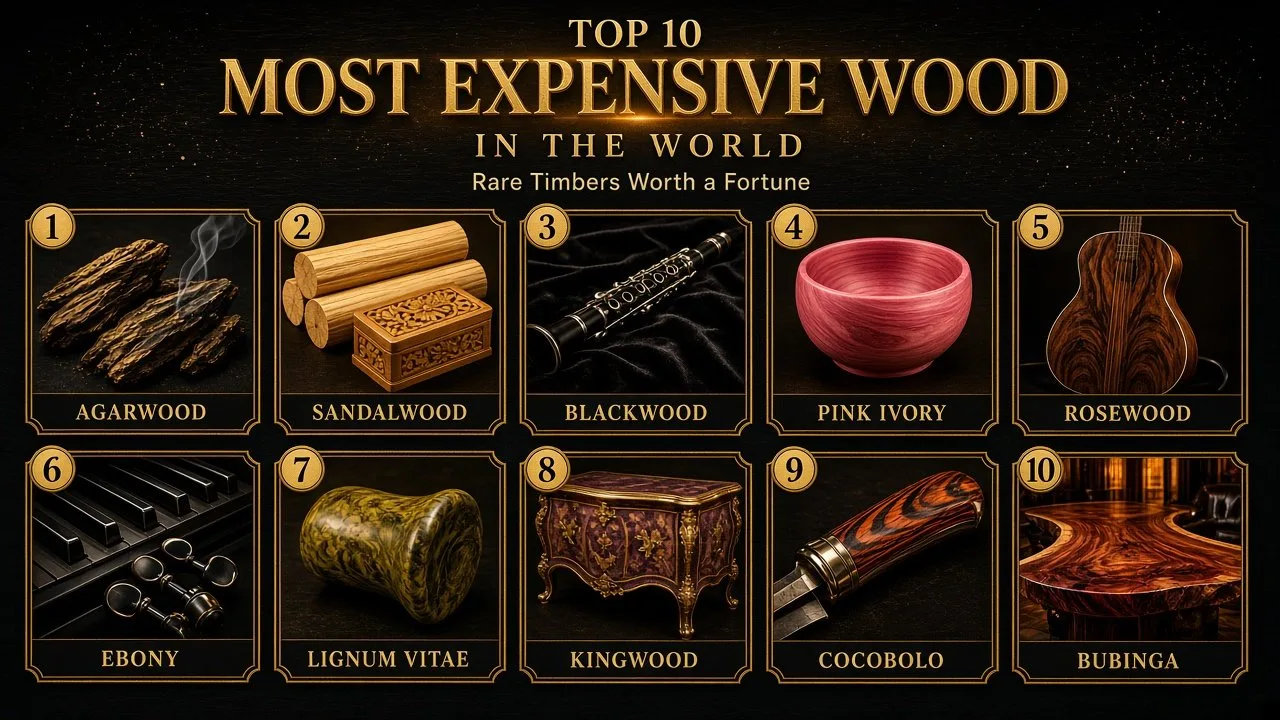
The most expensive wood in the world is agarwood, a resin-soaked timber prized for oud perfume, followed by sandalwood, African blackwood and pink ivory.
Most wood is cheap because trees grow almost everywhere. A handful of species break that rule. They grow slowly, stay small, live in a narrow corner of the world, or produce something no other tree can, such as a scent, a jet-black colour or a tone that musicians cannot find elsewhere. Add decades of overharvesting and strict trade rules, and some of these timbers now sell by the kilogram or the small turning block rather than by the plank.
This guide ranks ten of the most valuable woods on Earth. For each one you will find a Quick Facts table, where it comes from, what makes it special, why it costs so much and a few surprising facts. Technical figures such as density and hardness come from The Wood Database, and conservation details come from the CITES appendices and the IUCN Red List as reported by those references.
How We Ranked the Most Expensive Woods
There is no single global price list for rare timber. Prices change with grade, size, figure, legal paperwork and the country you buy in, and a small figured block can cost far more per unit than a plain board of the same species. Published one-off prices also go out of date quickly, so this list does not quote a price per kilogram for each wood.
Instead, the ranking reflects how trade and woodworking references place each species against the others. Agarwood and sandalwood come first because they are traded for fragrance, where the best material reaches prices that ordinary lumber never approaches. The dense black and pink African woods follow, then the protected rosewoods of the Americas, and finally bubinga, which is affordable in plain form but very costly when highly figured.
Four factors push a wood up the list:
- Scarcity in the wild, often caused by slow growth or past overharvesting
- Trade restrictions, such as listing in the CITES appendices, which add permits and limit supply
- Small tree size, which means few wide, clear boards
- A unique property, such as fragrance, colour, density or acoustic quality
Most Expensive Wood in the World at a Glance
| No. | Wood | Scientific name | Native region | Why it is so valuable |
|---|---|---|---|---|
| 1 | Agarwood | Aquilaria species | South and Southeast Asia | Fragrant resin used for oud perfume and incense |
| 2 | Indian Sandalwood | Santalum album | Indonesia, the Philippines, Western Australia, naturalised in India | Fragrant heartwood and oil, slow to mature |
| 3 | African Blackwood | Dalbergia melanoxylon | Dry savanna of Africa | Ultra-dense black wood for clarinets and oboes |
| 4 | Pink Ivory | Berchemia zeyheri | Southern Africa | Rare bright pink colour, large clear logs are scarce |
| 5 | Brazilian Rosewood | Dalbergia nigra | Atlantic Forest of Brazil | CITES Appendix I, legendary guitar tonewood |
| 6 | Gaboon Ebony | Diospyros crassiflora | Equatorial West Africa | Jet-black, very dense, small trees |
| 7 | Lignum Vitae | Guaiacum officinale and G. sanctum | Caribbean and northern South America | One of the hardest woods, endangered |
| 8 | Kingwood | Dalbergia cearensis | North-eastern Brazil | Violet-brown royal furniture wood from tiny trees |
| 9 | Cocobolo | Dalbergia retusa | Pacific Central America and southern Mexico | Fiery colours and oily, water-resistant wood |
| 10 | Bubinga | Guibourtia species | Equatorial Africa | Spectacular figure in huge slabs |
1. Agarwood
| Attribute | Details |
|---|---|
| Other names | Oud, oudh, aloeswood, eaglewood, gaharu, jinko |
| Source trees | Aquilaria species, mainly Aquilaria malaccensis |
| Native region | South and Southeast Asia, including north-eastern India |
| Main uses | Perfume oil, incense, small carvings, traditional medicine |
| Trade status | CITES Appendix II (Aquilaria malaccensis since 1995, all Aquilaria since 2004) |
Agarwood is not a species of tree but a substance that forms inside one. When an Aquilaria tree is wounded and infected by a mould, it defends itself by flooding its heartwood with a dark, fragrant resin. Healthy Aquilaria wood is pale, light and almost scentless, while infected heartwood becomes dense, dark and heavy with aroma. That transformation is what buyers pay for.
Origins and History
People have burned and worn agarwood for thousands of years. It was used as incense in ancient Egyptian funeral rites more than 3,000 years ago and is described in early Indian texts. It holds a respected place in Hindu, Buddhist, Islamic and Chinese traditions, and the Chinese name chenxiang means "sinking fragrance", a nod to resin-rich pieces that are heavy enough to sink in water.
In 16th-century Vietnam the finest grade, known as calambac, was so profitable that the Nguyen lords made its sale a royal monopoly. In Japan, a famous ancient piece of agarwood is kept at Nara and shown to the public only rarely.
Key Features
- Resin forms only after injury and infection, so most wild trees contain little or none
- Quality depends on species, region, age of the infection and which part of the tree it comes from
- Distilled agarwood oil, sold as oud, is a base note in many luxury perfumes
- In Japan, the highest grade of agarwood is called kyara
Why It Is So Expensive
The biggest reason is the depletion of wild trees. Because resin forms only in trees that have been injured and infected, wild supply is unpredictable. First-grade natural agarwood is widely described as one of the most expensive natural raw materials in the world, while plantation wood that has been artificially inoculated, and adulterated oil, sell for far less. That huge spread means two products both labelled "oud" can differ in price by orders of magnitude.
Interesting Facts
- The name agar is believed to come from a Dravidian word, probably the Tamil aghil
- In Assam, the bark of the agarwood tree was traditionally made into writing material
- Agarwood is unrelated to the aloe plant despite the name aloeswood
- Western perfumers usually sell it under its Arabic name, oud
2. Indian Sandalwood
| Attribute | Details |
|---|---|
| Other names | White sandalwood, East Indian sandalwood, chandan |
| Scientific name | Santalum album |
| Native region | Indonesia, the Philippines and Western Australia, naturalised in South India |
| Main uses | Essential oil, incense, carving, religious rituals |
| Conservation | Vulnerable on the IUCN Red List, export of timber banned by India |
Indian sandalwood is a small evergreen tree, usually 4 to 9 metres tall, whose heartwood carries one of the most recognisable scents in the world. It was carried by Austronesian sailors along ancient spice routes and had become naturalised in southern India by at least 1300 BCE. Over the centuries it became so closely tied to India that its common name stuck.
Origins and History
Sandalwood has been used in India for more than two thousand years, in temples, rituals and cremation, where today only a small symbolic piece is usually added to the pyre. The first extraction of its essential oil in India took place in Mysore in 1917, and Mysore sandalwood became a byword for quality.
Unusually for a valuable timber tree, Santalum album is partly parasitic. Its roots tap into the roots of neighbouring plants for nutrients, which is one reason it is hard to grow in neat plantations.
Key Features
- Only the heartwood is fragrant; the outer sapwood has no scent
- Its oil is rich in santalol, the compound behind its creamy, woody smell
- The tree develops its fragrance after about 10 years but is not ready to harvest until after about 20
- Fine-grained and oily, it carves well and resists rot
Why It Is So Expensive
Demand has far outstripped supply for decades. According to figures summarised from Indian research, the country's sandalwood production fell from about 4,000 tonnes a year in the 1960s to around 350 tonnes a year in 2014. India bans export of the timber, and harvest, transport and sale are regulated state by state. Private planting is growing, with a 2024 review estimating about 23,100 hectares of plantations in India, but new trees take two decades to pay off.
Interesting Facts
- The word sandalwood traces back to the Sanskrit chandanam, linked to burning incense
- Karnataka allowed private cultivation in 2001 and loosened sales rules again in 2022
- Australian sandalwood, Santalum spicatum, is a cheaper source of oil with a lower santalol content
- Chemists have produced synthetic sandalwood scents since the 20th century, but natural oil still commands a premium
3. African Blackwood
| Attribute | Details |
|---|---|
| Other names | Mpingo, grenadilla |
| Scientific name | Dalbergia melanoxylon |
| Native region | Dry savanna from Senegal to Eritrea and south to Mozambique and north-eastern South Africa |
| Density and hardness | About 1,270 kg per cubic metre; Janka hardness 3,670 lbf |
| Trade status | CITES Appendix II; near threatened according to the IUCN |
African blackwood is a small, gnarled, spiny tree that produces one of the densest and most stable timbers known. The heartwood is often completely black, with barely any visible grain, and it is technically a rosewood in the genus Dalbergia rather than a true ebony.
Origins and History
This may be the original ebony. African blackwood was imported into ancient Egypt thousands of years ago, and researchers have linked the Egyptian word hbny, from which "ebony" derives, mainly to this species. Furniture makers have valued it ever since, and some old ships reportedly carried it as ballast.
Key Features
- So dense it is often machined on metal-working equipment
- Holds fine threads and crisp details, making it a top choice for turning
- Very stable when dry and resistant to moisture
- Boards are usually narrow because the trees are small and irregular
Why It Is So Expensive
African blackwood is the classic material for clarinets and oboes, and it is also used for flutes, piccolos and Highland bagpipes. The tree can take upwards of 60 years to mature, and overharvesting has left it severely threatened in Kenya. The Wood Database places its price on par with Gaboon ebony, among the costliest lumbers sold.
Interesting Facts
- Billets are often dried with the pale yellow sapwood left on to slow drying and prevent cracks
- Some German knife makers use blackwood for handles because it repels moisture
- Woodturners report a sweet, rose-like scent when it is cut
- Mpingo is the Swahili name for the tree
4. Pink Ivory
| Attribute | Details |
|---|---|
| Other names | Red ivorywood |
| Scientific name | Berchemia zeyheri |
| Native region | Southern Africa |
| Density and hardness | About 1,035 kg per cubic metre; Janka hardness 3,230 lbf |
| Trade status | Not listed by CITES or on the IUCN Red List, according to The Wood Database |
Pink ivory is the wood people rarely believe is natural. Its colour runs from pale brownish pink to a bright, almost neon pink and on to deep red, and the most valuable pieces are the vivid pink ones. Many boards also show a curly or fiddleback figure that makes the colour shimmer.
Origins and History
According to Zulu folklore in South Africa, the tree is sacred and its wood was reserved for royalty. Popular retellings add dramatic details about punishments for commoners who used it, but these stories are hard to verify and are best treated as legend.
Key Features
- Fine, even texture with a good natural lustre
- Hard on cutting edges and difficult to plane, but turns and finishes well
- Colour can fade or dull over time, a change that is not fully understood
- Used for carving, inlay, knife handles, billiard cues and chess pieces
Why It Is So Expensive
Pink ivory is often said to be "rarer than diamonds". That claim is an exaggeration: the tree is reportedly fairly common in parts of South Africa. What is genuinely scarce is a large, straight, defect-free trunk with strong pink colour, and that premium material sells at prices comparable to Gaboon ebony.
Interesting Facts
- Despite the name, pink ivory has nothing to do with elephant ivory
- The trees can grow 30 to 40 metres tall, yet clear wood is still hard to find
- Freshly worked pink ivory has a distinct, somewhat unpleasant smell
- It is far more often carved or turned than used in board form
5. Brazilian Rosewood
| Attribute | Details |
|---|---|
| Other names | Bahia rosewood, Rio rosewood, jacaranda-da-Bahia |
| Scientific name | Dalbergia nigra |
| Native region | Atlantic Forest of south-eastern Brazil |
| Density and hardness | About 835 kg per cubic metre; Janka hardness 2,790 lbf |
| Trade status | CITES Appendix I since 1992; vulnerable on the IUCN Red List |
Brazilian rosewood is probably the most famous rosewood of all. Its chocolate to reddish-brown heartwood is streaked with black lines that sometimes form a "spider-web" or "landscape" pattern, and freshly cut wood gives off a rose-like scent.
Origins and History
European cabinetmakers prized it for centuries, from Regency furniture of the late 18th and early 19th centuries to Danish Modern pieces of the 20th century. Luthiers used it for lute ribs in the Renaissance and Baroque eras, and many classical and steel-string guitar makers still regard old-growth Brazilian rosewood as the best-sounding wood for backs and sides.
Key Features
- An evenly cut piece rings with a bright, sustained metallic tone when tapped
- Very durable and resistant to insect attack
- Works well with hand and machine tools despite its hardness
- Found only in Bahia, Espirito Santo, Minas Gerais and Rio de Janeiro states
Why It Is So Expensive
On 11 June 1992, Dalbergia nigra was placed on CITES Appendix I, the most restrictive category, which also covers finished products made from it. International trade in new wood is effectively closed, so legal sales are generally limited to reclaimed or pre-existing stock with documentation. That frozen supply, combined with steady demand from guitar makers and collectors, keeps prices very high.
Interesting Facts
- It is the only rosewood whose listing goes beyond the genus-wide CITES Appendix II listing of Dalbergia
- Highly figured logs were once sliced into veneer for piano cases and office furniture
- Its seeds are heavily eaten by rodents, which may explain poor natural regeneration
- Another of its common names, pianowood, hints at its old use in piano cases
6. Gaboon Ebony
| Attribute | Details |
|---|---|
| Other names | African ebony, Cameroon ebony, Nigerian ebony |
| Scientific name | Diospyros crassiflora |
| Native region | Equatorial West Africa, from Nigeria and Cameroon to Gabon and the Congo basin |
| Density and hardness | About 955 kg per cubic metre; Janka hardness 3,080 lbf |
| Conservation | Vulnerable on the IUCN Red List (2018 reassessment) |
Gaboon ebony is the jet-black wood most people picture when they hear the word ebony. It is believed to be the blackest of all timber-producing Diospyros species, with heartwood that shows almost no visible grain and polishes to a glassy shine.
Origins and History
Ebony has been carved since ancient Egyptian times. This species is named after Gabon, which historically exported most of it, although today it is more likely to come from Cameroon. It also grows in the Central African Republic, Equatorial Guinea, Nigeria and both Congos.
Key Features
- Extremely dense, strong and stiff
- High natural oil content can make gluing difficult
- Responds well to steam bending and takes a high polish
- Used for piano black keys, guitar fingerboards and chess pieces
Why It Is So Expensive
The Wood Database describes Gaboon ebony as among the most expensive of all available lumbers, usually about two to three times the price of most rosewoods. The trees are small, only 15 to 18 metres tall, and demand for flawless black wood for instruments and ornaments is constant. The species was listed as endangered by the IUCN in 1998 and reassessed as vulnerable in 2018, with forest conversion named as the most severe long-term threat.
Interesting Facts
- It is the standard wood for fingerboards, tailpieces and tuning pegs on violins, violas, cellos and double basses
- Very few natural woods are truly solid black, so many black look-alikes are dyed
- Wenge and katalox are sometimes used as cheaper ebony stand-ins
- Other traditional uses include pool cues, walking sticks, doorknobs and gun grips
7. Lignum Vitae
| Attribute | Details |
|---|---|
| Other names | Palo santo, guayacan, holywood, roughbark lignum vitae |
| Scientific name | Guaiacum officinale and Guaiacum sanctum |
| Native region | Caribbean, Central America and northern South America |
| Density and hardness | About 1,260 kg per cubic metre; Janka hardness 4,390 lbf |
| Trade status | CITES Appendix II; Guaiacum officinale listed as endangered by the IUCN in 2019 |
Lignum vitae is one of the hardest and heaviest woods in commercial use. Its olive to dark green-brown heartwood is so full of natural oil that raw surfaces feel greasy to the touch, and it sinks in water.
Origins and History
The name is Latin for "wood of life", a reference to its long history in medicine. Europe imported it as a remedy from 1508, and demand became so intense that, according to a 1949 timber reference, it sold for as much as seven gold crowns a pound. Guaiacum officinale is also the national flower of Jamaica.
Key Features
- Its natural oils suit it to bearings, bushings and pulley wheels
- The grain is interlocked, sometimes severely so
- Very durable outdoors and resistant to insects
- Has a mild, perfume-like fragrance
Why It Is So Expensive
Centuries of exploitation for both wood and resin pushed lignum vitae to the brink. It was among the first species listed by CITES in 1975, and genuine lignum vitae is now hard to obtain legally. Because supply is so tight, irregular chunks and turning blocks are sometimes sold by the pound instead of by the board foot.
Interesting Facts
- Guaiac, a resin from the wood, turns blue in the presence of blood and is used in some medical stool tests
- It is a traditional choice for mallet heads and tool handles
- Cheaper look-alikes are sold as Argentine lignum vitae or verawood, which come from a different genus
- The trees grow very slowly and reach only about 10 metres tall
8. Kingwood
| Attribute | Details |
|---|---|
| Other names | Violetwood, bois de violette, jacaranda-violeta |
| Scientific name | Dalbergia cearensis |
| Native region | North-eastern Brazil (Bahia, Ceara, Paraiba, Pernambuco and Piaui) |
| Density and tree size | About 1,045 kg per cubic metre; trunks only 15 to 30 cm across |
| Trade status | CITES Appendix II; near threatened according to the IUCN |
Kingwood, sold in older catalogues as violet wood, has dark purplish or reddish-brown heartwood with darker streaks, a fine texture and a high natural lustre. It is a true rosewood and one of the earliest woods traded under the Portuguese name jacaranda.
Origins and History
The name comes from the French royal court. Louis XIV and Louis XV favoured it for fine furniture in the 17th and 18th centuries, and it became a signature wood of French veneer work and marquetry.
Key Features
- Dense and difficult to work, with a moderate blunting effect on tools
- Turns very well and takes a high polish
- Very durable and resistant to termites
- Mostly used for inlay, veneer, tool handles and small turned items
Why It Is So Expensive
The tree itself is tiny, with a trunk rarely more than about 30 cm across, so kingwood is seldom available as lumber at all. Most of what reaches the market is small turning stock priced like other scarce rosewoods. The IUCN notes that wild harvesting before CITES controls may have caused local extinction in the state of Ceara.
Interesting Facts
- It was traded alongside Brazilian rosewood in the early days of the rosewood trade
- A close Mexican relative, Dalbergia congestiflora, looks very similar
- Freshly cut kingwood has a distinct rosewood scent
- Under the Dalbergia listing, finished items under 10 kg are exempt from CITES permits
9. Cocobolo
| Attribute | Details |
|---|---|
| Other names | Nicaraguan rosewood, granadillo, palo negro |
| Scientific name | Dalbergia retusa |
| Native region | Pacific side of Central America, from Colombia to southern Mexico |
| Density and hardness | About 1,095 kg per cubic metre |
| Trade status | CITES Appendix II; vulnerable on the IUCN Red List |
Cocobolo is famous for its colour. A single board can show yellow, orange, red and brown with streaks of black or purple, and the tones deepen as the wood ages. It is one of today's most prized woods for fine furniture, musical instruments and small turned objects.
Origins and History
Cocobolo has long been used for gunstocks, furniture and instruments. The Wounaan people have traditionally carved ceremonial staffs used in healing from this wood.
Key Features
- Natural oils make it water-resistant and very durable
- Fine, even texture that polishes beautifully
- Distinctive spicy scent, once used in a women's perfume
- Notoriously allergenic, causing skin, eye and breathing irritation in some woodworkers
Why It Is So Expensive
Supply is limited and demand for ornamental pieces is high. Cocobolo is covered by the genus-wide CITES listing of Dalbergia, and the IUCN lists it as vulnerable after a population decline of more than 20 percent over three generations. Wide, clear, colourful boards are especially scarce and costly.
Interesting Facts
- Its oils make it one of the hardest woods to glue
- Freshly sanded cocobolo looks lighter and brighter than aged pieces
- The tree produces retusin, a natural flavonoid compound
- Woodworkers are advised to wear dust protection because of its sensitising dust
10. Bubinga
| Attribute | Details |
|---|---|
| Other names | Kevazingo, African rosewood |
| Scientific name | Guibourtia demeusei, G. pellegriniana and G. tessmannii |
| Native region | Equatorial Africa |
| Density and hardness | About 890 kg per cubic metre; Janka hardness 2,410 lbf |
| Trade status | CITES Appendix II; two of the three species endangered on the IUCN Red List |
Bubinga is the giant of this list. The trees can reach 40 to 45 metres with trunks up to 2 metres wide, so it is one of the few exotic woods available as huge single slabs for dining and conference tables. Its pinkish-red to reddish-brown wood often carries spectacular figure.
Origins and History
Bubinga became one of the most popular imported African hardwoods for furniture and veneer. It is sometimes called African rosewood because of its resemblance to true rosewood, although it belongs to a different genus. The name kevazingo is usually applied to its decorative rotary-cut veneer.
Key Features
- Figure types include pommele, flamed, waterfall, quilted and mottled
- Bending strength ranks among the best of any wood
- Resistant to termites and marine borers
- Large natural-edge slabs make striking tabletops
Why It Is So Expensive
Plain bubinga is mid-priced for an imported hardwood, which is why it ranks last here. Highly figured boards and big slabs are another matter and are much more expensive. All three species are now listed on CITES Appendix II, and G. pellegriniana and G. tessmannii are endangered, which has tightened supply.
Interesting Facts
- Wet bubinga smells unpleasant, but the odour disappears once it dries
- Its strength and size let makers produce single-piece tabletops few other exotics can match
- Some species contain silica, which dulls cutting tools
- G. demeusei is listed as near threatened, the least at-risk of the three bubinga species
How the Most Expensive Woods Compare
| Wood | Density (kg per cubic metre) | Janka hardness (lbf) | CITES status | Typical use |
|---|---|---|---|---|
| African Blackwood | 1,270 | 3,670 | Appendix II | Clarinets, oboes, turning |
| Lignum Vitae | 1,260 | 4,390 | Appendix II | Bearings, mallets |
| Cocobolo | 1,095 | No figure in source | Appendix II | Knife handles, instruments |
| Kingwood | 1,045 | No figure in source | Appendix II | Inlay, veneer |
| Pink Ivory | 1,035 | 3,230 | Not listed | Carving, cues |
| Gaboon Ebony | 955 | 3,080 | Not listed (only Madagascar ebonies are) | Fingerboards, piano keys |
| Bubinga | 890 | 2,410 | Appendix II | Furniture, slabs |
| Brazilian Rosewood | 835 | 2,790 | Appendix I | Guitars, fine furniture |
Agarwood and sandalwood are left out of this table because they are valued for fragrance rather than as building timber. The comparison shows that the most expensive woods are not always the hardest. Brazilian rosewood is lighter than most woods on the list, yet its total trade ban makes it one of the hardest to buy.
Why Rare Woods Keep Getting More Expensive
Three pressures keep pushing prices up. Wild populations are shrinking, which is why so many of these species appear on the IUCN Red List. Trade rules have grown stricter, most notably the genus-wide CITES listing of all Dalbergia rosewoods, which means sellers need permits and buyers need paperwork. And many of these trees take decades to mature, so planting today does little for supply in the near future.
If you are buying rare wood, look for sellers who can show legal origin documents, consider reclaimed stock, and be cautious about bargains. Very cheap "ebony", "rosewood" or "oud" is often dyed, substituted or adulterated.
Frequently Asked Questions
What is the most expensive wood in the world?
Agarwood is generally considered the most expensive wood in the world. Its value comes from a fragrant resin that forms only after an Aquilaria tree is infected by a mould. The best natural pieces and the oud oil distilled from them sell at prices that ordinary timber never reaches, while plantation and adulterated grades cost far less.
What is the most expensive wood for furniture or woodworking?
Among woods used for building things, African blackwood and Gaboon ebony are usually the priciest, followed by pink ivory and the protected rosewoods. Brazilian rosewood can be even more expensive, but legal supply is mostly limited to reclaimed or old documented stock because it has been on CITES Appendix I since 1992.
Why is African blackwood so expensive?
African blackwood is extremely dense, stable and moisture-resistant, which makes it the preferred wood for professional clarinets and oboes. The trees are small and gnarled, can take more than 60 years to mature, and yield only narrow boards. It is also regulated under CITES, so legal supply is limited and demand from instrument makers stays strong.
Is pink ivory really rarer than diamonds?
No. That is a popular exaggeration. Pink ivory trees are reportedly fairly common in parts of South Africa. What is genuinely rare is a large, straight, defect-free trunk with vivid pink colour. That premium wood is expensive, comparable to Gaboon ebony, but the tree itself is not listed by CITES or on the IUCN Red List.
Can you legally buy Brazilian rosewood?
International trade in Brazilian rosewood is tightly restricted because it has been on CITES Appendix I since 1992, a listing that also covers finished products. Legal sales generally involve reclaimed or pre-existing wood with proper documentation. Anyone crossing borders with a guitar or other item made from it should check permit rules first.
Why is sandalwood so expensive?
Indian sandalwood takes around 20 years to be ready for harvest, only its heartwood is fragrant, and wild trees have been heavily overharvested. India's production fell from about 4,000 tonnes a year in the 1960s to around 350 tonnes in 2014, and the country bans timber exports, which keeps natural sandalwood oil scarce and costly.
Which is the hardest of the expensive woods?
Lignum vitae is the hardest wood on this list, with a Janka hardness of about 4,390 pounds-force according to The Wood Database. African blackwood follows at about 3,670. Both are denser than water, so a dry piece will sink, and both are traditional choices for hard-wearing parts such as bearings, mallets and finely threaded instrument joints.
Conclusion
The most expensive wood in the world is valued for something other than size. Agarwood and sandalwood are prized for scent, African blackwood and ebony for their deep black density, pink ivory for its improbable colour, and the rosewoods for beauty and tone. Almost all of them share the same story: slow growth, heavy demand and shrinking wild populations, followed by trade limits that make every legal board even scarcer.
That history is worth remembering when you see a price tag on a clarinet, a guitar or a bottle of oud. Buying documented or reclaimed wood helps protect these trees, so the next generation can still see them growing in the wild.
- The Wood Database, species pages: African Blackwood, Pink Ivory, Gaboon Ebony, Brazilian Rosewood, Lignum Vitae, Cocobolo, Kingwood, Bubinga and East Indian Rosewood
- CITES, Appendices I, II and III (listings for Dalbergia, Aquilaria, Guaiacum and Guibourtia)
- IUCN Red List of Threatened Species, assessments for Santalum album, Diospyros crassiflora, Guaiacum officinale, Dalbergia nigra and Dalbergia retusa
- Wikipedia articles used for orientation and cross-checking: Agarwood, Santalum album, Dalbergia melanoxylon, Diospyros crassiflora, Dalbergia nigra and Guaiacum officinale
- Record, S. J. and Hess, R. W., Timbers of the New World, Yale University Press, 1949 (as cited by The Wood Database)
















Log in with