











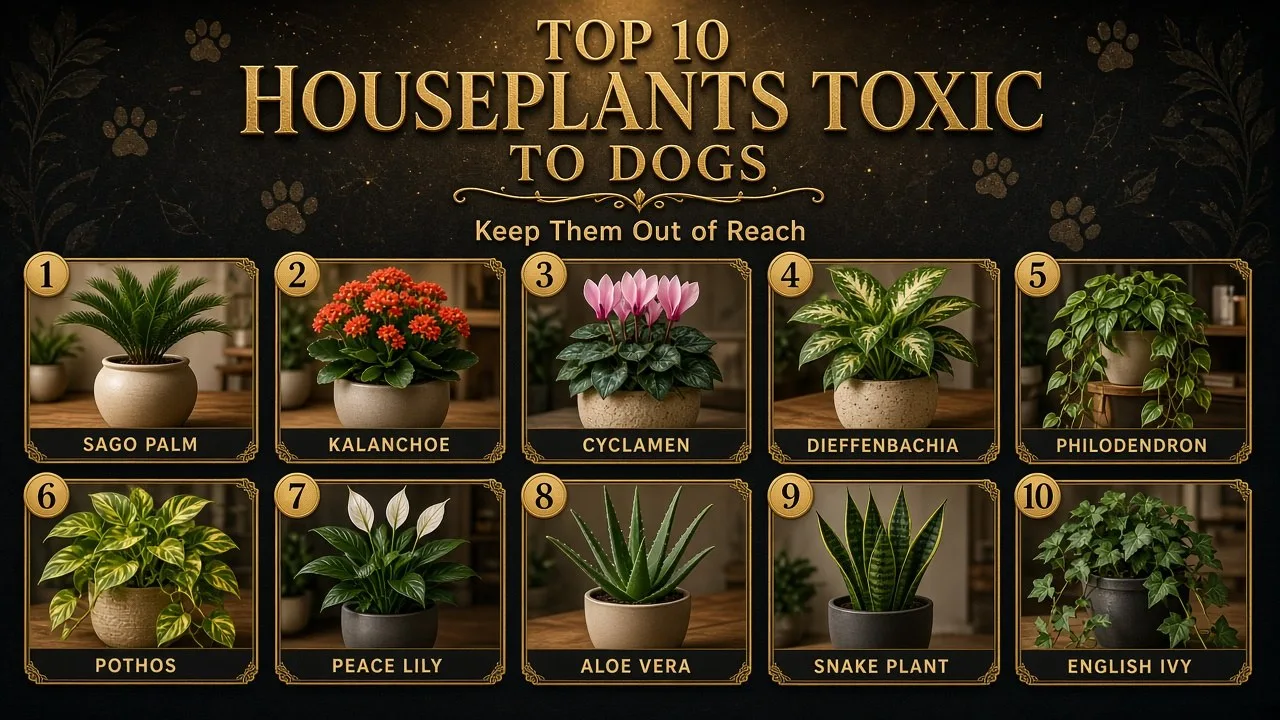
Houseplants toxic to dogs include sago palm, kalanchoe, cyclamen, dieffenbachia and pothos, popular indoor plants that can make a curious dog very ill.
Houseplants brighten a room, clean up a dull corner and make a home feel alive. Dogs, however, explore the world with their mouths, and a puppy or a bored adult dog will happily chew a dangling leaf or dig into a plant pot. Many of the most fashionable indoor plants contain natural chemicals that protect them from being eaten, and those same chemicals can harm a dog.
This guide covers ten common houseplants that veterinary toxicology references list as poisonous to dogs. For each plant you will find a Quick Facts table, the toxin involved, the warning signs and how serious an exposure usually is. The information comes from the ASPCA Animal Poison Control Center plant database, the Merck Veterinary Manual and published veterinary studies. It is general guidance, not a substitute for a vet. If you think your dog has eaten part of a plant, call your veterinarian or an animal poison control line straight away.
How We Chose These Plants
We started with plants that are sold widely as indoor or patio pot plants and that the ASPCA lists as toxic to dogs. We then ordered them roughly by how serious a typical poisoning can be, using the Merck Veterinary Manual. The first three plants on the list can affect the liver or the heart. Most of the others cause painful mouth irritation or stomach upset that usually clears up with care.
That order is a guide, not a guarantee. The danger always depends on the size of the dog, the part of the plant eaten, the amount swallowed and how quickly treatment starts. A mild plant can still cause a dangerous reaction in a small dog, and any plant chewing that is followed by worrying signs deserves a call to the vet.
Houseplants Toxic to Dogs at a Glance
| No. | Plant | Scientific name | Main toxin | Main danger |
|---|---|---|---|---|
| 1 | Sago palm | Cycas revoluta | Cycasin | Liver failure, can be fatal |
| 2 | Kalanchoe | Kalanchoe species | Bufadienolides (cardiac glycosides) | Vomiting, rarely heart rhythm problems |
| 3 | Cyclamen | Cyclamen species | Terpenoid saponins | Vomiting; heart problems and seizures after eating tubers |
| 4 | Dieffenbachia (dumb cane) | Dieffenbachia species | Insoluble calcium oxalates | Intense mouth pain and swelling |
| 5 | Philodendron | Philodendron species | Insoluble calcium oxalates | Mouth pain, drooling, vomiting |
| 6 | Pothos (devil's ivy) | Epipremnum aureum | Insoluble calcium oxalates | Mouth pain, drooling, vomiting |
| 7 | Peace lily | Spathiphyllum species | Insoluble calcium oxalates | Mouth pain, drooling, vomiting |
| 8 | Aloe vera | Aloe vera | Saponins, anthraquinones | Vomiting, diarrhoea, lethargy |
| 9 | Snake plant | Dracaena trifasciata (formerly Sansevieria) | Saponins | Nausea, vomiting, diarrhoea |
| 10 | English ivy | Hedera helix | Triterpenoid saponins | Vomiting, abdominal pain, drooling |
1. Sago Palm
| Attribute | Details |
|---|---|
| Scientific name | Cycas revoluta (and related cycads and zamias) |
| Other names | Coontie palm, cardboard palm, Japanese cycad |
| Main toxins | Cycasin and BMAA (beta-methylamino-L-alanine) |
| Most toxic part | The seeds, although every part is poisonous |
| Typical signs | Vomiting, bloody diarrhoea, jaundice, bruising, liver failure |
Why It Is Dangerous
The sago palm is the most dangerous plant on this list. The Merck Veterinary Manual describes dogs as extremely sensitive to cycads, with severe stomach and bowel signs, liver damage and nervous system problems expected after a meal of the plant. Its main toxin, cycasin, attacks the liver, while a second compound called BMAA mainly affects the nervous system.
The seeds hold the highest concentration of toxin, but the leaves, trunk and roots are poisonous too. According to Merck, the first signs often appear within about four hours and can progress to liver failure within 48 to 72 hours. Many deaths are caused by the destruction of liver tissue.
How Serious Is It?
Veterinary studies show how risky sago palm poisoning can be. A review of 60 dogs reported to the US National Animal Poison Control Center between 1987 and 1997, published in the Journal of the American Veterinary Medical Association, recorded a death rate of about 32 percent. A later study of 34 dogs in Louisiana found that half died or were euthanised.
Outcomes improve with fast treatment. A 2020 study of 130 dogs treated at two referral hospitals reported overall mortality of 12.3 percent, and found that giving activated charcoal sharply reduced the odds of death. This is why vets treat any sago palm chewing as an emergency, even before signs appear.
Warning Signs
- Vomiting and diarrhoea, which may contain blood
- Loss of appetite, tiredness and belly pain
- Wobbly walking, tremors or seizures
- Yellow gums or eyes (jaundice)
- Small bruises or bleeding spots on the skin and gums
Interesting Facts
- Despite its name, the sago palm is not a palm at all. It is a cycad, part of an ancient group of seed plants.
- Cycas revoluta is native to southern Japan and is popular as an indoor pot plant and bonsai.
- The 1998 veterinary review found that dogs which ate the seeds tended to develop more serious problems.
- Merck notes that the prognosis is fair to good when dogs receive prompt, aggressive care, and guarded to poor when treatment is delayed.
2. Kalanchoe
| Attribute | Details |
|---|---|
| Scientific name | Kalanchoe species |
| Other names | Mother-in-law plant, devil's backbone, chandelier plant, mother of millions |
| Main toxin | Bufadienolides, a type of cardiac glycoside |
| Most toxic part | The leaves contain the cardiac glycosides |
| Typical signs | Vomiting, diarrhoea, rarely an abnormal heart rhythm |
Why It Is Dangerous
Kalanchoe is a cheerful flowering succulent that is often sold as a gift plant. Its leaves contain bufadienolides, which belong to the cardiac glycoside family of toxins. These compounds interfere with a pump in heart muscle cells that controls sodium and potassium, which can slow the heart or make it beat irregularly.
The Merck Veterinary Manual groups kalanchoe with other cardiac glycoside plants such as oleander and foxglove. It notes that cats are thought to be more sensitive than dogs to this class of toxin. For most dogs that take a nibble, the ASPCA lists vomiting and diarrhoea as the usual signs, with heart rhythm problems being rare.
Warning Signs
- Vomiting and diarrhoea
- Weakness or unusual tiredness
- A heart rate that is too slow, too fast or irregular
- Collapse, in rare severe cases
Significance
Merck notes that signs from cardiac glycoside plants usually appear within the first two hours and can last for four to five days. Because these toxins have a narrow margin of safety, a vet will want to know about any ingestion, especially in a small dog or one that ate several leaves. Most dogs with stomach upset only have an excellent outlook.
Interesting Facts
- Kalanchoe belongs to the stonecrop family, Crassulaceae, the same family as the jade plant.
- Some species, nicknamed mother of millions, grow tiny plantlets along the edges of their leaves.
- Cardiac glycosides from plants are chemically similar to digoxin, a heart medicine, which helps vets diagnose and treat poisoning.
3. Cyclamen
| Attribute | Details |
|---|---|
| Scientific name | Cyclamen species |
| Other names | Sowbread |
| Main toxin | Terpenoid saponins |
| Most toxic part | The tuber, the round root that sits just below the soil |
| Typical signs | Drooling, vomiting, diarrhoea; heart and nervous signs after eating tubers |
Why It Is Dangerous
Cyclamen is a popular winter-flowering pot plant with swept-back petals in pink, red and white. Its toxins are terpenoid saponins, which are concentrated in the tuber. The Merck Veterinary Manual explains that these saponins irritate the gut, which in turn lets more of the toxin be absorbed into the body.
A dog that chews a few leaves or flowers will usually only drool, vomit or have diarrhoea. The ASPCA warns that large meals of the tuber can cause heart rhythm problems, seizures and even death. Dogs that dig in pots are at the highest risk, because digging exposes the tuber.
Warning Signs
- Drooling and vomiting
- Diarrhoea and loss of appetite
- Irregular heartbeat after large tuber ingestions
- Seizures or weakness in severe cases
Interesting Facts
- The name sowbread comes from the traditional observation that pigs dig up and eat the tubers.
- Cyclamen belongs to the primrose family, Primulaceae.
- Cyclamen is listed as toxic to dogs, cats and horses by the ASPCA.
4. Dieffenbachia (Dumb Cane)
| Attribute | Details |
|---|---|
| Scientific name | Dieffenbachia species |
| Other names | Dumb cane, giant dumb cane, tropic snow, exotica, spotted dumb cane |
| Main toxins | Insoluble calcium oxalate crystals and a protein-digesting enzyme |
| Most toxic part | All parts, including the sap |
| Typical signs | Intense mouth pain, drooling, pawing at the mouth, vomiting |
Why It Is Dangerous
Dieffenbachia is a striking plant with large leaves splashed with cream and green. Like many members of the arum family, it is packed with microscopic needle-shaped crystals of calcium oxalate. These crystals sit bundled inside special cells, and when a dog bites into a leaf they are fired into the soft tissue of the mouth and throat.
The result is immediate burning pain and swelling. The Merck Veterinary Manual notes that dogs may shake their heads, stick out their tongues, drool heavily and have trouble breathing. Because the pain starts so fast, most dogs stop chewing quickly, and Merck describes deaths as infrequent.
Warning Signs
- Sudden pain, crying or pawing at the mouth
- Heavy drooling and head shaking
- Swollen lips, tongue or throat
- Vomiting and difficulty swallowing
- Noisy or laboured breathing, which needs urgent care
Significance
The main emergency with dieffenbachia is swelling at the back of the throat, which can make breathing difficult. Merck notes that rinsing the mouth and offering milk or another calcium-rich dairy product can help bind the crystals. Most dogs recover fully, often without needing hospital treatment.
Interesting Facts
- The name dumb cane comes from the way the swelling can make it hard for a person who bites the plant to speak.
- Unlike some oxalate plants eaten by livestock, the insoluble crystals in houseplants are not a concern for kidney damage, according to Merck.
- Dieffenbachia is also toxic to cats.
5. Philodendron
| Attribute | Details |
|---|---|
| Scientific name | Philodendron species, including the heartleaf philodendron (Philodendron hederaceum) |
| Other names | Heartleaf philodendron, sweetheart plant, cordatum |
| Main toxin | Insoluble calcium oxalates |
| Most toxic part | All parts of the plant |
| Typical signs | Mouth pain and swelling, drooling, vomiting, difficulty swallowing |
Why It Is Dangerous
Philodendrons are among the easiest houseplants to grow, which is why they appear in so many homes. Trailing types are often placed on shelves where their vines hang within reach of a dog. Every part of the plant contains insoluble calcium oxalate crystals.
When a dog chews a stem or leaf, the crystals irritate the mouth, tongue and lips. The ASPCA lists oral pain and swelling, heavy drooling, vomiting and trouble swallowing as the main signs.
Warning Signs
- Drooling and lip licking
- Pawing at the face or mouth
- Swelling of the lips or tongue
- Vomiting or reluctance to eat
Interesting Facts
- The name philodendron comes from Greek words meaning tree lover, because many species climb trees in the wild.
- The fruit salad plant or Swiss cheese plant, Monstera deliciosa, was once sold as split-leaf philodendron and also contains insoluble oxalates.
- The ASPCA lists philodendrons as toxic to dogs, cats and horses.
6. Pothos (Devil's Ivy)
| Attribute | Details |
|---|---|
| Scientific name | Epipremnum aureum |
| Other names | Golden pothos, devil's ivy, taro vine, ivy arum |
| Main toxin | Insoluble calcium oxalates |
| Most toxic part | The entire plant |
| Typical signs | Mouth pain, heavy drooling, vomiting, difficulty swallowing |
Why It Is Dangerous
Pothos is a fast-growing trailing vine with heart-shaped leaves streaked with yellow or white. It is often confused with philodendron, and it causes the same kind of problem. The Merck Veterinary Manual notes that the entire plant is poisonous and that chewing any part causes immediate, intense pain in the mouth.
The good news is that the pain usually stops a dog from eating much. Merck states that the mouth pain resolves slowly, often without treatment, though a vet may give pain relief or soothing medicine in more severe cases.
Warning Signs
- Sudden drooling or foaming at the mouth
- Pawing at the mouth or rubbing the face on the floor
- Vomiting
- Difficulty swallowing
Interesting Facts
- Pothos earned the nickname devil's ivy because it is very hard to kill and stays green even in low light.
- Indoor pothos plants have much smaller leaves than the same species growing outdoors in the tropics.
- Pothos is in the arum family, Araceae, along with dieffenbachia, philodendron and the peace lily.
7. Peace Lily
| Attribute | Details |
|---|---|
| Scientific name | Spathiphyllum species |
| Other names | Mauna Loa peace lily |
| Main toxin | Insoluble calcium oxalates |
| Most toxic part | Leaves, stems and flowers |
| Typical signs | Mouth burning and irritation, drooling, vomiting, difficulty swallowing |
Why It Is Dangerous
The peace lily is a favourite for offices and living rooms because it flowers in shade and droops visibly when it needs water. Its glossy leaves and white flowers contain insoluble calcium oxalate crystals, so it causes the same mouth irritation as other arum-family plants.
The ASPCA lists intense burning of the mouth, tongue and lips, excessive drooling, vomiting and difficulty swallowing as the clinical signs. These signs are usually short-lived, but any swelling that affects breathing needs immediate veterinary attention.
Warning Signs
- Drooling and pawing at the mouth
- Red, irritated gums or lips
- Vomiting
- Reluctance to eat or drink
Significance
The peace lily is a good example of why names matter. It is not a true lily. True lilies of the genus Lilium, such as the Easter lily, can cause fatal kidney failure in cats, but the Merck Veterinary Manual says they have not been reported as toxic to other species in that way. Merck advises owners to identify a plant by its scientific name as well as its common name so that a vet can judge the risk correctly.
Interesting Facts
- The white part people call the flower is actually a leaf-like hood called a spathe that surrounds a spike of tiny flowers.
- The peace lily belongs to the arum family, Araceae, not the lily family.
- It is listed as toxic to both dogs and cats.
8. Aloe Vera
| Attribute | Details |
|---|---|
| Scientific name | Aloe vera (also called Aloe barbadensis) |
| Other names | Barbados aloe, Curacao aloe |
| Main toxins | Saponins and anthraquinone glycosides |
| Most toxic part | The bitter latex just under the leaf skin; the inner gel is considered edible |
| Typical signs | Vomiting, diarrhoea, lethargy |
Why It Is Dangerous
Aloe vera is famous for the soothing gel inside its leaves, so many owners are surprised to see it on a toxic plant list. The ASPCA notes that the gel itself is considered edible. The problem is the yellow latex found just beneath the skin of the leaf, which contains anthraquinone glycosides such as barbaloin.
These compounds act as a strong laxative. The Merck Veterinary Manual says that eating the plant can cause sudden, severe diarrhoea, sometimes with vomiting, and notes that younger leaves contain higher concentrations of the irritant compounds.
Warning Signs
- Vomiting
- Diarrhoea, which can lead to dehydration
- Lethargy and loss of appetite
Interesting Facts
- Aloe plants have been grown for their gel for centuries, and the gel is widely used in skin care products today.
- Keep human aloe products away from dogs too, because some contain other ingredients that are unsafe for pets.
- The ASPCA lists aloe as toxic to dogs, cats and horses.
9. Snake Plant
| Attribute | Details |
|---|---|
| Scientific name | Dracaena trifasciata (long known as Sansevieria trifasciata) |
| Other names | Mother-in-law's tongue, golden bird's nest, good luck plant |
| Main toxin | Saponins |
| Most toxic part | The leaves |
| Typical signs | Nausea, vomiting, diarrhoea |
Why It Is Dangerous
The snake plant, with its tall, stiff, sword-shaped leaves, is one of the most popular low-maintenance houseplants. It tolerates low light and irregular watering, so it often ends up on floors and in corners where dogs can reach it.
Its leaves contain saponins, soap-like compounds that irritate the stomach and intestines. The ASPCA lists nausea, vomiting and diarrhoea as the signs. Poisoning is usually mild, and most dogs recover with supportive care once the plant material has passed.
Warning Signs
- Drooling or lip licking from nausea
- Vomiting
- Diarrhoea
Interesting Facts
- Botanists moved the snake plant from the genus Sansevieria into Dracaena, so you may see either name on plant labels.
- Its relative the corn plant, Dracaena fragrans, also contains saponins and is listed as toxic to dogs by the ASPCA.
- Snake plants are toxic to cats as well as dogs.
10. English Ivy
| Attribute | Details |
|---|---|
| Scientific name | Hedera helix |
| Other names | Branching ivy, glacier ivy, needlepoint ivy, sweetheart ivy, California ivy |
| Main toxin | Triterpenoid saponins, including hederagenin |
| Most toxic part | The leaves, which the ASPCA says are more toxic than the berries |
| Typical signs | Vomiting, abdominal pain, drooling, diarrhoea |
Why It Is Dangerous
English ivy is grown both as a trailing indoor plant and as a climbing vine on walls and fences. Its leaves and berries contain saponins. The ASPCA lists vomiting, abdominal pain, drooling and diarrhoea as the signs, and notes that the foliage is more toxic than the berries.
The Merck Veterinary Manual adds that the toxin is poorly absorbed from the gut, so effects are usually limited. A large meal of leaves is most likely to cause stomach upset rather than serious systemic illness.
Warning Signs
- Drooling
- Vomiting and diarrhoea
- Signs of belly pain, such as a hunched back or restlessness
Interesting Facts
- English ivy is not related to poison ivy, which belongs to a different plant family.
- Merck notes that contact allergies to English ivy are common in people.
- English ivy is listed as toxic to dogs, cats and horses.
Other Common Houseplants Toxic to Dogs
Many other indoor plants contain the same toxins as the ten above. The table below lists more common examples, based on the ASPCA database and the Merck Veterinary Manual.
| Plant | Scientific name | Toxin | Typical signs |
|---|---|---|---|
| Jade plant | Crassula species | Unknown | Vomiting, depression, wobbliness |
| Corn plant | Dracaena fragrans | Saponins | Vomiting, drooling, loss of appetite |
| Caladium (elephant ear) | Caladium species | Insoluble calcium oxalates | Mouth pain and swelling, drooling |
| Asparagus fern | Asparagus densiflorus | Not specified | Skin irritation; berries cause stomach upset |
| Fruit salad plant | Monstera deliciosa | Insoluble calcium oxalates | Mouth irritation, drooling |
| Chinese evergreen | Aglaonema species | Insoluble calcium oxalates | Mouth irritation, drooling |
| Arrowhead vine | Syngonium species | Insoluble calcium oxalates | Mouth irritation, drooling |
| Umbrella plant | Schefflera species | Insoluble calcium oxalates | Mouth irritation, drooling |
Dog-Safe Houseplant Alternatives
You do not have to give up indoor greenery to keep a dog safe. The ASPCA lists the following popular houseplants as non-toxic to dogs. Even safe plants can cause a mild stomach upset if a dog eats a lot of leaves, so it is still best to discourage chewing.
| Plant | Scientific name | Why people like it |
|---|---|---|
| Spider plant | Chlorophytum comosum | Easy to grow, produces hanging baby plants |
| Boston fern | Nephrolepis exalta bostoniensis | Lush, feathery fronds for hanging baskets |
| Parlor palm | Chamaedorea elegans | Tolerates low light, adds a tropical look |
| Prayer plant | Calathea insignis and relatives | Patterned leaves that fold up at night |
| African violet | Saintpaulia species | Compact flowering plant for windowsills |
What to Do If Your Dog Eats a Houseplant
- Remove any plant material from your dog's mouth and move the dog away from the plant.
- Check for swelling of the mouth or throat and any trouble breathing. Breathing problems need an emergency vet straight away.
- Identify the plant, ideally by its scientific name, and take a photo or a piece of it with you. Merck stresses that plants sharing a common name can have very different toxicity.
- Call your veterinarian or the ASPCA Animal Poison Control Center on (888) 426-4435. The ASPCA notes that a consultation fee may apply.
- Do not try to make your dog vomit unless a vet tells you to.
- For sago palm, kalanchoe or cyclamen tubers, go to a vet even if your dog seems well. Early treatment, especially activated charcoal for sago palm, has been linked to better survival.
How to Keep Dogs Away From Toxic Plants
- Put toxic plants on high shelves or in hanging baskets well out of reach, and trim trailing vines so they do not hang down.
- Cover the soil in pots with decorative stones or mesh to discourage digging, which protects against tubers such as cyclamen.
- Pick up fallen leaves, flowers and seeds promptly.
- Keep plants out of rooms where a puppy or a dog is left alone.
- Check labels or the ASPCA plant database before buying a new plant or accepting one as a gift.
- Choose dog-safe plants for floor-level spots.
Frequently Asked Questions
What is the most toxic houseplant for dogs?
The sago palm is generally considered the most dangerous common houseplant for dogs. Every part of it is poisonous, and the seeds are the most toxic. Its toxin, cycasin, can cause liver failure within two to three days. Published studies have reported death rates ranging from about 12 percent to 50 percent or more in poisoned dogs.
Is pothos toxic to dogs?
Yes. Pothos, also called devil's ivy, contains insoluble calcium oxalate crystals that cause immediate burning pain in the mouth when chewed. Dogs usually drool, paw at their mouths and may vomit. The pain normally stops a dog from eating much, and most recover fully, but swelling that affects breathing needs urgent veterinary care.
Are peace lilies poisonous to dogs?
Peace lilies are toxic to dogs, but they are not true lilies. They contain insoluble calcium oxalates that irritate the mouth, causing drooling, vomiting and difficulty swallowing. They do not cause the kidney failure that true lilies cause in cats. Signs are usually short-lived, but a vet should be called if swelling or breathing trouble develops.
Is aloe vera safe for dogs?
Aloe vera is not safe for dogs to eat. The ASPCA says the inner gel is considered edible, but the yellow latex under the leaf skin contains anthraquinones and saponins that can cause vomiting, diarrhoea and lethargy. Keep aloe plants out of reach and do not let dogs lick aloe products meant for people.
How long after eating a toxic plant will a dog show symptoms?
It depends on the plant. Calcium oxalate plants such as dieffenbachia and pothos cause pain almost immediately. Merck notes that cardiac glycoside plants such as kalanchoe usually cause signs within two hours, and sago palm signs often start within about four hours, with liver failure developing over the next two to three days.
Are snake plants toxic to dogs?
Yes, snake plants are mildly toxic to dogs. Their leaves contain saponins, which can cause nausea, vomiting and diarrhoea if chewed or swallowed. Serious illness is uncommon, and most dogs recover with simple supportive care. If your dog has eaten a large amount or seems unwell, contact your veterinarian for advice.
Which houseplants are safe for dogs?
The ASPCA lists the spider plant, Boston fern, parlor palm, prayer plant and African violet among houseplants that are non-toxic to dogs. These make good choices for floor-level spots in a home with pets. Even safe plants can upset a dog's stomach if large amounts are eaten, so discourage chewing.
Conclusion
Houseplants toxic to dogs range from mildly irritating to life-threatening. Sago palm stands apart as a genuine emergency that can destroy a dog's liver, while kalanchoe and cyclamen tubers can affect the heart. Popular arum-family plants such as dieffenbachia, philodendron, pothos and peace lily mostly cause painful but short-lived mouth irritation, and aloe vera, snake plant and English ivy usually lead to stomach upset.
The safest approach is simple: know the names of the plants in your home, keep toxic ones well out of reach, and choose dog-safe alternatives for low spots. If your dog does chew a plant, identify it and call your vet or a poison control line quickly. For more pet safety advice, see our guide to foods dogs should never eat, or browse more lists in the Top 10 Facts section of Finepedia.
- ASPCA Animal Poison Control Center, Toxic and Non-Toxic Plants database: entries for sago palm, kalanchoe, cyclamen, dieffenbachia, golden pothos, philodendron, heartleaf philodendron, peace lily, aloe, snake plant, English ivy, jade plant, corn plant, caladium, asparagus fern, spider plant, Boston fern, parlor palm, prayer plant and African violet
- Merck Veterinary Manual, Houseplants and Ornamentals Toxic to Animals
- Albretsen JC and others, Cycad palm toxicosis in dogs: 60 cases (1987-1997), Journal of the American Veterinary Medical Association, 1998
- Ferguson D and others, Survival and prognostic indicators for cycad intoxication in dogs, Journal of Veterinary Internal Medicine, 2011
- The characterization of cycad palm toxicosis and treatment effects in 130 dogs, Australian Veterinary Journal, 2020



















Log in with