









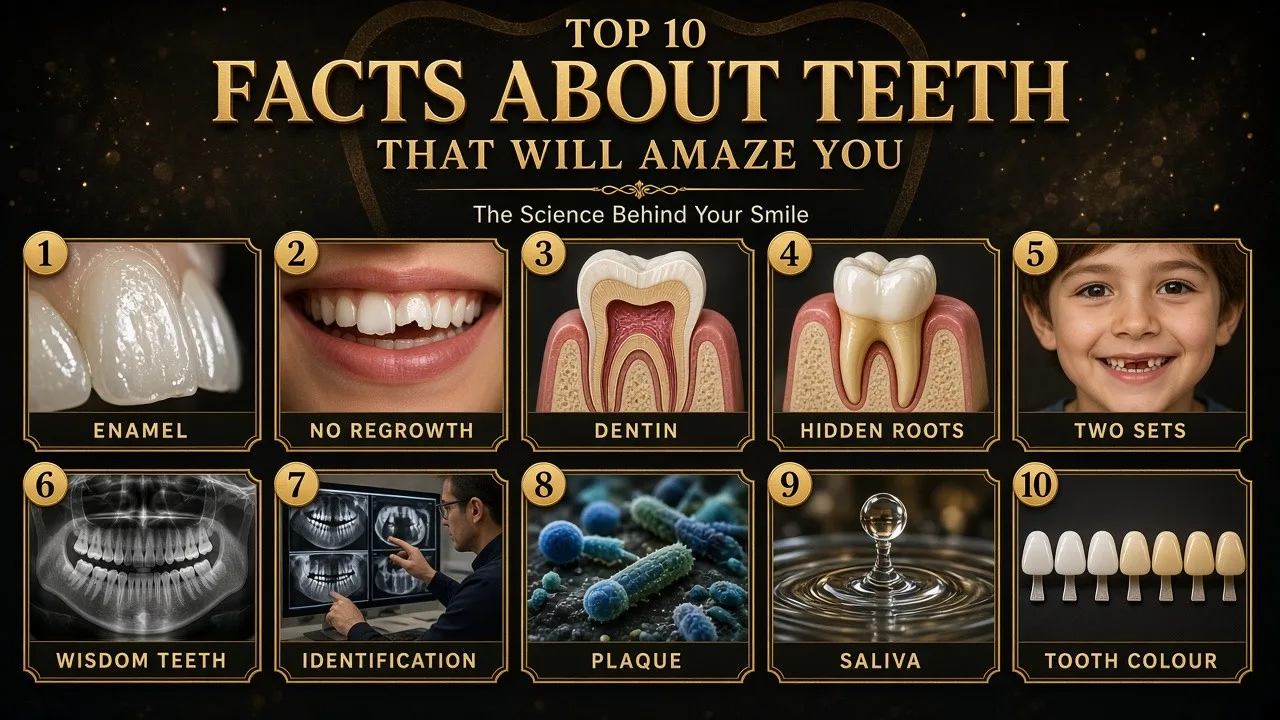
Facts about teeth range from enamel being the hardest substance in the body to dentin that keeps growing for life and saliva that guards your smile.
Teeth do far more than chew. They shape the way we speak, hold the face in proportion, and carry a record of our health, diet and age that can last for thousands of years. Yet most people know surprisingly little about what is inside them, how they grow, or why some problems can be reversed while others cannot.
This guide brings together ten amazing facts about human teeth, from the mineral science of enamel to the bacteria living in your mouth. Each fact is checked against dental and medical references, and a myth-check table at the end corrects some popular claims that circulate online.
What a Tooth Is Made Of
Every tooth is built from four main tissues. Three of them are hard and mineralised, and one is soft and alive. Knowing these layers makes the facts below much easier to follow.
| Layer | Where it is | What it does |
|---|---|---|
| Enamel | The outer shell of the crown, the part you can see | Protects the tooth from biting forces, heat and acid |
| Dentin | Under the enamel and cementum, forming most of the tooth | Supports the enamel and carries signals to the pulp |
| Cementum | A thin layer covering the root | Anchors the tooth to the jaw through tiny ligament fibres |
| Pulp | The soft centre of the tooth | Holds the nerves and blood vessels that keep the tooth alive |
The crown is the part covered in enamel above the gum line, while the root sits below it, covered in cementum and set into the upper jaw (maxilla) or lower jaw (mandible). The point where the two meet is called the neck of the tooth, or the cementoenamel junction.
How We Chose These 10 Facts
This is an editorial list, not a ranking. We picked facts that are surprising to most readers, that are supported by established dental science, and that help explain how to look after your teeth. Where the original topic used figures that do not hold up, such as the daily amount of saliva, we have corrected them using reliable sources.
This article is general information, not dental advice. Anyone with tooth pain, bleeding gums or a loose tooth should see a dentist.
Facts About Teeth at a Glance
| No. | Fact | Key detail |
|---|---|---|
| 1 | Enamel is the hardest substance in the body | About 96% mineral, mostly hydroxyapatite |
| 2 | Enamel cannot grow back | It has no living cells, nerves or blood supply |
| 3 | Dentin keeps forming for life | It is the main reason teeth can feel sensitive |
| 4 | Much of each tooth is hidden | Roots sit below the gum, set into the jaw |
| 5 | You get two sets of teeth | 20 primary teeth, then 32 permanent teeth |
| 6 | Wisdom teeth may never appear | Usually erupt between ages 17 and 25, if at all |
| 7 | Teeth help identify people | Dental records are a standard identification tool |
| 8 | Plaque is a living biofilm | It can harden into tartar that brushing cannot remove |
| 9 | Saliva protects your teeth | Around 1.5 litres a day, about 99% water |
| 10 | Tooth colour comes from dentin | Enamel is semi-translucent, so the layer beneath shows through |
1. Enamel Is the Hardest Substance in the Human Body
Tooth enamel is the hardest substance the human body makes, and it contains the highest proportion of minerals of any tissue, at about 96%. The rest is water and a small amount of organic material. Its main mineral is hydroxyapatite, a crystalline form of calcium phosphate packed into tightly arranged rods.
On the Mohs hardness scale, enamel ranks at about 5, roughly on a par with steel. That strength lets the front teeth slice through food and the back teeth grind it, day after day, for decades.
Strong but Brittle
The same high mineral content that makes enamel hard also makes it brittle. A sharp knock, biting on something very hard, or grinding at night can chip or crack it. Dentin underneath, which is softer and more flexible, acts as a cushion that stops enamel from shattering.
Interesting Facts
- Enamel forms while the tooth is still developing inside the jaw, before it ever appears in the mouth.
- On dental X-rays, enamel shows up lighter than dentin or pulp because it is denser.
- Enamel is thickest on the biting surfaces and thinnest at the neck of the tooth.
2. Enamel Cannot Grow Back
Unlike skin or bone, enamel cannot repair itself in any major way. It has no blood vessels, no nerves and no living cells once the tooth has formed, so the body has no way to rebuild it after it is lost. A chip, a deep crack or a cavity in the enamel will stay unless a dentist repairs it.
Early Damage Can Be Reversed
Enamel is not completely static. Acids from food and from bacteria remove minerals from its surface, and minerals can move back in. This process, called remineralisation, can repair early, microscopic damage before a true cavity forms. Fluoride helps by speeding up the movement of calcium and phosphate back into the tooth surface, which is why fluoride toothpaste and fluoride varnish are widely recommended.
What Wears Enamel Away
- Frequent sugary snacks and drinks, which feed acid-producing bacteria
- Acidic drinks such as soft drinks and fruit juices
- Hard-bristled brushes and heavy-handed brushing
- Grinding or clenching the teeth
3. Dentin Keeps Growing Throughout Life
Dentin makes up most of each tooth, in both the crown and the root. Unlike enamel, it keeps forming throughout life. The cells that make it, called odontoblasts, line the inside of the pulp and continue to lay down new dentin slowly with age, and faster in response to wear or injury.
Dentin is less mineralised than enamel and rates about 3 on the Mohs scale. Because it is softer, decay spreads through it faster once a cavity breaks through the enamel.
Why Teeth Feel Sensitive
Dentin is filled with microscopic channels called dentinal tubules, which run from the pulp out towards the enamel and cementum. Each tubule holds fluid and a thin extension of an odontoblast cell. When gums recede or enamel wears away, these tubules are exposed, and hot, cold or sweet foods can trigger a sharp twinge. This is the main cause of sensitive teeth.
Interesting Facts
- The tubules follow a gentle S-shaped path through the dentin.
- They are widest and most crowded close to the pulp.
- Dentin comes in three types: primary, secondary, which forms after the root is complete, and tertiary, which forms in response to decay or wear.
4. Much of Every Tooth Is Hidden Below the Gum
The white crown you see in the mirror is only part of the tooth. Below the gum line, the root, covered in cementum, anchors the tooth deep in the jawbone. The original topic compared teeth to icebergs for this reason, and the image fits: much of the structure that holds a tooth in place is out of sight.
Different teeth have different numbers of roots, which helps explain why some extractions and root canal treatments are harder than others.
| Tooth type | Usual number of roots |
|---|---|
| Incisors and canines | One |
| Most premolars | One |
| Upper first premolars | Two |
| Lower molars | Two |
| Upper molars | Three |
Why the Gums Matter
The roots are protected by the gums and held in the jaw by the periodontal ligament. When gum disease sets in, the gum and bone can pull away from the root, and teeth can loosen and fall out. Healthy gums are firm and pink and do not bleed when you brush.
5. You Get Two Complete Sets of Teeth
Humans grow two sets of teeth in a lifetime. Children have 20 primary teeth, often called baby teeth or milk teeth, and adults have 32 permanent teeth. Primary teeth begin forming in the embryo, at around six weeks, and the buds of adult teeth start forming around the fourth month of pregnancy.
Teething usually starts around six months of age and continues until roughly two to three years old. The first permanent molars typically arrive at about six years, starting the mixed stage when a child has both baby and adult teeth.
| Tooth type | Job | Primary set | Permanent set |
|---|---|---|---|
| Incisors | Cutting | 8 | 8 |
| Canines | Tearing | 4 | 4 |
| Premolars | Crushing | 0 | 8 |
| Molars | Grinding | 8 | 12 |
| Total | 20 | 32 |
How Baby Teeth Fall Out
As an adult tooth grows, it presses on the root of the baby tooth above it. Specialised cells dissolve that root, so the baby tooth loosens and falls out, usually without pain or much bleeding. Occasionally a baby tooth stays in place well into adulthood, often because the adult tooth beneath it never developed.
6. Wisdom Teeth May Never Appear
Wisdom teeth are the third molars, the last teeth at the back of each side of the jaw. They usually emerge between the ages of 17 and 25, much later than the rest, which is how they got their name: they arrive at an age when people are supposedly wiser.
Many people never get some or all of their wisdom teeth. How often they are missing varies hugely between populations, from almost never in some groups to almost always in others. When they do form, there is often too little room for them, so they can come in at an angle or stay trapped under the gum.
Interesting Facts
- The lower third molars are the smallest molars in the adult mouth.
- Extra teeth beyond the usual 32, such as rare fourth molars, are called supernumerary teeth.
- In the Universal Numbering System used in the United States, the wisdom teeth are numbered 1, 16, 17 and 32.
7. Teeth Help Identify People
Teeth are among the toughest parts of the body, and the combination of a person's fillings, crowns, missing teeth and natural shapes is highly individual. Forensic dentists compare remains with dental records and X-rays to identify people when other evidence is scarce, such as after fires and mass disasters.
Teeth can also help experts estimate a person's age, because the order in which teeth form and erupt follows a predictable pattern in childhood and the teenage years.
The Limits of Bite Mark Evidence
Identifying someone from their own teeth and dental records is very different from matching a bite mark on skin to a suspect. Bite mark analysis has proved highly controversial, and scientific bodies including the US National Institute of Standards and Technology, the National Academy of Sciences and the President's Council of Advisors on Science and Technology have criticised it as lacking scientific support.
8. Your Teeth Host a Living Biofilm
Plaque is not simply leftover food. It is a living biofilm, a community of microorganisms, mostly bacteria, that grows on the teeth and gums. Within hours of brushing, a thin protein film called the pellicle coats the teeth, bacteria attach to it, and colonies build up in layers.
One species, Streptococcus mutans, is regarded as the main cause of tooth decay in its early stages. It turns sugars into acid, and that acid dissolves the minerals in enamel. The World Health Organization describes tooth decay in the same way: plaque converts free sugars in food and drink into acids that destroy the tooth over time.
From Plaque to Tartar
If plaque is not removed, minerals from saliva can harden it into dental calculus, also called tartar. Tartar is rough and firmly stuck to the tooth, which gives fresh plaque an ideal surface to grow on. Brushing and flossing remove plaque, but once tartar has formed, only a dental professional can remove it.
- Brush twice a day with fluoride toothpaste.
- Clean between the teeth with floss or interdental brushes, where bristles cannot reach.
- Cut down on how often you have sugary foods and drinks.
- Have regular dental check-ups and cleanings.
9. Saliva Is Your Teeth's Natural Defender
Saliva is about 99% water, but the remaining 1% does a great deal of work. It contains electrolytes, mucus, enzymes such as amylase, which starts breaking down starch, and antimicrobial substances that help control bacteria. It also contains cells from which DNA can be extracted.
Saliva washes away food particles and acts as a buffer, using bicarbonate and phosphate to reduce acidity in the mouth after eating. That helps protect enamel from the acid attacks that lead to decay.
How Much Saliva Do We Make?
The body produces an estimated 1.5 litres of saliva a day, not the 10,000 gallons a day claimed in some online lists. Production drops sharply during sleep, which is one reason brushing before bed matters so much: there is less saliva to protect the teeth overnight. A persistently dry mouth, which some medicines can cause, raises the risk of decay.
10. The Colour of Your Teeth Comes From Dentin
Enamel is semi-translucent, so the colour of the dentin underneath strongly affects how a tooth looks. Natural enamel ranges from light yellow to greyish or bluish white. Teeth that look more yellow often have thinner, more translucent enamel that lets the yellow dentin show through, while greyer teeth tend to have more opaque enamel.
That means slightly yellow teeth are not automatically a sign of decay, despite claims to the contrary. Stains from coffee, tea, tobacco and some foods can darken teeth, and enamel can thin with age and wear, letting more dentin show. Decay usually shows up differently, as white chalky spots, brown or black areas, or holes, often with sensitivity or pain.
Interesting Facts
- The biting edges of the upper front teeth often look slightly blue or see-through, because there is no dentin behind the enamel there.
- Old amalgam fillings can slowly darken the surrounding tooth as tin from the filling moves into the dentin tubules.
Myth Check: Popular Claims About Teeth
| Claim | Verdict | What the evidence says |
|---|---|---|
| We make 10,000 gallons of saliva a day | False | Estimated production is about 1.5 litres a day |
| Yellow teeth always mean decay | False | Natural enamel ranges from light yellow to greyish white |
| Enamel can heal like bone | False | Lost enamel is not renewed, though early mineral loss can be reversed |
| Bite marks are as reliable as fingerprints | False | Major scientific bodies have criticised bite mark analysis |
| Everyone gets four wisdom teeth | False | Many people are missing some or all of them |
A Short History of Cleaning Teeth
People have cared for their teeth for thousands of years. The tools have changed, but the goal of removing plaque and freshening breath has stayed the same.
| Period | Development |
|---|---|
| About 5000 BC | Egyptians make a tooth powder from ashes of ox hooves, pumice, burnt eggshells and myrrh |
| 3500 BC | The earliest known chew sticks, twigs with frayed ends, are found in Sumer in Mesopotamia |
| Ancient Greece and Rome | Tooth powders gain abrasives such as crushed bones and oyster shells |
| Tang dynasty China (619 to 907) | The first bristle toothbrush resembling the modern one, made with hog bristles |
| 1780 | William Addis is believed to have made the first mass-produced toothbrush in Britain |
| 1890s | Fluoride is first added to toothpaste |
| 1945 | Community water fluoridation begins after studies link moderate fluoride levels to fewer cavities |
Chew sticks remain in use today, especially in Africa, and the miswak, a teeth-cleaning twig from the Salvadora persica tree, is still widely used in the Middle East.
Why These Facts Matter
Oral diseases are among the most common health problems in the world. The World Health Organization estimates that they affect nearly 3.7 billion people, and untreated tooth decay in permanent teeth is the single most common health condition recorded by the Global Burden of Disease 2021 study. Severe gum disease accounts for more than 1 billion cases worldwide.
Most of this is preventable. The WHO names high sugar intake, too little fluoride and poor plaque removal as the main drivers of decay, and poor oral hygiene and tobacco use as the main risk factors for gum disease. Understanding how enamel, dentin, plaque and saliva work makes it easier to see why simple habits make such a difference.
Frequently Asked Questions
What is the hardest part of the human body?
Tooth enamel is the hardest substance in the human body. It is about 96% mineral, mostly a crystalline calcium phosphate called hydroxyapatite, and ranks about 5 on the Mohs hardness scale. Despite that hardness, it is brittle and can be dissolved by acids from food, drinks and bacteria.
Can tooth enamel grow back?
No. Enamel has no living cells, nerves or blood supply, so the body cannot rebuild it once it is lost. Very early mineral loss can be reversed through remineralisation, which fluoride toothpaste and varnish support, but chips, deep wear and cavities need to be repaired by a dentist.
How many teeth do humans have?
Children have 20 primary teeth, which usually start appearing around six months of age. Adults have 32 permanent teeth: 8 incisors, 4 canines, 8 premolars and 12 molars, including the four wisdom teeth. Many adults have fewer because wisdom teeth never formed or were removed.
Why are teeth sensitive to cold?
Sensitivity usually happens when dentin is exposed through worn enamel or receding gums. Dentin is full of tiny fluid-filled tubules that lead towards the pulp, where the nerves are. Cold, heat or sweet foods move the fluid in those tubules and trigger a short, sharp pain.
How much saliva does a person make each day?
An adult produces an estimated 1.5 litres of saliva a day, with much less made during sleep. Claims that people make 10,000 gallons a day are wrong. Saliva washes away food, buffers acids with bicarbonate and phosphate, and contains enzymes and antimicrobial substances that help protect the teeth.
Are yellow teeth a sign of decay?
Not necessarily. Enamel is semi-translucent, so the yellow colour of the dentin beneath it shows through, especially where enamel is thin. Staining from coffee, tea and tobacco also darkens teeth. Decay tends to show as chalky white spots, brown or black patches, or holes, so see a dentist if you notice those.
What causes tooth decay?
Tooth decay starts when bacteria in plaque, especially Streptococcus mutans, turn sugars from food and drink into acids. Those acids dissolve the minerals in enamel and then dentin. Frequent sugar, too little fluoride and poor brushing all raise the risk, while fluoride toothpaste, less sugar and regular cleaning lower it.
Conclusion
Teeth are remarkable structures. Enamel is harder than bone yet cannot regrow, dentin keeps forming for life, roots anchor each tooth deep in the jaw, and a living biofilm and a steady flow of saliva shape their health every day. Humans get two complete sets of teeth, wisdom teeth may never arrive, and dental records can identify people long after other evidence is gone.
The most useful fact of all is that most dental problems can be prevented. Brushing twice a day with fluoride toothpaste, cleaning between the teeth, limiting sugar and seeing a dentist regularly protect the enamel you will never be able to grow back. For more surprising lists, explore our Top 10 Facts and Health and Body collections on Finepedia.
- World Health Organization, Oral health fact sheet (17 March 2025)
- Encyclopaedic overviews (Wikipedia): Human tooth, Tooth enamel, Dentin, Saliva, Dental plaque, Streptococcus mutans, Dental calculus, Deciduous teeth, Tooth eruption, Wisdom tooth, Forensic dentistry, Tooth decay, Periodontal disease, Toothbrush, Toothpaste, Water fluoridation, Tooth whitening, Miswak
- Topic reference: 10mosttoday.com, 10 Most Amazing Facts About Teeth


















Log in with