











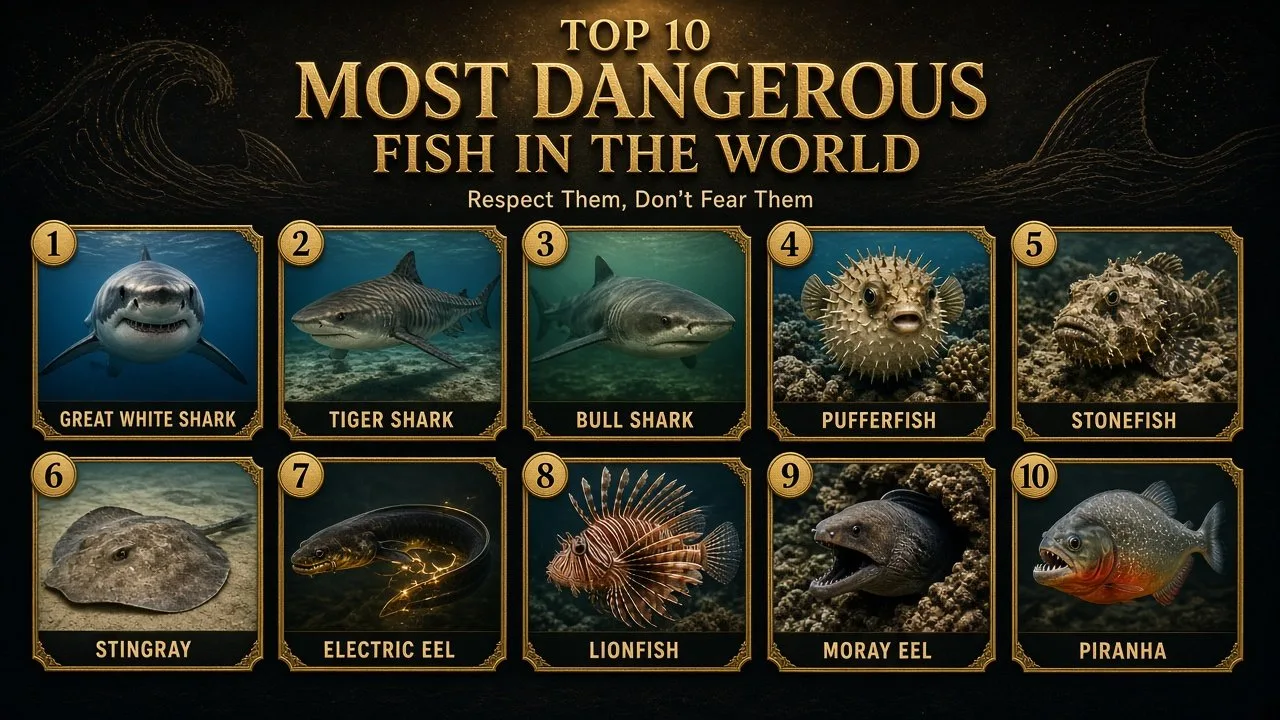
The most dangerous fish in the world include the great white, tiger and bull sharks, the pufferfish, the stonefish, the stingray and the electric eel.
Most fish are harmless to people, and even the famous ones on this list would rather avoid us. Yet a small number of species can kill or badly injure a person through a bite, a venomous spine, a powerful electric shock or a toxin hidden in the flesh. Knowing which fish deserve respect, and why, is the best way to enjoy the sea, rivers and reefs safely.
This guide ranks ten genuine fish (sharks and rays included, since they are fish too) by how much harm they actually cause humans. Each entry explains where the fish lives, what makes it dangerous, how often it hurts people and how to stay safe. A final section looks at popular myths, such as the candiru, and at the box jellyfish, which is often called a deadly fish but is not a fish at all.
How We Ranked the Most Dangerous Fish
There is no official league table of dangerous fish, so this ranking is an editorial judgement based on published records and scientific accounts. Each species was weighed against four questions.
- Recorded harm: how many people have been injured or killed, according to sources such as the International Shark Attack File and national poison records.
- Severity: whether an encounter is usually painful, disabling or potentially fatal.
- Exposure: how likely ordinary swimmers, divers, anglers, waders or diners are to meet the fish.
- Treatability: whether first aid, antivenom or medical care can reliably prevent death.
Sharks with long records of fatal bites rank highest. Venomous and poisonous fish follow, because they cause many injuries but deaths are rare where care is available. Fish with frightening reputations but few serious incidents sit at the bottom.
The Most Dangerous Fish at a Glance
| Rank | Fish | Scientific Name | Where It Lives | Main Danger |
|---|---|---|---|---|
| 1 | Great white shark | Carcharodon carcharias | Temperate and cool coastal seas worldwide | Powerful bites; most recorded shark bites on humans |
| 2 | Tiger shark | Galeocerdo cuvier | Tropical and warm temperate seas | Large bites in shallow reefs, harbours and river mouths |
| 3 | Bull shark | Carcharhinus leucas | Warm coasts, estuaries and rivers | Bites in shallow, murky and even fresh water |
| 4 | Pufferfish | Family Tetraodontidae | Tropical and subtropical seas | Tetrodotoxin poisoning when eaten |
| 5 | Stonefish | Genus Synanceia | Indo-Pacific reefs and shallows | Most venomous fish; stings from dorsal spines |
| 6 | Stingray | Order Myliobatiformes | Coastal seas and some rivers | Barbed, venomous tail spine |
| 7 | Electric eel | Genus Electrophorus | Amazon and Orinoco basins, the Guianas | Electric discharges of up to 860 volts |
| 8 | Lionfish | Genus Pterois | Indo-Pacific; invasive in the Atlantic and Caribbean | Venomous fin spines |
| 9 | Moray eel | Family Muraenidae | Tropical and subtropical reefs | Deep bites; ciguatera poisoning when eaten |
| 10 | Piranha | Subfamily Serrasalminae | South American rivers and lakes | Sharp, powerful bites in rare group attacks |
1. Great White Shark
| Attribute | Details |
|---|---|
| Scientific name | Carcharodon carcharias |
| Adult size | Females mature at about 4.6 to 4.9 m; males at about 3.4 to 4.0 m |
| Weight | Females about 1,000 to 1,900 kg; males about 680 to 1,000 kg |
| Habitat | Cool to temperate coastal waters worldwide |
| Human record | 351 documented unprovoked bites since 1580, 59 of them fatal (as of 2024) |
Where It Lives
The great white shark ranges through tropical, temperate and colder waters, but its main populations gather off California and Mexico, the north-east United States, the Mediterranean, southern Africa, Australia and New Zealand. Well-known feeding grounds include the Farallon Islands, Guadalupe Island, Cape Cod, the Western Cape of South Africa and the Neptune Islands of South Australia. These are often places where seals and sea lions breed, which brings the sharks close to beaches and surf breaks.
Why It Is Dangerous
- It is responsible for more recorded unprovoked bites on humans than any other shark species.
- Its jaw holds around 300 serrated, triangular teeth that are continually replaced.
- Computer modelling suggests a very large white shark could bite with more than 18,000 newtons of force at the back of the jaw.
- Most bites are thought to be investigative or cases of mistaken identity, but one bite from an animal this size can cause fatal blood loss.
Significance
The International Shark Attack File (ISAF) at the Florida Museum of Natural History reported 65 confirmed unprovoked shark bites worldwide in 2025, with nine unprovoked deaths. ISAF said most of those deaths were caused by white sharks, mainly involving surfers in Australia. Even so, humans are not normal prey for the species, and many people swim and surf near white sharks without incident every year.
The shark is also vulnerable itself. The IUCN lists it as vulnerable globally and critically endangered in European and Mediterranean waters, threatened by accidental capture, fishing and beach protection nets.
In Popular Culture
Peter Benchley's 1974 novel Jaws and Steven Spielberg's 1975 film turned the great white into the world's most feared fish. The 1971 documentary Blue Water, White Death had already introduced the species to a wide audience. Benchley later said he regretted portraying the shark as a man-eater.
Interesting Facts
- The largest preserved specimen, caught in the Mediterranean in 1956, measured 5.83 m.
- Orcas hunt white sharks, sometimes targeting their energy-rich livers.
- Its liver can make up more than a quarter of its body weight.
- The great white is still smaller than the plankton-eating whale shark and basking shark.
2. Tiger Shark
| Attribute | Details |
|---|---|
| Scientific name | Galeocerdo cuvier |
| Size | One of the largest predatory sharks; a confirmed specimen measured 5.5 m and 1,524 kg |
| Habitat | Tropical and warm temperate seas, reefs, harbours and river mouths |
| Diet | Almost anything, from turtles and dugongs to dead whales and rubbish |
| Human record | Second only to the great white in recorded bites and fatal attacks |
Where It Lives
Tiger sharks live in tropical and warm temperate oceans around the world. They often visit shallow reefs, harbours, canals and river mouths where run-off brings in food. This habit of hunting close to shore puts them in the same water as swimmers, snorkellers and surfers, particularly around Hawaii, Australia and other Pacific and Indian Ocean islands.
Why It Is Dangerous
- It is the second-largest predatory shark after the great white.
- Its broad, heavily calcified jaws and serrated teeth can slice through turtle shells.
- It eats a huge range of foods, earning the nickname "garbage eater" of the sea.
- Its willingness to investigate unfamiliar objects can lead to bites on people.
Significance
Tiger sharks rank second behind white sharks in recorded attacks on humans, but such events remain rare and are seldom fatal. Hawaii typically records three or four shark bites a year, a very low rate given the thousands of people who use its waters daily. The species is listed as near threatened because of finning and fishing.
In Popular Culture
The best-known tiger shark survivor is surfer Bethany Hamilton, who lost her left arm to a tiger shark in Hawaii in 2003 at the age of 13 and went on to compete professionally. Her story was told in the book and film Soul Surfer.
Interesting Facts
- Its stripes, which give the shark its name, fade as it grows older.
- The orca is the tiger shark's only recorded natural predator.
- Tiger sharks have been seen feeding on dead whales alongside great whites.
- Its genus name Galeocerdo combines Greek words for shark and fox.
3. Bull Shark
| Attribute | Details |
|---|---|
| Scientific name | Carcharhinus leucas |
| Other names | Zambezi shark (Africa), Lake Nicaragua shark |
| Habitat | Warm shallow coasts, estuaries, rivers and lakes |
| Special ability | Euryhaline: can live in both salt and fresh water |
| Conservation status | Vulnerable (IUCN) |
Where It Lives
The bull shark is found in warm, shallow waters along coasts worldwide, and it is famous for swimming far up rivers. It has been recorded in the Mississippi River as far as Alton, Illinois, about 1,100 km from the sea. In India it travels up the Ganges, Brahmaputra and Mahanadi, and it is found in Lake Nicaragua and the Zambezi system in Africa.
Why It Is Dangerous
- It favours shallow, often murky water where people swim, wade, bathe and fish.
- It is territorial and has little tolerance for provocation.
- Larger bull sharks are blamed for many nearshore bites, including many where the species was never identified.
- Its ability to enter fresh water means people can meet it far from the ocean.
Significance
Along with the great white and tiger shark, the bull shark is one of only three shark species responsible for a double-digit number of fatal, unprovoked attacks on humans. Some experts think bull sharks may be more dangerous to people than any other shark because of where they live. Bull sharks have bitten swimmers around Sydney Harbour inlets, off Florida and in Indian rivers, where some incidents were once blamed on the rare Ganges shark.
In Popular Culture
Some experts suspect a bull shark was behind the Jersey Shore shark attacks of 1916, because two of the fatal bites happened in brackish and fresh water. Jaws author Peter Benchley said those attacks were not the inspiration for his novel.
Interesting Facts
- The name comes from its stocky shape, broad flat snout and unpredictable behaviour.
- Bull sharks have lived in the water hazard of a golf course in Queensland, Australia, after floods.
- A bull shark appears on Costa Rica's 2,000 colones banknote.
- Unlike true river sharks, bull sharks are not permanent freshwater species.
4. Pufferfish
| Attribute | Details |
|---|---|
| Scientific name | Family Tetraodontidae |
| Other names | Blowfish, globefish, swellfish, fugu (as a dish in Japan) |
| Toxin | Tetrodotoxin, concentrated in the liver, ovaries, intestines and skin |
| Habitat | Mainly tropical and subtropical seas; some freshwater species |
| Main risk | Eating poorly prepared fish; there is no approved antidote |
Where It Lives
Pufferfish live mainly in warm seas, with some species in brackish and fresh water. They are slow swimmers that defend themselves by gulping water to inflate into a spiny ball. Most species are toxic, and some are among the most poisonous vertebrates on Earth.
Why It Is Dangerous
Unlike the sharks above, a pufferfish is dangerous on the plate rather than in the water.
- Tetrodotoxin blocks the sodium channels that nerves use to send signals, causing paralysis.
- In laboratory tests on mice, tetrodotoxin is far more poisonous by mouth than potassium cyanide.
- Symptoms begin with tingling of the lips and tongue, then spread to weakness, paralysis and breathing failure.
- Victims can stay conscious while paralysed, and death usually comes from respiratory failure within hours.
- No antidote is approved for human use; treatment means supporting breathing and circulation until the toxin clears.
Significance
Japan, where pufferfish is eaten as fugu, has controlled its preparation by law for decades. Since 1958 fugu chefs have needed a licence, which involves a two or three year apprenticeship and an exam that only about 35 percent of applicants pass. Tokyo health figures recorded 20 to 44 fugu poisoning incidents a year across Japan between 1996 and 2006, with 0 to 6 deaths a year, and most cases involved fishermen eating their own catch rather than restaurant meals.
Interesting Facts
- Tetrodotoxin is made by bacteria, which the fish pick up through their diet; farmed fugu raised away from those bacteria can be non-toxic.
- Captain James Cook and two naturalists were poisoned by a pufferfish in 1774 and survived because they ate only a little.
- Japanese scientist Yoshizumi Tahara isolated and named tetrodotoxin in 1909.
- Tetrodotoxin is being studied as a treatment for cancer-related pain.
5. Stonefish
| Attribute | Details |
|---|---|
| Scientific name | Genus Synanceia (reef stonefish: Synanceia verrucosa) |
| Claim to fame | The most venomous fish known |
| Venom delivery | Typically 13 sharp dorsal spines, each with venom glands |
| Habitat | Shallow coastal waters of the Red Sea and Indo-Pacific, including northern Australia |
| Treatment | Hot water immersion and, in severe cases, antivenom |
Where It Lives
Stonefish live on shallow reefs, rocky areas and sandy or muddy flats in the Indo-Pacific. The reef stonefish is the most widespread species. Their grey, warty, mottled skin makes them almost impossible to tell apart from rocks and coral, which is exactly how they ambush small fish and shrimp.
Why It Is Dangerous
- Most stings happen when someone steps on a hidden stonefish, driving the spines into the foot.
- The venom causes intense pain and can bring on breathing weakness, heart damage, convulsions and paralysis.
- Stonefish can survive out of water for up to 24 hours, so stings can happen on the beach at low tide.
- Survivors can be left with nerve damage and muscle wasting around the wound.
Significance
Stonefish antivenom is the second most administered antivenom in Australia. Hot water of at least 45 °C helps break down the protein-based venom, and the old practice of using a tight tourniquet is no longer recommended. Deaths are rare where medical care is available, but a sting is a medical emergency.
Interesting Facts
- Stonefish are eaten as a delicacy in parts of Japan, southern China, Hong Kong and Vietnam, once the venomous spines are removed.
- Cooking destroys the venom because it is made of proteins that break down when heated.
- Some Aboriginal Australian ceremonies re-enact the death of a person who trod on a stonefish.
- Females are larger than males.
6. Stingray
| Attribute | Details |
|---|---|
| Scientific name | Order Myliobatiformes (about 220 species in 29 genera) |
| Weapon | One to three barbed, venomous spines on the tail |
| Habitat | Coastal tropical and subtropical seas; some in rivers and the deep ocean |
| Behaviour | Not usually aggressive; stings when stepped on or threatened |
| Famous case | Steve Irwin, killed by a short-tail stingray in 2006 |
Where It Lives
Stingrays are flat, bottom-dwelling cousins of sharks. They are common in warm coastal waters worldwide, where they often lie partly buried in sand in the shallows. Some, such as the river stingrays of South America, live entirely in fresh water.
Why It Is Dangerous
- The tail spine is serrated and backward-barbed, so it tears flesh and often breaks off in the wound.
- Venom stored in the spine's tissue causes severe pain, swelling and muscle cramps.
- Wounds frequently become infected and may need surgery to remove fragments.
- A sting to the chest or abdomen can be fatal if it pierces a vital organ.
Significance
Stingray injuries are among the most common fish injuries for waders, but fatal stings are rare. The death of wildlife presenter Steve Irwin on 4 September 2006, at Batt Reef near Port Douglas in Queensland, was only the second recorded in Australian waters since 1945. The barb pierced his chest while he was filming a documentary called Ocean's Deadliest.
How to Stay Safe
- Shuffle your feet when wading on sandy bottoms; this warns rays to swim away.
- Never swim directly over a ray that is close to the bottom.
- Soak a sting in hot water and seek medical help, especially if the spine broke off.
Interesting Facts
- Stingrays find buried prey by sensing their electric fields.
- Manta rays belong to the same order but have no stinging spine.
- Some stingrays have two or even three spines.
7. Electric Eel
| Attribute | Details |
|---|---|
| Scientific name | Genus Electrophorus (three described species since 2019) |
| Strongest shock | Up to 860 volts (Electrophorus voltai) |
| Size | Electrophorus electricus reaches 2 m and 20 kg |
| Habitat | Fresh water in the Amazon and Orinoco basins and the Guianas |
| Relatives | Not a true eel; a knifefish of the order Gymnotiformes |
Where It Lives
Electric eels live in slow rivers, swamps and floodplains in northern South America. They breathe air, surfacing every few minutes, and hunt mainly at night, using weak electric pulses to sense their surroundings because their eyesight is poor.
Why It Is Dangerous
- Three electric organs made of modified muscle cells produce both low-voltage and high-voltage discharges.
- Electrophorus voltai, described in 2019, is the strongest known bioelectricity generator in nature.
- A strong shock can stun a person, and a fall or loss of muscle control in water raises the risk of drowning.
- Eels can leap partly out of the water to press against a threat and deliver a stronger shock.
Significance
Electric eels have shaped science as well as folklore. Their shocks were studied in the 1770s, and that research influenced Luigi Galvani and Alessandro Volta, whose work led to the first electric battery in 1800. In 1800 explorer Alexander von Humboldt described local people driving horses into a pool so the eels would exhaust their charge attacking them.
Interesting Facts
- The Tupi name puraké means "the one that numbs".
- Electric eels keep growing throughout life, adding vertebrae as they go.
- Males are larger than females.
- Captive electric eels have lived for more than 20 years.
8. Lionfish
| Attribute | Details |
|---|---|
| Scientific name | Genus Pterois (red lionfish: Pterois volitans) |
| Size | Red lionfish can grow to about 47 cm |
| Weapon | Venomous dorsal, pelvic and anal fin spines |
| Native range | Indo-Pacific reefs |
| Invasive range | Western Atlantic, Caribbean, Gulf of Mexico and eastern Mediterranean |
Where It Lives
Lionfish are native to coral reefs of the Indo-Pacific. Two species, the red lionfish and the common lionfish, have become invasive along the east coast of the United States, in the Caribbean and in the Mediterranean, probably after aquarium fish were released off Florida from the mid-1980s. Divers in the Caribbean now meet them on almost any reef.
Why It Is Dangerous
- Its spines are purely defensive; a threatened lionfish turns them toward an attacker.
- A sting causes extreme pain and can bring headaches, vomiting and breathing difficulties.
- Stings are usually not fatal, but some people react more strongly than others and should get medical care.
- Hot water soaking is the usual first aid because few hospitals carry specific treatments.
Significance
The lionfish is more dangerous to reefs than to people. In the western Atlantic it eats huge numbers of small reef fish and has few natural predators. A female can release about 15,000 eggs at a time and up to about two million a year, which is why many Caribbean nations encourage spearfishing and eating lionfish.
Interesting Facts
- Its bold stripes are warning colours that advertise its venom.
- The species name volitans means "flying", after its wing-like fins.
- Lionfish are safe to eat once the spines are removed.
9. Moray Eel
| Attribute | Details |
|---|---|
| Scientific name | Family Muraenidae (about 200 species in 16 genera) |
| Habitat | Rocky and coral reefs in tropical and subtropical seas |
| Special feature | A second set of pharyngeal jaws in the throat |
| Danger in the water | Deep, tearing bites when provoked or hand-fed |
| Danger on the plate | Ciguatera poisoning from large reef morays |
Where It Lives
Moray eels hide in crevices on reefs and rocky shores, often with only the head showing. Most species are marine, though a few live in brackish or fresh water. They are a familiar sight for divers in the Red Sea, the Caribbean and across the Indo-Pacific.
Why It Is Dangerous
- Morays have strong jaws and backward-curving teeth that make bites deep and hard to release.
- Their pharyngeal jaws shoot forward from the throat to grab prey, a feature no other known animal uses in quite this way.
- Bites often happen when divers reach into holes or try to feed eels by hand.
- Large species such as the giant moray and yellow-edged moray can carry high levels of ciguatoxin.
Significance
Moray bites can need stitches and antibiotics, but they are rarely life-threatening. The bigger hidden danger is food poisoning. Ciguatera causes stomach, nerve and heart symptoms that can last for days, and in one case 57 people in the Northern Mariana Islands were poisoned after eating the head and half the body of one yellow-edged moray. For this reason morays are not recommended as food.
Interesting Facts
- In ciguatoxic morays, the toxin is most concentrated in the liver.
- The English word moray comes, through Portuguese and Latin, from the Greek name muraina.
- Snowflake and zebra morays are popular aquarium fish.
10. Piranha
| Attribute | Details |
|---|---|
| Scientific name | Subfamily Serrasalminae (red-bellied piranha: Pygocentrus nattereri) |
| Size | Most species 12 to 35 cm; the red-bellied piranha reaches up to 50 cm |
| Habitat | Rivers, floodplains, lakes and reservoirs of South America |
| Diet | Omnivorous: fish, carrion, seeds and plants |
| Human record | Bites occur, mostly in the dry season, but deaths are very rare |
Where It Lives
Piranhas are native to the Amazon and Orinoco basins, the rivers of the Guianas and the Paraguay-Paraná and São Francisco systems. Estimates of the number of species range from fewer than 30 to more than 60. The red-bellied piranha is the best-known and occurs in several river systems.
Why It Is Dangerous
- Piranhas have one of the strongest bites of any bony fish, and the black piranha's bite is among the most forceful measured in vertebrates relative to body size.
- Their finely serrated, interlocking teeth slice flesh cleanly.
- Bites are most likely when fish crowd into shrinking pools in the dry season and food is scarce.
- Splashing, bait, struggling fish and existing wounds all raise the risk, and children are bitten more often than adults.
Significance
Piranhas are far less deadly than their reputation suggests. Much of the legend of fish stripping a cow to the bone in minutes traces back to former US president Theodore Roosevelt's 1913 to 1914 expedition, and that spectacle was later found to have been staged by local guides, who had corralled and starved the fish beforehand. Most real piranha incidents are single bites to the feet or hands of bathers.
Interesting Facts
- The name comes from the Old Tupi word pirãîa.
- Many piranhas eat seeds and plants as well as meat.
- A female red-bellied piranha lays around 5,000 eggs in a nest built by the male.
Myths and Near Misses
Several animals often appear on lists of deadly fish but did not make this ranking, either because they are not fish or because the evidence of harm is weak.
| Animal | Is It a Fish? | Why It Is Not Ranked |
|---|---|---|
| Box jellyfish | No, a cnidarian | Some species, such as Chironex fleckeri, cause fatal stings, but jellyfish are not fish |
| Candiru | Yes, a parasitic catfish | There are no credible reports of it entering a human urethra; the stories are folklore |
| Goliath tigerfish | Yes | A huge Congo River predator with dagger-like teeth, but serious attacks on people are poorly documented |
| Oceanic whitetip shark | Yes | Probably killed many shipwreck and air-crash survivors, but those deaths are largely missing from bite statistics |
Venom, Poison and Bites Compared
| Type of Danger | Fish on This List | How It Harms | Key First Response |
|---|---|---|---|
| Bite | Great white, tiger and bull sharks, moray eel, piranha | Blood loss and tissue damage | Leave the water, stop bleeding, call emergency services |
| Venom (sting) | Stonefish, stingray, lionfish | Toxin injected by spines | Hot water soaking and urgent medical care |
| Poison (eaten) | Pufferfish, moray eel (ciguatera) | Toxin absorbed through the gut | Emergency care; breathing support for tetrodotoxin |
| Electric shock | Electric eel | Stunning shock, risk of drowning | Get out of the water and check breathing |
How to Stay Safe Around Dangerous Fish
- Swim at patrolled beaches, follow local shark warnings and avoid the water at dawn, dusk and night.
- Stay out of murky water, river mouths and areas where people are fishing or cleaning fish.
- Wear thick-soled shoes on reef flats and shuffle your feet in sandy shallows.
- Look but never touch: do not handle lionfish, stonefish or rays, or hand-feed morays.
- Eat pufferfish only from licensed chefs, and never eat large reef predators known for ciguatera in affected regions.
- Learn local first aid, including hot water treatment for fish stings.
Frequently Asked Questions
What is the most dangerous fish in the world?
The great white shark is usually considered the most dangerous fish to humans. It has the largest number of recorded unprovoked bites of any shark, 351 since 1580 as of 2024, with 59 deaths. Bites are still rare, and most are not fatal, but a single bite from an animal of this size can be life-threatening.
What is the most venomous fish?
The stonefish is the most venomous fish known. Its dorsal spines inject a protein venom that causes extreme pain and can affect breathing and the heart. Most stings happen when someone steps on a camouflaged fish. Hot water helps break down the venom, and Australia keeps a dedicated stonefish antivenom for severe cases.
Is pufferfish really deadly to eat?
Yes, if it is prepared badly. Many pufferfish carry tetrodotoxin in the liver, ovaries and skin, and there is no approved antidote. In Japan, fugu chefs need a licence and most poisonings involve people preparing their own catch. Japanese figures for 1996 to 2006 showed 0 to 6 deaths a year.
Are piranhas dangerous to humans?
Piranhas can bite, but they rarely pose a serious threat. Attacks usually happen in the dry season, when fish crowd into small pools, or when bait and splashing excite them. Most injuries are single bites to hands or feet. The famous story of piranhas stripping a cow in minutes was staged for Theodore Roosevelt.
Can an electric eel kill a person?
An electric eel shock can stun a person, and in water that can lead to drowning, so it is dangerous. The species Electrophorus voltai can discharge up to 860 volts, the strongest known in nature. Deaths are rarely documented, and the eels use their shocks mainly to hunt fish and defend themselves.
Is the box jellyfish a fish?
No. The box jellyfish is a cnidarian, related to corals and sea anemones, not a fish. A few species, such as Chironex fleckeri in Australia, can cause fatal stings, which is why it often appears on lists of deadly sea creatures. It is left out of this ranking because it is not a fish.
How did Steve Irwin die?
Steve Irwin died on 4 September 2006 at Batt Reef, near Port Douglas in Queensland, when a short-tail stingray barb pierced his chest while he was filming a documentary. Fatal stingray stings are very rare; his death was only the second recorded in Australian waters since 1945.
Conclusion
The most dangerous fish in the world are a mix of large predators, venomous ambush hunters and fish that are deadly only when eaten. The great white, tiger and bull sharks top the list because they have caused the most serious injuries and deaths, while the pufferfish, stonefish and stingray show that small fish can be just as dangerous in the wrong circumstances. At the other end, piranhas and morays prove that a fearsome reputation is not the same as a high death toll.
For almost everyone, the real risk is small and easily reduced. Respect warning signs, watch where you put your hands and feet, and leave the preparation of risky seafood to licensed experts. Most of these fish are far more threatened by people than people are by them.
- International Shark Attack File, Florida Museum of Natural History: Yearly Worldwide Shark Attack Summary (2025 report)
- IUCN Red List assessments for the white shark, tiger shark and bull shark (as summarised in encyclopaedic species accounts)
- Tokyo Bureau of Social Welfare and Public Health statistics on fugu poisoning, 1996 to 2006 (as reported in published reviews of tetrodotoxin)
- Encyclopaedic species accounts used to cross-check facts: Great white shark, Tiger shark, Bull shark, Shark attack, Tetraodontidae, Tetrodotoxin, Fugu, Stonefish, Reef stonefish, Stingray, Steve Irwin, Electric eel, Pterois, Red lionfish, Moray eel, Piranha, Red-bellied piranha, Candiru, Goliath tigerfish, Box jellyfish


















Log in with