











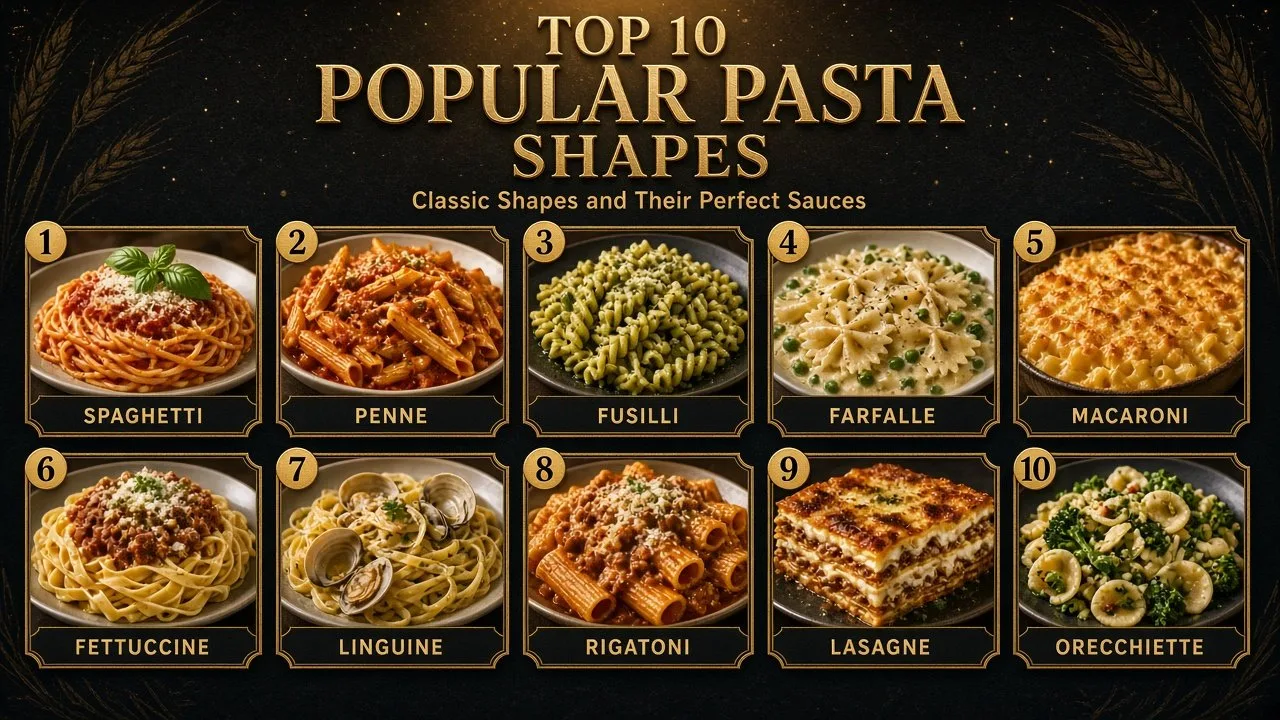
Popular pasta shapes include spaghetti, penne, fusilli, farfalle and macaroni, ten classic forms whose size and texture decide which sauce suits them best.
Pasta is one of the simplest foods in the world, usually little more than wheat and water, yet it comes in an astonishing range of forms. The food historian Oretta Zanini De Vita catalogued more than 300 distinct shapes known by well over a thousand regional names, and a single shape can carry a different name in each Italian town that makes it. For everyday cooking, though, a small group of shapes fills most supermarket shelves and most restaurant menus around the world.
This guide covers the ten pasta shapes that home cooks are most likely to meet. For each one you will find a Quick Facts table, where the shape comes from, what makes it distinctive, which sauces and dishes it suits, and a few facts worth knowing. At the end there is a quick pairing table, a section on other shapes worth trying, and answers to common questions.
How We Chose These Shapes
There is no single official ranking of pasta shapes by sales, and popularity varies a great deal between countries. Our list is not a strict ranking. Instead it brings together shapes that are widely produced by major pasta makers, appear in many of the best-known Italian and international dishes, and represent the main families of pasta: long strands, ribbons, tubes, twists, sheets and small cupped shapes.
Spaghetti comes first because it is the shape most people picture when they hear the word pasta. The rest are grouped roughly by how often they appear in everyday cooking outside Italy. Several much-loved shapes that did not make the ten, such as tagliatelle, pappardelle, capellini and bucatini, are covered in a separate section near the end.
Popular Pasta Shapes at a Glance
| No. | Shape | Meaning of the name | Family | Classic pairing |
|---|---|---|---|---|
| 1 | Spaghetti | Little strings | Long, round | Tomato sauce, carbonara, clams |
| 2 | Penne | Pens or quills | Short tube | Arrabbiata, pesto, baked dishes |
| 3 | Fusilli | Little spindles | Twist | Pesto, pasta salads, chunky sauces |
| 4 | Farfalle | Butterflies | Pinched shape | Light vegetable sauces, salads |
| 5 | Macaroni | Disputed, possibly from Greek | Short tube | Macaroni and cheese, soups |
| 6 | Fettuccine | Little ribbons | Flat ribbon | Ragù, butter and Parmesan |
| 7 | Linguine | Little tongues | Long, flattened | Pesto, seafood sauces |
| 8 | Rigatoni | Ridged or lined | Large ridged tube | Meat sauces, baked pasta |
| 9 | Lasagne | Possibly from Greek or Latin words for a dish | Flat sheet | Layered baked dishes |
| 10 | Orecchiette | Little ears | Small cup | Broccoli rabe, sausage, vegetables |
1. Spaghetti
| Attribute | Details |
|---|---|
| Meaning | Little strings, from the Italian word spago (string) |
| Shape | Long, thin, solid and round in cross-section |
| Usual length | About 25 to 30 cm in today's packets |
| Thinner and thicker versions | Spaghettini and spaghettoni |
| Best with | Tomato sauces, olive oil and garlic, carbonara, clam sauce |
Origins and History
Spaghetti is the plural diminutive of spago, the Italian word for string, so the name simply means little strings. Long dried pasta has deep roots around the Mediterranean. In 1154 the geographer Muhammad al-Idrisi, writing for the Norman king Roger II of Sicily, described a dried string pasta called itriyya being made near Palermo and shipped abroad. That is one of the earliest written records of a dried pasta industry in Europe.
Over the following centuries, dried long pasta became a staple of southern Italy, especially around Naples, where the climate suited drying pasta outdoors. Mass production and emigration in the nineteenth and twentieth centuries carried spaghetti around the world, and it is now made in factories on every inhabited continent.
Key Features
- Solid, round strands made from durum wheat semolina and water in the standard Italian version.
- Originally sold much longer, but shorter lengths of 25 to 30 cm became the norm in the second half of the twentieth century.
- Under US federal food standards, spaghetti is defined by diameter: more than 0.06 inch but not more than 0.11 inch.
- Its smooth surface suits sauces that coat the strands rather than chunky sauces that need somewhere to cling.
Classic Dishes
Spaghetti appears in some of the best-known dishes in Italian cooking. Rome is famous for spaghetti alla carbonara, made with egg, cured pork cheek, cheese and black pepper, and for cacio e pepe. Naples is known for spaghetti alle vongole with clams. Spaghetti aglio, olio e peperoncino, with garlic, olive oil and chilli, is a classic late-night dish because it uses only pantry ingredients.
Outside Italy, spaghetti with meatballs became a symbol of Italian-American cooking, and spaghetti bolognese is a family favourite in Britain and Australia, even though in Bologna itself the meat ragù is traditionally served with egg tagliatelle.
In Popular Culture
Spaghetti has a strong place in popular culture. The 1955 Disney film Lady and the Tramp features one of cinema's most famous scenes, two dogs sharing a plate of spaghetti. In 1957 the BBC programme Panorama broadcast an April Fools' Day report showing a Swiss family harvesting spaghetti from trees, which is still remembered as one of the best-known television hoaxes.
Interesting Facts
- A single strand is called a spaghetto.
- The term spaghetti western was coined for Italian-made cowboy films of the 1960s.
- Capellini and angel hair pasta are essentially very thin relatives of spaghetti.
2. Penne
| Attribute | Details |
|---|---|
| Meaning | Pens or quills, from the Italian penna |
| Shape | Short tube with both ends cut on a diagonal |
| Origin | Liguria, northwest Italy |
| Main versions | Penne lisce (smooth) and penne rigate (ridged) |
| Best with | Arrabbiata, pesto, tomato and cream sauces, baked pasta |
Origins and History
Penne is one of the few pasta shapes with a clear date of birth. In 1865 Giovanni Battista Capurro, a pasta maker from San Martino d'Albaro near Genoa, patented a machine that cut fresh pasta diagonally without crushing it. The angled cut produced a tube that resembled the steel nib of the pens people wrote with at the time, which is where the name comes from.
Capurro's machine made pieces from about 3 cm, sold as mezze penne or half pens, up to about 5 cm. The shape later spread throughout Italy and abroad, becoming one of the most common short pastas in supermarkets.
Key Features
- The diagonal ends act like small scoops, catching sauce as you eat.
- Penne rigate has fine ridges running along its length that help thicker sauces cling.
- Pennoni is a wider version, and some American makers sell a similar shape as mostaccioli.
- It holds its shape well when baked, which makes it popular for oven dishes.
Classic Dishes
Penne all'arrabbiata, a fiery tomato sauce with garlic and chilli, is the shape's best-known Italian dish. The name means angry penne, a nod to the heat of the chilli. Penne is also widely used with pesto, with creamy tomato sauces such as penne alla vodka, and in baked pasta dishes topped with cheese.
In Popular Culture
Penne all'arrabbiata appears in several Italian films, including Federico Fellini's Roma (1972) and Marco Ferreri's La Grande Bouffe (1973), both of which show the dish being eaten on screen.
Interesting Facts
- The English word pen comes from the same Latin root, penna, meaning feather.
- A baked penne dish in the colours of the Italian flag, named after the painter Salvatore Fiume, is said to have won a cooking contest among writers.
- In Italy, many cooks prefer the ridged rigate version because the sauce grips it better.
3. Fusilli
| Attribute | Details |
|---|---|
| Meaning | Little spindles, from fuso (spindle) |
| Shape | Short corkscrew or spiral |
| Origin | Southern Italy |
| Other names | Rotini in the United States and Canada |
| Best with | Pesto, pasta salads, chunky vegetable and meat sauces |
Origins and History
Fusilli takes its name from the spindle, or fuso, around which the dough was traditionally wrapped by hand. The shape is believed to have Arab roots. In Sicily a similar hand-rolled pasta is called busiata and in Sardinia busa, names linked to an Arabic word for the thin reed around which dough was wound.
Hand-formed fusilli are still made in parts of southern Italy and are often named after their towns, such as fusilli avellinesi from Avellino and fusilli napoletani from Naples. The short, solid spirals sold in most packets today are made by machine.
Key Features
- Tight spirals create grooves that trap sauce, herbs and small pieces of vegetable.
- There are solid twisted versions and hollow corkscrew versions, called fusilli bucati.
- Long versions exist too, including fusilli lunghi and a double-braided style known as fusilli Capri.
- Fusilli keeps its bite well, so it works served cold.
Classic Dishes
Fusilli is a favourite for pesto, because the basil sauce settles into every twist. It is also one of the most common shapes in pasta salads, where it holds dressings and chopped vegetables. In Campania, hand-made fusilli are sometimes served with a slow-cooked onion and meat sauce known as Genovese, or with beans.
Interesting Facts
- In North America the extruded spiral shape is usually sold as rotini, often in a three-colour mix.
- Larger versions are called fusilloni.
- The same spindle method, wrapping dough around a thin rod, is used for several other regional shapes.
4. Farfalle
| Attribute | Details |
|---|---|
| Meaning | Butterflies |
| Popular English name | Bow-tie pasta |
| Origin | Lombardy and Emilia-Romagna, northern Italy |
| Dates back to | About the sixteenth century |
| Best with | Light vegetable sauces, cream sauces, pasta salads |
Origins and History
Farfalle is the Italian word for butterflies, and in English the shape is usually called bow-tie pasta. It dates back to about the sixteenth century in Lombardy and Emilia-Romagna. In Emilia-Romagna a local version is called strichetti, a regional word for bow ties.
The shape is made from a small rectangle or oval of pasta, trimmed with ruffled edges on two sides and pinched firmly in the middle. That simple technique gives farfalle two different textures in one piece.
Key Features
- The pinched centre stays firmer and chewier than the thin, softer wings.
- Sizes range from tiny farfalline, used in soups, to large farfalloni.
- A ridged version is sold as farfalle rigate.
- Coloured farfalle are made with ingredients such as spinach, beetroot or squid ink, and green, white and red mixes echo the Italian flag.
Classic Dishes
Farfalle works best with sauces that are not too heavy, such as butter and peas, light tomato sauces, or cream with salmon. Its cheerful shape makes it a common choice for cold pasta salads and children's meals.
Interesting Facts
- Cooking farfalle evenly takes a little care, because the centre needs longer than the edges.
- Miniature farfalline are often used in broths.
- In the United States it is often labelled bow ties on the packet.
5. Macaroni
| Attribute | Details |
|---|---|
| Italian name | Maccheroni |
| Shape | Narrow tube, often curved (elbow macaroni) |
| How the curve forms | Uneven extrusion speed on each side of the tube |
| US standard | Tube more than 0.11 inch and up to 0.27 inch in diameter |
| Best with | Cheese sauces, soups, baked dishes, salads |
Origins and History
Macaroni is one of the oldest pasta names in Europe, and its origin is debated. The most widely accepted theory links it to Greek words connected with blessedness, while other linguists have proposed links to a medieval Greek word for a funeral meal. In much of Italy, maccheroni can describe various tube pastas or even long pasta, not just the small curved tubes known in English.
By the eighteenth century, macaroni was so fashionable in Britain that young men returning from European travels were nicknamed macaronis. That is the joke behind the line in the song Yankee Doodle about sticking a feather in a cap and calling it macaroni.
Key Features
- Most macaroni is made commercially by extrusion through a die.
- The familiar elbow curve forms because the dough leaves one side of the die faster than the other.
- In the United States, macaroni is legally defined by tube diameter in federal food standards.
- The hollow centre fills with sauce, which is why it suits smooth, melting cheese.
Classic Dishes
In much of the English-speaking world, macaroni means macaroni and cheese, a baked or stovetop dish of pasta in cheese sauce that has become a comfort food staple. Macaroni is also widely used in soups, cold pasta salads and baked casseroles. In Tunisia, which is one of the largest consumers of pasta per person, pasta dishes are known by the local name makrouna.
Interesting Facts
- US federal standards group macaroni, spaghetti and vermicelli under the shared label macaroni product.
- In Italy, maccheroni alla chitarra is actually a long, square-edged pasta cut on a guitar-like frame.
- Ridged tubes such as rigatoni belong to the wider macaroni family.
6. Fettuccine
| Attribute | Details |
|---|---|
| Meaning | Little ribbons |
| Shape | Flat, fairly thick ribbon about 6.5 mm wide |
| Traditional dough | Egg and flour, usually one egg per 100 g of flour |
| Regional home | Rome and central Italy |
| Best with | Beef or chicken ragù, butter and Parmesan |
Origins and History
Fettuccine is closely linked with Roman cooking. It is a flat ribbon traditionally made with fresh egg dough, and it is a little wider and thicker than the tagliatelle of Bologna. In Rome it is classically served with a beef or chicken ragù.
The dish that made fettuccine famous abroad, fettuccine Alfredo, was created at a restaurant in Rome in the early twentieth century and served with a tableside flourish of butter and cheese. American visitors carried its reputation home, and in the United States it is usually made with cream, a version that is almost unknown in Italy.
Key Features
- Wide, flat ribbons give plenty of surface for rich sauces to cling to.
- Fresh egg fettuccine has a tender, slightly porous texture.
- Fettucce is the name for a wider version, and fettuccelle for a narrower one.
- It is often sold dried in nests to stop the ribbons breaking.
Classic Dishes
In Italy, fettuccine is paired with meat ragù, butter and Parmesan, or mushroom sauces. Abroad it is best known through fettuccine Alfredo, which has become a fixture on Italian-American restaurant menus.
Interesting Facts
- Fresh fettuccine cooks in just a few minutes, much faster than dried pasta.
- It is one of the easiest shapes to make at home with a rolling pin and a knife.
- Fettuccine and tagliatelle are often used interchangeably outside Italy.
7. Linguine
| Attribute | Details |
|---|---|
| Meaning | Little tongues, from the Latin lingua |
| Shape | Long strands with a flattened, oval cross-section |
| Width | About 4 mm, between spaghetti and fettuccine |
| Origin | Genoa, Liguria |
| Best with | Pesto, clams and other seafood, light tomato sauces |
Origins and History
Linguine comes from Genoa, the port city of Liguria in northwest Italy. Its name means little tongues. Writing about the Genoese economy of the 1700s, the economist Giulio Giacchero described linguine served with green beans, potatoes and basil pesto as a typical festive dish of Ligurian families at that time.
Liguria is the home of basil pesto, so it is no surprise that linguine and pesto remain one of the region's signature pairings.
Key Features
- Linguine is flattened on two sides, so it sits halfway between round spaghetti and flat fettuccine.
- The flat surface holds thin, oily sauces better than round strands.
- A thinner version is called linguettine.
- Dried linguine usually cooks in about 8 to 10 minutes.
Classic Dishes
Linguine al pesto, often with potatoes and green beans in the Genoese style, is the shape's classic dish. Linguine is also a favourite for seafood, especially linguine alle vongole with clams, and for light sauces of tomato, garlic and olive oil.
Interesting Facts
- The name is sometimes spelled linguini in English.
- In the United States, National Linguine Day falls on 15 September.
- Linguine is closely related to trenette, another Ligurian pasta traditionally served with pesto.
8. Rigatoni
| Attribute | Details |
|---|---|
| Meaning | Ridged or lined, from rigato |
| Shape | Large, wide tube with straight-cut ends and ridges |
| Regional home | Southern and central Italy, especially Sicily and Rome |
| Smaller version | Rigatoncini |
| Best with | Meat sauces, sausage, baked pasta, Roman offal dishes |
Origins and History
Rigatoni takes its name from rigato, meaning ridged or lined. It is associated with the cooking of southern and central Italy and is especially loved in Sicily. Rigatoni is larger than penne and its ends are cut straight across rather than on a diagonal.
In Rome, rigatoni is the traditional partner for some of the city's most robust dishes, including rigatoni con la pajata, a historic dish made with veal intestines in tomato sauce.
Key Features
- Wide tubes hold chunks of meat, sausage or vegetables inside.
- The ridges help sauce and grated cheese stick to the outside.
- Straight-cut ends set it apart from penne at a glance.
- Its thick walls stand up well to baking.
Classic Dishes
Rigatoni is a natural choice for slow-cooked meat sauces, sausage ragù and baked pasta dishes. It is also widely used in Roman favourites such as carbonara and amatriciana, where it is sometimes chosen instead of spaghetti or bucatini.
Interesting Facts
- Rigatoni is sometimes slightly curved, but never as curved as elbow macaroni.
- Ziti, a similar tube, is smooth rather than ridged.
- Rigatoncini is a smaller version close to the size of penne.
9. Lasagne
| Attribute | Details |
|---|---|
| Shape | Wide, flat sheets |
| Singular and plural | Lasagna (one sheet), lasagne (several) |
| Ancient link | A layered Roman dish described in the cookbook attributed to Apicius |
| Famous version | Lasagne alla bolognese |
| Best with | Layers of ragù, béchamel, cheese and vegetables |
Origins and History
Lasagne is one of the oldest pasta forms. Its name may come from the Greek laganon, a flat sheet of dough, or from a Greek and Latin word for a cooking pot. Ancient Rome had a layered dish described in the cookbook attributed to Apicius, and a fourteenth-century English cookbook compiled for King Richard II includes a layered dish called loseyn.
Those early versions had no tomatoes, which only reached Europe after 1492. The modern baked lasagne, with tomato-based meat sauce and white sauce, took shape much later.
Key Features
- Lasagne sheets are usually cooked and then layered with fillings before baking.
- In Italy, northern regions tend to say lasagne and southern regions lasagna for the baked dish.
- British English usually spells it lasagne, while American English favours lasagna.
- Sheets can be smooth or have ruffled edges, and fresh and no-boil dried versions are both common.
Classic Dishes
The most famous version is lasagne alla bolognese, made with layers of meat ragù, béchamel and Parmesan, often using green spinach pasta sheets. Southern Italian versions may include ricotta, small meatballs and mozzarella. Vegetable and seafood lasagnes are popular too.
Interesting Facts
- In English, lasagne is used both for the pasta and for the finished baked dish.
- Regional variations exist across almost every part of Italy.
- Because it is assembled before baking, lasagne is often prepared ahead for large family meals.
10. Orecchiette
| Attribute | Details |
|---|---|
| Meaning | Little ears |
| Shape | Small dome or cup, about 2.5 cm across |
| Origin | Apulia (Puglia), southern Italy, especially Bari |
| Dough | Durum wheat semolina, water and salt, rarely eggs |
| Best with | Broccoli rabe, sausage, tomato sauces, vegetables |
Origins and History
Orecchiette is the signature pasta of Apulia, the heel of Italy's boot. The name comes from orecchia, the Italian word for ear, with a diminutive ending. The shape has been documented in the region, particularly around Bari, since at least the twelfth and thirteenth centuries. Some food historians link it to a similar pasta from medieval Provence brought by the Angevin rulers, but that theory is still debated.
In the old town of Bari, orecchiette is still made by hand. The dough is rolled into a rope, cut into small pieces, dragged across the board with a knife and turned over the thumb to form the cup.
Key Features
- The centre is thinner than the rim, giving a chewy edge and a tender middle.
- A rough outer surface helps thick sauces cling.
- The cup shape scoops up small pieces of vegetable or crumbled sausage.
- In the Bari dialect it is often called strasc'nat, from strascinare, to drag, after the hand technique.
Classic Dishes
The classic dish is orecchiette con cime di rapa, with broccoli rabe, garlic, chilli, olive oil and often anchovies. Orecchiette is also served with tomato sauce and ricotta, or with sausage and greens.
Interesting Facts
- In the town of Cisternino, a larger, deeply ribbed version is called priest's ears.
- In the dialect of Taranto it is called recchietedde or chiancaredde.
- Making orecchiette by hand is a skill often passed down through families in Apulia.
Which Pasta Shape Goes With Which Sauce
A simple rule helps when matching pasta to sauce: thin, smooth shapes suit light, smooth sauces, while wider, ridged or hollow shapes suit chunky or heavy ones.
| Sauce type | Good shapes | Why it works |
|---|---|---|
| Light olive oil or garlic sauces | Spaghetti, linguine, capellini | Thin strands coat evenly without clumping |
| Pesto | Linguine, fusilli, trenette | Flat or twisted surfaces trap the herb sauce |
| Smooth tomato sauces | Spaghetti, penne, bucatini | The sauce coats the outside and fills hollows |
| Chunky meat ragù | Rigatoni, fettuccine, tagliatelle, pappardelle | Wide or ridged shapes hold pieces of meat |
| Cream and cheese sauces | Fettuccine, macaroni, penne | Broad surfaces and tubes carry rich sauce |
| Vegetable sauces | Orecchiette, farfalle, fusilli | Cups and folds catch small vegetable pieces |
| Baked dishes | Lasagne, rigatoni, penne, macaroni | Sturdy shapes keep their form in the oven |
| Soups | Macaroni, farfalline, small tubes | Small shapes fit on a spoon |
Other Pasta Shapes Worth Knowing
Many shapes just outside our ten are staples in Italian kitchens and worth trying.
| Shape | Meaning | Description | Classic use |
|---|---|---|---|
| Tagliatelle | From tagliare, to cut | Egg ribbons about 6 to 7 mm wide, from Emilia-Romagna and Marche | Bolognese ragù |
| Pappardelle | From pappare, to gobble up | Very broad flat ribbons 2 to 3 cm wide, from Tuscany | Rich meat and game sauces |
| Capellini | Little hairs | Very thin strands under 1 mm thick; angel hair is thinner still | Broths and light sauces |
| Bucatini | From buco, hole | Thick spaghetti with a hole through the centre, common in Rome | Amatriciana |
| Ziti | Traditional southern Italian name | Long or cut smooth tubes | Baked pasta |
Bologna takes the width of tagliatelle seriously. A solid gold replica of a single tagliatella is kept at the city's chamber of commerce to show the correct width, about 8 mm when cooked.
Why Pasta Shapes Matter
Pasta shapes are not only decorative. Each shape changes how much sauce clings to the pasta, how it feels in the mouth and how long it takes to cook. Ridges, hollows, twists and flat surfaces all hold sauce in different ways, which is why Italian cooks are careful about which shape goes with which dish.
Shape also reflects regional history. Many pastas began as local specialities tied to a town's wheat, tools and traditions, and their names often describe everyday objects such as strings, pens, butterflies, ears and tongues. Learning a few shapes is an easy way to explore the regional diversity of Italian food.
Frequently Asked Questions
What is the most popular pasta shape in the world?
Spaghetti is widely regarded as the best-known pasta shape in the world. It is produced in huge quantities by pasta makers on every continent and appears in famous dishes from carbonara to spaghetti and meatballs. Short shapes such as penne and fusilli are also extremely common, especially in supermarkets outside Italy.
How many pasta shapes are there?
There is no fixed number, because new shapes are invented and many old ones have several regional names. The food historian Oretta Zanini De Vita documented more than 300 distinct shapes known by well over a thousand names. In everyday shops, only a few dozen shapes are widely available.
What is the difference between penne and rigatoni?
Penne are narrower tubes with ends cut on a diagonal, like the nib of an old pen. Rigatoni are wider tubes with ridges and ends cut straight across. Both suit thick sauces and baking, but rigatoni holds bigger pieces of meat or vegetable inside its wider tube.
What is the difference between linguine and fettuccine?
Linguine is a long strand about 4 mm wide with a flattened oval cross-section, from Genoa. Fettuccine is a flatter, wider ribbon of about 6.5 mm, traditionally made with egg and linked with Rome. Linguine suits pesto and seafood, while fettuccine is better for ragù and butter sauces.
Why do some pasta shapes have ridges?
Ridges add surface texture that helps sauce and grated cheese stick to the pasta. That is why ridged versions such as penne rigate, rigatoni and farfalle rigate are often chosen for thicker sauces. Smooth versions, called lisce in Italian, are preferred by some cooks for lighter or creamier dishes.
Is fresh pasta better than dried pasta?
Neither is better overall; they suit different dishes. Fresh egg pasta such as fettuccine and tagliatelle is tender and pairs well with butter and rich ragù. Dried durum wheat pasta such as spaghetti and penne keeps a firmer bite and works well with olive oil, tomato and seafood sauces.
What does al dente mean?
Al dente is Italian for to the tooth. It describes pasta cooked until tender but still slightly firm when bitten. In Italy, pasta is often drained al dente and finished for a minute in the sauce, where it absorbs flavour and softens a little more without becoming mushy.
Conclusion
The most popular pasta shapes each earned their place for a reason. Spaghetti and linguine are made for smooth, light sauces, penne and rigatoni carry thicker sauces and bake well, fusilli and farfalle shine in salads and vegetable dishes, and lasagne, macaroni and orecchiette are the backbone of some of the world's favourite comfort foods.
Behind every shape is a piece of regional history, from Capurro's pen-cutting machine in Liguria to the hand-pressed orecchiette of Bari. Choosing the right shape for the sauce is one of the simplest ways to make a home-cooked pasta dish taste the way it was meant to. For more lists like this one, explore the Top 10 Facts section of Finepedia.
- Wikipedia articles on Pasta, Spaghetti, Penne, Fusilli, Farfalle, Macaroni, Fettuccine, Linguine, Rigatoni, Lasagna, Orecchiette, Tagliatelle, Pappardelle, Capellini and Bucatini (consulted October 2026 for verification of dates, names and dimensions).
- US Code of Federal Regulations, Title 21, Section 139.110, Macaroni products (definitions of macaroni, spaghetti and vermicelli by diameter).
- Oretta Zanini De Vita, Encyclopedia of Pasta, University of California Press.
- Muhammad al-Idrisi, geographical work for Roger II of Sicily, 1154 (as cited in histories of pasta).
- Original topic reference: 10mosttoday.com, 10 Most Popular Pasta Shapes.


















Log in with