






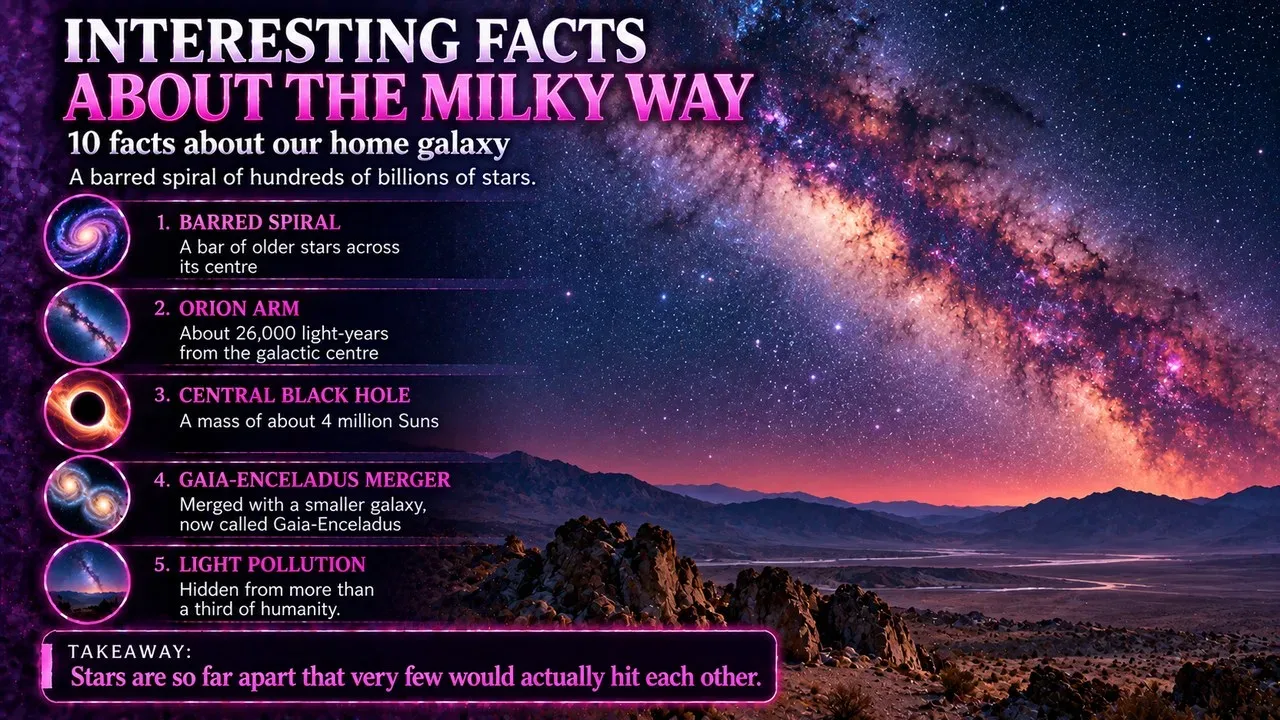
The Milky Way is the galaxy that contains the Solar System. Its name describes how it looks from Earth: a hazy band of light across the night sky, made by stars in other parts of the galaxy that are too far away to be seen one by one.[1] It is a barred spiral galaxy about 87,400 light-years across. It holds between 100 and 400 billion stars and at least as many planets, and at its centre sits a supermassive black hole called Sagittarius A*.[1]
This Finepedia list, updated in October 2026, gathers the top 10 interesting facts about the Milky Way galaxy. It covers its size and shape, the Sun's place in it, how long one trip around the galaxy takes, the black hole at its heart, how old it is, how much it weighs, its neighbour galaxies, the future meeting with Andromeda, and how people came to understand what the Milky Way really is.
Key Facts
The first table gives an overview of the Milky Way, and the second sums up all ten facts on this list.
| Feature | Detail |
|---|---|
| Type | Barred spiral galaxy[1] |
| Diameter of the bright disc | About 87,400 light-years[1] |
| Thickness of the stellar disc | Up to about 4,000 light-years[1] |
| Number of stars | 100 to 400 billion[1] |
| Total mass | About 0.88 trillion times the Sun's mass, counting to 200 kiloparsecs from the centre[1] |
| Central black hole | Sagittarius A*, about 4.1 million solar masses[1] |
| Sun's distance from the centre | About 27,000 light-years[1] |
| Sun's home | The inner edge of the Orion Arm[2] |
| One orbit of the galaxy | About 240 million years[1] |
| Galaxy group | The Local Group, with the Andromeda Galaxy[8] |
The 10 Facts at a Glance
| No. | Fact | Key figure |
|---|---|---|
| 1 | The Milky Way is a barred spiral galaxy | About 87,400 light-years across |
| 2 | It holds hundreds of billions of stars and planets | 100 to 400 billion stars |
| 3 | The Sun sits on the Orion Arm | About 27,000 light-years from the centre |
| 4 | One galactic year is very long | About 240 million years |
| 5 | A black hole sits at the centre | Sagittarius A*, about 4.1 million solar masses |
| 6 | It is almost as old as the universe | Oldest stars about 13.5 billion years old |
| 7 | Most of its mass is invisible | About 0.88 trillion solar masses, mostly dark matter |
| 8 | It has satellite galaxies and belongs to the Local Group | Some 134 known Local Group members |
| 9 | It may one day collide with Andromeda | 50 per cent chance within 10 billion years |
| 10 | Its name comes from a Greek myth | Hera's spilled milk |
1. It Is a Barred Spiral About 87,400 Light-Years Across
The Milky Way is a barred spiral galaxy. Its bright disc has a diameter of about 26.8 kiloparsecs, or 87,400 light-years.[1] The stars in the innermost 10,000 light-years form a central bulge, and a bar of stars stretches out from it.[1] Astronomers first began to suggest that the Milky Way has a bar, rather than being an ordinary spiral, in the 1960s.[1] Bars are common. They are found in about two-thirds of all spiral galaxies in the nearby universe, and they affect how stars and gas move inside a galaxy.[12]
For all its width, the galaxy is thin. Its disc of stars is estimated to be up to about 1.35 kiloparsecs (4,000 light-years) thick.[1] The disc is surrounded by a much larger halo. A galactic halo is a roughly spherical part of a galaxy that extends beyond its visible body. It includes old stars, hot gas and dark matter.[11] A 2020 study predicted that the edge of the Milky Way's dark matter halo lies about 952,000 light-years from the centre, which would give a total diameter of about 1.9 million light-years.[1]
Four Spiral Arms
The gas and stars in the disc are arranged in four spiral arms.[1] These arms contain more gas and dust than average and are where most new stars form.[1] However, the exact shape of the arms is uncertain, and astronomers have no agreed view of their nature. Arms in real galaxies branch, merge and twist in ways that simple spiral patterns do not capture.[1] Seeing the shape from inside is hard, because we look at the disc edge-on through clouds of dust.
2. It Holds Hundreds of Billions of Stars and Planets
The Milky Way contains between 100 and 400 billion stars and at least as many planets.[1] A January 2013 study of the five-planet system Kepler-32 by the Kepler space observatory found that the galaxy contains, on average, at least one planet per star. That gives 100 to 400 billion planets.[1] A separate January 2013 analysis of Kepler data estimated that at least 17 billion Earth-sized planets orbit stars in the Milky Way.[1]
The European Space Agency's Gaia spacecraft did much to count and map these stars. It worked out distances by measuring the parallax of about a billion stars.[1] Gaia launched on 19 December 2013 on a Soyuz rocket from Kourou in French Guiana.[10] Its detectors wore out more slowly than expected, so the mission was extended, and ESA finally switched it off on 27 March 2025.[10] It has been estimated that Gaia increased the number of observed stars from about 2 million in the 1990s to 2 billion.[1] Its data have been called "transformational".[1]
3. The Sun Lives on the Orion Arm, 27,000 Light-Years from the Centre
The Solar System lies about 27,000 light-years (8.3 kiloparsecs) from the centre of the galaxy, near the inner edge of the Orion Arm.[1] Estimates of the distance to the centre since 2000 have all fallen between 24,000 and 28,400 light-years.[5] The Orion Arm, also called the Orion–Cygnus Arm, is a minor spiral arm. It is about 3,500 light-years wide and roughly 20,000 light-years long.[2] The Solar System sits about halfway along it, in a relatively empty region of gas known as the Local Bubble.[2]
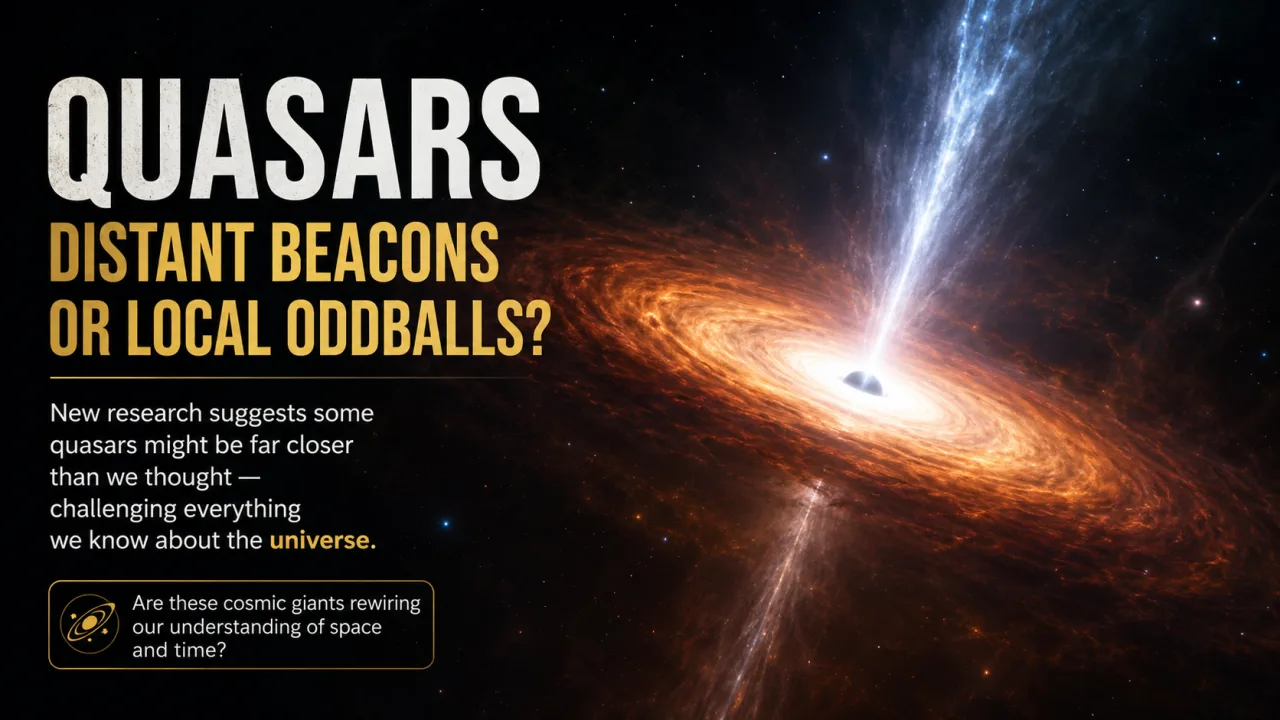
Related: Quasars: Distant Beacons or Local Oddballs?
The next arm out, the Perseus Arm, is about 6,500 light-years away from our local arm.[1] Our neighbourhood is fairly sparse. There are about 208 stars brighter than absolute magnitude 8.5 within 49 light-years of the Sun, which works out at about one star per 2,360 cubic light-years.[1] The Solar System also lies within the Milky Way's galactic habitable zone, the region thought to be suitable for life.[1]
4. One Trip Around the Galaxy Takes About 240 Million Years
Everything in the Milky Way orbits its centre, including the Sun. The Solar System takes about 240 million years to complete one orbit, a period called a galactic year.[1] Some sources give a shorter figure of about 225 million Earth years.[3] Either way, the Sun is thought to have completed 18 to 20 orbits during its lifetime, but only 1/1250 of an orbit since humans first appeared.[1]
The way the galaxy spins holds a clue to what it is made of. Away from the central bulge and the outer rim, a typical star in the Milky Way orbits at 200 to 220 km/s.[1] In 2009, the Very Long Baseline Array measured speeds as high as 254 km/s for stars at the outer edge of the galaxy.[1] The Milky Way's rotation curve, which shows how orbital speed changes with distance from the centre, matches the universal rotation curve of spiral galaxies. That match is the best evidence for dark matter in galaxies, although a minority of astronomers argue that a change to the law of gravity could explain it instead.[1]
5. A Supermassive Black Hole Sits at Its Heart
At the centre of the Milky Way is an intense radio source called Sagittarius A*. It is a supermassive black hole with a mass of about 4.1 million times that of the Sun.[1] From Earth, the centre of the galaxy lies in the direction of the constellation Sagittarius, where the Milky Way looks brightest.[1]
Reinhard Genzel and Andrea Ghez each won a quarter-share of the 2020 Nobel Prize in Physics for showing that Sagittarius A* is a supermassive compact object. A black hole was the only explanation for it.[4] On 12 May 2022, the Event Horizon Telescope Collaboration, a worldwide network of radio observatories, released the first image of Sagittarius A*.[4] The image shows a glowing disc of matter around the black hole's event horizon.[4]
The Fermi Bubbles
In November 2010, astronomers announced that two huge, lobe-shaped bubbles of energetic plasma sit above and below the galaxy's core. They give off gamma rays and X-rays.[5] These Fermi or eROSITA bubbles extend up to about 25,000 light-years above and below the centre of the galaxy.[5] Their discoverers, Tracy Slatyer, Douglas Finkbeiner and Meng Su, won the 2014 Bruno Rossi Prize for finding them.[5]
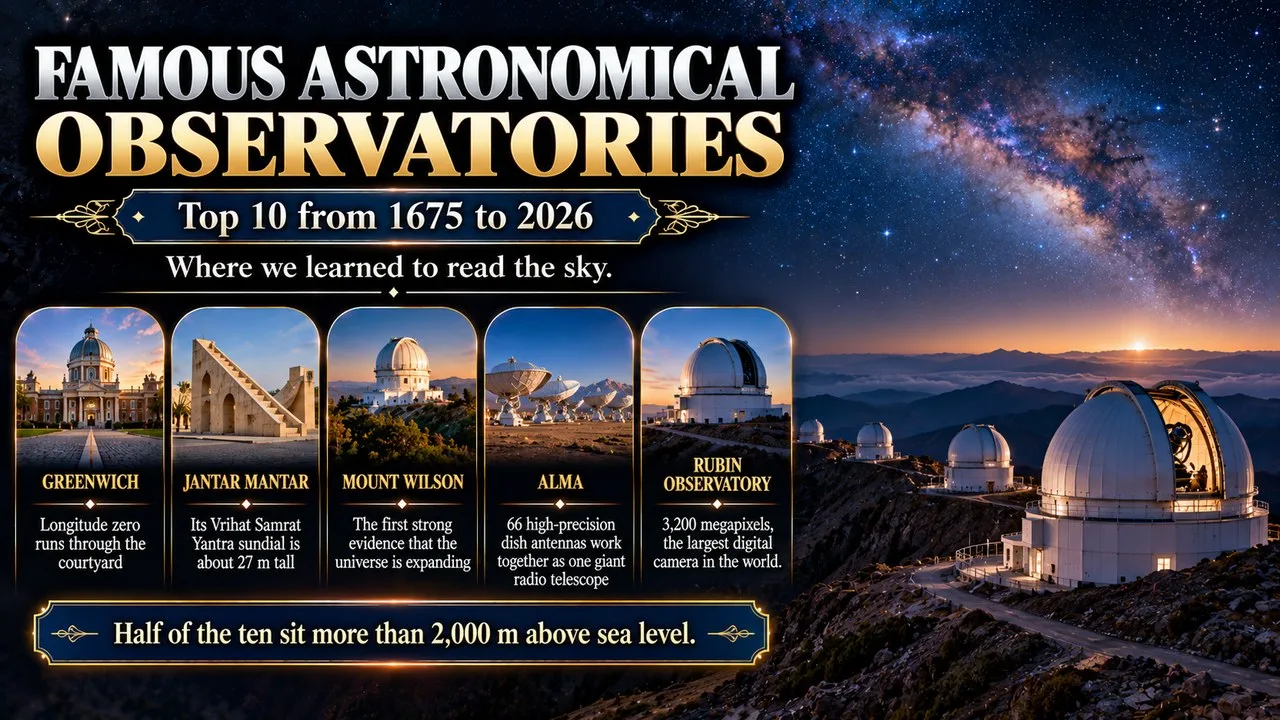
Related: Top 10 Famous Astronomical Observatories
6. It Is Almost as Old as the Universe
Some of the Milky Way's stars are nearly as old as the universe itself. In 2007, a star in the galactic halo, HE 1523-0901, was estimated to be about 13.2 billion years old.[1] Another star, 2MASS J18082002-5104378 B, is about 13.5 billion years old. It is made almost entirely of material released in the Big Bang and may be one of the first stars.[1] Globular clusters are among the oldest objects in the galaxy, so their ages set a lower limit for the age of the Milky Way.[1]
Astronomers think the galaxy's oldest stars formed shortly after the Dark Ages of the early universe. They first formed a spherical shape, which later flattened into a spiral disc where later generations of stars formed.[1] Cosmological simulations suggest that about 11 billion years ago the Milky Way merged with a large galaxy nicknamed the Kraken.[1] Since then its history has been unusually quiet. The galaxy seems to have had no mergers with large galaxies in the last 10 billion years, which is unusual for a spiral of its type.[1] By contrast, its neighbour, the Andromeda Galaxy, has been shaped by more recent mergers with large galaxies.[1]
7. Most of Its Mass Is Invisible
The Milky Way has about 0.88 trillion times the mass of the Sun, counting everything within 200 kiloparsecs of the centre.[1] Estimates vary with the method and data used. The low end is 5.8 × 10^11 solar masses, a little less than the Andromeda Galaxy.[1] Most of this mass is not in stars but in dark matter, an unseen form of matter spread through the galaxy's halo.[1] Observations of distant galaxies show that when the universe was only a few billion years old, it held about one-sixth as much ordinary matter as dark matter.[1]
8. It Has Satellite Galaxies and Belongs to the Local Group
The Milky Way has several satellite galaxies. It belongs to the Local Group of galaxies, which is part of the Virgo Supercluster, which in turn is part of the Laniakea Supercluster.[1] The Local Group is shaped like a dumbbell. The Milky Way and its satellites form one end, and the Andromeda Galaxy and its satellites form the other.[8] Some 134 members are known within 1 megaparsec of the group's centre, most of them dwarf galaxies. The exact number is unknown, because the Milky Way hides some of them from view.[8]
- The Large Magellanic Cloud, a dwarf galaxy about 163,000 light-years away. It is the second- or third-closest galaxy to the Milky Way. [6]
- The Sagittarius Dwarf Spheroidal Galaxy, a loop-shaped satellite discovered in 1994. It is about 10,000 light-years across, 80,380 light-years from Earth and about 50,000 light-years from the Milky Way's core. [7] On its looping path it has passed through the plane of the Milky Way several times. In 2018, the Gaia project showed that it had disturbed the motions of a set of stars near the galaxy's core. [7]
9. It May Collide with Andromeda
The Milky Way and the Andromeda Galaxy are the two largest galaxies in the Local Group, and they may collide in about 4.5 billion years.[9] Earlier measurements suggested that the two would merge in about five billion years.[9] In 2025, Till Sawala and colleagues used new data from the Gaia spacecraft and the Hubble telescope and found that the chance of a collision is much lower.[9] They ran 100,000 simulations covering 22 different variables, and found only a 50 per cent chance of a head-on collision within the next 10 billion years.[9] In about half of the simulated cases, the two galaxies fly past each other.[9]
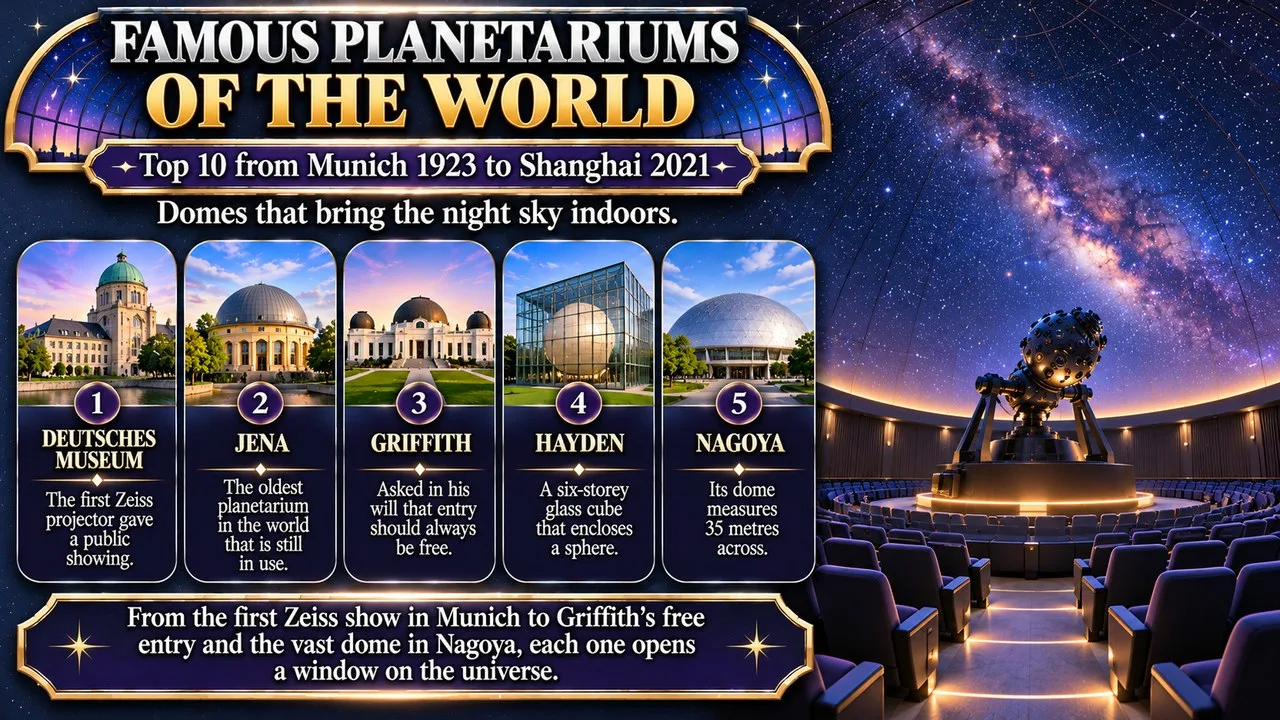
Related: Top 10 Famous Planetariums of the World
If the galaxies do merge, the stars within them are so far apart that it is extremely unlikely that any two would collide. Some stars may be thrown out, however.[9] The merged galaxy has already been given a name: Milkomeda, or Milkdromeda.[9]
10. Its Name Comes from a Greek Myth, and Its Nature Took Centuries to Learn
In one Greek myth, Zeus places his infant son Heracles at the breast of the sleeping goddess Hera so the baby will drink her divine milk and become immortal. Hera wakes, realises she is nursing an unknown baby, and pushes it away. Some of her milk spills, and it forms the band of light known as the Milky Way.[1] Other cultures gave it other names. In several Uralic, Turkic and Baltic languages it is the "Birds' Path", and in Arabic it is Darb at-Tabbānah, the "Pathway of the Straw".[1] Swedes call it Vintergatan, or "Winter Street", because it is clearest in northern winters.[1]
- Ancient Greece: The philosophers Anaxagoras and Democritus believed the Milky Way was the glow of stars, according to Aristotle.
- 1610: Galileo Galilei used a telescope and showed that the band is made of a vast number of faint stars.
- Early 1920s: Until then, most astronomers thought the Milky Way contained all the stars in the universe.
- 1920: The Great Debate took place between Harlow Shapley and Heber Doust Curtis.
- 1923: Edwin Hubble's observations showed that the Milky Way is just one of many galaxies.
Today many people cannot see the galaxy at all. From a dark site, the Milky Way appears as a hazy band of white light about 30° wide, arching across the sky.[1] Light pollution and moonlight can greatly reduce how visible it is.[1] Maps of artificial night sky brightness show that more than a third of the world's population cannot see the Milky Way from their homes because of light pollution.[1]
Key Figures
- 87,400 light-years: Diameter of the Milky Way's bright disc. [1]
- About 1.9 million light-years: Possible diameter of its dark matter halo, from a 2020 study. [1]
- 100–400 billion: Number of stars in the Milky Way. [1]
- At least 17 billion: Estimated Earth-sized planets, from a 2013 Kepler analysis. [1]
- 27,000 light-years: Distance from the Sun to the galactic centre. [1]
- 240 million years: Time for the Solar System to orbit the galaxy once. [1]
- 200–220 km/s: Typical orbital speed of the galaxy's stars. [1]
- 4.1 million solar masses: Mass of Sagittarius A*. [1]
- 0.88 trillion solar masses: Total mass of the Milky Way within 200 kiloparsecs. [1]
- 13.5 billion years: Age of one of the galaxy's oldest known stars. [1]
- 134: Known members of the Local Group within 1 megaparsec of its centre. [8]
- 50 per cent: Chance of a head-on collision with Andromeda within 10 billion years, from a 2025 study. [9]
Frequently Asked Questions
How big is the Milky Way?
The bright disc of the Milky Way is about 87,400 light-years across and up to about 4,000 light-years thick. Its dark matter halo may stretch around 1.9 million light-years across.[1]
Where is Earth in the Milky Way?
Earth and the rest of the Solar System are about 27,000 light-years from the centre of the galaxy, near the inner edge of the Orion Arm, inside the Local Bubble.[1][2]
Related: Top 10 Most Bizarre Phobias: Strange Fears That Exist
Is there a black hole at the centre of the Milky Way?
Yes. Sagittarius A* is a supermassive black hole of about 4.1 million solar masses. The Event Horizon Telescope released its first image in May 2022.[1][4]
Will the Milky Way collide with Andromeda?
Possibly. A 2025 study found about a 50 per cent chance of a head-on collision within the next 10 billion years. Even then, individual stars would almost never hit each other.[9]
How many stars are in the Milky Way?
Estimates range from 100 to 400 billion stars, and there are at least as many planets.[1]
Why can't I see the Milky Way from my home?
Light pollution hides it. More than a third of the world's population cannot see the Milky Way from home because of artificial light at night.[1]
See also
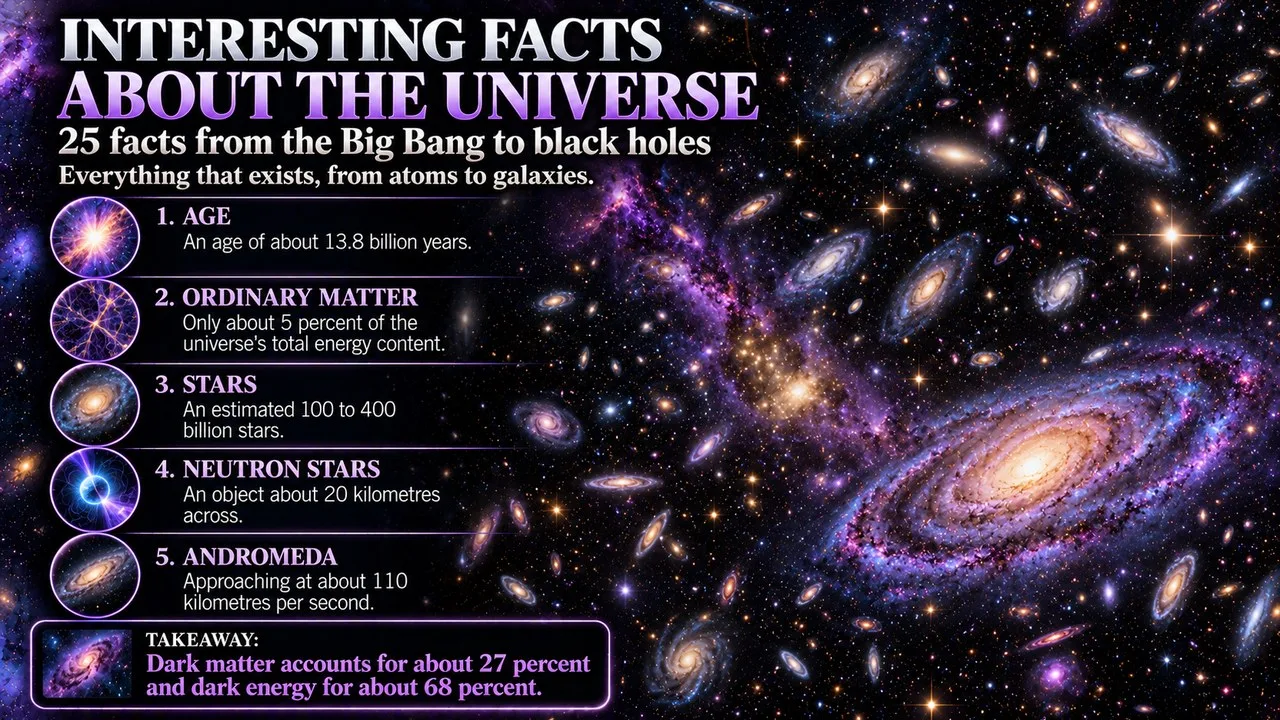
- Top 25 Interesting Facts About the Universe
- Top 25 Interesting Facts About the Solar System
- Top 10 Interesting Facts About the Moon
- ^ [1] "Milky Way". Wikipedia. Wikipedia
- ^ [2] "Orion Arm". Wikipedia. Wikipedia
- ^ [3] "Galactic year". Wikipedia. Wikipedia
- ^ [4] "Sagittarius A*". Wikipedia. Wikipedia
- ^ [5] "Galactic Center". Wikipedia. Wikipedia
- ^ [6] "Large Magellanic Cloud". Wikipedia. Wikipedia
- ^ [7] "Sagittarius Dwarf Spheroidal Galaxy". Wikipedia. Wikipedia
- ^ [8] "Local Group". Wikipedia. Wikipedia
- ^ [9] "Andromeda–Milky Way collision". Wikipedia. Wikipedia
- ^ [10] "Gaia (spacecraft)". Wikipedia. Wikipedia
- ^ [11] "Galactic halo". Wikipedia. Wikipedia
- ^ [12] "Barred spiral galaxy". Wikipedia. Wikipedia


















Discussion
Log in with