






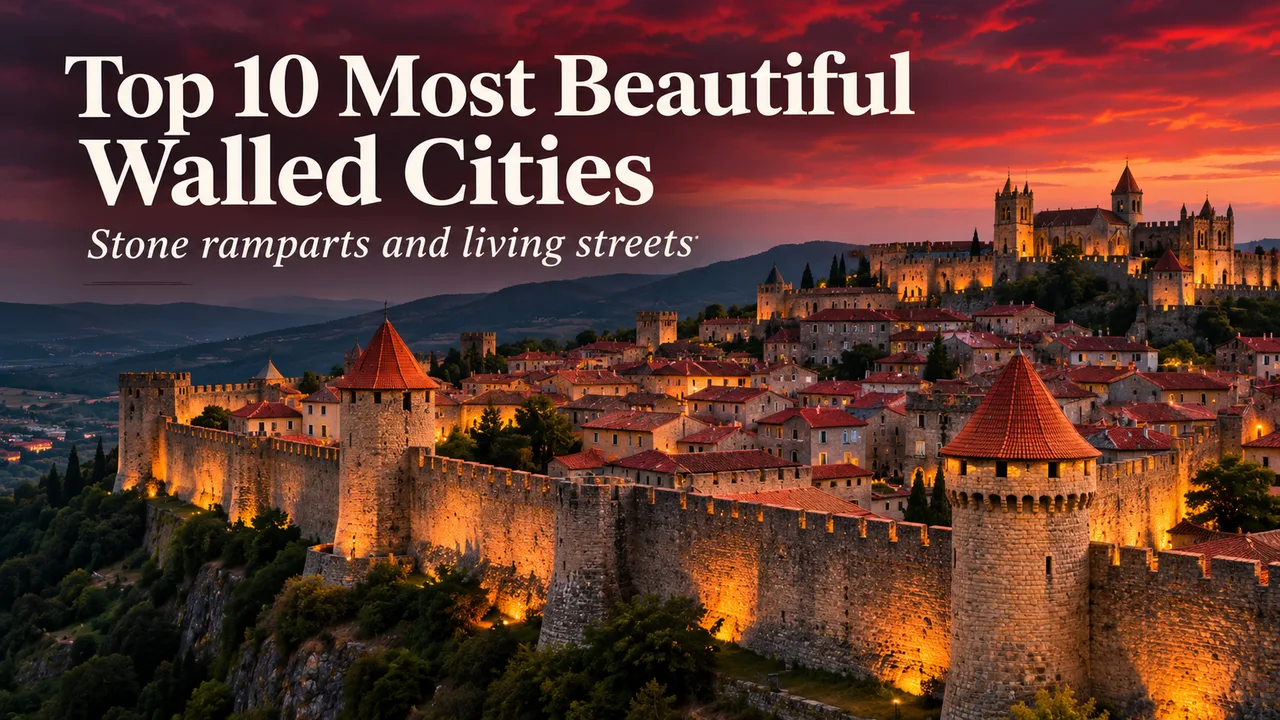
The most beautiful walled cities in the world preserve the defensive rings that once protected their people from invaders. Today these walls frame historic streets, squares and monuments, giving visitors a rare chance to step into a complete historic townscape [1].
City walls have been built for thousands of years, from ancient Mesopotamia to medieval Europe and imperial China. They controlled trade, collected taxes at gates and gave residents a sense of identity. When artillery made walls less effective, many cities tore them down to expand, but others kept them, often thanks to early conservation efforts [1].
This Finepedia list features ten walled cities chosen for the completeness of their walls, their beauty and their historic importance. It includes coastal fortresses in Europe, ancient Chinese ramparts and desert citadels in India and North America's only walled city north of Mexico.
Key Facts
The table below summarizes the ten walled cities in this list, with their country, wall length or date, and one standout fact.
Beautiful Walled Cities at a Glance
| Rank | Name | Location/Country | Key figure | Notable fact |
|---|---|---|---|---|
| 1 | Dubrovnik | Croatia | Walls about 1,940 m long | Pearl of the Adriatic |
| 2 | Carcassonne | France | 52 towers, 3 km of walls | Restored by Viollet-le-Duc |
| 3 | Xi'an City Wall | Shaanxi, China | About 13.7 km long | One of the best-preserved city walls in China |
| 4 | Avila | Spain | About 2.5 km, 87 towers | Among the most complete medieval walls in Europe |
| 5 | Quebec City | Canada | About 4.6 km of walls | Only fortified city north of Mexico in the Americas |
| 6 | Jaisalmer Fort | Rajasthan, India | Built 1156 | One of the world's largest living forts |
| 7 | Rothenburg ob der Tauber | Bavaria, Germany | Walls almost fully intact | Classic medieval German town |
| 8 | Old City of Jerusalem | Jerusalem | Walls built 1535-1542 | Sacred to three faiths |
| 9 | Tallinn Old Town | Estonia | About 1.85 km of walls survive | One of the best-preserved medieval cities in northern Europe |
| 10 | Cartagena | Colombia | About 11 km of walls | Fortified Caribbean port |
1. Dubrovnik
Dubrovnik on Croatia's Adriatic coast is enclosed by a ring of stone walls about 1,940 metres long. Most of the walls were built between the twelfth and seventeenth centuries, when the city was the wealthy Republic of Ragusa [2].
The walls include towers, bastions and the fortress of Minceta, which offers sweeping views over terracotta roofs and the sea. The walls reach up to 25 metres high on the landward side and were strong enough that the city was never conquered by force while the republic stood.
Dubrovnik was damaged during a siege in 1991 and restored afterwards. It became a UNESCO World Heritage Site in 1979 and gained new fame as a filming location for Game of Thrones. Walking the full circuit of the walls is the city's signature experience and offers some of the finest views in the Mediterranean.
2. Carcassonne
Carcassonne in southern France is a hilltop citadel known as La Cite. It has two rings of walls, about 3 kilometres long in total, with 52 towers [3].
The site was fortified since Roman times, and the medieval walls were expanded in the thirteenth century. By the nineteenth century the fortress had fallen into ruin and was nearly demolished.
Architect Eugene Viollet-le-Duc restored it from 1853, adding slate roofs that some critics consider inaccurate. Today Carcassonne is a UNESCO World Heritage Site and one of France's most visited monuments, with its turreted silhouette inspiring fairy-tale designs and the popular board game named after it.
3. Xi'an City Wall
The city wall of Xi'an in China was built in the fourteenth century during the Ming dynasty. It is about 13.7 kilometres long, 12 metres high and up to 18 metres wide at the top [4].
Related: Top 10 Most Bizarre Phobias: Strange Fears That Exist
Xi'an was once the capital of many Chinese dynasties and the starting point of the Silk Road. The wall was built on the foundations of an older Tang dynasty palace wall.
Visitors can walk or rent bicycles to ride along the top of the wall, completing a full loop in a few hours. Gates, watchtowers and a moat survive, and the wall is lit up at night with lanterns, especially during festivals.
The wall was renovated several times, including a major restoration in the 1980s that connected sections and rebuilt gates. It hosts an annual marathon on its ramparts, one of the most unusual races in the world.
4. Avila
Avila in central Spain is surrounded by walls about 2.5 kilometres long with 87 towers and nine gates. Built mainly from the eleventh to fourteenth centuries, they are among the most complete medieval city walls in Europe [5].
The city is the birthplace of Saint Teresa of Avila, and churches and convents linked to her draw pilgrims. The cathedral's apse forms part of the walls, showing how faith and defence were combined.
The walls are especially impressive when floodlit at night. Avila became a UNESCO World Heritage Site in 1985 along with its churches outside the walls.
Walking the ramparts offers views of granite houses, church towers and the dry plains of Castile. The city's high altitude of about 1,130 metres makes it one of the highest provincial capitals in Spain.
5. Quebec City
Quebec City in Canada is the only fortified city north of Mexico in the Americas whose walls still exist. The walls stretch about 4.6 kilometres around the Upper Town [6].
Founded by Samuel de Champlain in 1608, Quebec was a strategic stronghold for France and later Britain. The Citadelle, a star-shaped fortress, is still an active military base.
Related: The Science Behind Auroras: How Solar Winds Create Colorful Skies
The historic district, with its narrow streets and the Chateau Frontenac hotel, became a UNESCO World Heritage Site in 1985. Its European feel and winter carnival make it one of Canada's most beloved destinations.
The walls were mostly built by the British in the nineteenth century after the city came under their control. Gates such as Porte Saint-Louis welcome visitors into a district of stone houses, cafes and art galleries.
6. Jaisalmer Fort
Jaisalmer Fort in Rajasthan, India, was built in 1156 by the Rajput ruler Rawal Jaisal. Rising from the Thar Desert, its yellow sandstone walls glow gold in the sun, earning it the name Sonar Quila, or Golden Fort [7].
Unlike most forts, Jaisalmer is a living fort, with thousands of people still living inside its walls. Narrow lanes are lined with houses, temples and havelis decorated with fine carvings.
The fort is part of the Hill Forts of Rajasthan UNESCO World Heritage Site. Its walls have 99 bastions, and growing population and water use have raised concerns about its preservation.
Sunset views of the fort from nearby dunes and lakes are especially striking. Camel safaris into the desert begin from the town, adding to its appeal for travellers exploring Rajasthan.
7. Rothenburg ob der Tauber
Rothenburg ob der Tauber in Bavaria is one of the best-preserved medieval towns in Germany. Its walls survive almost complete, and visitors can walk along a covered walkway on top [8].
The town prospered as a Free Imperial City in the Middle Ages. Its half-timbered houses, towers and cobbled squares create a storybook atmosphere.
Related: Top 10 Facts About Dogs
Rothenburg was damaged in the Second World War, but its walls and centre were carefully restored, partly with donations from around the world. Its Christmas market and the Plonlein corner are among the most photographed scenes in Germany.
Its medieval crime museum, night watchman tour and toy museums add to the town's charm. Fairy-tale films and animations have drawn inspiration from Rothenburg's streets and walls.
8. Old City of Jerusalem
The Old City of Jerusalem is surrounded by walls built between 1535 and 1542 by the Ottoman sultan Suleiman the Magnificent. They are about 4 kilometres long with several gates [9].
Within the walls lie some of the most sacred sites of Judaism, Christianity and Islam, including the Western Wall, the Church of the Holy Sepulchre and the Dome of the Rock.
The Old City is divided into Jewish, Christian, Muslim and Armenian quarters. Visitors can walk along the ramparts for views over the city's domes and rooftops. It is listed as a UNESCO World Heritage Site.
The walls were built partly on older foundations dating to Roman and earlier periods. The Damascus Gate and Jaffa Gate are among the busiest entrances, filled with markets and pilgrims.
9. Tallinn Old Town
Tallinn, the capital of Estonia, has one of the best-preserved medieval old towns in northern Europe. About 1.85 kilometres of its walls and 26 towers survive [10].
Tallinn was a member of the Hanseatic League, a powerful trading network, and its wealth funded churches, guild halls and town walls. Tall towers, such as Fat Margaret, protected the harbour.
Related: Top 10 Tallest Buildings in the World
The Old Town became a UNESCO World Heritage Site in 1997. Its cobbled streets, town hall square and colourful houses make it a popular destination, especially during its Christmas market.
Visitors can climb some of the towers and walk short wall sections. The town's medieval pharmacy, still operating in the town hall square, is one of the oldest continuously working pharmacies in Europe.
10. Cartagena
Cartagena on Colombia's Caribbean coast is surrounded by about 11 kilometres of walls built by the Spanish between the sixteenth and eighteenth centuries to protect the port from pirates and rivals [11].
The city was a key port for Spanish treasure fleets, and the nearby Castillo San Felipe de Barajas is one of the largest Spanish fortresses in the Americas.
Inside the walls, colourful colonial houses, balconies and plazas make Cartagena one of the most attractive cities in Latin America. It is a UNESCO World Heritage Site and a busy cultural centre.
The city's literary heritage includes Gabriel Garcia Marquez, who set parts of his stories in the old town. Walking the walls at sunset, as breezes come off the sea, is a favourite local tradition.
Conclusion
The world's most beautiful walled cities show how people built walls for defence, yet created places of lasting beauty. Their walls now protect history rather than people from invaders.
Visiting these cities, you can walk the ramparts and imagine life centuries ago, while enjoying some of the most charming streets and views anywhere.
- ^ [1] "Defensive wall". Wikipedia. Wikipedia: Defensive wall
- ^ [2] "Walls of Dubrovnik". Wikipedia. Wikipedia: Walls of Dubrovnik
- ^ [3] "Historic Fortified City of Carcassonne". UNESCO World Heritage Centre. UNESCO: Carcassonne
- ^ [4] "Fortifications of Xi'an". Wikipedia. Wikipedia: Xi'an City Wall
- ^ [5] "Walls of Avila". Wikipedia. Wikipedia: Walls of Avila
- ^ [6] "Fortifications of Quebec City". Wikipedia. Wikipedia: Fortifications of Quebec City
- ^ [7] "Jaisalmer Fort". Wikipedia. Wikipedia: Jaisalmer Fort
- ^ [8] "Rothenburg ob der Tauber". Wikipedia. Wikipedia: Rothenburg
- ^ [9] "Walls of Jerusalem". Wikipedia. Wikipedia: Walls of Jerusalem
- ^ [10] "Historic Centre (Old Town) of Tallinn". UNESCO World Heritage Centre. UNESCO: Tallinn
- ^ [11] "Port, Fortresses and Group of Monuments, Cartagena". UNESCO World Heritage Centre. UNESCO: Cartagena




















Discussion
Log in with