







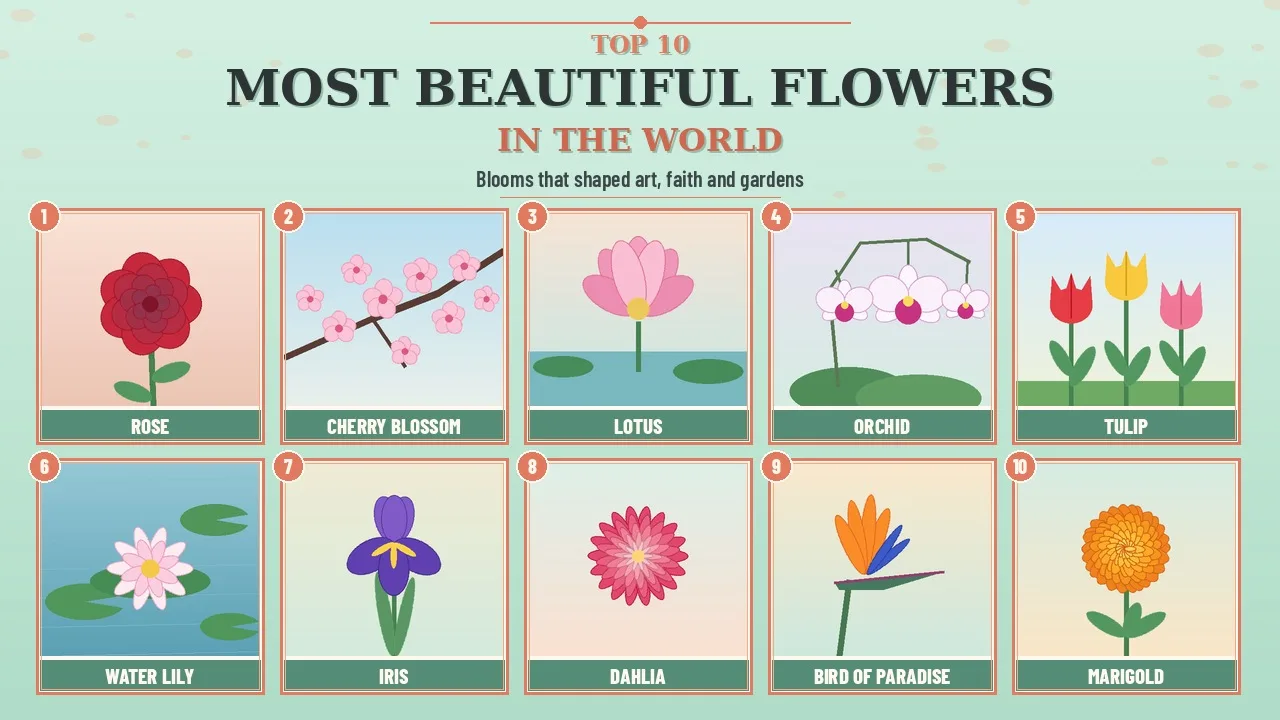
The most beautiful flowers in the world, from roses and cherry blossoms to lotuses and orchids, have shaped art, faith and gardens across every continent.
Beauty in a flower is partly personal, yet some blooms win admiration almost everywhere they grow. They appear on national emblems, in museum masterpieces, in wedding garlands and on festival posters, and people travel thousands of kilometres just to stand among them for a few days each year. This Finepedia guide picks ten of those flowers and explains where each one comes from, what makes it look the way it does, and why it matters to the people who grow and celebrate it.
Every botanical detail below, including scientific names, native ranges and species counts, has been checked against botanical references and encyclopedia entries. Where botanists disagree, for example on how many species a genus contains, the article gives a range or a rounded figure instead of false precision. Folklore is labelled as folklore, and none of the quotes or statistics are invented.
How We Chose the Most Beautiful Flowers in the World
No scientific test can prove that one flower is lovelier than another, so this ranking is editorial. Four questions shaped the final order:
- Visual impact: does the flower have a striking form, a wide colour range or an unusual structure that stops people in their tracks?
- Global recognition: is it admired well beyond its native region, in gardens, florists and media around the world?
- Cultural weight: does it carry religious, national or artistic meaning, from temple offerings to famous paintings?
- Experience in 2026: can ordinary visitors still see it in spectacular settings, such as public gardens and annual festivals?
Single species and whole groups of related plants were both eligible. Roses, orchids and tulips are judged as the familiar garden groups people actually buy and grow, while the lotus and the bird of paradise are each a single well-known species.
Ten Most Beautiful Flowers in the World at a Glance
| Rank | Flower | Scientific name | Native region | Best known for |
|---|---|---|---|---|
| 1 | Rose | Rosa species and hybrids | Mostly Asia, plus Europe, North America and northwest Africa | Romance, perfume and thousands of garden varieties |
| 2 | Cherry blossom | Prunus (subgenus Cerasus) | Northern Hemisphere, especially East Asia | Hanami in Japan and spring festivals worldwide |
| 3 | Lotus | Nelumbo nucifera | East, South and Southeast Asia | National flower of India and a symbol of purity |
| 4 | Orchid | Orchidaceae family | Every continent except Antarctica | Astonishing variety of shapes and colours |
| 5 | Tulip | Tulipa species and hybrids | Southern Europe to Central Asia | Tulip mania and Dutch bulb fields |
| 6 | Water lily | Nymphaeaceae family | Temperate and tropical waters worldwide | Monet's Giverny paintings |
| 7 | Iris | Iris species and hybrids | Northern Hemisphere | Rainbow colours and Van Gogh's Irises |
| 8 | Dahlia | Dahlia species and hybrids | Mexico and Central America | Geometric blooms and national flower of Mexico |
| 9 | Bird of paradise | Strelitzia reginae | South Africa | A bloom shaped like a bird's crested head |
| 10 | Marigold | Tagetes species | Mexico and Latin America | Day of the Dead altars and Indian garlands |
If you enjoy plant rankings, Finepedia also covers the most expensive plants in the world (https://finepedia.com/post/most-expensive-plants-in-the-world-top-10) and the most famous trees in the world (https://finepedia.com/post/most-famous-trees-in-the-world-top-10).
1. Rose
| Attribute | Details |
|---|---|
| Scientific name | Rosa (genus), family Rosaceae |
| Species | More than 300 species and tens of thousands of cultivars |
| Native range | Mostly Asia, with smaller numbers in Europe, North America and northwest Africa |
| Flowering | Late spring to autumn in temperate gardens, depending on variety |
| Symbol of | Love, England, the United States and Luxembourg |
Origins and History
Wild roses are modest shrubs and climbers whose flowers usually carry just five petals, in white, pink or occasionally yellow or red. Gardeners have been reshaping them for thousands of years. Because different rose species cross easily, breeders were able to combine the scent of one, the repeat flowering of another and the colour of a third, which is how the lush, many-petalled garden rose came about.
The damask rose, a hybrid of Rosa gallica and Rosa moschata, became the great perfume rose. Its petals are still distilled into rose oil today, mainly in Iran, Bulgaria and Turkey. In Bulgaria the crop is grown in long hedges around Kazanlak and Karlovo, an area known as the Valley of Roses, where a rose festival is held every June.
Key Features
- Plants range from low trailing shrubs to climbers reaching about 7 m (23 ft)
- Stems usually carry sharp prickles, which botanists distinguish from true thorns
- Colours run from white and cream through pinks, reds, oranges and yellows
- Many varieties are strongly fragrant, a key reason roses dominate the cut-flower trade
- After flowering, many species form colourful hips that birds eat and people use in teas and jams
Significance
No flower is more closely tied to romance. Red roses are the default language of love on Valentine's Day, and whole bouquets are chosen by colour, with yellow often given for friendship and white for remembrance. Roses also carry political weight. In 15th-century England the white rose of York and the red rose of Lancaster gave their name to the Wars of the Roses, and those colours still mark the counties of Yorkshire and Lancashire.
In 1986 President Ronald Reagan signed legislation making the rose the floral emblem of the United States. The rose is also the national flower of Luxembourg, and the Tudor rose remains a familiar emblem of England.
In Popular Culture
Shakespeare gave the rose one of its most quoted lines in Romeo and Juliet: "That which we call a rose by any other name would smell as sweet." Painters from the Dutch still-life masters to the French Impressionists returned to the flower again and again, and it remains a staple of tattoos, perfume bottles and greeting cards.
Interesting Facts
- A few species, such as Rosa omeiensis and Rosa sericea, usually have only four petals instead of five.
- Coastal species such as Rosa rugosa have dense prickles that may help trap wind-blown sand and protect their roots.
- Deer happily browse roses despite the prickles.
- The rose family, Rosaceae, also includes apples, cherries, strawberries and almonds.
2. Cherry Blossom
| Attribute | Details |
|---|---|
| Scientific name | Prunus, subgenus Cerasus, family Rosaceae |
| Species | About 100 wild cherry species, plus many ornamental cultivars |
| Native range | Mainly the Northern Hemisphere, especially East Asia |
| Flowering | Late winter to spring; Okinawa from January, Tokyo and Kyoto around late March to early April |
| Symbol of | Japan, renewal and the brief beauty of life |
Origins and History
In Japanese, the word sakura can mean either the cherry tree or its flowers. The custom of hanami, which simply means flower viewing, is many centuries old. It is said to have begun in the Nara period (710 to 794), when people mostly admired plum blossoms. By the Heian period (794 to 1185) the cherry had taken over, and the court held blossom-viewing parties with poetry, sake and feasts beneath the branches. The habit spread from the nobility to the samurai and, by the Edo period, to ordinary townspeople.
Most ornamental cherries seen in parks today are cultivated varieties rather than wild trees. Many trace back to the Oshima cherry. The best known is the Yoshino cherry, which spread across Japan after the Meiji era and became the main tree for hanami because its pale flowers open all at once, before the leaves appear.
Key Features
- Five-petalled flowers in white or soft pink, with double-flowered forms in many cultivars
- Blossoms often cover the bare branches before any leaves emerge
- Peak bloom at a given site typically lasts only about a week
- A blooming front moves north through Japan each spring, tracked closely by the media
- Western parks tend to favour the deep-pink double cultivar Kanzan
Significance
The cherry blossom is considered the national flower of Japan. Its short life has made it a long-standing symbol of transience, a reminder that beauty is precious precisely because it does not last. In modern Japan, hanami picnics are a social ritual for families, friends and office teams alike.
The flower also became a symbol of friendship between nations. On 27 March 1912, First Lady Helen Herron Taft and Viscountess Chinda, wife of the Japanese ambassador, planted the first two of 3,020 cherry trees given to Washington, D.C., by Tokyo mayor Yukio Ozaki. That gift is still celebrated by the National Cherry Blossom Festival, which became an annual national event in 1935. Cherry trees are among the most photographed trees on the planet, and several appear in Finepedia's guide to the most famous trees in the world (https://finepedia.com/post/most-famous-trees-in-the-world-top-10).
Interesting Facts
- Kyoto has records of full-bloom dates going back about 1,200 years, and in 2021 it recorded its earliest full bloom in that entire span.
- The average peak in Kyoto has shifted from around 17 April in the 1850s to around 5 April in the 2020s.
- Yoshino cherries are vulnerable to a fungal disease called witches' broom, so some Japanese cities are replanting with the similar cultivar Jindai-akebono.
- Cuttings from the original 1912 Washington trees have been used to keep the grove's genetic line alive.
3. Lotus
| Attribute | Details |
|---|---|
| Scientific name | Nelumbo nucifera, family Nelumbonaceae |
| Also called | Sacred lotus, Indian lotus, padma, kamala |
| Native range | East Asia through Indochina and much of India |
| Flowering | Summer, in shallow ponds and slow rivers |
| Symbol of | India, purity, rebirth and enlightenment |
Origins and History
The sacred lotus is one of only two living species in its family. It is often confused with the water lily, but the two are not closely related. Lotus plants grow from rhizomes rooted in mud, in water roughly 30 cm to 2.5 m deep, and raise their round leaves and large pink or white flowers well above the surface.
People across Asia have cultivated the lotus for millennia, both for its looks and as food. Its seeds, rhizomes and young leaves appear in Chinese, Indian, Japanese and Southeast Asian cooking, and in Myanmar fibres from the stems are spun into lotus silk for special robes.
Key Features
- Large flowers in shades of pink and white, with a flat seed head shaped like a showerhead at the centre
- Leaves can repel water almost completely, so droplets roll off and carry dirt with them
- The flower can hold its own temperature at about 30 to 35 °C even when the air is as cool as 10 °C
- Each fertilised flower produces a seed head holding about 10 to 30 seeds
- Seeds can survive dormant in pond mud for very long periods
Significance
The lotus is the national flower of India and is widely treated as an unofficial emblem of Vietnam. Its image of a spotless flower rising out of muddy water has made it a central symbol in Hinduism, Buddhism and Jainism, standing for purity, spiritual awakening and rebirth. Hindu deities such as Lakshmi are often shown seated on or holding a lotus, lotus flowers are offered to the Buddha in temples across Asia, and lotus seeds are strung into prayer beads.
In Popular Culture
The flower's self-cleaning leaves gave their name to the lotus effect, studied by botanist Wilhelm Barthlott in the 1970s. Engineers have borrowed the idea for water-repellent paints, glass and fabrics, making the lotus one of the clearest examples of nature-inspired design.
Interesting Facts
- In 1994, scientists germinated a lotus seed estimated to be about 1,300 years old, recovered from a dry lakebed in northeastern China.
- Because of that longevity, the lotus is a traditional Chinese symbol of long life.
- Water droplets on a lotus leaf can sit at a contact angle of up to about 170 degrees, which is why they bead up and roll away.
- Researchers think the warm flower may attract cold-blooded insect pollinators.
4. Orchid
| Attribute | Details |
|---|---|
| Scientific name | Orchidaceae (family) |
| Species | About 28,000 accepted species in roughly 700 genera |
| Native range | Every continent except Antarctica; richest in the tropics |
| Flowering | Varies by species; many indoor moth orchids bloom for months |
| Symbol of | Luxury, refinement and Singapore |
Origins and History
Orchids form one of the two largest families of flowering plants, rivalled only by the daisy family. Their roughly 28,000 species account for an estimated 6 to 11 percent of all seed plants. The family name comes from the Ancient Greek word orchis, a reference to the paired root tubers of some European species, and the English word orchid was introduced by the botanist John Lindley in 1845.
Nineteenth-century Europe went through an orchid craze, with wealthy collectors sending plant hunters into tropical forests in search of new species. Today, laboratory propagation has made once-rare orchids affordable, and the moth orchids of the genus Phalaenopsis, roughly 70 species named after their resemblance to moths in flight, are among the most widely sold potted plants in the world.
Key Features
- Flowers are built around a specialised central lip, the labellum, which often acts as a landing pad for pollinators
- Male and female parts are fused into a single structure called the column
- Seeds are as fine as dust and depend on fungal partners to germinate
- Many species are epiphytes that grow on tree branches rather than in soil
- Colours and patterns range from pure white to spotted, striped and nearly black
Significance
Some orchids pull off remarkable tricks. Bee orchids of the genus Ophrys mimic the colour, shape and scent of a female insect so well that males try to mate with the flower and carry its pollen away. The only orchid crop of major commercial value is vanilla, made from the cured seed pods of Vanilla planifolia.
Orchids also carry national meaning. On 15 April 1981, Singapore named the hybrid Vanda Miss Joaquim its national flower, praising its resilience and year-round blooms. It was the first registered plant hybrid from Singapore. Prize orchid hybrids can also fetch extraordinary sums, as Finepedia's guide to the most expensive plants in the world (https://finepedia.com/post/most-expensive-plants-in-the-world-top-10) shows.
Interesting Facts
- Some orchids have no leaves at all and photosynthesise through their roots or rely entirely on fungi.
- In several Phalaenopsis species, the petals turn green and start photosynthesising after pollination instead of wilting.
- The fragrance of one moth orchid, Phalaenopsis bellina, has been found to contain about 79 chemical compounds.
- Vanda Miss Joaquim was first reported in 1893 by Henry Ridley, then director of the Singapore Botanic Gardens.
5. Tulip
| Attribute | Details |
|---|---|
| Scientific name | Tulipa (genus), family Liliaceae |
| Species | About 75 species, plus thousands of garden cultivars |
| Native range | A belt from southern Europe to Central Asia |
| Flowering | Spring, usually March to May in the Northern Hemisphere |
| Symbol of | The Netherlands, the Ottoman Empire and springtime |
Origins and History
Wild tulips grow on steppes and mountain slopes from southern Europe across to Central Asia. Persian and Turkish growers were the first to cultivate them, with records going back to 10th-century Persia. By the 15th century the tulip was among the most prized flowers of the Ottoman world and later became a symbol of the Ottoman court. The English word is thought to come from a Turkish word for turban, perhaps because of the flower's shape.
European diplomats at the Ottoman court reported on tulips in the 16th century, and the bulbs soon reached northern Europe. In the Dutch Republic they set off tulip mania, often described as the first recorded speculative bubble. Prices rose sharply from 1634 and collapsed in February 1637. At the peak, rare bulbs sold for more than ten times the yearly income of a skilled craftsman, and the famous Semper Augustus reached about 10,000 guilders.
Key Features
- A simple cup of six petal-like tepals that opens in sunlight and partly closes at night
- An enormous colour range, including near-black, fringed, striped and multi-petalled types
- Grows from a bulb that needs a cold winter to flower well
- Bloom time is short, usually a couple of weeks for each variety
- The Netherlands is the world's leading producer of tulip bulbs
Significance
The most prized tulips of the 1630s had feathered, flame-like streaks. These "broken" tulips were caused by a virus carried by aphids, which disrupted the flower's pigment and weakened the bulb. The virus has now been almost eliminated from commercial fields, and today's striped varieties come from breeding instead. Tulips of this look are often called Rembrandts, after the painter of the same period. The history of those bubble-era bulbs also earns them a place in Finepedia's list of the most expensive plants in the world.
The tulip is also a living symbol of gratitude. In 1945 the Dutch royal family sent 100,000 bulbs to Ottawa to thank Canada for sheltering the future Queen Juliana and her children during the Second World War. That gift grew into the Canadian Tulip Festival, first held in 1953.
Interesting Facts
- Keukenhof in Lisse, the Netherlands, covers about 32 hectares and plants around 7 million bulbs each autumn.
- Keukenhof opened to the public in 1950 and welcomed about 1.4 million visitors in 2025.
- Princess Margriet of the Netherlands was born in Ottawa in 1943, while her family lived in exile there.
- Much of what people "know" about tulip mania comes from Charles Mackay's 1841 book, which modern historians say exaggerated the economic damage.
6. Water Lily
| Attribute | Details |
|---|---|
| Scientific name | Nymphaeaceae (family); main genus Nymphaea |
| Species | About 70 species in five genera |
| Native range | Freshwater ponds and lakes in temperate and tropical regions worldwide |
| Flowering | Summer in temperate climates; much of the year in the tropics |
| Symbol of | Bangladesh, Sri Lanka, Iran and Impressionist art |
Origins and History
Water lilies are rooted in mud at the bottom of ponds, with round, notched leaves that float on the surface and flowers that sit on or just above the water. Several species open only during the day, while others bloom at night. Many of the larger-flowered genera are pollinated by beetles.
The most dramatic member of the family is the giant water lily of the Amazon, Victoria amazonica. Botanist John Lindley named its genus in honour of the newly crowned Queen Victoria in the 1830s, and the plant became a Victorian sensation when greenhouses were built specially to grow it. Its leaves can reach about 3 m (10 ft) across and are strong enough that one leaf grown in Ghent, Belgium, supported a load of 226 kg.
Key Features
- Star-shaped or cup-shaped flowers in white, pink, red, yellow, blue and purple
- Floating leaves with a waxy upper surface that sheds water
- Flowers usually last only a few days, opening and closing each day or night
- Stems and leaves contain air channels that help keep them afloat
- Tropical species often have a stronger fragrance than hardy ones
Significance
The water lily is the national flower of Bangladesh, Sri Lanka and Iran, and a water lily appears on the national emblem of Bangladesh. But its global fame owes most to one painter. Claude Monet produced about 250 oil paintings of the water lilies in his garden pond at Giverny, and they dominated the last three decades of his life. Many were painted while his eyesight was failing from cataracts.
In 1927, a few months after Monet's death, the Musée de l'Orangerie in Paris opened two oval rooms built to hold eight huge water lily murals. In 2008 one of his water lily canvases, Le Bassin aux Nymphéas, sold for almost £41 million at Christie's in London.
Interesting Facts
- A giant water lily flower opens white on its first night and turns pink on the second.
- The giant water lily's leaf stalks can be 7 to 8 m long.
- In 2022, botanists at Kew described a separate species, Victoria boliviana, as the largest water lily in the world.
- Monet's garden at Giverny is open to visitors for much of the year, from spring to autumn.
7. Iris
| Attribute | Details |
|---|---|
| Scientific name | Iris (genus), family Iridaceae |
| Species | About 320 accepted species |
| Native range | Temperate regions across the Northern Hemisphere |
| Flowering | Mostly spring and early summer; tall bearded irises in May and June |
| Symbol of | The rainbow, royalty and artistic inspiration |
Origins and History
The iris takes its name from the Greek word for rainbow, which was also the name of the Greek goddess who carried messages along the rainbow between the gods and humans. Some writers say the name refers to the huge range of colours found across the genus, which includes blues, purples, yellows, whites, bronzes and near-black shades.
Irises grow wild across Europe, Asia and North America, in habitats from dry hillsides to marshes. Gardeners have bred them for centuries, especially the bearded irises, which are now grown in thousands of named varieties. Florence even has a dedicated iris garden, the Giardino dell'Iris, which hosts an annual breeders' competition.
Key Features
- Each flower has three upright petals, called standards, and three outer sepals, called falls
- Bearded irises carry a fuzzy strip of hairs on each fall that guides bees to the nectar
- Leaves are long, flat and sword-shaped, growing in fans
- Most garden irises grow from rhizomes, while others grow from bulbs
- Colour combinations often pair contrasting standards and falls in the same flower
Significance
The iris has a long link with royal heraldry. The fleur-de-lis, emblem of the French monarchy, means "lily flower", but historians have long debated whether it was originally based on a lily or on a yellow iris. Dried rhizomes of certain irises are also the source of orris root, an expensive ingredient prized in perfumery for its violet-like scent.
In Popular Culture
Vincent van Gogh painted Irises in May 1889, soon after he entered the Saint-Paul-de-Mausole asylum at Saint-Rémy-de-Provence, working directly from flowers in the hospital garden. In 1987 the painting sold for US$53.9 million, at the time the highest price ever paid for a painting. The buyer could not complete the payment, and in 1990 the work was bought by the J. Paul Getty Museum in Los Angeles, where it hangs today.
Interesting Facts
- The common garden bearded iris is often called German iris, although it is a hybrid rather than a wild German plant.
- Irises feature regularly in major flower shows, including the Chelsea Flower Show.
- Their seed capsules split into three sections when ripe.
- Some dwarf irises bloom as early as February and March in the Northern Hemisphere.
8. Dahlia
| Attribute | Details |
|---|---|
| Scientific name | Dahlia (genus), family Asteraceae |
| Species | Roughly 40 to 50 species, depending on the classification used |
| Native range | Mexico and Central America |
| Flowering | Midsummer until the first frost |
| Symbol of | Mexico, elegance and creativity |
Origins and History
Dahlias were known to the Aztecs and other peoples of Mexico long before Europeans arrived. The Aztecs called one type acocoxochitl, a name linked to its hollow stems, and some peoples ate the tubers. Spanish visitors reported the plants in 1525, and Francisco Hernández, physician to King Philip II of Spain, described them during a scientific expedition to Mexico in the 1570s.
In 1789 the director of Mexico City's botanical garden sent plant material to the Royal Botanical Garden in Madrid. There, the botanist Antonio José Cavanilles grew the plants and named the genus after the Swedish botanist Anders Dahl. Breeders across Europe soon began producing new forms, and the craze has never really stopped.
Key Features
- Flower heads are made of many small florets arranged in a disc, a structure shared with daisies and sunflowers
- Garden forms range from flat single flowers to perfect spheres known as pompons and balls
- Sizes run from small button blooms to "dinner plate" flowers wider than a human hand
- Comes in almost every colour except true blue
- Grows from tubers that must be protected from frost in cold climates
Significance
On 13 May 1963, Mexican President Adolfo López Mateos issued a decree declaring the dahlia the symbol of the nation's floriculture, and it is widely recognised as Mexico's national flower. The plant also links beauty with usefulness: its tubers store energy as inulin, a sugar polymer, rather than starch.
For flower lovers, the dahlia's appeal lies in its almost mathematical geometry. Tightly packed petals spiral outwards in regular patterns, and the huge variety of shapes means growers can fill a whole garden with dahlias without repeating a look.
Interesting Facts
- Dahlias belong to the same family as sunflowers, daisies, chrysanthemums and zinnias.
- The tree dahlia, Dahlia imperialis, can grow taller than a person and was described by Hernández in the 16th century.
- Most dahlias have little scent and attract pollinators through bright colour instead.
- French botanist Nicolas-Joseph Thiéry de Menonville noticed dahlias in an Oaxaca garden in 1787 while on a mission to smuggle out the cochineal insect.
9. Bird of Paradise
| Attribute | Details |
|---|---|
| Scientific name | Strelitzia reginae, family Strelitziaceae |
| Also called | Crane flower; isigude in Nguni languages |
| Native range | Eastern and Western Cape and KwaZulu-Natal, South Africa |
| Flowering | Mainly autumn to spring, with flowers on and off for much of the year in warm climates |
| Symbol of | South Africa and the City of Los Angeles |
Origins and History
The bird of paradise grows wild in coastal scrub and along riverbanks in South Africa. It reached Britain in 1773, when it was grown at the Royal Botanic Gardens, Kew, and was described by Sir Joseph Banks in 1788. Its species name, reginae, means "of the queen" and honours Queen Charlotte, wife of King George III, who was born into the House of Mecklenburg-Strelitz.
Its common names both come from birds. Bird of paradise compares the open flower to the display plumage of the birds-of-paradise of New Guinea, while crane flower likens it to the crested head and beak of a crowned crane.
Key Features
- A stiff, beak-like green and purple bract, called a spathe, holds the flowers horizontally
- Each flower has three bright orange sepals and three blue or purple petals
- Several flowers emerge one after another from the same spathe, extending the display
- Large, paddle-shaped evergreen leaves on long stalks
- Cut stems last a long time in a vase, making it a florist favourite
Significance
The flower's shape is not just for show. The spathe acts as a sturdy perch for sunbirds, which visit to drink nectar. When a bird lands, its weight opens the joined blue petals and dusts its feet with pollen, which it then carries to the next flower.
Outside South Africa, the bird of paradise is a signature plant of warm, sunny gardens. Florida and California are its main growing regions in the United States, and it has been chosen as the official flower of the City of Los Angeles. In cooler countries it is popular as a large indoor plant.
Interesting Facts
- Two of the blue petals are fused into an arrow-shaped structure that holds the nectar.
- A form with white rather than blue petals was found along the Mzimvubu River in the Eastern Cape in 2002.
- Kirstenbosch National Botanical Garden in Cape Town bred a yellow-flowered form, Mandela's Gold.
- Plants usually take several years to bloom when grown from seed.
10. Marigold
| Attribute | Details |
|---|---|
| Scientific name | Tagetes (genus), family Asteraceae |
| Species | About 50 species |
| Native range | Central and southern Mexico and other parts of Latin America |
| Flowering | Summer to autumn; grown almost all year in warm regions |
| Symbol of | Remembrance in Mexico and celebration in India |
Origins and History
Marigolds of the genus Tagetes are native to the Americas, mainly Mexico. The Nahua people called them cempohualxochitl, which can be translated as "twenty flower", a name often linked to the Aztec counting system, which was based on twenty. The Aztecs grew them for medicine, ceremonies and decoration, and after the Spanish conquest the plants travelled to Europe and then across the world.
The names used in English gardens are geographically misleading. The large Aztec marigold, Tagetes erecta, is often sold as the African marigold, and the smaller Tagetes patula as the French marigold, yet both originate in the Americas. The pot marigold, Calendula, belongs to a different genus.
Key Features
- Dense, ruffled flower heads in gold, orange, yellow and cream, often with maroon markings
- Plants range from about 10 cm to more than 2 m tall, depending on species
- Leaves are finely divided and have a strong, pungent smell
- Easy to grow from seed and tolerant of most soils
- Flowers last well after cutting, which makes them ideal for garlands
Significance
In Mexico the Aztec marigold, or cempasúchil, is the flower of the Day of the Dead. Families cover altars and graves with its bright petals around 1 and 2 November, and it is also known as flor de muertos, the flower of the dead. In South Asia marigolds have become just as essential: strings of orange and yellow blooms decorate temples, homes, weddings and festivals such as Diwali.
The flower's intense colour comes from carotenoids, mainly lutein. Dried petals or extracts are added to poultry feed to deepen the colour of egg yolks, and lutein from marigolds is used in eye-health supplements.
Interesting Facts
- In Mexico, the Aztec marigold still grows wild in states including México, Michoacán, Puebla, Veracruz and Guerrero.
- Some marigold petals are edible and are sometimes scattered over salads.
- One species, Tagetes minuta, is treated as an invasive weed in some countries.
- Marigolds are widely planted among vegetables by home gardeners, who use them as companion plants.
Where and When to See These Flowers at Their Best
| Flower | Famous place to see it | Typical peak season |
|---|---|---|
| Rose | Valley of Roses, Kazanlak, Bulgaria | Late May to June |
| Cherry blossom | Kyoto and Tokyo, Japan; Tidal Basin, Washington, D.C. | Late March to early April |
| Lotus | Temple ponds and lakes across India and Southeast Asia | Summer |
| Orchid | National Orchid Garden, Singapore Botanic Gardens | Year-round |
| Tulip | Keukenhof, Netherlands; Canadian Tulip Festival, Ottawa | Mid-March to mid-May; May in Ottawa |
| Water lily | Monet's garden, Giverny, France | Summer |
| Iris | Giardino dell'Iris, Florence, Italy | May |
| Dahlia | Public gardens and flower shows in Mexico, Europe and North America | Late summer to first frost |
| Bird of paradise | Kirstenbosch, Cape Town; gardens in southern California | Winter to spring in South Africa |
| Marigold | Day of the Dead markets in Mexico; festival flower markets in India | Late October to November |
Honourable Mentions
Many other flowers could easily claim a place on this list. These came close:
- Lilac (Syringa vulgaris): native to the Balkan Peninsula, loved for its heavily scented spring clusters, and the state flower of New Hampshire. It appeared in the original shortlist but was moved here to make room for the tulip, which has a far larger global following.
- Sunflower (Helianthus annuus): a North American native whose giant heads track the sun while young and now fill fields across Europe and Asia.
- Peony (Paeonia): prized in China for centuries and famous for its huge, scented, many-petalled blooms in late spring.
- Lavender (Lavandula): the purple fields of Provence in early summer are among the most photographed flower landscapes in Europe.
- Hibiscus: large tropical blooms that are the national flower of Malaysia and a symbol of Hawaii.
Why Flowers Matter Beyond Their Looks
Flowers evolved to attract animals, not people. Their colours, scents and shapes are signals to bees, beetles, moths and birds, and many of the features we find most beautiful, from the bird of paradise's perch to the bee orchid's disguise, are clever solutions to the problem of pollination. Appreciating that design makes each bloom more remarkable, not less.
They also carry enormous human meaning. The flowers on this list stand for love, grief, faith, gratitude and national pride. They have inspired some of the most valuable paintings ever sold, triggered a financial bubble and sealed friendships between countries. Flower festivals in Japan, the Netherlands, Canada and Bulgaria now draw millions of visitors, and the global trade in cut flowers and bulbs supports growers on several continents.
Finally, they are a reminder of how much depends on healthy ecosystems. Many wild relatives of these garden favourites grow in limited ranges and rely on specific pollinators, so protecting their habitats protects the gene pool that future gardeners will draw on.
Frequently Asked Questions
What is the most beautiful flower in the world?
There is no official answer, because beauty is subjective. The rose is the most common choice in surveys and in florist sales, thanks to its layered petals, scent and wide colour range. Cherry blossoms, lotuses and orchids are also frequently named, especially in Asia, where they carry deep cultural and religious meaning.
What is the difference between a lotus and a water lily?
They look similar but belong to different plant families. The lotus, Nelumbo nucifera, raises its leaves and flowers well above the water and has a distinctive seed head shaped like a showerhead. Water lilies, mostly Nymphaea, have notched leaves that float flat on the surface and flowers that sit on or just above the water.
Which country has the most beautiful national flower?
That depends on taste, but some of the most admired national flowers are India's lotus, Japan's cherry blossom, Singapore's Vanda Miss Joaquim orchid, Mexico's dahlia and the rose of the United States and England. Each was chosen for a mix of beauty, history and local meaning, and many feature on coins, stamps and emblems.
When is the best time to see cherry blossoms in Japan?
In most years, Tokyo and Kyoto reach full bloom around late March to early April, while Okinawa starts in January and Hokkaido follows in late April or May. Blooms last only about a week at each spot, and recent springs have trended earlier, so check official blossom forecasts before you book.
Are any of these flowers toxic to pets?
Yes. Tulip bulbs and irises are listed as toxic to dogs and cats by animal poison control services, and the bulb is usually the most concentrated part. Never let pets chew garden bulbs or cut flowers. Finepedia's guide to houseplants toxic to dogs (https://finepedia.com/post/houseplants-toxic-to-dogs-top-10-to-keep-out-of-reach) lists other common risks.
Why were tulips once so expensive?
In the 1630s the Dutch Republic experienced tulip mania, when prices for rare bulbs soared and then crashed in February 1637. The most coveted tulips had streaked patterns caused by a virus, which made them rare and unpredictable. At the peak, a single Semper Augustus bulb reportedly sold for about 10,000 guilders.
Do orchids grow wild everywhere?
Almost. Wild orchids are found on every continent except Antarctica, from Arctic tundra to tropical rainforests, although the greatest diversity is in the tropics. Many tropical species grow on tree branches, while those in temperate regions such as Europe usually grow in soil, often in meadows and woodland.
Conclusion
The most beautiful flowers in the world are far more than pretty faces. The rose has shaped romance and royal history, the cherry blossom has taught generations to value fleeting moments, and the lotus has become a sacred image of purity rising from the mud. Orchids, tulips and water lilies show how one family or genus can inspire both science and obsession, while irises, dahlias, birds of paradise and marigolds bring colour to art, national identity and centuries-old festivals.
Whichever flower you love most, the best way to appreciate it is in person: in a Kyoto park in spring, among Keukenhof's bulb beds, beside Monet's pond at Giverny or at a Day of the Dead altar in Mexico. For more lists of nature's standouts and other striking subjects, explore Finepedia's guides to the most famous trees in the world (https://finepedia.com/post/most-famous-trees-in-the-world-top-10) and the most beautiful horse breeds (https://finepedia.com/post/most-beautiful-horse-breeds-top-10-stunning-breeds).
- Royal Botanic Gardens, Kew: Plants of the World Online (species and family checks) – https://powo.science.kew.org/
- National Park Service: History of the Cherry Trees, Washington, D.C. – https://www.nps.gov/subjects/cherryblossom/history-of-the-cherry-trees.htm
- Keukenhof official website – https://keukenhof.nl/en/
- Singapore National Parks Board: Vanda Miss Joaquim, Singapore's national flower – https://www.nparks.gov.sg/
- J. Paul Getty Museum: Irises by Vincent van Gogh – https://www.getty.edu/art/collection/object/103JNH
- Diario Oficial de la Federación, 13 May 1963: decree declaring the dahlia a symbol of Mexican floriculture – https://dof.gob.mx/index_111.php?day=13&month=05&year=1963
- Wikipedia (cross-check): Rose; Rosa × damascena; Cherry blossom; Hanami; National Cherry Blossom Festival; Nelumbo nucifera; Lotus effect; Orchidaceae; Phalaenopsis; Vanda Miss Joaquim; Tulip; Tulip mania; Keukenhof; Canadian Tulip Festival; Nymphaeaceae; Victoria amazonica; Water Lilies (Monet series); Iris (plant); Irises (painting); Fleur-de-lis; Dahlia; Strelitzia reginae; Tagetes; Tagetes erecta; Syringa vulgaris


















Log in with