









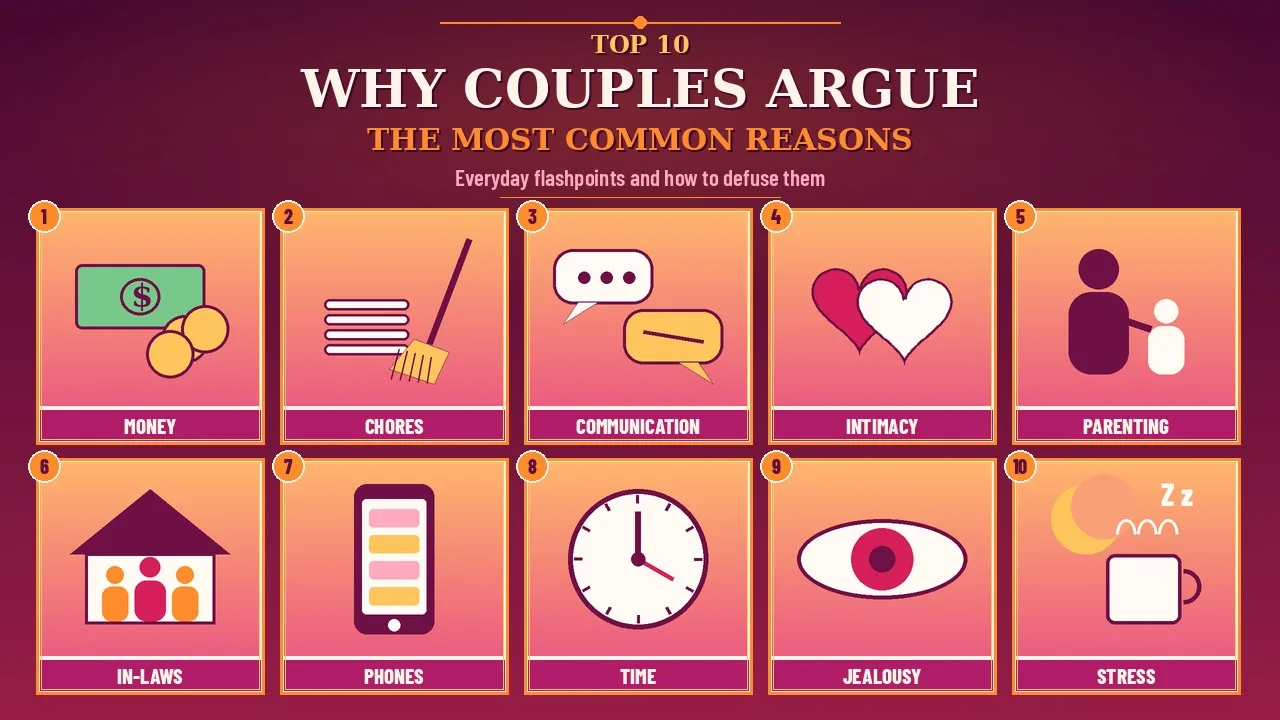
Why couples argue usually comes down to a few everyday flashpoints, from money and chores to sex, in-laws and phones, and most fights follow set patterns.
Every couple disagrees. Two people with different upbringings, habits, moods and priorities are sharing a budget, a calendar and often a home, so friction is not a sign that something is broken. What separates steady relationships from struggling ones is rarely whether partners argue, but what they argue about, how often the same fight returns and how they treat each other while it is happening.
This Finepedia guide ranks the ten most common reasons couples argue, explains why each topic is so charged, and offers practical ways to turn a recurring fight into a workable conversation. Statistics come from published surveys and peer-reviewed studies, which are named in the text and listed at the end. Where research is limited or disputed, the article says so instead of guessing.
How We Ranked the Most Common Reasons Couples Argue
There is no single global census of couple arguments, so this ranking is editorial. It draws on large surveys, relationship research and the issues couples therapists most often describe. Four questions shaped the order:
- How often does the topic come up for ordinary couples, according to surveys and research?
- How emotionally loaded is it, meaning how strongly does it touch on fairness, security, respect or desire?
- Does it tend to repeat, turning into the same argument month after month?
- How much damage can it do if it is handled badly over years?
The list focuses on everyday disagreements between partners who are broadly safe with each other. Arguments that involve threats, fear, control or violence are not ordinary conflict, and the section near the end explains where to turn in that situation.
Ten Most Common Reasons Couples Argue at a Glance
| Rank | Reason | What the fight is usually really about | Typical trigger |
|---|---|---|---|
| 1 | Money and spending | Security, freedom and shared goals | A large purchase or a surprise bill |
| 2 | Household chores and the mental load | Fairness and feeling taken for granted | Dishes left in the sink, forgotten tasks |
| 3 | Communication and feeling unheard | Respect and emotional connection | Interrupting, sarcasm, the silent treatment |
| 4 | Sex and intimacy | Desire, closeness and rejection | Mismatched libidos, turned-down advances |
| 5 | Parenting decisions | Values and authority | Discipline, screen time, schooling |
| 6 | In-laws and extended family | Loyalty and boundaries | Holidays, unsolicited advice, visits |
| 7 | Phones, screens and attention | Feeling less important than a device | Scrolling during dinner or conversation |
| 8 | Time together and time apart | Priority and independence | Long work hours, solo hobbies, plans with friends |
| 9 | Jealousy and trust | Safety and commitment | Messages, an ex, late replies |
| 10 | Stress, tiredness and hunger | Low reserves rather than the topic itself | A bad night's sleep or a skipped meal |
1. Money and Spending
| Attribute | Details |
|---|---|
| Rank | 1 |
| Core issue | Different attitudes to saving, spending and risk |
| Key statistic | 31 percent of adults with partners say money is a major source of conflict (American Psychological Association, 2015) |
| Common flashpoints | Debt, big purchases, who pays for what, supporting relatives |
| Best first step | A calm, scheduled money conversation, not one in the middle of a crisis |
Why It Sparks Arguments
Money is never only about money. For one partner, savings in the bank mean safety; for the other, spending on travel or hobbies means enjoying life while they can. Those attitudes are usually learned early, from how parents handled bills, debt and generosity, so a disagreement over a new phone can quickly become a clash between two family histories.
The American Psychological Association's Stress in America survey, released in February 2015, found that money was the top source of stress for Americans and that almost a third of adults with partners described it as a major source of conflict in their relationship. Money arguments also tend to arrive at already tense moments, such as a job loss, a move or a new baby.
Common Flashpoints
- One partner is a natural saver and the other a natural spender.
- Debt that one person brought into the relationship, or hid from the other.
- Large purchases made without discussion.
- Unequal incomes and disagreement about whether costs should be split equally or in proportion to earnings.
- Financial help for parents, siblings or adult children.
- Different ideas about how much to save for emergencies, a home or retirement.
Why It Matters
Financial disagreements touch on trust, power and the future at the same time. When one partner earns more, the other may feel they have less say, even if nobody intends that. Earning patterns are also changing: Pew Research Center reported in 2023 that in 29 percent of opposite-sex marriages in the United States both spouses earn about the same, up from 11 percent in 1972, and that wives are the sole or primary breadwinner in 16 percent of marriages, up from 5 percent. Couples can no longer rely on old assumptions about who manages the money, so they have to negotiate it openly.
How to Defuse It
- Hold a short monthly money meeting at a quiet time, with numbers in front of you.
- Agree a spending limit above which either partner checks in before buying.
- Talk about what money means to each of you, not only what it is spent on.
- Consider a mix of joint and individual accounts so each person keeps some autonomy.
- Disclose debts and financial commitments early in a serious relationship.
Interesting Facts
- The APA's 2015 survey found that money and work had been the top two sources of significant stress every year since 2007.
- Pew found the share of US marriages where the husband was the sole earner fell from 49 percent in 1972 to 23 percent in 2022.
- Many couples therapists suggest a "no-questions" personal allowance for each partner to reduce small, repeated spending disputes.
2. Household Chores and the Mental Load
| Attribute | Details |
|---|---|
| Rank | 2 |
| Core issue | A sense that one partner carries more of the work of running the home |
| Hidden factor | The mental load: remembering, planning and organising, not only doing |
| Common flashpoints | Cleaning standards, dishes, laundry, school forms, appointments |
| Best first step | List every recurring task, including invisible ones, and divide them openly |
Why It Sparks Arguments
Chores are a classic source of repeated arguments because they never end. The dishes are washed today and dirty again tomorrow, so any imbalance is felt every single day. Partners also bring different standards of tidiness: one person may see crumbs on the counter as a problem, while the other genuinely does not notice them.
Beyond the visible tasks sits what is often called the mental load. Somebody has to notice that the milk is running out, remember the dentist appointment, plan a child's birthday and track when bills are due. When one partner does most of that thinking, they can feel like the household manager rather than an equal, even if the physical tasks are shared.
Common Flashpoints
- Different definitions of "clean" and "tidy".
- Tasks that are done only after being asked, which can feel like more work than doing them alone.
- Cooking criticism, where one partner corrects how the other prepares food.
- Disagreement about how the home should look, from furniture to clutter.
- Changes in the balance after a new baby, a job change or working from home.
Why It Matters
Chore arguments are rarely about a single plate. They are about fairness and appreciation. A partner who feels they are always picking up the slack may begin to feel resentful, and resentment makes every other argument harder. The Gottman Institute, the research and training organisation founded by psychologists John and Julie Gottman, lists housecleaning among the topics that can be either a simple, solvable problem for one couple or a long-running one for another.
How to Defuse It
- Write down every recurring task, including planning and remembering, then divide ownership of whole tasks rather than helping with pieces.
- Agree a shared minimum standard instead of arguing about whose standard is right.
- Let the person who owns a task do it their way, without constant correction.
- Review the split every few months, especially after life changes.
- Say thank you for routine work; appreciation lowers the temperature of later discussions.
Interesting Facts
- Many couples find that rotating disliked tasks, such as cleaning the bathroom, reduces arguments more than a fixed split.
- The phrase "mental load" became widely known through online comics and articles in the late 2010s, although researchers have studied invisible household work for decades.
- Arguing about how a partner cooks or cleans is one of the most common small conflicts, partly because it feels like a judgment on competence.
3. Communication and Feeling Unheard
| Attribute | Details |
|---|---|
| Rank | 3 |
| Core issue | How partners talk during disagreements, not what they disagree about |
| Research model | Gottman's Four Horsemen: criticism, contempt, defensiveness and stonewalling |
| Strongest warning sign | Contempt, which the Gottman Institute calls the single greatest predictor of divorce |
| Best first step | A gentle start: describe a specific problem and a need, without blaming |
Why It Sparks Arguments
Many couples discover that they are not really fighting about the topic in front of them. They are fighting about the way the topic was raised: a sarcastic tone, an eye roll, an old grievance dragged back in, or a partner who stops responding altogether. Once someone feels attacked or dismissed, the original issue, whether it was a late reply or a forgotten errand, gets lost.
Memory adds another layer. Two people can sincerely remember the same evening differently, and arguing about who said what three weeks ago rarely ends with agreement. It is usually more useful to focus on how each person felt and what they need now.
Common Flashpoints
- Starting a conversation with "you always" or "you never".
- Interrupting, or planning a reply instead of listening.
- Bringing up past mistakes in an unrelated argument.
- Blaming, where every problem is presented as the other person's fault.
- The silent treatment or walking away without saying when you will return.
- Disputes over what was said in a previous argument.
Why It Matters
John Gottman's research at the University of Washington, where he was a professor of psychology for 16 years, identified four communication patterns he called the Four Horsemen. Criticism attacks a partner's character rather than a specific behaviour. Contempt adds mockery, sarcasm and a sense of superiority. Defensiveness deflects responsibility, and stonewalling means emotionally shutting down. The Gottman Institute describes contempt as the single greatest predictor of divorce.
The way a conflict begins also matters. The Gottman Institute reports that a six-year study was able to predict a couple's likelihood of divorce by observing just the first three minutes of a conflict discussion. Some researchers have criticised how strongly these prediction claims are presented, noting that the models were built on small samples, so they are best treated as useful warning signs rather than a crystal ball.
How to Defuse It
- Use a gentle start: "I felt worried when you did not call. Can we agree to text if we are running late?"
- Replace criticism with a specific complaint about one behaviour.
- Take responsibility for even a small part of the problem; it disarms defensiveness.
- If you feel flooded, ask for a break of at least 20 minutes, do something soothing alone, and agree to return to the conversation.
- Aim for warmth even during disagreement; the Gottman Institute recommends a ratio of about five positive interactions for every negative one.
Interesting Facts
- The Four Horsemen are named after the biblical Four Horsemen of the Apocalypse, as a metaphor for patterns that can signal the end of a relationship.
- The Gottman Institute pairs each horseman with an antidote; for contempt, the antidote is building a culture of appreciation and respect.
- Blaming patterns are common in arguments because blame protects our self-image, but they leave the underlying problem unsolved.
4. Sex and Intimacy
| Attribute | Details |
|---|---|
| Rank | 4 |
| Core issue | Differences in desire, frequency, preferences and emotional closeness |
| Why it is hard | Many couples find it embarrassing to talk about directly |
| Common flashpoints | Mismatched libido, rejection, stress, health changes, new parenthood |
| Best first step | Talk about intimacy outside the bedroom, at a relaxed moment |
Why It Sparks Arguments
Sex is one of the least discussed and most sensitive sources of conflict. It is rare for two people to want exactly the same amount of physical intimacy at every stage of life. Work stress, illness, medication, pregnancy, young children and ageing can all change desire, and they often change it for one partner more than the other.
Because the topic is so personal, many couples avoid it until frustration builds. A partner who wants more intimacy may feel rejected or unwanted, while a partner who wants less may feel pressured or judged. Both reactions are understandable, which is why the argument can feel impossible to win.
Common Flashpoints
- One partner initiating far more often than the other.
- Feeling rejected after an advance is turned down.
- Exhaustion, especially in the years with babies or young children.
- Different expectations about affection that is not sexual, such as hugs and hand-holding.
- Body image concerns and health changes.
Why It Matters
For many couples, physical closeness is closely tied to feeling loved and connected. When intimacy drops without any conversation, partners tend to fill the silence with their own explanations, such as "they are no longer attracted to me", which may be completely wrong. The Gottman Institute lists sex among the topics that can be either solvable or perpetual, depending on the couple.
How to Defuse It
- Choose a calm time, not the moment after a rejection, to talk about needs.
- Describe what you would like more of, rather than what is missing.
- Separate affection from expectation, so a hug does not always feel like a request.
- Plan time together when energy is higher, rather than relying on the end of a long day.
- Consider a qualified couples or sex therapist if the issue keeps returning, and see a doctor if health changes may be involved.
Interesting Facts
- Mismatched desire is one of the most common issues couples therapists report seeing.
- Sleep, stress and workload often influence desire more than attraction does.
- Many couples say talking about intimacy gets easier with practice, even though the first conversation feels awkward.
5. Parenting Decisions
| Attribute | Details |
|---|---|
| Rank | 5 |
| Core issue | Different values, upbringings and ideas about raising children |
| Common topics | Discipline, screen time, bedtimes, food, education, religion |
| Context | Pew Research Center (2023): 77 percent of Americans say children are better off when both parents focus equally on work and home |
| Risk | Arguing in front of children, or one parent undermining the other |
| Best first step | Agree on a few core rules privately, then present a united front |
Why It Sparks Arguments
Parenting brings together two sets of childhood memories. One partner may have grown up with strict rules and want the same structure, while the other remembers a relaxed home and wants more freedom for their children. Neither view is automatically wrong, but the differences show up dozens of times a day, from bedtime battles to how long a child can spend on a tablet.
Questions of authority add pressure. In the past, many families assumed that one parent, often the mother, made most day-to-day childcare decisions. Today many couples expect to share those decisions, which is fairer but means more things need to be agreed.
Common Flashpoints
- How strict to be, and what consequences are appropriate.
- Screen time, phones and social media.
- Food, sleep schedules and activities.
- Schooling choices and homework support.
- Religious or cultural traditions.
- Who takes time off work when a child is ill.
Why It Matters
Children notice when parents disagree, and constant conflict about them can leave them feeling responsible. Disagreement handled respectfully, however, can actually show children how adults solve problems. The bigger risk is one parent overruling the other in front of the children, which teaches children to play parents against each other. The Gottman Institute also names disciplining children among the topics that can be solvable for one couple and perpetual for another.
How to Defuse It
- Agree a short list of family rules that both parents will enforce.
- Discuss disagreements away from the children whenever possible.
- Explain to each other why a particular rule matters to you, based on your own childhood.
- Allow different styles on smaller issues; children can cope with two slightly different parents.
- Revisit rules as children grow, because what suits a toddler will not suit a teenager.
Interesting Facts
- Pew's 2023 report found only 2 percent of Americans think children are better off when the mother focuses more on work and the father more on home, while 19 percent prefer the reverse.
- Many new parents say disagreements become more frequent in the first year, when sleep is short and responsibilities are new.
- Couples who discuss parenting values before having children often report fewer surprises later.
6. In-Laws and Extended Family
| Attribute | Details |
|---|---|
| Rank | 6 |
| Core issue | Loyalty, boundaries and how much influence relatives have |
| Common topics | Holidays, visits, advice, money, childcare, cultural expectations |
| Special case | Blended families, where step-relatives and former partners are involved |
| Hard truth | You cannot simply leave your partner's family out of your life |
| Best first step | Each partner handles conversations with their own family |
Why It Sparks Arguments
When you commit to a partner, you also inherit their family, with its traditions, expectations and history. A parent who offers constant advice, a sibling who borrows money, or a relative who seems to dislike you can create tension even if they live far away. In many cultures, close involvement of parents in a married couple's life is normal and welcome, while in others it can feel intrusive, so couples from different backgrounds may disagree about what is reasonable.
Holidays and family celebrations raise the stakes. Deciding whose parents to visit, for how long and how much to spend can turn a happy season into a negotiation. Blended families add more layers, with step-children, former partners and two sets of rules to balance.
Common Flashpoints
- Splitting holidays and festivals between two families.
- Unannounced visits or long stays.
- Parents criticising how the couple raises children or runs their home.
- Financial support for relatives.
- Feeling that a partner always takes their family's side.
Why It Matters
These arguments are really about whether a partner feels prioritised. If one person feels that their spouse puts a parent's wishes ahead of the relationship, trust erodes. At the same time, asking a partner to cut off or ignore their family can feel like an impossible demand. The Gottman Institute lists in-laws among common conflict topics that may be solvable or long-running depending on the couple.
How to Defuse It
- Agree as a couple first, then communicate decisions to relatives together.
- Let each partner deliver difficult messages to their own family.
- Plan holiday schedules early, and alternate where possible.
- Set kind but clear boundaries about visits, advice and money.
- Focus criticism on specific behaviour, never on your partner's family as a whole.
Interesting Facts
- Holidays are a well-known peak time for family arguments, because expectations are high and couples spend long stretches together.
- In blended families, step-parent roles often take years to settle, and disagreements about them are common.
- Couples who present decisions as joint choices usually face less pushback from relatives than those who blame each other.
7. Phones, Screens and Attention
| Attribute | Details |
|---|---|
| Rank | 7 |
| Core issue | Feeling less important than a device |
| Key statistic | 51 percent of partnered US adults say their partner is often or sometimes distracted by their phone during conversations (Pew Research Center, 2020) |
| Related term | Phubbing: snubbing someone in favour of your phone |
| Best first step | Agree phone-free times, such as meals and the first minutes after getting home |
Why It Sparks Arguments
Smartphones are a relatively new reason couples argue, but they have become one of the most constant. A partner scrolling through social media during dinner, checking work email in bed or answering messages mid-conversation can send a clear, if unintended, signal: something else matters more right now.
Pew Research Center's survey of US adults, conducted in October 2019 and published in 2020, found that about half of people who are married, cohabiting or in a committed relationship say their partner is at least sometimes distracted by their phone when they are trying to talk, and four in ten say they are at least sometimes bothered by how much time their partner spends on their device. Among partnered adults aged 30 to 49, about six in ten report their partner being distracted by their phone.
Common Flashpoints
- Phones at the dinner table or in bed.
- Gaming or streaming that takes priority over shared time.
- Social media likes, follows or messages that seem suspicious.
- Checking work messages during holidays or weekends.
- Looking through a partner's phone without permission.
Why It Matters
Research has given the habit a name: phubbing, short for phone snubbing. A study by James A. Roberts and Meredith David of Baylor University, published in the journal Computers in Human Behavior, surveyed more than 450 US adults. It found that 46.3 percent said their partner phubbed them and 22.6 percent said it caused problems in their relationship, and those who reported more phubbing also reported more conflict and lower relationship satisfaction.
Phones also raise privacy questions. Pew found that 34 percent of partnered adults admit to looking through their partner's phone without that person's knowledge, even though seven in ten Americans say this is rarely or never acceptable.
How to Defuse It
- Agree on phone-free zones, such as the dinner table and the bedroom.
- Put phones face down or in another room during important conversations.
- Tell your partner when you need to check something, so it does not feel like a snub.
- Talk openly about what online behaviour each of you considers a breach of trust.
- Check your own habits before criticising your partner's.
Interesting Facts
- The word phubbing, a blend of phone and snubbing, was popularised by a Stop Phubbing campaign created by the advertising agency McCann.
- Pew found that 75 percent of partnered adults have shared their phone password with their partner.
- Partnered women aged 18 to 29 were about twice as likely as men of the same age to say their partner is often distracted by their phone, according to Pew.
8. Time Together and Time Apart
| Attribute | Details |
|---|---|
| Rank | 8 |
| Core issue | Balancing shared time with work, friends, hobbies and personal space |
| Common topics | Long work hours, travel, nights out, solo hobbies, holidays |
| Hidden factor | Different needs for social time and solitude |
| Best first step | Plan regular time together and respect agreed time apart |
Why It Sparks Arguments
Couples often argue about time because time shows priorities. If one partner works late most evenings, travels frequently or spends every weekend on a hobby, the other may feel that the relationship always comes last. On the other side, a partner who needs time alone or with friends may feel smothered if every free hour is expected to be shared.
Holidays can make this worse. Expectations for a trip or a festival are high, and spending every hour together can expose small irritations that normally pass unnoticed. Disappointment when reality does not match the plan is a frequent trigger for arguments.
Common Flashpoints
- Working late or bringing work home.
- Weekends dominated by one partner's hobby or sport.
- Nights out with friends, and how often they happen.
- Planning holidays, birthdays and anniversaries.
- One partner wanting more alone time than the other.
Why It Matters
Quality time is how many couples maintain closeness. When it shrinks without discussion, partners can drift apart and become more like roommates. Personal space matters too: people who keep their own friendships and interests often bring more energy to the relationship. The challenge is agreeing on a balance that both partners can live with.
How to Defuse It
- Schedule regular time together, even a weekly walk or meal, and protect it.
- Agree how many evenings or weekends each partner can spend on their own plans.
- Give advance notice of late work or trips.
- Talk about expectations before holidays and special occasions to avoid disappointment.
- Accept that introverts and extroverts recharge differently.
Interesting Facts
- Many couples therapists suggest a short daily check-in conversation about each other's day as a simple way to stay connected.
- Arguments during holidays are often about unmet expectations rather than the holiday itself.
- Partners who share at least one hobby often find it easier to agree on how to spend free time.
9. Jealousy and Trust
| Attribute | Details |
|---|---|
| Rank | 9 |
| Core issue | Insecurity, past hurt or unclear boundaries with other people |
| Common triggers | Friendships, contact with an ex, flirting, messages, secrecy |
| Warning sign | Jealousy that turns into monitoring, control or isolation |
| Best first step | Agree openly on what each partner sees as acceptable |
Why It Sparks Arguments
A little jealousy is a normal human emotion, but it becomes a regular source of arguments when partners have different ideas about boundaries. One person may see friendly messages with a colleague as harmless, while the other sees them as a threat. Past experiences, such as being cheated on in an earlier relationship, can make someone more sensitive to signs of distance.
Trust arguments can be especially painful because they are hard to resolve with facts. Reassurance helps only if the insecure partner can accept it, and repeated questioning can make the other partner feel accused.
Common Flashpoints
- Close friendships with someone who could be seen as a romantic rival.
- Continued contact with an ex.
- Secretive phone or social media behaviour.
- Late replies or unexplained absences.
- A past betrayal that has not been fully worked through.
Why It Matters
Trust is the foundation of a stable relationship, and recurring jealousy can slowly erode it from both sides. Healthy jealousy leads to honest conversation about needs. Unhealthy jealousy can turn into checking a partner's phone, restricting who they see or controlling their movements, which are signs of a controlling relationship rather than ordinary conflict.
How to Defuse It
- Talk calmly about specific situations that make you uneasy, and why.
- Agree together on boundaries with exes, friends and online contacts.
- Offer reassurance proactively, especially after a past breach of trust.
- Work on personal insecurity rather than expecting a partner to remove every trigger.
- Seek couples counselling after an affair or serious breach; rebuilding trust usually takes time and structure.
Interesting Facts
- Contact with an ex is a frequent trigger, which is one reason Finepedia covers bad reasons for staying friends with your ex (https://finepedia.com/post/staying-friends-with-your-ex-10-bad-reasons-to-avoid).
- Jealousy is often strongest early in a relationship, before trust has been tested.
- Many couples find that agreeing on boundaries in advance prevents arguments better than discussing them after a problem.
10. Stress, Tiredness and Hunger
| Attribute | Details |
|---|---|
| Rank | 10 |
| Core issue | Low physical and emotional reserves that make small issues feel big |
| Sleep research | UC Berkeley study (published 2013): couples reported more conflict after a poor night's sleep |
| Hunger research | 2014 study of 107 married couples linked lower blood glucose to more anger at a spouse |
| Best first step | Notice when either partner is exhausted or hungry, and delay serious talks |
Why It Sparks Arguments
Some arguments are not really about any topic at all. They happen because one or both partners are tired, hungry, overworked or anxious, and their patience is running out. A comment that would be ignored on a relaxed Sunday morning can start a fight at the end of a long, stressful day.
Research supports this. UC Berkeley psychologists Amie Gordon and Serena Chen found that people reported more conflict with their romantic partners after a poor night's sleep. In a two-week diary study, 78 young adults in relationships tracked their sleep and their relationship stresses. In a follow-up lab study, couples were best at resolving conflict when both partners were well rested.
Common Flashpoints
- Arguments late at night when both partners are exhausted.
- Disagreements before meals, when people are hungry.
- Work pressure or money worries spilling into the relationship.
- Sleep loss with a new baby or shift work.
- Anxiety and low mood, which can make neutral comments feel hostile.
Why It Matters
Recognising the role of tiredness and hunger can prevent unnecessary conflict. A 2014 study published in the Proceedings of the National Academy of Sciences, led by Ohio State University's Brad Bushman, measured blood glucose in 107 married couples over 21 days. Each evening, participants stuck between 0 and 51 pins in a voodoo doll representing their spouse, depending on how angry they felt. People with lower evening glucose used more pins. Other researchers have questioned how well these measures capture real aggression, but the everyday advice is still sensible: do not start a serious conversation on an empty stomach.
Ongoing stress and anxiety can also show up physically, and Finepedia's guide to the physical symptoms of anxiety (https://finepedia.com/post/physical-symptoms-of-anxiety-top-10-signs-explained) explains common signs.
How to Defuse It
- Avoid tackling big topics late at night; agree to talk the next day.
- Eat something before a difficult conversation.
- Tell your partner when you have had a bad day, so they know your reserves are low.
- Protect sleep for both partners, especially during busy periods.
- Address long-term stress together, with professional support if needed.
Interesting Facts
- The informal word "hangry", meaning irritable because of hunger, is now listed in major English dictionaries.
- In the Berkeley study, poor sleep predicted more conflict even when researchers accounted for stress, anxiety and relationship satisfaction.
- Many couples agree a simple rule: no serious conversations after a set time at night.
Honourable Mentions
Several other topics regularly cause arguments but did not make the top ten:
- Politics and religion, especially when partners hold strongly different views.
- Moving house or deciding where to live.
- Pets, from who walks the dog to whether to get one at all.
- Driving and directions on car journeys.
- Health habits such as smoking, drinking and exercise.
- Disagreements about how to remember past events.
Solvable vs Perpetual Problems
One of the most useful ideas from relationship research is that not every disagreement can be solved. The Gottman Institute reports that 69 percent of relationship conflict is about perpetual problems, issues rooted in fundamental differences in personality or lifestyle needs that couples return to again and again. Solvable problems, by contrast, are situational and can be settled with a practical agreement.
| Type | What it looks like | Example | Best approach |
|---|---|---|---|
| Solvable problem | Specific and situational | Who collects the children on Tuesdays | Negotiate a clear practical agreement |
| Perpetual problem | Rooted in personality or lifestyle differences | A saver married to a spender | Keep an ongoing, good-humoured dialogue and find compromises |
| Gridlocked problem | A perpetual problem that feels impossible to discuss | Every conversation about family ends in hurt | Understand the dreams and values behind each position, often with professional help |
According to the Gottman Institute, the same topic can be solvable for one couple and perpetual for another. What matters is whether a couple can keep talking about a perpetual issue without contempt or shutting down. When that dialogue breaks down, the conflict becomes gridlocked and partners may gradually disengage emotionally.
How to Argue Better: Practical Tips
Disagreement cannot be eliminated, but it can be made less damaging and more productive. These approaches are widely recommended by couples therapists and relationship researchers:
- Start gently. Describe the problem and your feelings, then ask for something specific.
- Stick to one topic. Avoid bringing up past arguments.
- Listen to understand, and summarise what your partner said before replying.
- Take breaks when emotions run high, and agree a time to come back.
- Look for compromise rather than victory; a win for one partner can still be a loss for the relationship.
- Repair quickly with humour, an apology or a kind gesture.
- Follow up on agreements so the same fight does not return.
When Arguments Become Something More Serious
Ordinary arguments, even heated ones, involve two people who feel safe with each other. Some relationship behaviour is different. If a partner uses threats, intimidation, physical harm, constant monitoring, financial control or isolation from friends and family, it is not normal conflict but a sign of an abusive relationship. In that situation, couples counselling is usually not the right first step. Reach out to a trusted person, a doctor, local domestic violence services or emergency services if you are in immediate danger.
For couples who are safe but stuck in repeated, painful arguments, a qualified couples therapist can help both partners understand the patterns and find new ways to talk.
Frequently Asked Questions
What do couples argue about the most?
Money, household chores, communication, sex, parenting and in-laws are among the most commonly reported topics. The American Psychological Association found in 2015 that 31 percent of adults with partners said money was a major source of conflict. Many arguments are really about deeper issues, such as fairness, respect and feeling valued by a partner.
Is it normal for couples to argue?
Yes. Disagreement is a normal part of any close relationship, because two people with different needs and habits are sharing their lives. Research suggests the bigger question is how couples argue. Respectful disagreement can help partners understand each other, while patterns such as contempt and stonewalling are linked to unhappier relationships over time.
How often do couples argue?
There is no healthy number that applies to everyone. Some couples have frequent small disagreements and remain very happy, while others argue rarely but avoid important topics. Frequency matters less than whether arguments are respectful, whether problems get resolved and whether partners repair the relationship afterwards with kindness or an apology.
Why do couples keep having the same argument?
Many recurring arguments are perpetual problems rooted in personality or lifestyle differences. The Gottman Institute says 69 percent of relationship conflict falls into this category. Rather than trying to win, couples often do better by understanding the values behind each position and agreeing workable compromises they can revisit when circumstances change.
Can arguing be good for a relationship?
It can, when it is handled well. Respectful disagreement brings problems into the open, helps partners learn each other's needs and prevents resentment from building. The key is to argue about specific issues, avoid insults and contempt, listen carefully and make up afterwards. Avoiding every conflict can leave important problems unsolved for years.
How can couples stop fighting about money?
Regular, calm money conversations help, ideally scheduled rather than held during a crisis. Couples can agree a spending limit that needs joint approval, share information about debts openly and combine joint and personal accounts. Talking about what money means to each person, such as security or freedom, often reduces conflict more than budgets alone.
When should a couple see a counsellor?
Consider counselling when the same argument keeps returning without progress, when conversations regularly turn into insults or shutdowns, after a serious breach of trust, or when a major change such as a new baby creates ongoing tension. If there is any threat, fear or violence, contact domestic violence support services rather than relying on couples counselling.
Conclusion
Why couples argue is rarely a mystery. Money, chores, communication, sex, parenting and in-laws top most lists, while phones, time, jealousy and simple tiredness add regular sparks. Behind nearly every one of these topics sit deeper needs for security, fairness, respect and closeness, which is why a small disagreement can feel so large.
The encouraging news is that arguing is not the problem in itself. Couples who start gently, avoid contempt, take breaks when needed and accept that some differences are permanent can keep disagreeing without damaging their bond. For more on habits that shape our lives and wellbeing, explore Finepedia's guides on why people fail to reach their goals (https://finepedia.com/post/why-people-fail-to-reach-their-goals-10-key-reasons) and the happiest countries in the world (https://finepedia.com/post/happiest-countries-in-the-world-top-10-ranked-2026).
- American Psychological Association: APA survey shows money stress weighing on Americans' health nationwide (February 2015) – https://www.apa.org/news/press/releases/2015/02/money-stress
- The Gottman Institute: The Four Horsemen: Criticism, Contempt, Defensiveness and Stonewalling – https://www.gottman.com/blog/the-four-horsemen-recognizing-criticism-contempt-defensiveness-and-stonewalling/
- The Gottman Institute: Managing Conflict: Solvable vs. Perpetual Problems – https://www.gottman.com/blog/managing-conflict-solvable-vs-perpetual-problems/
- The Gottman Institute: How to Fight Smarter: Soften Your Start-Up – https://www.gottman.com/blog/softening-startup/
- Pew Research Center: In a Growing Share of U.S. Marriages, Husbands and Wives Earn About the Same (April 2023) – https://www.pewresearch.org/social-trends/2023/04/13/in-a-growing-share-of-u-s-marriages-husbands-and-wives-earn-about-the-same/
- Pew Research Center: Dating and Relationships in the Digital Age (May 2020) – https://www.pewresearch.org/internet/2020/05/08/dating-and-relationships-in-the-digital-age/
- Gordon, A. M. and Chen, S. (2014). The Role of Sleep in Interpersonal Conflict. Social Psychological and Personality Science – https://journals.sagepub.com/doi/10.1177/1948550613488952
- Bushman, B. J. et al. (2014). Low glucose relates to greater aggression in married couples. PNAS – https://www.pnas.org/doi/10.1073/pnas.1400619111


















Log in with