










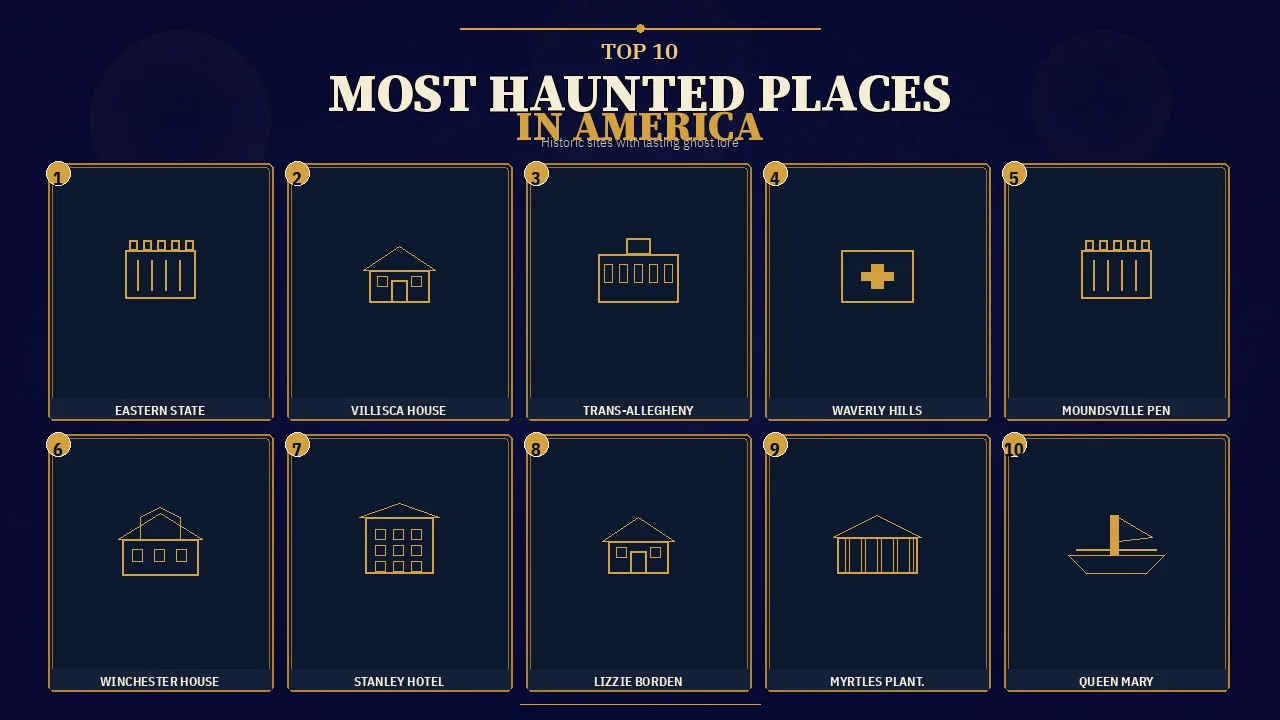
The most haunted places in America include documented crime houses, asylums and prisons where public ghost lore still draws active tours in 2026.
Across the United States, a small set of historic sites has become a durable part of public memory for reasons that go beyond campfire stories. They are places of recorded tragedy, long-running investigation folklore, and active tourism: museums, bed-and-breakfasts, former prisons and hospitals that sell guided tours, overnight investigations and seasonal Halloween events. Belief is optional. What this Finepedia ranking measures is documentation, longevity of public lore, and whether visitors can still walk the grounds in 2026.
This list is original. It overlaps a few well-known addresses that appear on nearly every American haunt roundup, then replaces weaker single-spirit or bar-level listings with sites whose histories are easier to verify and whose tour calendars remain active. Folklore is labelled as folklore. Death counts that cannot be confirmed from institutional or official records are left out. Living people are not accused of crimes they were not convicted of.
How We Ranked the Most Haunted Places in America
Three criteria shaped the order:
- Documented historical tragedy or notoriety (crime, incarceration, epidemic disease, wartime siege, or a famous unsolved case)
- Longevity of public haunting lore in books, television investigations and local tourism marketing
- Current visitor access as of 2026: daytime historic tours, paranormal programs, overnight stays or seasonal festivals
Sites that score highly on all three sit near the top. Purely private residences with thin archival support, or venues whose reputation rests on a single poorly sourced legend, were dropped even when they appear on older internet lists. Ranking is editorial, not a claim that any location is scientifically haunted.
At a Glance: Top 10 Most Haunted Places in America
| Rank | Place | Location | Type | Notable for |
|---|---|---|---|---|
| 1 | Eastern State Penitentiary | Philadelphia, Pennsylvania | Former prison / museum | Opened 1829; Halloween Nights festival |
| 2 | Villisca Axe Murder House | Villisca, Iowa | Historic crime house | Unsolved 1912 axe murders; overnight stays |
| 3 | Trans-Allegheny Lunatic Asylum | Weston, West Virginia | Former asylum | Kirkbride Plan landmark; year-round ghost hunts |
| 4 | Waverly Hills Sanatorium | Louisville, Kentucky | Former TB hospital | 1910–1961; public overnight investigations |
| 5 | West Virginia Penitentiary | Moundsville, West Virginia | Former prison | Closed 1995; Old Sparky on tour |
| 6 | Winchester Mystery House | San Jose, California | Historic mansion | Sarah Winchester's maze-like Victorian |
| 7 | The Stanley Hotel | Estes Park, Colorado | Operating hotel | Inspired Stephen King's The Shining |
| 8 | Lizzie Borden House | Fall River, Massachusetts | B&B / museum | 1892 murders; overnight rooms |
| 9 | Myrtles Plantation | St. Francisville, Louisiana | Historic inn | Antebellum home; evening mystery tours |
| 10 | RMS Queen Mary | Long Beach, California | Retired ocean liner | Year-round paranormal tours; Dark Harbor |
Related Finepedia reading includes our guides to the most dangerous tourist destinations in the world (https://finepedia.com/post/most-dangerous-tourist-destinations-in-the-world-top-10), the most popular Halloween candies in the US (https://finepedia.com/post/most-popular-halloween-candies-in-the-us-top-10) and creative uses for pumpkins (https://finepedia.com/post/creative-uses-for-pumpkins-top-10-ideas). Readers exploring seasonal folklore may also like the most powerful witches in Harry Potter ranking (https://finepedia.com/post/most-powerful-witches-in-harry-potter-top-10-ranked).
1. Eastern State Penitentiary
| Attribute | Details |
|---|---|
| Location | 2027 Fairmount Avenue, Philadelphia, Pennsylvania |
| Opened / closed | 1829 / 1971 |
| Type | Former penitentiary; National Historic Landmark; museum |
| Known for | Separate System of solitary confinement; Al Capone and Willie Sutton among famous inmates |
| Visit in 2026 | Daytime historic tours year-round; Halloween Nights select nights 2 October–7 November 2026 |
Origins and History
Eastern State Penitentiary opened in 1829 as a radical experiment in prison reform. Quaker-influenced planners believed isolation, labour and reflection could produce penitence, the root of the word penitentiary. Architect John Haviland designed a radial plan of cellblocks spreading from a central hub so a small staff could watch long corridors. Each cell had a skylight nicknamed the eye of God, a private exercise yard and almost no contact with other prisoners.
The Separate System influenced prisons worldwide, then collapsed under overcrowding and cost. By the twentieth century Eastern State held inmates in congregate conditions closer to ordinary prisons. Famous prisoners included Al Capone, who served a short weapons-related sentence in 1929–1930, and bank robber Willie Sutton, who escaped with others through a tunnel in 1945 and was recaptured the same day. The prison closed in 1971. After years of abandonment and near-demolition, preservationists stabilized the site. A modest Halloween fundraiser launched in 1991 grew into today's Halloween Nights festival, which still funds the nonprofit historic site.
Key Features
- Radial cellblocks and crumbling plaster that make the ruin itself part of the exhibit
- Audio and guide-led daytime tours that focus on criminal-justice history, not only ghosts
- Seasonal Halloween Nights with multiple haunted-house attractions inside the real prison walls
- Exhibits on solitary confinement and its modern legacy
- A preserved cell associated in popular memory with Capone's stay
Significance
Eastern State sits at number one because it combines architectural importance, a clear documentary record and one of the largest haunted-tourism footprints in the country. Visitors can spend a daytime visit learning how the Separate System worked, then return for a night festival that draws crowds from across the region. Public ghost lore here is decades old, but the institution itself is careful to present history first. That dual identity — landmark prison museum and major Halloween destination — is rare.
Interesting Facts
- Halloween Nights marked its 35th season in 2026, tracing back to the 1991 preservation fundraiser once known in earlier forms as Terror Behind the Walls.
- The site remains a National Historic Landmark and operates as a nonprofit museum outside the Halloween season.
- Sutton's 1945 tunnel escape remains one of the best-documented escape stories attached to the prison.
- Daytime programming in 2026 includes guide-led history and solitary-confinement tours alongside the audio tour.
2. Villisca Axe Murder House
| Attribute | Details |
|---|---|
| Location | 508 East 2nd Street, Villisca, Iowa |
| Crime date | Night of 9–10 June 1912 |
| Type | Restored crime-scene house; museum and overnight rental |
| Known for | Eight victims, including six children; case never solved |
| Visit in 2026 | Daytime house tours; whole-house or per-room overnight stays |
Origins and History
On the night of 9 June 1912, after a Children's Day program at the Presbyterian church, Josiah B. Moore, his wife Sarah, their four children and two overnight guests — sisters Ina and Lena Stillinger — returned to the Moore family home in Villisca. By morning all eight were dead, killed with an axe that belonged to the household. Neighbour Mary Peckham noticed the family had not begun morning chores; Josiah's brother Ross unlocked the door and found the Stillinger girls in the guest room. Townspeople soon crowded the house, contaminating the scene before the National Guard secured a perimeter.
The investigation produced several suspects over the years, including itinerant preacher George Kelly, who confessed under interrogation, recanted, and was acquitted after two trials in 1917. Other theories named local businessmen, a possible hired killer and later serial-offender comparisons. No one was ever convicted. In the 1990s historians Martha and Gavin Linn bought the house and restored it to a 1912 appearance, removing later plumbing and electrical fixtures so the interior would match the night of the crime. The home is now on the National Register of Historic Places and open for tours and overnight bookings.
Key Features
- Interior staged without modern electricity or indoor plumbing in the main house
- Self-guided and private daytime tours focused on the crime and its aftermath
- Overnight stays by whole house or individual room, with sleeping bags rather than use of period beds
- A restored barn nearby with restroom and power for overnight guests
- EMF meters and add-on history tours available through the operator
Significance
Villisca is one of the few American crime houses where visitors can legally sleep in the rooms associated with an unsolved mass murder. That combination of archival notoriety and immersive access keeps it near the top of any serious haunted-places list. The lore of crying children and an axe-bearing figure is widely repeated on television investigations, but the harder facts — eight dead, no conviction, a carefully restored shell — are enough to explain its draw without inventing details.
Interesting Facts
- Six of the eight victims were children, which is why the case still shocks more than a century later.
- Spent cigarettes found in the attic fed the theory that the killer waited inside before the family returned from church.
- Every mirror in the house was found covered after the murders, a detail often repeated in retellings.
- Before 2024, overnight stays were typically whole-house only; per-room options later made the experience more accessible to individuals.
3. Trans-Allegheny Lunatic Asylum
| Attribute | Details |
|---|---|
| Location | 71 Asylum Drive, Weston, West Virginia |
| Construction | Begun 1858; main building completed about 1880–1881 |
| Type | Former state hospital; National Historic Landmark |
| Known for | Kirkbride Plan architecture; severe overcrowding by mid-20th century |
| Visit in 2026 | Historic and paranormal tours; ghost hunts offered year-round |
Origins and History
Construction of the Trans-Allegheny Asylum for the Insane began in 1858 on land beside the West Fork River in Weston, then still part of Virginia. Architect Richard Snowden Andrews followed the Kirkbride Plan, which treated carefully designed wings, light and air as part of treatment. The Civil War interrupted building; Union forces seized funds and materials early in the conflict. Patients were admitted as early as 1864 even while work continued. The main structure was finished around 1880–1881 and is often cited among the largest hand-cut stone masonry buildings in the United States.
Designed for about 250 patients, the hospital later held thousands at peak overcrowding in the 1950s. It operated for decades as Weston State Hospital before closing in 1994. After abandonment, the state auctioned the property in 2007. Private owner Joe Jordan restored the historic name Trans-Allegheny Lunatic Asylum and opened the complex for historic tours, paranormal events and seasonal festivals beginning around 2007–2008. The building was designated a National Historic Landmark in 1990.
Key Features
- Vast stone Kirkbride wings that visitors tour by day or with flashlights at night
- Documented Civil War-era construction interruptions and local military use of the site
- Paranormal tours and overnight-style ghost hunts marketed alongside historic interpretation
- Ballroom, medical wings and patient wards that appear repeatedly in television investigations
- Seasonal fall festivals that mix history and haunt programming
Significance
Few American asylums combine Kirkbride-scale architecture, a National Historic Landmark designation and a year-round ghost-hunt calendar. Trans-Allegheny ranks high because the building's size and documented overcrowding give weight to wherever lore attaches, while the current operators keep doors open for both history tourists and paranormal groups. Public stories range from Civil War soldiers to former patients; this article treats those as reported accounts rather than proven events.
Interesting Facts
- The original design capacity of roughly 250 patients was later exceeded many times over.
- Television series including Ghost Hunters and Ghost Adventures have filmed inside the asylum.
- The 2007 auction sale price was reported at about 1.5 million dollars for the main complex.
- Guided historic tours emphasize architecture and institutional history, not only haunt claims.
4. Waverly Hills Sanatorium
| Attribute | Details |
|---|---|
| Location | Louisville, Kentucky (Pages Lane / Paralee Drive access) |
| Opened / closed (TB era) | 1910 (wood); 1926 (five-story); closed June 1961 |
| Type | Former tuberculosis sanatorium; National Register property |
| Known for | TB epidemic care; supply tunnel nicknamed the body chute in lore |
| Visit in 2026 | Historic and paranormal tours (season roughly March–August); public and private overnight investigations; autumn haunted house |
Origins and History
Jefferson County's high early-twentieth-century tuberculosis death rate drove construction of a wooden sanatorium on Waverly Hill in 1910, sized for roughly forty to fifty patients. Demand forced expansion: a children's pavilion, tents and eventually a durable five-story hospital opened on 17 October 1926 with capacity for more than four hundred patients. The campus functioned almost as a self-contained town, with laundry, gardens, a post office and staff housing. Facilities were segregated; Black patients were housed separately from the main white wards.
Effective antibiotics, especially streptomycin, reduced the need for long-term TB hospitals. Remaining patients transferred out and Waverly Hills closed as a sanatorium in June 1961. The building later operated as Woodhaven Geriatric Center until 1980, then passed through failed redevelopment plans before Tina and Charlie Mattingly purchased it in 2001 and began funding restoration through tours and a Halloween attraction. A 500-foot tunnel between the heating plant and the main building carried steam and supplies by cable car; lore holds that staff sometimes moved deceased patients through it so living patients would not see funeral traffic. Historians describe that use as limited and anecdotal rather than the tunnel's primary purpose.
Key Features
- Five-story Tudor Gothic main hospital with long open-air porches built for fresh-air therapy
- The hillside supply tunnel popularly called the body chute on paranormal tours
- Two-hour paranormal walks and longer public overnight investigations
- Seasonal haunted-house nights in autumn
- Ongoing restoration funded in part by ticket sales
Significance
Waverly Hills is one of the most filmed former hospitals in American ghost media, yet its core story is medical history: an epidemic, a segregated institution and a building saved by tourism dollars. Ranking it fourth recognizes both the scale of documented suffering from tuberculosis and the intensity of 2026 visitor programming. Inflated death-toll legends that circulate online are not repeated here because solid institutional totals are hard to pin to a single public source.
Interesting Facts
- The name traces to a nineteenth-century schoolteacher's fondness for Walter Scott's Waverley novels.
- Esther Maxwell Barrens became the first Black nurse hired at Waverly Hills in 1926.
- The five-story building was added to the National Register of Historic Places in 1983.
- Owners have floated hotel-conversion ideas over the years; tours and events remain the active model in 2026.
5. West Virginia Penitentiary (Moundsville)
| Attribute | Details |
|---|---|
| Location | 818 Jefferson Avenue, Moundsville, West Virginia |
| Opened / closed | Mid-1860s construction; closed 1995 |
| Type | Former state penitentiary; National Register historic district |
| Known for | Gothic stone facade; executions including electric chair Old Sparky |
| Visit in 2026 | Guided historical tours in season; paranormal and twilight tours on selected dates |
Origins and History
When West Virginia became a state in 1863 it lacked a state prison. The legislature funded construction at Moundsville beginning in 1866. The Gothic Revival complex, with crenellated walls stretching opposite the city's prehistoric mound, followed the Auburn Plan of stacked barred cells inside a fortress-like outer wall. Overcrowding and violence marked much of the twentieth century. Deadly riots in the 1970s and a 1986 New Year's Day riot helped push courts toward ordering the facility closed. The last inmates transferred to a new prison at Mount Olive in 1995.
After closure, the Moundsville Economic Development Council turned the penitentiary into a tour site and training venue. Visitors walk cellblocks, the recreation yard and areas associated with punishment. The original electric chair, nicknamed Old Sparky, is displayed on the historical tour. Public sources commonly cite ninety-four executions carried out at the prison across hanging and electrocution eras, with the last electrocution in 1959.
Key Features
- Intimidating stone facade and interior cell ranges preserved as a museum
- Guided day tours covering daily prison life and capital punishment history
- Optional paranormal programs after dark
- Law-enforcement training events, including mock riot exercises
- Gift shop and event rentals that keep the site financially active
Significance
Moundsville earns its place among the most haunted places in America because it combines a long, violent institutional record with open public access. Ghost lore about residual inmates is widely marketed, but the documented story of overcrowding, riots and executions already explains why the building feels heavy to many visitors. It pairs naturally with Trans-Allegheny as a West Virginia double stop for dark-tourism travellers.
Interesting Facts
- Local legend claims Moundsville chose the penitentiary over a university; historians treat that story as doubtful.
- The prison sits across from the Grave Creek Mound, a major Adena culture earthwork.
- Old Sparky remains one of the most photographed objects on the tour route.
- The 2026 historical tour season is generally listed from early April through late November.
6. Winchester Mystery House
| Attribute | Details |
|---|---|
| Location | 525 South Winchester Boulevard, San Jose, California |
| Primary builder | Sarah Winchester (expansion from 1886 until her death in 1922) |
| Type | Victorian mansion / tourist attraction |
| Known for | Labyrinthine layout; stairs and doors that lead nowhere |
| Visit in 2026 | Daytime mansion tours; Festival Fright Nights select nights 18 September–1 November 2026 |
Origins and History
Sarah Lockwood Winchester, widow of Winchester Repeating Arms Company heir William Wirt Winchester, purchased an eight-room farmhouse near San Jose in 1886 and spent the rest of her life expanding it. Continuous construction produced a sprawling Queen Anne Victorian with roughly 160 rooms, thousands of windows, dozens of staircases and fireplaces, and a floor plan altered so often that doors open onto walls and stairs climb into ceilings. Popular legend says she built to confuse spirits of those killed by Winchester rifles. Historians note that continual remodeling, changing tastes and damage from the 1906 San Francisco earthquake also explain many oddities; the spirit-maze story is folklore layered onto a real building obsession.
After Sarah's death in 1922 the house opened to the public as a tourist attraction. It remains one of California's best-known historic homes. In 2026 the seasonal Festival Fright Nights event, produced with a haunted-attraction partner, runs on select nights from mid-September through 1 November with multiple zones and attractions across the estate.
Key Features
- Guided walking tours through the maze of rooms, staircases and architectural quirks
- Tiffany glass, expensive hardware and unfinished spaces left mid-remodel
- Separate seasonal Halloween festival with timed tickets
- Grounds and outbuildings that expand the visit beyond the main house
- Strong gift-shop and photo-op tourism infrastructure
Significance
Winchester Mystery House ranks high among haunted destinations because the building itself is the spectacle. Whether or not visitors accept spirit lore, the mansion's documented eccentricity is unmatched. That makes it a safer inclusion than sites whose fame rests only on a single unverifiable ghost. It also anchors West Coast representation on a list otherwise heavy with Midwestern and Appalachian institutions.
Interesting Facts
- Common tour figures cite about 160 rooms, 2,000 doors and 10,000 windows, numbers that vary slightly by source and renovation era.
- Sarah Winchester inherited a fortune from the rifle company but was a private figure who rarely spoke publicly about her motives.
- The 1906 earthquake damaged portions of the house and shifted how later wings connected.
- Festival Fright Nights tickets for 2026 are sold online with timed entry.
7. The Stanley Hotel
| Attribute | Details |
|---|---|
| Location | 333 East Wonderview Avenue, Estes Park, Colorado |
| Opened | 1909 |
| Type | Operating historic hotel |
| Known for | Inspiration for Stephen King's novel The Shining |
| Visit in 2026 | Hotel stays; daytime and nighttime spirited ghost tours (age limits apply) |
Origins and History
Inventor and entrepreneur Freelan Oscar Stanley came to Colorado seeking relief from tuberculosis and helped develop Estes Park as a mountain resort. With his twin brother Francis, he had already made a fortune from the Stanley Steamer automobile. The Stanley Hotel opened in 1909 as a grand colonial-revival lodge with electric lighting and modern amenities for the era. It quickly became a social centre for Rocky Mountain tourism.
In late September 1974, Stephen King and his wife Tabitha stayed overnight as the hotel wound down toward its seasonal close. King later described empty corridors, a deserted dining room and a nightmare about his young son being chased by a fire hose. Those impressions fed The Shining, published in 1977. The Stanley leans into that literary fame with tours that mix hotel history and reported ghost stories. Unlike abandoned prisons on this list, it remains a working hotel where guests sleep in ordinary booked rooms while tour groups explore public spaces after dark.
Key Features
- Full-service historic hotel with restaurants, events and mountain views
- Sixty-minute spirited ghost tours indoors and outdoors after dark
- Special Halloween-night tour options in season
- Public spaces associated with King's visit and later film culture (the Kubrick film was not shot here)
- Age minimums on ghost tours (commonly 8+)
Significance
The Stanley's place among the most haunted places in America rests as much on cultural history as on folklore. A verified author visit produced one of the most famous horror novels in English, which in turn amplified every creak in the building. That feedback loop — literature, tourism, lore — is unusually clear and well documented compared with anonymous spirit stories elsewhere.
Interesting Facts
- Stanley's tuberculosis recovery story parallels how mountain air shaped other health-tourism sites of the era.
- Ghost tours do not enter occupied guest rooms; night routes avoid guest floors out of respect for paying guests.
- Parking fees may apply for day visitors in peak months unless they are hotel guests.
- The hotel hosts concerts and events that have nothing to do with haunt tourism, underscoring its dual identity.
8. Lizzie Borden House
| Attribute | Details |
|---|---|
| Location | 230 Second Street, Fall River, Massachusetts |
| Crime date | 4 August 1892 |
| Type | Bed-and-breakfast and museum |
| Known for | Murders of Andrew and Abby Borden; Lizzie Borden's acquittal |
| Visit in 2026 | Daytime house tours; overnight rooms; ghost hunts and evening tours |
Origins and History
On the morning of 4 August 1892, wealthy Fall River businessman Andrew Borden and his second wife Abby were killed with a hatchet-like weapon inside their home at what is now 230 Second Street. Andrew's adult daughters Lizzie and Emma lived in the house. Lizzie became the prime suspect, was tried in 1893 and acquitted. No one else was ever convicted. The case became a national sensation and later a durable piece of American true-crime folklore, complete with schoolyard rhymes that oversimplify a complex trial.
The house passed through private owners for decades before opening as a bed-and-breakfast and museum in the 1990s. Guests can tour the crime-scene rooms by day and book overnight stays in themed rooms. Current operators also run Fall River ghost tours and supervised ghost hunts. Ownership changed again in the 2020s, but the core product — sleep where the Bordens died — remains.
Key Features
- Museum-style interpretation of the 1892 crime and trial
- Overnight suites and rooms inside the original house
- Ninety-minute house tours sold separately from lodging
- Evening ghost programming in Fall River
- Gift shop aimed at true-crime and haunt tourists
Significance
Like Villisca, the Lizzie Borden House sells proximity to an unsolved (or at least un-convicted) American murder. It ranks slightly lower because the case is more famous for courtroom drama and popular culture than for continuous ghost reports, yet overnight access and steady tour traffic keep it firmly in the national haunted-destination tier. This article does not assert Lizzie's guilt or innocence beyond the historical record of her acquittal.
Interesting Facts
- Andrew Borden bought the Second Street house in 1872; it was considered modest for a man of his wealth, which later fed family-tension theories.
- The famous jump-rope rhyme about Lizzie giving her mother forty whacks is folklore, not trial evidence.
- Breakfast is often offered as an add-on for overnight guests rather than included by default.
- USA Today and other travel outlets continue to list the house among notable autumn true-crime stays as recently as 2026.
9. Myrtles Plantation
| Attribute | Details |
|---|---|
| Location | St. Francisville, Louisiana |
| Built | Circa 1796 (General David Bradford) |
| Type | Historic house museum and overnight inn |
| Known for | Antebellum architecture; widely marketed ghost lore |
| Visit in 2026 | Daytime guided and self-guided tours; evening and private mystery tours; overnight stays |
Origins and History
Myrtles Plantation began as a late-eighteenth-century home built by General David Bradford, a figure connected to the Whiskey Rebellion who settled in Spanish West Florida. Later owners expanded the house into the ornate gallery-fronted mansion visitors see today. One of the few well-documented violent events on the property is the 1871 shooting of William Winter on the front gallery; he died inside the house after being carried upstairs. That episode appears in period reporting and is distinct from later ghost storytelling.
The plantation's most famous spirit story concerns Chloe, an enslaved woman said to have poisoned members of the Woodruff family. Historians and folklore researchers note that no archival Chloe matching the tale has been found, and that Sara Woodruff and her children's deaths align with yellow fever rather than a documented poisoning plot. Responsible tours increasingly separate verified history from legend. The site markets itself as one of America's most haunted homes while operating as an inn with daily tours and evening mystery programs.
Key Features
- Guided downstairs tours of the main house and grounds
- Evening mystery tours seven nights a week and private mystery options on selected nights
- Overnight lodging in historic rooms
- A mirror and other props heavily featured in folklore retellings
- Southern landscape and oak alley scenery that draw non-haunt visitors too
Significance
Myrtles lands at ninth because its tourism lore is enormous while parts of its most famous ghost story fail basic documentary checks. Including it still makes sense: the house is real, the Winter murder is real, and evening tours remain easy to book in 2026. Ranking it below better-documented prisons and crime houses reflects Finepedia's preference for verifiable tragedy over polished legend.
Interesting Facts
- Bradford fled west after his role in the Whiskey Rebellion; the house's earliest chapter is political exile as much as plantation agriculture.
- The Chloe narrative is a classic example of how Southern ghost tourism can overwrite archival silence with a dramatic story.
- Daytime tickets often allow self-guided exploration of the downstairs after an introduction.
- Overnight guests sometimes book specifically for anniversary or honeymoon stays unrelated to haunt interest.
10. RMS Queen Mary
| Attribute | Details |
|---|---|
| Location | Long Beach, California (permanently docked) |
| Launched / maiden voyage | 1934 / 1936 (Cunard White Star service) |
| Type | Retired ocean liner; hotel and tourist attraction |
| Known for | Wartime troopship service; year-round paranormal tours; Dark Harbor Halloween event |
| Visit in 2026 | Ship tours, hotel stays, paranormal programs; Dark Harbor select nights into early November |
Origins and History
The RMS Queen Mary was built in Scotland for Cunard and entered transatlantic passenger service in the 1930s as one of the world's great ocean liners. During the Second World War she was converted into a troopship, painted grey and nicknamed the Grey Ghost for her speed and elusive profile. After returning to passenger duty postwar, she was retired in 1967 and permanently moored at Long Beach as a hotel and attraction.
Decades of hotel use, restoration battles and entertainment programming followed. Paranormal tours — including names such as Haunted Encounters, Paranormal Ship Walk and Graveyard Tour — market reports of spirits in first-class suites, crew areas and the former pool. Each autumn, the Dark Harbor Halloween festival surrounds the ship with mazes and scare zones; the 2026 season continues that tradition on select nights from mid-September into early November.
Key Features
- Self-guided and guided ship tours through art-deco interiors and wartime exhibits
- Overnight hotel rooms aboard the permanently docked liner
- Multiple ticketed paranormal experiences year-round
- Large-scale Dark Harbor Halloween festival on the surrounding grounds
- Waterfront Long Beach location with skyline views
Significance
The Queen Mary closes the list as the strongest floating entry in American haunted tourism. Its documentary resume — luxury liner, wartime troopship, long second life as a Long Beach landmark — would matter even without ghost tours. The combination of hotel stays, year-round paranormal tickets and a major Halloween production keeps it competitive with landlocked asylums and prisons. Folklore about specific named spirits is reported by tour operators; this ranking does not treat those claims as historical fact.
Interesting Facts
- As a troopship, Queen Mary carried thousands of Allied personnel per crossing and was considered too fast for conventional U-boat attack profiles.
- Dark Harbor launched in its modern form around 2010, replacing earlier ship-based Halloween events.
- Some paranormal tours focus on areas not always included on standard daytime walking routes.
- The ship has undergone repeated restoration phases; visitors should check which decks and rooms are open on their date.
Frequently Asked Questions
What are the most haunted places in America in 2026?
This Finepedia ranking highlights Eastern State Penitentiary, the Villisca Axe Murder House, Trans-Allegheny Lunatic Asylum, Waverly Hills Sanatorium, West Virginia Penitentiary, Winchester Mystery House, the Stanley Hotel, the Lizzie Borden House, Myrtles Plantation and the RMS Queen Mary, based on documented history, lore longevity and active tours.
Can you stay overnight in haunted places in the United States?
Yes. Villisca offers overnight house or room rentals; the Lizzie Borden House and Myrtles Plantation operate as inns; the Stanley Hotel and Queen Mary are full hotels; and several former institutions sell ticketed overnight paranormal investigations rather than lodging.
Is Eastern State Penitentiary still open to visitors?
Yes. Eastern State operates as a historic site with daytime tours much of the year, and Halloween Nights runs on select nights from 2 October through 7 November 2026, with haunted attractions and historic programming inside the prison.
Was Fort Mifflin built in 1917?
No. Fort Mifflin on the Delaware River at Philadelphia was begun in the 1770s and played a major role in the Revolutionary War. Older online lists sometimes misstate the date; the fort is a National Historic Landmark with its own ghost-tour tradition but is not in this Top 10.
Are the ghost stories at Myrtles Plantation proven?
No. The Winter shooting of 1871 is documented, but the popular Chloe poisoning legend lacks matching archival evidence and conflicts with disease records. Treat evening mystery-tour stories as folklore unless a primary source is cited.
Why do so many haunted places in America used to be prisons or hospitals?
Prisons, asylums and TB hospitals concentrate death, isolation and institutional architecture. After closure they often sit empty for years, which invites exploration lore, television filming and later tourism that funds preservation.
Do you need to believe in ghosts to visit these sites?
No. Every location on this list can be visited as a history, architecture or true-crime destination. Paranormal tickets are optional add-ons at most sites, and daytime historic tours usually emphasize archival facts first.
Conclusion
The most haunted places in America are best understood as layered landscapes: court records and hospital registers underneath decades of oral lore, television episodes and ticketed scares. Eastern State and Villisca lead this ranking because their paper trails are thick and their doors still open. Asylums and prisons across Appalachia and Kentucky follow for the same reason. Mansions, hotels and a retired ocean liner round out a list that spans coasts without relying on unverifiable body counts or invented quotes.
If you go, book through official site calendars, respect private property and memorial spaces, and separate marketing copy from primary history. Halloween crowds in 2026 will be heaviest at Eastern State, Winchester and the Queen Mary; quieter true-crime stays remain possible in Villisca and Fall River for travellers who plan ahead.
- Eastern State Penitentiary Historic Site — https://easternstate.org/
- Halloween Nights at Eastern State — https://easternstate.org/events/details/halloween-nights
- Villisca Axe Murder House — https://murderhouse.com/
- Wikipedia: Villisca axe murders — https://en.wikipedia.org/wiki/Villisca_axe_murders
- Trans-Allegheny Lunatic Asylum — https://trans-alleghenylunaticasylum.com/
- Wikipedia: Trans-Allegheny Lunatic Asylum — https://en.wikipedia.org/wiki/Trans-Allegheny_Lunatic_Asylum
- Waverly Hills Sanatorium — https://thewaverlyhillssanatorium.com/
- Wikipedia: Waverly Hills Sanatorium — https://en.wikipedia.org/wiki/Waverly_Hills_Sanatorium
- West Virginia Penitentiary tours — https://wvpentours.com/
- e-WV: Moundsville Penitentiary — https://www.wvencyclopedia.org/entries/1378
- Winchester Mystery House / Festival Fright Nights — https://winchestermysteryhouse.com/ and https://festivalfrightnights.com/
- The Stanley Hotel — https://www.stanleyhotel.com/
- Colorado Encyclopedia: Stanley Hotel — https://coloradoencyclopedia.org/article/stanley-hotel
- Lizzie Borden House — https://lizzie-borden.com/
- The Myrtles Plantation — https://themyrtles.com/
- Wikipedia: Legends of Myrtles Plantation — https://en.wikipedia.org/wiki/Legends_of_Myrtles_Plantation
- The Queen Mary paranormal attractions — https://www.queenmary.com/paranormal-attractions.htm
- Wikipedia: Fort Mifflin (date correction vs older lists) — https://en.wikipedia.org/wiki/Fort_Mifflin
- Topic inspiration only (not copied): https://10mosttoday.com/10-most-haunted-places-in-america/




















Log in with