







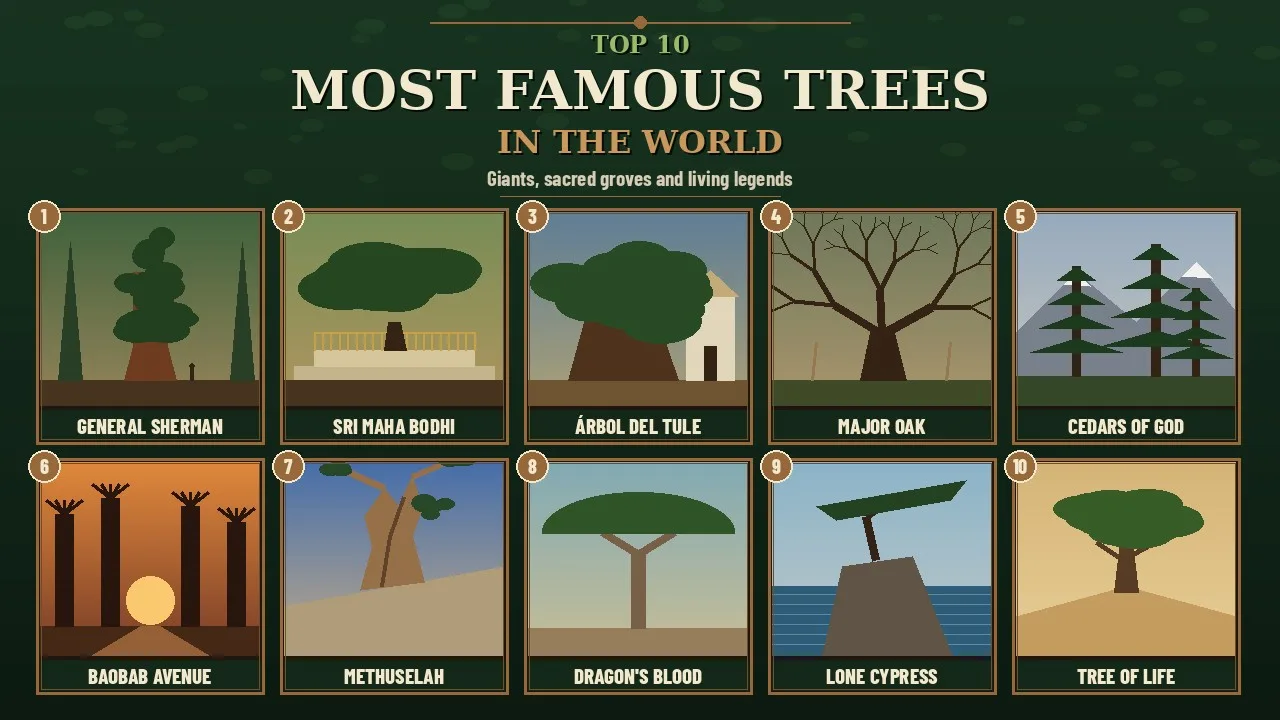
The ten most famous trees in the world range from giant sequoias and sacred figs to ancient oaks and desert survivors that still draw visitors in 2026.
Some trees become famous because they are measurably extraordinary: the biggest by volume, the stoutest trunk, the oldest confirmed age. Others earn their fame through faith, folklore or a single unforgettable silhouette on a postcard. A few manage all of these at once. This Finepedia guide brings together ten living (or still-standing) trees and tree groves that people cross oceans to see, and explains what makes each one remarkable.
Every figure in this article has been checked against park services, UNESCO listings, conservation bodies or well-sourced encyclopedia entries. Where scientists disagree about an age or a measurement, the range is given instead of a single dramatic number. Legends are labelled as legends. Trees that have fallen or been felled in recent years are covered separately at the end, so the main ranking only includes trees you can still visit today.
How We Ranked the World's Most Famous Trees
There is no official league table of famous trees, so this ranking is editorial. Four questions decided the order:
- Global recognition: is the tree known well beyond its own country, in books, films, stamps or travel media?
- Record or scientific importance: does it hold a verified superlative such as largest, oldest or stoutest?
- Cultural or spiritual weight: is it tied to a religion, a national identity or a long-lived legend?
- Visitor experience: can people still see it in 2026, and does it shape tourism in its region?
Single trees and famous groves are both eligible, because places such as the Cedars of God and the Avenue of the Baobabs are celebrated as one landmark even though they contain many individual trees.
Ten Most Famous Trees in the World at a Glance
| Rank | Tree | Location | Species | Famous for |
|---|---|---|---|---|
| 1 | General Sherman | Sequoia National Park, California, USA | Giant sequoia | Largest known living single-stem tree by volume |
| 2 | Jaya Sri Maha Bodhi | Anuradhapura, Sri Lanka | Sacred fig (Bo tree) | Oldest human-planted tree with a recorded planting date |
| 3 | Árbol del Tule | Santa María del Tule, Oaxaca, Mexico | Montezuma cypress | Stoutest tree trunk in the world |
| 4 | Major Oak | Sherwood Forest, Nottinghamshire, England | English oak | Robin Hood folklore; confirmed dead in 2026 but left standing |
| 5 | Cedars of God | Kadisha Valley, Bsharri, Lebanon | Lebanon cedar | Ancient grove, national emblem, UNESCO World Heritage |
| 6 | Avenue of the Baobabs | Menabe region, western Madagascar | Grandidier's baobab | Iconic roadside grove and sunset landscape |
| 7 | Methuselah | White Mountains, California, USA | Great Basin bristlecone pine | Among the oldest known non-clonal trees |
| 8 | Dragon's Blood Trees of Socotra | Socotra Archipelago, Yemen | Dracaena cinnabari | Umbrella-shaped crowns and blood-red resin |
| 9 | Lone Cypress | Pebble Beach, California, USA | Monterey cypress | One of the most photographed trees in North America |
| 10 | Tree of Life | Southern desert, Bahrain | Prosopis (mesquite) | Lone green tree in a barren desert |
If you enjoy nature rankings, Finepedia also covers the most expensive plants in the world (https://finepedia.com/post/most-expensive-plants-in-the-world-top-10), the most expensive wood in the world (https://finepedia.com/post/most-expensive-wood-in-the-world-top-10-rarest-timbers) and the rarest rock formations on Earth (https://finepedia.com/post/rarest-rock-formations-in-the-world-top-10-wonders).
1. General Sherman
| Attribute | Details |
|---|---|
| Location | Giant Forest, Sequoia National Park, Tulare County, California, USA |
| Species | Giant sequoia (Sequoiadendron giganteum) |
| Size | 83.8 m (274.9 ft) tall; 31.1 m (102.6 ft) around at ground level |
| Volume | About 1,487 cubic metres (roughly 52,500 cubic feet) of trunk wood |
| Estimated age | About 2,300 to 2,700 years |
Origins and History
The giant sequoia now called General Sherman takes its name from William Tecumseh Sherman, the American Civil War general. According to the official story, which historians treat with some caution, naturalist James Wolverton gave it the name in 1879. A few years later the land fell under the control of the Kaweah Colony, a utopian socialist logging community, whose members renamed the tree after Karl Marx. When Sequoia National Park was established and the colony broke up in 1892, the original name returned.
Its status as the world's biggest tree was settled in 1931, after careful comparisons with the nearby General Grant Tree. That contest helped establish trunk volume as the standard way to compare giant trees.
Key Features
- The largest known living single-stem tree on Earth when measured by volume
- The National Park Service estimates the trunk alone weighs nearly 1,400 tons
- Its first large branch grows about 39.6 m (130 ft) above the base
- The average spread of the crown is about 32.5 m (106.5 ft)
- A paved half-mile trail leads down to the tree, with a shorter wheelchair-accessible route from a separate parking area
Significance
General Sherman is not the tallest, widest or oldest tree in the world, yet it combines all three qualities at such an impressive scale that no other living tree contains more wood in a single trunk. It has become the symbol of the giant sequoia, a species found naturally only on the western slopes of California's Sierra Nevada. For many visitors it is the reason they come to Sequoia National Park at all.
The tree has also become a barometer for wildfire risk in the Sierra. In September 2021, as the KNP Complex Fire moved through the park, firefighters wrapped the base of the tree in protective foil normally used on buildings. The fire did not reach it, and the tree came through unharmed.
Interesting Facts
- In January 2006 its biggest branch, more than 2 m wide and over 30 m long, snapped off and cracked the pavement below. Experts did not see it as a sign of poor health.
- A fence surrounds the tree to protect its shallow roots from trampling.
- Several giant trees cut down in the 19th and 20th centuries, including some coast redwoods, were probably even bigger.
- The Park Service estimates the tree's wood could build around 120 average-sized houses, a comparison it uses to show the scale rather than a plan.
2. Jaya Sri Maha Bodhi
| Attribute | Details |
|---|---|
| Location | Mahamewna Gardens, Sacred City of Anuradhapura, Sri Lanka |
| Species | Sacred fig or Bo tree (Ficus religiosa) |
| Planted | 3rd century BCE; Sri Lankan tradition gives the year 288 BCE |
| Age | More than 2,300 years |
| Status | Major Buddhist pilgrimage site within a UNESCO World Heritage city |
Origins and History
Buddhist tradition holds that the Buddha attained enlightenment while seated beneath a sacred fig at Bodh Gaya in India. According to the Sri Lankan chronicle known as the Mahavamsa, a cutting from the southern branch of that tree was carried to Sri Lanka by the nun Sanghamitta, a daughter of the Mauryan emperor Ashoka. King Devanampiya Tissa planted it in his royal park at Anuradhapura, on a raised terrace.
Over the following two millennia, successive kings added statues, water channels, walls and railings around the tree. The present outer wall, roughly 3 m high, was built in the 18th century during the reign of King Kirti Sri Rajasinha, partly to keep wild elephants away. A golden fence was added in 1969.
Key Features
- Stands on a high terrace about 6.5 m above the surrounding ground
- Ringed by lower terraces of younger Bo trees, called Parivara Bodhi, planted to protect it
- Access to the top terrace is restricted to protect the ageing tree
- Its heavy branches rest on metal supports installed to protect the ageing tree
- The site is managed by the chief monk of the Atamasthana and its administrative council
Significance
The Jaya Sri Maha Bodhi is widely described as the oldest living tree planted by humans whose planting date is recorded. That makes it unusual among ancient trees, whose ages normally come from estimates rather than written history. For Sri Lanka's Buddhists it is far more than a botanical record: it is a living link to the moment of the Buddha's enlightenment, and millions of pilgrims visit every year.
Farmers in the Anuradhapura region traditionally bring rice from their first harvest as an offering, and many devotees make vows at the tree asking for safe childbirth or recovery from illness.
Interesting Facts
- Storms broke two of its branches in 1907 and 1911, and another was cut by a vandal in 1929.
- In 1985 the site was the scene of a deadly attack on pilgrims during Sri Lanka's civil war, now remembered as the Anuradhapura massacre.
- The Sacred City of Anuradhapura, which includes the tree's temple complex, is a UNESCO World Heritage Site.
- Sri Lankan sources give slightly different dates for the planting, but all place it in the 3rd century BCE.
3. Árbol del Tule
| Attribute | Details |
|---|---|
| Location | Church grounds, Santa María del Tule, Oaxaca, Mexico (about 9 km east of Oaxaca city) |
| Species | Montezuma cypress or ahuehuete (Taxodium mucronatum) |
| Trunk | 42.0 m (137.8 ft) around, measured in 2005 |
| Height | About 35.4 m (116 ft) by laser in 2005 |
| Estimated age | Best scientific estimate about 1,433 to 1,600 years |
Origins and History
The Tule tree grows beside the church in the small town of Santa María del Tule, on the road from Oaxaca city to the ruins of Mitla. Local Zapotec tradition says it was planted about 1,400 years ago by Pechocha, a priest of the Aztec wind god Ehecatl. That folk dating sits reasonably close to the estimate scientists have reached from growth rates.
The site was sacred before the Spanish conquest and was later taken over by the Catholic Church, which may help explain why the tree survived when so many others did not. The word ahuehuete comes from the Nahuatl language and is often translated as "old man of the water", a nod to the species' love of streams and springs.
Key Features
- Holds the record for the stoutest tree trunk in the world
- The heavily buttressed trunk gives a diameter of about 14 m, or about 9.4 m once the bulges are smoothed out
- The broad crown makes the height surprisingly difficult to measure
- DNA testing showed that it is one tree, not several trunks fused together
- Local guides point out shapes in the knotted bark said to resemble animals
Significance
Árbol del Tule is a different kind of giant from General Sherman. It is not especially tall, but its trunk is wider than that of any other known tree, which is why early visitors suspected it was several trees grown together. It is also a powerful local symbol: the town's identity, its main square and much of its tourism revolve around this one cypress.
In 2001 it was placed on Mexico's tentative list for UNESCO World Heritage status, though it was removed from that list in 2013. Concern for its health has grown since reports in 1990 linked damage to its roots with water shortages, pollution and heavy traffic on a nearby highway.
Interesting Facts
- Its recorded diameter rose from 11.42 m in 1982 to 14.05 m in 2005.
- Age claims range widely, from about 1,200 to 3,000 years, with one unsupported claim of 6,000 years.
- In 1990, roughly 8,000 cars a day on a nearby highway were cited as one threat to its roots.
- Visitors can view it from the churchyard in the centre of town.
4. Major Oak
| Attribute | Details |
|---|---|
| Location | Sherwood Forest, near Edwinstowe, Nottinghamshire, England |
| Species | English oak (Quercus robur) |
| Estimated age | About 800 to 1,200 years |
| Size | Girth about 10 m (33 ft); crown spread about 28 m (92 ft) at its peak |
| Status | Confirmed dead by the RSPB in June 2026; left standing as a monument and wildlife habitat |
Origins and History
Long before it was called the Major Oak, this tree was known as the Cockpen Tree, after the cockfights once held beneath it. Its modern name honours Major Hayman Rooke, a soldier and antiquarian who described it in his 1790 book on remarkable oaks and suggested it was close to a thousand years old.
Local folklore links the tree with Robin Hood and his Merry Men, who are said to have sheltered under its branches. There is no historical evidence for that story, but it turned the oak into a pilgrimage point for anyone fascinated by the outlaw legend. Support chains were fitted in 1908, and a frame of scaffolding props was added from the 1970s. A fence went up in 1974 because visitors were compacting the soil around its roots.
Key Features
- Its huge, spreading shape may come from several young trees that fused together, although this is uncertain
- At its peak, it was estimated to weigh about 23 tons
- It was commonly ranked as the second-largest oak in the UK
- It received around 350,000 visitors a year before its death was announced
- The RSPB has managed Sherwood Forest since 2018
Significance
In a 2002 public survey, the Major Oak was voted Britain's favourite tree, and in 2014 it won England's Tree of the Year poll run by the Woodland Trust. For generations it has been the face of Sherwood Forest on postcards and in school trips.
In June 2026 the RSPB announced that the oak had failed to come into leaf and was believed to have died. Experts pointed to a mix of causes: great age, hard and compacted soil, a weakened root system, more than a century of well-meaning supports, and recent heatwaves and droughts. The tree will stay standing, providing decaying wood habitat that is part of why Sherwood Forest is legally protected. It remains on this list because people still travel to see it, and its story is now one of the clearest public lessons about how much care ancient trees need.
In Popular Culture
The oak appears in countless Robin Hood retellings, souvenirs and local branding. During the Second World War it served as the formation sign of the British Army's 46th Infantry Division, which included battalions of the Sherwood Foresters.
Interesting Facts
- Around 1912, suffragette Emmeline Pankhurst was reportedly among a group of about 30 women who climbed inside the hollow trunk.
- An acorn collected in 1926 grew into the Robin Hood Oak at a forestry college in New York State.
- Arsonists damaged the tree in a fire in 1982.
- In 2003, a plantation of 260 saplings grown from its acorns was established in Dorset.
5. Cedars of God
| Attribute | Details |
|---|---|
| Location | Kadisha Valley, Bsharri, on the slopes of Mount Makmel, northern Lebanon |
| Species | Lebanon cedar (Cedrus libani) |
| Altitude | More than 2,000 m (about 6,600 ft) |
| Protection | UNESCO World Heritage Site since 1998, listed with Ouadi Qadisha (the Holy Valley) |
| Local name | Arz el-Rab, meaning "Cedars of the Lord" |
Origins and History
Lebanon's mountains were once covered by vast cedar forests. The cedar's fragrant, durable timber was prized across the ancient world: the Phoenicians built merchant ships from it, the Egyptians used cedar resin in mummification, and the Bible describes King Solomon sourcing cedar for the Temple in Jerusalem. A great cedar forest also features in the Epic of Gilgamesh, one of the oldest surviving works of literature.
Centuries of logging reduced those forests to scattered remnants. The grove at Bsharri is one of the most famous survivors. Christian monks in the Kadisha Valley venerated the trees for centuries, and European travellers began recording them in detail from the 16th century. The French naturalist Pierre Belon counted 28 old cedars in 1550, while the English chaplain Henry Maundrell counted only 16 very old trees in 1697.
Key Features
- A compact grove of ancient and younger cedars high on Mount Makmel
- Four of the trees have reached about 35 m (115 ft) in height
- Some of the oldest trunks measure 12 to 14 m around
- Visits are allowed only with an authorised guide
- A reforestation programme run by the Committee of the Friends of the Cedar Forest began in 1985
Significance
The Lebanon cedar is the emblem of the country and sits at the centre of the Lebanese flag. The Cedars of God are therefore both a natural landmark and a national symbol, and their UNESCO listing recognises the cultural landscape of monasteries and hermitages in the valley below as well as the trees themselves.
The grove is also a reminder of how much forest has been lost. What once covered a mountain range is now a protected patch that visitors must tour with a guide, and climate change adds pressure to trees adapted to cold, snowy winters.
Interesting Facts
- Travellers' counts of the oldest trees fell from 28 in 1550 to 16 by 1697, before later writers began counting younger trees as well.
- In 1871, a visitor from the Palestine Exploration Fund estimated that the grove contained about 355 trees.
- The Lebanon cedar is mentioned many times in the Bible as a symbol of strength and majesty.
- Winter snow often makes the high grove hard to reach.
6. Avenue of the Baobabs
| Attribute | Details |
|---|---|
| Location | Road No. 8 between Morondava and Belon'i Tsiribihina, Menabe region, western Madagascar |
| Species | Grandidier's baobab (Adansonia grandidieri), endemic to Madagascar |
| Trees | About 20 to 25 along a 260 m stretch, with about 25 more in nearby fields |
| Height | Around 30 m (98 ft) |
| Protection | Temporary protection from 2007; natural monument since July 2015 |
Origins and History
The baobabs lining this dusty road did not always stand alone. They are survivors of the dense tropical forest that once covered much of western Madagascar. As the population grew, the forest was cleared for farming, but people kept the baobabs because they valued them for food, building materials and their own sake. The result is the surreal scene that now makes the area famous: huge, smooth trunks rising from rice paddies and scrub.
The Malagasy name renala, or reniala, is usually translated as "mother of the forest". In July 2007 the government gave the avenue temporary protected status, and in 2015 it became a natural monument.
Key Features
- Massive, column-like trunks topped by small, flat crowns, giving the trees an upside-down look
- Best known for sunrise and sunset photography, when the trunks glow orange
- Grandidier's baobab is classified as an endangered species
- Local tourist stalls and a small parking fee support the site
- The nearby Baobab Amoureux are two baobabs of a different species twisted around each other
Significance
Few roadside landscapes are as recognisable as this one. The avenue has become a visual shorthand for Madagascar in travel brochures and documentaries, and it brings tourists to a region that sees few other international visitors.
The trees remain under pressure from deforestation, bushfires and runoff from paddy fields. Since 2014 the Malagasy organisation Fanamby has run an ecotourism project to protect the area while helping the local community earn from it.
Interesting Facts
- Popular sources often describe the trees as up to 800 years old, but no published dating confirms this for individual trees.
- A local legend says the Baobab Amoureux grew from a couple who were forbidden to marry.
- Baobabs store water in their fibrous trunks to survive long dry seasons.
- The road is unpaved, so travel in the rainy season can be difficult.
7. Methuselah
| Attribute | Details |
|---|---|
| Location | Methuselah Grove, Ancient Bristlecone Pine Forest, Inyo National Forest, White Mountains, California, USA |
| Species | Great Basin bristlecone pine (Pinus longaeva) |
| Elevation | About 2,900 to 3,000 m (9,500 to 9,800 ft) |
| Age | About 4,858 years in 2026, based on a 1957 core sample; one later estimate is lower |
| Exact spot | Not disclosed by the US Forest Service |
Origins and History
In 1957 the scientists Edmund Schulman and Tom Harlan took a core sample from a gnarled bristlecone pine in California's White Mountains. Counting its growth rings, they estimated that it was 4,789 years old at the time, meaning it germinated around 2833 BCE, a few centuries before the Great Pyramid of Giza was built. Schulman named it Methuselah after the biblical figure said to have lived 969 years.
For decades Methuselah was widely described as the oldest known living tree. The picture is now more complicated. A dendrochronologist at the University of Arizona has not been able to reproduce the original estimate because one core is missing, and has suggested an age of about 4,669 years. Harlan also reported finding an even older bristlecone, more than 5,000 years old, but neither that tree nor its sample could be located after his death in 2013.
Key Features
- Grows in thin, rocky soil at high altitude where cold, wind and drought slow its growth
- Like many ancient bristlecones, much of its trunk is dead wood, with only narrow strips of living bark keeping it alive
- Its dense, resinous wood resists decay and insects
- Its exact location has been kept secret to protect it from damage, although it has leaked online
- A trail through the Methuselah Grove lets visitors walk among trees of a similar age
Significance
Methuselah is recognised as the oldest confirmed non-clonal tree, meaning a single tree rather than a colony of genetically identical stems. Its fame comes not from size but from time: it was already ancient when the Roman Empire rose and fell.
Bristlecone pines are also scientific treasures. Using living and dead bristlecones, researchers have built a tree-ring record stretching back about 11,000 years, with one gap. That record helps scientists check radiocarbon dates and study past climate.
Interesting Facts
- Another bristlecone, known as Prometheus, was more than 4,862 years old when it was cut down in 1964 for research.
- Clonal organisms such as the Pando aspen colony in Utah are older as a whole, but they are not single trees.
- The bristlecone's slow growth produces very tight growth rings.
- Visitors are asked not to remove any wood, cones or bark from the grove.
8. Dragon's Blood Trees of Socotra
| Attribute | Details |
|---|---|
| Location | Socotra Archipelago, Yemen, in the Arabian Sea |
| Species | Socotra dragon tree (Dracaena cinnabari) |
| Size | Up to about 9 m (30 ft) tall with crowns about 12 m (39 ft) across |
| Known for | Umbrella-shaped crowns and dark red resin known as dragon's blood |
| Protection | Part of the Socotra Archipelago World Heritage Site, inscribed in 2008 |
Origins and History
Socotra has been isolated from mainland Africa and Arabia for millions of years, and many of its plants grow nowhere else. The dragon tree is the best known of them. It is thought to be a relic of ancient subtropical forests that once spread across North Africa before the region dried out.
Europeans first described the species scientifically during an East India Company survey of Socotra in 1835. In 1880 the Scottish botanist Isaac Bayley Balfour formally named it Dracaena cinnabari. Its red resin, traded for centuries, has been used as a dye, a varnish and a traditional medicine.
Key Features
- A dense, upturned crown shaped like an open umbrella, which helps shade the roots and capture moisture from mist
- Branches that split repeatedly into pairs, giving a neat, geometric look
- Stiff leaves up to 60 cm long, found only at the tips of the youngest branches
- Small berries that turn orange-red when ripe and are spread by birds
- One of only a handful of tree-forming species in the Dracaena genus
Significance
The dragon's blood tree is the national tree of Yemen and the visual symbol of Socotra. Its strange, almost alien shape has made it one of the most photographed plants in the world, and it draws travellers to one of the most remote places on Earth.
The species is under pressure. Overgrazing by goats makes it hard for young trees to survive, and development and climate change add further stress. Severe cyclones such as Chapala and Megh, which struck the island in 2015, add another risk for old trees. Because protecting the dragon tree also protects many other species around it, conservationists treat it as an umbrella species.
Interesting Facts
- Unlike most plants in its group, the tree develops secondary growth, which allows the trunk to thicken.
- Its growth zones look like tree rings but cannot be used to judge its age reliably.
- The tree usually flowers around March, and the fruit takes about five months to ripen.
- The resin's name and colour have inspired legends about the blood of dragons.
9. Lone Cypress
| Attribute | Details |
|---|---|
| Location | Granite headland over Carmel Bay, off 17-Mile Drive, Pebble Beach, California, USA |
| Species | Monterey cypress |
| Estimated age | Believed to have sprouted around 1750; exact age unknown |
| Owner | Pebble Beach Company, which has used it as its trademark since 1919 |
| Viewing | From a roadside viewpoint; the tree itself has been fenced off since 1969 |
Origins and History
The Lone Cypress is believed to have taken root around the middle of the 18th century, when California was still part of the Spanish colony of New Spain. Its age has never been measured directly, because coring the trunk could harm it. Paintings and photographs from the 1880s show it with a fuller, dome-shaped crown than it has today.
Over the following century the tree became a symbol of the Monterey Peninsula. A stone wall was built around its base in 1941 to stop erosion, steel cables were added in 1948 for support, and the tree was fenced off in 1969 to protect its roots from foot traffic.
Key Features
- Perches alone on a rocky outcrop above the Pacific, shaped by wind and salt spray
- Monterey cypress grows naturally in only two places: Pebble Beach and Point Lobos
- Sits between two famous golf courses, Cypress Point Club and Pebble Beach Golf Links
- Seen from a dedicated stop on the scenic 17-Mile Drive, which charges a vehicle entry fee
- Supported by cables and a retaining wall
Significance
Often called one of the most photographed trees in North America, the Lone Cypress is a symbol of endurance on a dramatic coastline. It also shows how a single tree can become a brand: a drawing of it was registered as the Pebble Beach Company trademark in 1919, and the company has said that protection extends to the tree itself.
Its future is uncertain. The longest-lived Monterey cypress confirmed by physical evidence reached only about 284 years, and the Lone Cypress may already be close to that age.
Interesting Facts
- An unknown arsonist tried to set it alight in 1984, but it survived with minor scarring.
- In February 2019, a powerful Pineapple Express storm tore away one of its limbs.
- Its 1919 trademark makes it one of the few trees closely tied to a company's brand identity.
- The viewpoint is one of the most visited stops on 17-Mile Drive.
10. Tree of Life (Bahrain)
| Attribute | Details |
|---|---|
| Location | Desert hill about 6 km from Jebel Dukhan and 40 km from Manama, Bahrain |
| Species | A Prosopis tree, commonly described as a mesquite |
| Height | About 9.75 m (32 ft) |
| Age | More than 400 years; a 1990s study suggested it was planted in 1582 |
| Visitors | About 65,000 people a year |
Origins and History
Known in Arabic as Shajarat-al-Hayat, the Tree of Life grows on a small rise in the barren southern desert of Bahrain, near Jebel Dukhan, the country's highest point. Studies of the soil and tree rings in the 1990s suggested it was planted in 1582. In 2010, archaeologists also found pottery and other objects around 500 years old near the tree, showing that people lived or worked in the area at that time.
How the tree survives in a place with almost no rainfall is still debated. One theory says its roots reach far down to underground water; others think it can extract moisture from the sand. Some local stories even place it on the site of the biblical Garden of Eden.
Key Features
- The only large tree for miles around in a flat, stony desert
- Abundantly covered in green leaves despite extreme summer heat
- Its resin and seed pods have traditional uses for candles, aromatics, gum and food
- Most impressive at sunset, when the desert glows around it
Significance
The Tree of Life is one of Bahrain's best-known tourist attractions and a symbol of resilience. Its fame comes from contrast more than size: a single living tree in a landscape where nothing else of its scale grows. In 2009 it was nominated for the New 7 Wonders of Nature campaign, though it did not make the final list.
In Popular Culture
The tree was mentioned in the 1991 comedy L.A. Story, where Steve Martin's character calls it one of the most mystical places on Earth.
Interesting Facts
- Sources disagree on the exact Prosopis species, so this article uses the broader name.
- The nearest city, Manama, is less than an hour's drive away.
- It is often cited as an example of how deep-rooted desert plants can survive long droughts.
Comparison: Record-Holding Trees at a Glance
| Record | Tree | Key figure | Notes |
|---|---|---|---|
| Largest by volume | General Sherman | About 1,487 cubic metres | Single-stem tree, still growing |
| Stoutest trunk | Árbol del Tule | 42.0 m around (2005) | Buttressed trunk; about 9.4 m smoothed diameter |
| Oldest confirmed non-clonal tree | Methuselah | About 4,858 years (1957 core) | Age estimate debated |
| Oldest human-planted tree with a recorded date | Jaya Sri Maha Bodhi | More than 2,300 years | Planted in the 3rd century BCE |
| Tallest known tree | Hyperion (honourable mention) | About 116 m | Coast redwood, Redwood National Park; area closed to visitors |
Honourable Mentions and Lost Legends
Several trees are famous enough to appear on almost any list, but did not make the main ranking because they have fallen, are off-limits to visitors, or rest on stories that do not hold up.
- Hyperion, California, USA: the tallest known living tree, a coast redwood measured at about 116 m. Since 2022 the area around it has been closed, and anyone entering illegally faces a fine of up to 5,000 US dollars or up to six months in jail.
- The Great Banyan, Howrah, India: a banyan in the Acharya Jagadish Chandra Bose Indian Botanic Garden near Kolkata, believed to be at least 250 years old. Its main trunk was removed in 1925, yet the tree covers about 1.89 hectares with more than 3,700 aerial prop roots. Finepedia's guide to banyan tree facts (https://finepedia.com/post/general-knowledge-facts-about-the-banyan-tree-the-majestic-symbol-of-strength-and-life) explains how these roots let one tree look like a forest.
- Pando, Utah, USA: a quaking aspen colony that grows from one root system and is often called one of the largest and oldest living organisms. It is a clone, not a single tree.
- Cotton Tree, Freetown, Sierra Leone: a kapok tree linked to the founding of Freetown in 1792. Most of it collapsed during heavy rain on 24 May 2023, although part of the trunk survived.
- Boab Prison Tree, Derby, Australia: a hollow boab about 1,500 years old with a girth of 14.7 m. Researchers have found no evidence that it was ever used as a lockup, despite the popular story.
- Tree of Ténéré, Niger: once considered the most isolated tree on Earth, a lone acacia on Saharan caravan routes. It was knocked down by a truck in 1973.
Why Famous Trees Matter
Famous trees are more than tourist stops. They hold records of past climates in their rings, provide habitats for insects, birds and fungi, and connect communities to their history and beliefs. The stories in this list also show a pattern: the very attention that makes a tree famous can harm it. Soil compaction around the Major Oak, crowds at Hyperion and traffic near the Tule tree all show how love can become a threat.
The best way to visit is simple. Stay on paths, respect fences, never take bark or cones, and support the parks and communities that care for these trees.
Frequently Asked Questions
What is the most famous tree in the world?
There is no single official answer, but General Sherman in Sequoia National Park is often named first because it is the largest known living tree by volume. Other candidates include the sacred Jaya Sri Maha Bodhi in Sri Lanka, the Árbol del Tule in Mexico and Sherwood Forest's Major Oak, each famous for different reasons.
Which is the oldest tree in the world?
The Great Basin bristlecone pine Methuselah in California is recognised as the oldest confirmed non-clonal tree, at about 4,858 years based on a 1957 core sample. Some researchers suggest a lower age. Clonal colonies such as Pando are older as organisms, but they are not individual trees.
Is the Major Oak still alive in 2026?
No. In June 2026 the RSPB, which manages Sherwood Forest, announced that the Major Oak had failed to produce leaves and was believed to have died. Experts blamed a combination of age, compacted soil, weak roots, past structural supports and recent heatwaves. The tree will remain standing as a monument and wildlife habitat.
Can you visit the Methuselah tree?
You can walk through the Methuselah Grove in the Ancient Bristlecone Pine Forest in California's White Mountains, but the US Forest Service does not mark or disclose the tree itself. Keeping its location secret helps protect it from souvenir hunters and damage. Visitors should stay on the trail and leave all wood and cones untouched.
What is the widest tree in the world?
The Árbol del Tule in Santa María del Tule, Mexico, has the stoutest trunk of any known tree. In 2005 its trunk measured 42 m around. Because the trunk is heavily buttressed, its smoothed diameter is about 9.4 m, which is still slightly wider than any known giant sequoia.
Why is it called the dragon's blood tree?
The Socotra dragon tree gets its name from its dark red resin, called dragon's blood. People have harvested the resin for centuries for dyes, varnish and traditional medicine. The tree grows naturally only on the Socotra Archipelago in Yemen, which is a UNESCO World Heritage Site.
What happened to Freetown's Cotton Tree?
Freetown's historic kapok, linked to the city's founding in 1792, mostly collapsed during heavy rain on 24 May 2023. Part of its trunk survived, and Sierra Leone's president promised a new monument incorporating its remains. Because most of the tree fell, it appears in this article's honourable mentions rather than the main ranking.
Conclusion
The world's most famous trees earn their status in very different ways. General Sherman and the Árbol del Tule impress through sheer size, Methuselah through age, the Jaya Sri Maha Bodhi and the Cedars of God through faith and history, and the Lone Cypress and the Tree of Life through unforgettable settings. The Major Oak shows that even legends do not last forever.
Together these ten trees tell the story of how people have honoured, used, measured and endangered trees over thousands of years. If you visit any of them, treat them with the same care that has kept them standing for so long.
- National Park Service, Sequoia and Kings Canyon National Parks: The General Sherman Tree – https://www.nps.gov/seki/learn/nature/sherman.htm
- RSPB: The Major Oak, a new chapter for a legend of Sherwood Forest (June 2026) – https://www.rspb.org.uk/whats-happening/news/the-major-oak
- BBC News: Major Oak, ancient Robin Hood tree is dead, experts say (18 June 2026) – https://www.bbc.co.uk/news/articles/clyer9m0jmko
- UNESCO World Heritage Centre: Ouadi Qadisha (the Holy Valley) and the Forest of the Cedars of God – https://whc.unesco.org/en/list/850/
- UNESCO World Heritage Centre: Socotra Archipelago – https://whc.unesco.org/en/list/1263/
- UNESCO World Heritage Centre: Sacred City of Anuradhapura – https://whc.unesco.org/en/list/200/
- Wikipedia (cross-check): General Sherman Tree; Jaya Sri Maha Bodhi; Árbol del Tule; Major Oak; Cedars of God; Avenue of the Baobabs; Methuselah (pine tree); Dracaena cinnabari; Lone Cypress; Tree of Life (Bahrain); Hyperion (tree); The Great Banyan; Cotton Tree (Sierra Leone); Boab Prison Tree, Derby; Tree of Ténéré



















Log in with