





Top 10 Curses People Took Deadly Seriously in History (unchanged)
 By Dhiraj Sharma · Published
· Updated
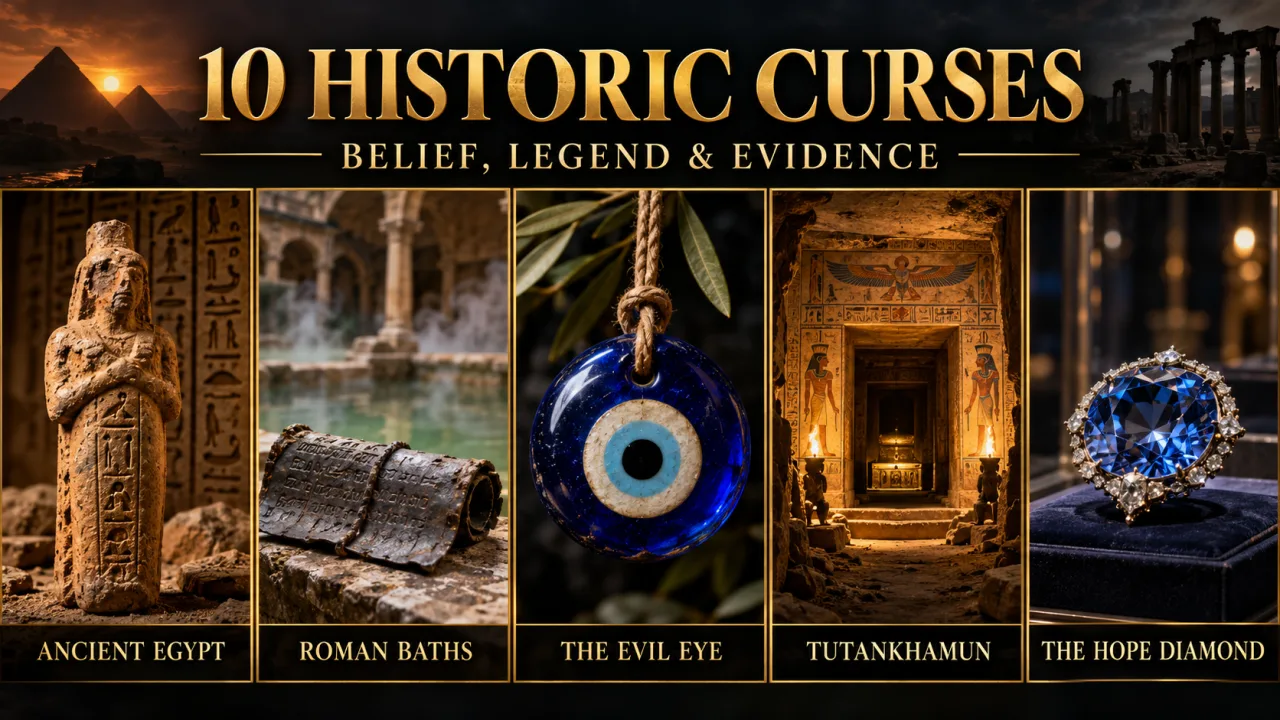
People have blamed curses for misfortune for thousands of years, from the smashed clay figurines of ancient Egypt and the lead tablets thrown into Roman springs to the legends that grew around Tutankhamun's tomb and the Hope Diamond.[1][3][14][15] The objects and stories behind these curses are real historical evidence of belief, ritual, rivalry and fear, but they are not proof that supernatural forces caused later events. This Finepedia list, updated in November 2026, looks at the top 10 curses people took deadly seriously in history, what each one was meant to do and what the evidence actually shows.
Introduction
A curse is a wish for harm made in the hope that a god, a spirit or some unseen force will carry it out. In the ancient world, curses were often formal rituals. Officials wrote enemies' names on objects and broke them, and ordinary people scratched complaints onto sheets of lead and handed them to a goddess.[2][5] Later, curses moved into stone inscriptions, religious arguments, theatre superstitions, newspaper stories and sales pitches.[8][11][15][17]
Popular history sites have collected dozens of these stories, and this list picks out ten of the best documented.[20] For each one it explains where the curse came from, why people believed in it and what historians, archaeologists and scientists have found when they looked closely. Taken together, the examples show how curses have been used to express anger, protect property, frighten enemies, justify injustice and explain bad luck.
Key Facts
The table below sums up all ten curses on this list, with where each comes from and what it is.
The 10 Curses at a Glance
| No. | Curse | Where | What it is |
|---|---|---|---|
| 1 | Egyptian execration figurines | Ancient Egypt | Enemies' names written on clay figures that were then broken |
| 2 | Roman curse tablets | Bath, England | Prayers for justice against thieves |
| 3 | The evil eye | Many cultures | An envious look believed to cause harm, warded off with the nazar |
| 4 | Björketorp runestone | Blekinge, Sweden | A runestone whose curse reads "I prophesy destruction" |
| 5 | Shakespeare's grave | Stratford-upon-Avon | "Curst be he that moves my bones" |
| 6 | The "curse of Ham" | Book of Genesis | A curse on Canaan later misused to justify slavery |
| 7 | Tutankhamun's tomb | Egypt | Legend that grew after Lord Carnarvon's death in 1923 |
| 8 | The Hope Diamond | Smithsonian, Washington, D.C. | A 45.52-carat blue diamond linked to its owners' misfortunes |
| 9 | The "Scottish play" | Theatres | Saying "Macbeth" in a theatre is said to bring bad luck |
| 10 | Tecumseh's curse | United States | Presidents elected in years ending in zero |
1. Egyptian execration figurines
In ancient Egypt, officials sometimes wrote the names of enemies or rebellious groups on clay figurines, pottery vessels or statues and then deliberately broke them. Archaeologists call these objects execration texts. The ritual symbolically placed a threat under the power of the Egyptian king and the gods, and it was most common in times of conflict with Egypt's neighbours in Asia.[2] One surviving clay figurine of this kind belongs to a large group of similar objects bought in Cairo in 1938 by the Belgian Egyptologist Jean Capart.[1]
The practice was especially widespread in the Middle Kingdom. More than 1,000 execration deposits have been found at sites including Giza, Saqqara, Thebes, Abydos and Elephantine.[2] At the Middle Kingdom fortress of Mirgissa in Lower Nubia, excavators found around 200 broken inscribed red vases, more than 400 broken uninscribed vases and nearly 350 mud figurines.[2] Because the jars, figurines and vases were almost destroyed in the rituals, archaeologists have to piece the fragments back together to study them.[2]
Some execration texts list foreign rulers and places, which turns them into an early political map. They contain what may be the first known mention of Jerusalem, and they also name the Kingdom of Kush and more than 200 Nubian rulers.[2] The objects show that Egyptians used symbolic destruction as part of statecraft and religion. They do not show that the people named were harmed by the ritual.
2. Roman curse tablets at Bath
At the Roman temple of Sulis Minerva in Bath, in south-west England, visitors threw thin sheets of metal into the sacred spring. The Roman Baths museum describes the tablets as the personal and private prayers of 130 individuals, inscribed on small sheets of lead or pewter and dating from the second to the late fourth century AD.[3] Most were found in 1979 and 1980 during excavations of the spring under the King's Bath.[4]
All but one of the Bath tablets ask the goddess to recover stolen goods and punish the thief, a type of curse known as a "prayer for justice".[4] They follow a common formula. The victim gives the stolen item to the goddess, so that the theft becomes a crime against her, and then asks for the thief to be punished until it is returned.[4] One man named Docimedis, who had lost two gloves, asked that the thief should lose their mind and eyes.[4] A similar tablet in the collection of Amgueddfa Cymru - Museum Wales is addressed to the goddess Nemesis and curses a thief who stole a cloak and a pair of boots.[6]
Most of the Bath texts are written in the everyday Latin spoken in Roman Britain, which makes them valuable evidence for ordinary language, and two may be in a British Celtic language.[4] In 2014 the tablets were added to the UNESCO Memory of the World UK Register.[3][4] Curse tablets were common across the Greek and Roman world, where about 1,600 have been found, often rolled up, pierced with nails and buried in graves or thrown into wells.[5] They are unusually personal records of everyday disputes, not evidence that curses worked.
3. The evil eye
Belief in the evil eye, the idea that an envious or admiring look can cause harm, is found in many cultures around the Mediterranean, the Balkans, West, Central and South Asia, Africa, the Caribbean and Latin America.[7] In classical Greece it was mentioned by writers such as Hesiod, Plato and Plutarch, and one modern study listed more than 100 ancient works that refer to it.[7] Greeks and Romans used amulets and charms against it, and even spat into the folds of their clothes for protection, a custom the Romans called despuere malum, "to spit at evil".[7]
Related: Top 10 Most Bizarre Phobias: Strange Fears That Exist
People developed many ways to turn the evil eye aside. The best known today are the blue and white eye-shaped bead called the nazar, most often seen in Turkey on houses, cars and jewellery, and the hand-shaped hamsa.[7] After glass beads began to be produced in the Mediterranean region around 1500 BC, eye beads became popular protective charms.[7]
There is no single origin or uniform practice. Meanings vary by time and place, and for many people the nazar and the hamsa are now simply decoration.[7] Historians study the evil eye as a social belief that explains vulnerability, envy and the need for protection, rather than as a force that has been scientifically demonstrated.
4. The curse on Sweden's Björketorp runestone
The Björketorp runestone stands in the province of Blekinge in southern Sweden. At 4.2 metres it is one of the tallest runestones known, and it stands with two other stones on an ancient burial ground beside a stone circle.[8][9] Its runic inscription is in Proto-Norse, and most scholars date it to the seventh century.[9]
The county administrative board of Blekinge describes the stone as carrying an unusual curse, and translates part of it as "I prophesy destruction".[8] The inscription is commonly understood as a threat of ruin to anyone who damages the monument. A similar message appears on the nearby Stentoften runestone, and Björketorp belongs to a small group of Blekinge stones, with Istaby, Gummarp and Stentoften, carved in the same unusual runic style.[8][9]
The exact meaning of the wording and the purpose of the stones are still debated. Excavations in 1914 found nothing buried by the runestone or in the stone circle.[9] The inscription shows the power of written threats and sacred boundaries in early medieval Scandinavia. It tells us what people feared, not about any confirmed supernatural consequence.
5. Shakespeare's grave inscription
William Shakespeare died in April 1616 and was buried in Holy Trinity Church in Stratford-upon-Avon. His gravestone in the chancel does not bear his name, but it was believed to be his from at least 1656.[10] It carries a short verse that ends: "Blessed be the man that spares these stones, And curst be he that moves my bones."[10]
The verse is often repeated as a curse, and the Shakespeare Birthplace Trust itself describes it as the curse on his gravestone.[10] The stone is the first in a row that commemorates other members of Shakespeare's family, so the warning sits at the head of a family burial place rather than standing alone.[10] Above it, his funerary monument carries a separate Latin epitaph comparing him to Nestor, Socrates and Virgil.[21]
Related: Top 10 Facts About Dogs
Whether the lines were written by Shakespeare himself or chosen by someone else, they read most naturally as a plea to leave a grave undisturbed, the same aim as many older tomb curses. The words are real and still visible in the church, but claims that they carry magical force belong to folklore, not to the historical record.
6. The so-called "Curse of Ham"
The phrase "Curse of Ham" is a misleading name for a later interpretation of a story in the Book of Genesis. In the biblical text, Noah's curse is directed at Canaan, Ham's son, and not at Ham himself.[11] Scholars have argued for more than 2,000 years about what Ham did wrong and why Canaan was the one cursed, and the story may originally have been meant to justify the Israelites' rule over the Canaanites.[11]
Genesis never says that Ham was black. Over many centuries, however, Christian and Islamic writers linked Ham with dark skin and with slavery, and European writers later used the story to help justify the Atlantic slave trade.[11] In the Southern United States, defenders of slavery cited it as one of their arguments against abolition. The historian Stephen R. Haynes traced this American use of the story in his book Noah's Curse.[11][12]
That interpretation was used to defend racial oppression. It is not a neutral reading of the biblical passage, and many Christian groups, including Methodists and Quakers, opposed slavery and worked for its abolition.[11] This example matters because a supposed curse can become a political weapon when people claim it gives them the right to harm others.
7. The curse of Tutankhamun's tomb
When Howard Carter's team opened the tomb of Tutankhamun in 1922, newspapers helped popularise the story that anyone who entered it would die under a pharaoh's curse.[14] The legend grew after Lord Carnarvon, who financed the excavation, died in April 1923. A mosquito bite on his face had become infected after he cut it while shaving.[14] The novelist Marie Corelli had published a warning of "dire punishment" two weeks earlier, and Sir Arthur Conan Doyle suggested that spirits created by Tutankhamun's priests had killed him.[14]
Most people connected with the excavation did not die soon afterwards. Of the 58 people present when the tomb and sarcophagus were opened, only eight died within a dozen years, and Carter himself lived until 1939.[14] Carter dismissed talk of curses as "tommy-rot".[14]
In 2002 the British Medical Journal published a study by the epidemiologist Mark Nelson that compared 25 Westerners who were exposed to the "curse" with others who were in Egypt at the same time but were not. The study found no significant difference in age at death or survival and concluded that there was no evidence for a mummy's curse.[13] The story is a case study in how coincidence, publicity and fascination with ancient Egypt can build a legend.
Related: Top 10 Tallest Buildings in the World
8. The Hope Diamond curse
The Hope Diamond is a 45.52-carat blue diamond whose recorded history begins in 1666, when the French merchant Jean-Baptiste Tavernier bought the rough stone in India and sold it to King Louis XIV.[16] It is now on display at the Smithsonian's National Museum of Natural History in Washington, D.C.[15][16]
The Smithsonian says the story of a curse began only in the early twentieth century. One early account appeared in the Washington Post in 1908, with a selective list of former owners' misfortunes.[15] The museum explains that the jeweller Pierre Cartier probably embellished the stories as a sales tactic when he was trying to sell the diamond to Ned and Evalyn Walsh McLean, and that May Yohe, the former wife of Lord Francis Hope, spread her own version in a 1921 book and film.[15] Many of the dramatic details do not survive scrutiny. The story that Tavernier was torn apart by wolves, for example, does not match the historical record.[16]
The jeweller Harry Winston, who bought the diamond in 1949, did not believe in the curse. In 1958 he donated it to the Smithsonian, sending it by registered mail in a box wrapped in brown paper.[16] A Smithsonian curator later said that owning the diamond had brought the museum nothing but good luck.[16] Its documented history is compelling without treating the curse as fact.
9. The "Scottish play" superstition
Actors have long avoided saying the name of Shakespeare's Macbeth inside a theatre, calling it "the Scottish play" instead. The superstition holds that saying the name will bring bad luck, accidents or even death to a production.[17][18] The Royal Shakespeare Company notes that the play was written around 1606, when King James, who had ordered witch-hunts in Scotland, had recently become king of England.[17] One popular theory claims that real witches, unhappy with how they were portrayed, cursed the play.[18]
Stories of disaster are easy to find. The Astor Place Riot in New York in 1849, caused by rivalry between two actors playing Macbeth in competing productions, left at least 20 people dead.[17][18] Laurence Olivier was narrowly missed by a falling stage weight at the Old Vic in 1937, and the actress Diana Wynyard fell from the stage during the sleepwalking scene at Stratford in 1948.[17]
There are practical explanations. The RSC points out that Macbeth was a popular play that reliably made money, so theatres in financial trouble often staged it as a last attempt to fill seats, and a run of the play could therefore become a sign that a company was in difficulty.[17] Actors who say the name by accident are told to leave the theatre, spin around three times, spit, curse and knock to be let back in.[17] The superstition is part of theatrical culture, not proof that the play causes accidents.
Related: 10 Sikh Gurus: The Pillars of Sikhism Who Shaped Faith, Equality, Courage, and Humanity
10. Tecumseh's supposed presidential curse
A popular American legend says that presidents elected in years ending in zero, every twenty years from 1840, would die in office. It is often called the Curse of Tippecanoe or Tecumseh's curse.[19] William Henry Harrison defeated the forces of Tenskwatawa, the brother of the Shawnee leader Tecumseh, at the Battle of Tippecanoe in 1811, and the legend says that Tenskwatawa or Tecumseh cursed him and the presidents who followed.[19]
The pattern seemed to fit for more than a century. Harrison, elected in 1840, died a month after taking office in 1841, and Abraham Lincoln, James Garfield, William McKinley, Warren Harding, Franklin Roosevelt and John F. Kennedy, all elected in years divisible by twenty, also died in office.[19] The idea was popularised by Ripley's Believe It or Not! in 1931 and 1948.[19]
There is no reliable evidence that Tecumseh or his brother made such a prophecy. Ronald Reagan, elected in 1980, was shot and wounded two months after his inauguration but survived, and George W. Bush, elected in 2000, completed two full terms.[19] Many presidents outside the pattern have also faced assassination attempts or serious illness.[19] The sequence is an example of pattern-seeking: a striking run of events can look like a rule until broader evidence and chance are considered.
Conclusion
Curses offer a memorable explanation for danger, betrayal or sudden loss. Some were ritual tools, like the Egyptian execration figurines and the Roman tablets at Bath, while others were warnings carved into stone, such as the Björketorp runestone and Shakespeare's grave.[2][4][8][10] Still others were stories shaped by newspapers, theatre and commerce, from Tutankhamun's tomb and the Hope Diamond to the Scottish play.[14][15][17]
Looking closely at the evidence helps separate what people believed from what can be shown. Studies of the Tutankhamun excavation found no curse effect, the Smithsonian traces the Hope Diamond legend to sales talk and newspaper stories, and the presidential "curse" failed as soon as it was tested.[13][15][19] Yet these accounts remain valuable history, because they reveal how communities understood power, justice, fear and misfortune, and how a curse could be turned into a weapon, as with the misuse of Noah's curse to defend slavery.[11]
- ^ [1] "Execration figurine". Global Egyptian Museum. Global Egyptian Museum
- ^ [2] "Execration texts". Wikipedia. Wikipedia
- ^ [3] "Roman curse tablets". The Roman Baths. Roman Baths
- ^ [4] "Bath curse tablets". Wikipedia. Wikipedia
- ^ [5] "Curse tablet". Wikipedia. Wikipedia
- ^ [6] "Roman lead curse tablet". Amgueddfa Cymru - Museum Wales. Museum Wales
- ^ [7] "Evil eye". Wikipedia. Wikipedia
- ^ [8] "Björketorpsstenen". Länsstyrelsen Blekinge. Länsstyrelsen Blekinge
- ^ [9] "Björketorp Runestone". Wikipedia. Wikipedia
- ^ [10] "Shakespeare's death". Shakespeare Birthplace Trust. Shakespeare Birthplace Trust
- ^ [11] "Curse of Ham". Wikipedia. Wikipedia
- ^ [12] "Noah's Curse: The Biblical Justification of American Slavery". Stephen R. Haynes, Oxford University Press, 2002. DOI
- ^ [13] "The mummy's curse: historical cohort study". Mark R. Nelson, BMJ, 2002. PubMed
- ^ [14] "Curse of the pharaohs". Wikipedia. Wikipedia
- ^ [15] "History of the Hope Diamond". Smithsonian National Museum of Natural History. Smithsonian
- ^ [16] "Hope Diamond". Wikipedia. Wikipedia
- ^ [17] "The Curse of the Scottish Play". Royal Shakespeare Company. RSC
- ^ [18] "Macbeth". Wikipedia. Wikipedia
- ^ [19] "Curse of Tippecanoe". Wikipedia. Wikipedia
- ^ [20] "20 Curses People Took Deadly Seriously Throughout History". HistorySnob. HistorySnob
- ^ [21] "Shakespeare's funerary monument". Wikipedia. Wikipedia

























Discussion
Log in with