


 By
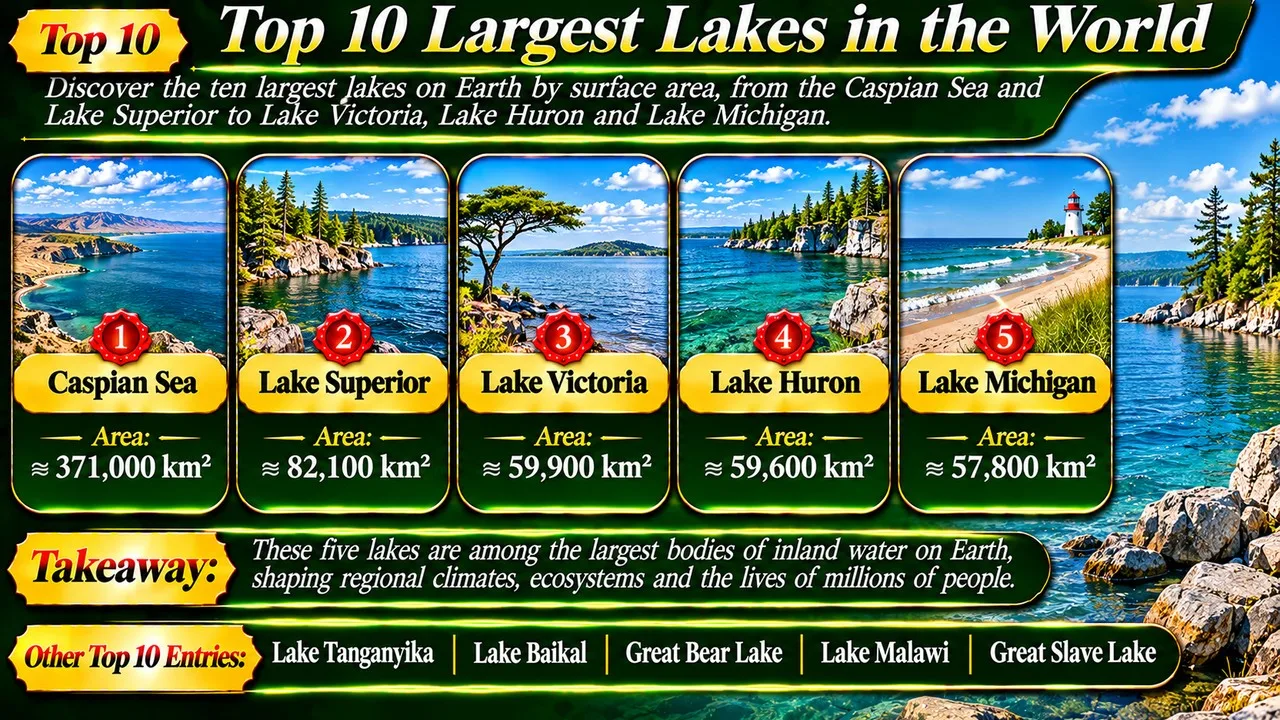
Earth's biggest lakes by surface area run from the salty Caspian Sea to the icy, deep lakes of northern Canada and hold much of the planet's fresh water. Ranking lakes sounds simple, but geographers often disagree about where a lake ends, whether a lagoon counts, and which survey year to use [1].
The list below ranks natural lakes by surface area, using the figures most widely repeated in geographic references as of November 2026. The Caspian Sea is included because it is an enclosed inland body of water with no natural outlet to the ocean, even though its water is slightly salty and it is often called a sea [2]. Lake Michigan and Lake Huron are listed separately, as they are in most atlases, although hydrologists note that they share one water level and could be treated as a single lake [3].
Lake levels and shorelines change with rainfall, irrigation and climate, so areas are rounded and should be read as approximate. The once-huge Aral Sea, which used to rank fourth in the world, is left out because irrigation projects shrank it to a fraction of its former size in the late twentieth century [1].
Key Facts
The table gives each lake's location, approximate surface area and one feature that sets it apart.
Largest Lakes at a Glance
| Rank | Name | Location/Country | Surface area (approx.) | Notable fact |
|---|---|---|---|---|
| 1 | Caspian Sea | Kazakhstan, Russia, Turkmenistan, Azerbaijan, Iran | 371,000 square km | World's largest inland body of water |
| 2 | Lake Superior | Canada and United States | 82,100 square km | Largest freshwater lake by surface area |
| 3 | Lake Victoria | Tanzania, Uganda, Kenya | About 59,900 square km | Largest lake in Africa and largest tropical lake |
| 4 | Lake Huron | Canada and United States | 59,600 square km | Contains Manitoulin Island, the largest lake island |
| 5 | Lake Michigan | United States | 57,800 square km | Largest lake lying entirely within one country |
| 6 | Lake Tanganyika | Tanzania, DR Congo, Burundi, Zambia | About 32,900 square km | Longest freshwater lake in the world |
| 7 | Lake Baikal | Russia | About 31,700 square km | Deepest and oldest lake on Earth |
| 8 | Great Bear Lake | Canada | About 31,150 square km | Largest lake entirely in Canada |
| 9 | Lake Malawi | Malawi, Mozambique, Tanzania | About 29,600 square km | Richest lake on Earth for fish species |
| 10 | Great Slave Lake | Canada | 27,200 square km | North America's deepest lake |
1. Caspian Sea
The Caspian Sea sits between Europe and Asia, bordered by Kazakhstan, Russia, Azerbaijan, Iran and Turkmenistan. Its main body covers about 371,000 square kilometres, an area roughly the size of Japan, which makes it by far the largest inland body of water on the planet [2]. It is endorheic, meaning that water flows in but never drains out to the ocean, so evaporation is the only way water leaves.
Its water is about 1.2 percent salt, roughly a third of the saltiness of ordinary seawater. The Volga, the longest river in Europe, supplies most of its fresh water and enters through a shallow delta in the north, while the southern basin plunges to more than 1,000 metres deep [2]. The surface of the lake lies about 27 metres below global sea level.
The Caspian is famous for sturgeon and caviar and for the oil and gas fields beneath its bed, which have made cities such as Baku important energy centres. Scientists warn that warming and reduced river inflow could lower its level significantly this century, exposing shallow northern waters and threatening wildlife such as the endemic Caspian seal [2].
2. Lake Superior
Lake Superior is the northernmost, westernmost and highest of North America's Great Lakes, shared by the Canadian province of Ontario and the US states of Minnesota, Wisconsin and Michigan. With a surface area of about 82,100 square kilometres it is the largest freshwater lake in the world by area [3][4].
It is also enormous in volume. Superior holds roughly 12,100 cubic kilometres of water, more than the other four Great Lakes combined, and its maximum depth is about 406 metres [3]. Water flows out through the St Marys River into Lake Huron and eventually reaches the Atlantic via the St Lawrence River.
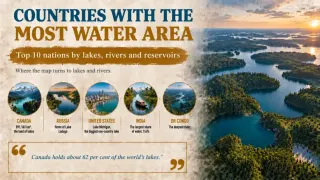
Related: Top 10 Countries with the Most Water Area
The lake is known for cold, clear water, rugged shores and violent autumn storms. Hundreds of ships have been lost on it, the best known being the freighter Edmund Fitzgerald, which sank in a November gale in 1975. Today its shoreline includes protected areas such as Pictured Rocks National Lakeshore in Michigan and Pukaskwa National Park in Ontario, which draw hikers and kayakers in summer.
3. Lake Victoria
Lake Victoria is the largest lake in Africa and the largest tropical lake in the world. Most modern references give its area as about 59,900 square kilometres, divided between Tanzania (around 49 percent), Uganda (45 percent) and Kenya (6 percent) [5]. Older sources sometimes quote a larger figure of about 68,800 square kilometres, which is why it occasionally appears ahead of Lake Superior in older lists.
Despite its size, Victoria is shallow, with an average depth of about 40 metres and a maximum of roughly 80 metres [5]. Its catchment covers nearly 170,000 square kilometres, and the White Nile leaves the lake near Jinja in Uganda, making it a key source of the world's longest river.
Tens of millions of people live around its shores and depend on it for fishing, water and transport. The introduction of the Nile perch in the twentieth century boosted commercial fishing but contributed to the loss of many native cichlid fish species, and pollution and invasive water hyacinth remain long-term concerns [5].
4. Lake Huron
Lake Huron is shared between Ontario in Canada and the US state of Michigan. Its surface area of about 59,600 square kilometres places it fourth worldwide and second among the Great Lakes [3][6]. The name comes from early French explorers, who named it after the Huron, or Wyandot, people living in the region.
Huron is linked to Lake Michigan by the wide and deep Straits of Mackinac, so the two lakes share the same surface level. Hydrologically they behave like one lake, and if combined they would form the largest freshwater lake in the world by area [6]. Water passes through Huron relatively quickly for a Great Lake, with a retention time of roughly 22 years.
The lake holds Manitoulin Island, the largest island in any freshwater lake, and the scenic Georgian Bay, whose granite shores and tens of thousands of islands inspired Canadian landscape painters. Huron's shores also preserve many historic lighthouses and shipwrecks, several of them protected in the Thunder Bay National Marine Sanctuary off Alpena, Michigan.
5. Lake Michigan
Lake Michigan is the only one of the Great Lakes that lies entirely within the United States, bordered by Wisconsin, Illinois, Indiana and Michigan. With an area of about 57,800 square kilometres no lake on Earth that sits wholly inside one country is bigger [3][7].
Related: Lake Vostok: The Largest Subglacial Lake Beneath Antarctica
It is also deep and voluminous, reaching about 281 metres at its deepest point and holding close to 4,900 cubic kilometres of water [7]. The name is believed to come from an Ojibwe word meaning "great water." Long bays such as Green Bay and Grand Traverse Bay indent its northern shores.
Major cities line its coast, including Chicago, Milwaukee and Gary, and the lake supplies drinking water to millions of people. Its eastern shore is famous for huge freshwater sand dunes, protected in places such as Sleeping Bear Dunes National Lakeshore and Indiana Dunes National Park, which make the lake as popular for beach holidays as for shipping.
6. Lake Tanganyika
Lake Tanganyika stretches along the floor of the East African Rift, shared by four nations: Tanzania, Burundi, Zambia and the DR Congo. It covers about 32,900 square kilometres and is roughly 670 kilometres long, making it the longest freshwater lake in the world [1][8].
Its depth is extraordinary. Tanganyika reaches about 1,470 metres at its deepest point, second only to Lake Baikal, and it is also the second-largest freshwater lake by volume [8]. Its basins began forming millions of years ago, which puts it among the oldest lakes on Earth. Water drains west through the Lukuga River into the Congo River system.
The lake supports hundreds of fish species found nowhere else, especially colourful cichlids prized by aquarium keepers. Fishing for small sardine-like species feeds millions of people in the surrounding countries. Because the deep water never mixes with the surface, the lake has no oxygen below about 100 metres in the north and about 250 metres in the south, so fish and other animals live only in its upper layers [8].
7. Lake Baikal
Lake Baikal in southern Siberia, Russia, covers about 31,700 square kilometres, slightly larger than Belgium. That ranks it seventh by area, but no lake on Earth is deeper, with a maximum depth of about 1,642 metres, and the largest freshwater lake by volume [9].
Related: Top 10 Most Beautiful Crater Lakes in the World
Baikal holds roughly 23,600 cubic kilometres of water, around a fifth of all the fresh water held in the world's surface lakes and rivers, and more than all five North American Great Lakes combined. Estimated at 25 to 30 million years old, it is considered the oldest lake on Earth, and its water is famously clear [9].
UNESCO listed Lake Baikal as a World Heritage Site in 1996 for its unique ecosystem. It is home to thousands of plant and animal species, many of them endemic, including the Baikal seal, or nerpa, one of the few seals that lives only in fresh water [9]. In winter its surface freezes into thick, transparent ice that attracts photographers and skaters.
8. Great Bear Lake
Great Bear Lake lies on the Arctic Circle in Canada's Northwest Territories. Its surface area of about 31,150 square kilometres makes it Canada's biggest lake that lies wholly inside the country and eighth in the global ranking [1][10]. Its name comes from Dene words linked to grizzly bears.
The lake is remote and cold, frozen for much of the year, and drains via the Great Bear River into the Mackenzie River. Its maximum depth is around 446 metres, and its clean, nutrient-poor waters support large lake trout [10]. Only one permanent community, Délı̨nę, stands on its shores.
The Sahtu Dene people have lived around the lake for generations, and two peninsulas on its shores form the Saoyú-ʔehdacho National Historic Site of Canada [10]. The lake is also a legend among anglers: a lake trout weighing about 32.65 kilograms, caught here in 1995, is recorded as the largest ever landed with a rod and line.
9. Lake Malawi
Lake Malawi, known as Lake Nyasa in Tanzania and Lago Niassa in Mozambique, is the southernmost of the great Rift Valley lakes. It covers about 29,600 square kilometres and reaches about 706 metres deep, making it the fourth-largest freshwater lake by volume and the ninth largest by area [1][11].
The lake is renowned for biodiversity. No other lake is home to so many kinds of fish, including at least 700 kinds of cichlid, most of which live nowhere else [11]. Because its water layers do not mix, deep water is low in oxygen and most fish live near the shore and the surface.
Related: Top 10 Most Bizarre Phobias: Strange Fears That Exist
Part of the southern lake is protected as Lake Malawi National Park, listed by UNESCO in 1984, and Mozambique declared its own reserve on its section in 2011 [11]. Snorkellers at Cape Maclear can see dozens of brightly coloured mbuna cichlids in clear water, while fishing communities depend on the lake for food and income.
10. Great Slave Lake
Great Slave Lake in Canada's Northwest Territories covers about 27,200 square kilometres, enough to place it tenth worldwide [12]. It is around 470 kilometres long and, at about 614 metres, no lake on the continent is deeper.
The lake takes its name from the Slavey, a Dene people. Communities on its shores include Yellowknife, the territorial capital, as well as Hay River, Fort Resolution and Łutselk'e, a small Dene hamlet on the remote East Arm [12]. The Mackenzie River, one of the longest rivers in North America, begins at its western end.
In winter the lake freezes thick enough to carry ice roads, and its northern skies are among the best places to watch the aurora. The wild East Arm, with cliffs, islands and very deep water, is now protected as Thaidene Nëné, a national park reserve of about 14,000 square kilometres established in August 2019 in partnership with the Łutsël K'e Dene First Nation and other Indigenous groups [13].
Conclusion
From the salty Caspian to Great Slave Lake, these giant lakes show how varied inland waters can be. Some are shallow and warm, like Lake Victoria; others are deep, cold and ancient, like Baikal and Tanganyika.
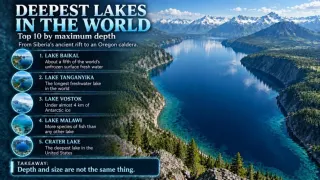
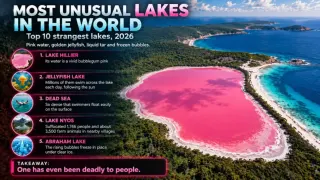
Together they supply drinking water, food and transport to hundreds of millions of people and shelter wildlife found nowhere else. Many also face pressure from pollution, invasive species and climate change, which is why their size and health are watched closely by scientists. For more record-breaking waters, see the deepest lakes in the world, the most unusual lakes and the longest rivers in the world.
- ^ [1] "List of lakes by area". Wikipedia. Wikipedia: List of lakes by area
- ^ [2] "Caspian Sea". Wikipedia. Wikipedia: Caspian Sea
- ^ [3] "Physical Features of the Great Lakes". US Environmental Protection Agency. EPA: Great Lakes facts
- ^ [4] "Lake Superior". Wikipedia. Wikipedia: Lake Superior
- ^ [5] "Lake Victoria". Wikipedia. Wikipedia: Lake Victoria
- ^ [6] "Lake Huron". Wikipedia. Wikipedia: Lake Huron
- ^ [7] "Lake Michigan". Wikipedia. Wikipedia: Lake Michigan
- ^ [8] "Lake Tanganyika". Wikipedia. Wikipedia: Lake Tanganyika
- ^ [9] "Lake Baikal". UNESCO World Heritage Centre. UNESCO: Lake Baikal
- ^ [10] "Great Bear Lake". Wikipedia. Wikipedia: Great Bear Lake
- ^ [11] "Lake Malawi National Park". UNESCO World Heritage Centre. UNESCO: Lake Malawi National Park
- ^ [12] "Great Slave Lake". Wikipedia. Wikipedia: Great Slave Lake
- ^ [13] "Thaidene Nene established as Canada's newest national park reserve". Parks Canada. Parks Canada: Thaidene Nene



















Discussion
Log in with