



Top 10 Everyday English Words With Surprising Histories
 By Dhiraj Sharma · Published
Share Post
Loading…
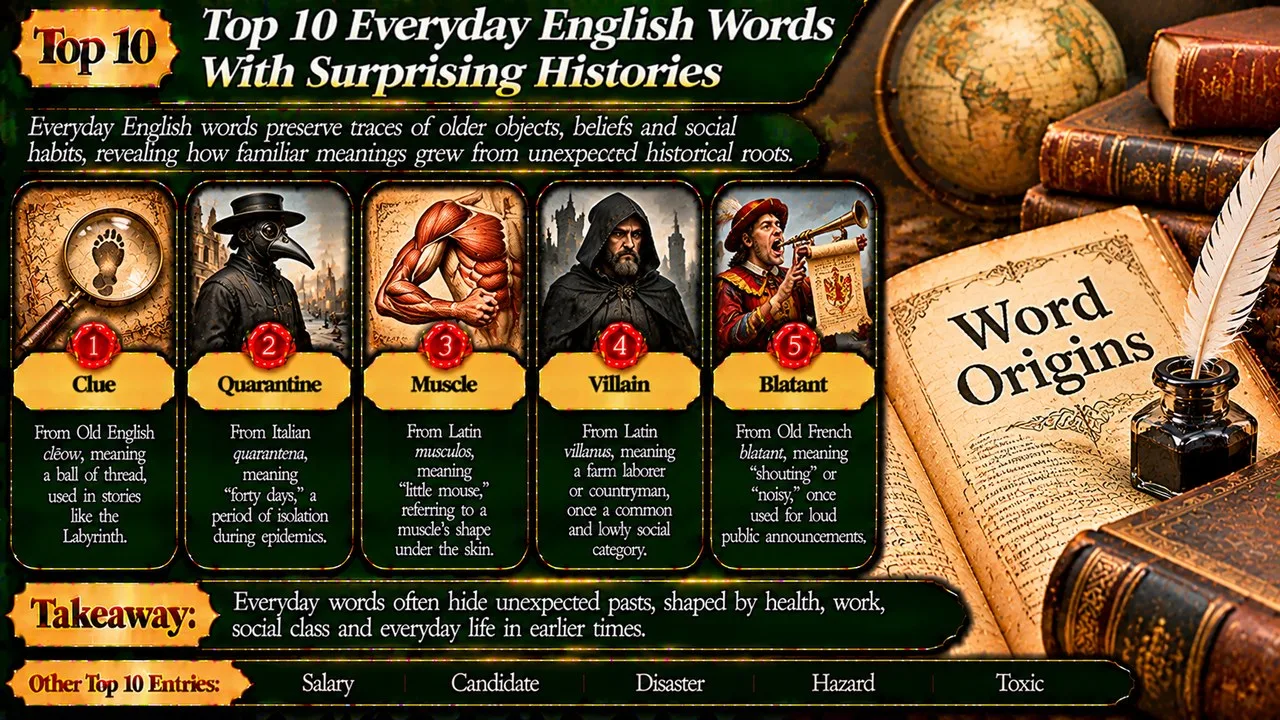
Everyday English words preserve traces of older objects, beliefs and social habits, revealing how familiar meanings grew from unexpected historical roots.
A word's origin is not a rule for how it must be used now. Meanings move as speakers borrow, compare and reinterpret. A concrete object can become an abstract idea, while a neutral social label can acquire an insult. Good etymology follows attested forms and plausible transitions rather than accepting the most entertaining story attached to a word.
This order values clarity of evidence, the scale of the meaning change and the usefulness of the lesson. The Listverse topic provides the starting point [21]; dictionary evidence determines the account. Where an origin is disputed, the uncertainty stays visible. None of these histories implies that a modern speaker secretly endorses the beliefs or social attitudes preserved in an older form.
Key Facts
These ten entries highlight contrasting features and contexts.
Everyday English Words With Surprising Histories at a Glance
| Rank | Name | Context | Main feature | Notable point |
|---|---|---|---|---|
| 1 | Clue | Guidance | Ball of thread | Metaphor |
| 2 | Salary | Work | Latin salt root | Story uncertain |
| 3 | Quarantine | Health | Forty days | Meaning widened |
| 4 | Candidate | Selection | White toga | Custom to role |
| 5 | Muscle | Body | Little mouse | Visual comparison |
| 6 | Disaster | Misfortune | Unfavourable star | Older belief |
| 7 | Villain | Character | Rural status | Social judgement |
| 8 | Hazard | Risk | Dice game | Earlier root debated |
| 9 | Toxic | Harm | Arrow poison | Broader meaning |
| 10 | Blatant | Obviousness | Literary creature | Clamour to prominence |
1. Clue
Clue developed from clew, a word for a ball of thread or yarn. The connection with finding an answer becomes clearer through the familiar story of Theseus and the labyrinth. A thread guides the traveller through a confusing place, providing a model for information that guides a person through a difficult question. The modern spelling and meaning preserve that figurative movement even when no physical thread is involved. [1] [2]
The myth is useful for explaining the comparison, but it is not a dated record of one person inventing the modern word. Etymology follows the history of usage, including the gradual extension of a concrete sense. Clew also survives in other contexts, so the later clue did not simply erase every older form. [1] [2]
It leads the list because the change is both surprising and easy to understand once the intermediate image is restored. A detective's clue is metaphorical guidance, not merely a synonym chosen at random. The history shows how an ordinary material object can supply a durable way to think about reasoning.
2. Salary
Salary ultimately connects with Latin salarium and the Latin word for salt, sal. That connection has encouraged a popular story that Roman soldiers were paid in salt. The linguistic relationship does not establish that story. Dictionaries distinguish the attested word history from uncertainty about the original arrangement behind it. [3] [4]
The modern English word refers to payment for work, usually in a regular form. Its path through French and Latin is more securely documented than a single account of how every Roman payment operated. Historical institutions and word origins are different subjects that can overlap without proving one another. Knowing the root associated with salt does not settle whether a particular allowance bought salt or took another form. [3] [4]
Salary ranks highly because it teaches a useful caution. A true root can be attached to an unsupported anecdote, giving the whole story an undeserved air of certainty. The responsible version is not less interesting: it preserves the connection while admitting where the surviving evidence stops, rather than turning a possibility into a universal practice.
Related: Top 10 Most Bizarre Phobias: Strange Fears That Exist
3. Quarantine
Quarantine comes through Italian and refers historically to a period of forty days. The term became associated with restrictions intended to limit the spread of disease, especially in maritime settings. The number belongs to the history of the word; it is not a medical instruction that every modern precaution must last exactly that long. A borrowed name can survive after the practical rules around it have changed. [5] [6]
Ports faced the challenge of receiving people and goods while trying to prevent illness from arriving with them. Restrictions developed in different places and did not all begin with an identical waiting period. That is why a concise word history should not be expanded into a claim that every early measure used forty days from its first appearance. Institutional practices can precede, vary alongside and outlast a particular label. [5] [6]
Its place reflects the connection between public measures and ordinary vocabulary. The modern word carries a numerical past without functioning as a fixed number in every present use. Understanding that distinction helps separate etymology from health advice: historical naming explains where a term came from, not what duration is appropriate for a particular illness or exposure.
4. Candidate
Candidate comes from Latin candidatus, linked with candidus, meaning bright or shining white. In ancient Rome, men seeking public office were associated with a specially whitened toga. The clothing supplied a visible connection between a person seeking a position and a word that later travelled into other languages. [7] [8]
The root should not be turned into a claim that Roman candidates were judged morally pure or that every modern candidate has such a quality. Clothing, public presentation and word formation are enough to explain the historical connection. English widened the term beyond electoral contests: a person can be considered for a job, an award or another role. The shared idea is being put forward or considered, not wearing white. [7] [8]
It ranks for showing how a public custom can become abstract vocabulary. The physical marker disappears while the social role remains. That change also warns against overinterpreting a root: the historical colour helps explain the word's formation, but it does not define the character or intentions of the people to whom the word is applied today.
5. Muscle
Muscle reaches English through a Latin form, musculus, that also means little mouse. The comparison is usually explained by the appearance of a moving muscle beneath the skin. A familiar animal supplied an image for part of the body. This is a linguistic metaphor, not a claim that a muscle and a mouse share the same structure or that the old comparison provides an anatomical explanation. [9] [10]
Related: The Evolution of Stranger Things: Seasons, Themes, and Characters
The word's path involved other languages and changes in spelling before its modern English form settled. Such journeys are common in the vocabulary of medicine and anatomy. Borrowing can preserve a vivid everyday image inside a term that later feels technical and neutral. Scientific usefulness does not depend on remembering the original metaphor. [9] [10]
Its position reflects the unexpected survival of a concrete comparison. People name unfamiliar or difficult-to-see things through resemblance to what they already know. The result can become so ordinary that the comparison vanishes from awareness. Restoring it adds historical interest without asking modern anatomy to accept the assumptions or imagery of an earlier period.
6. Disaster
Disaster reaches English through forms associated with Italian disastro, combining a negative element with a word connected to a star. The older sense reflects the idea of an unfavourable stellar influence. What now commonly names a catastrophic event once carried a more explicit connection with beliefs about the heavens. The word preserves that cultural history without providing evidence that stars cause a particular accident or calamity. [11] [12]
Borrowing through French helped bring the term into English. Its meaning broadened beyond a literal appeal to celestial influence, allowing speakers to describe ruinous outcomes without making an astrological claim. That transition matters. A word can lose the explanatory belief embedded in its origin while remaining useful as a label for an event. Modern speakers do not have to reconstruct or accept every stage of its development to use it clearly. [11] [12]
Disaster ranks for showing the distance between inherited vocabulary and present belief. The same language can retain traces of older explanations while its speakers adopt different accounts of cause and responsibility. Etymology reveals the historical framework behind the label, but it should not be confused with an explanation of earthquakes, floods or human-made failures.
7. Villain
Villain began with a connection to rural labour and estate life, through French forms ultimately related to Latin villa. Its earlier social sense referred to a person of low rural status rather than automatically to an evil character. Over time, contempt attached to that status helped the word acquire meanings associated with bad conduct. The modern dramatic enemy is the endpoint of a social and semantic change, not the original meaning. [13] [14]
Related: Chernobyl Miniseries: Stories of Tragedy of a Nuclear Catastrophe, Heroism and Sacrifice
This history makes class prejudice visible in vocabulary. An insult can develop when a powerful group treats another group's way of life as evidence of inferior character. That does not mean rural workers actually possessed the faults later attached to the word. Nor does it establish that every speaker using villain consciously repeats the older judgement. The important point is how a label for social position could become a moral accusation. [13] [14]
It earns a place because a familiar entertainment word preserves a less comfortable history than its current use suggests. Tracing that shift encourages careful reading of older texts, where the intended meaning may differ. It also shows why defining an old word solely through its modern sense can distort the society being studied.
8. Hazard
Hazard came through French, where the related word referred to a game of dice. Chance in a game supplied a route towards ideas of risk and danger. The connection remains understandable even after the gaming sense becomes unfamiliar: an uncertain outcome can carry the possibility of loss. The modern word need not refer to gambling, but its history helps explain how uncertainty became part of its meaning. [15] [16]
The earlier ancestry beyond French is less secure. Accounts proposing an Arabic origin differ in detail, and an attractive explanation involving a specific word or place should not be presented as settled without adequate evidence. Dictionary histories often contain precisely these boundaries between a well-attested borrowing and a more tentative reconstruction. Leaving that boundary visible is more informative than forcing every term into a complete story stretching back to one certain beginning. [15] [16]
Its ranking reflects the value of uncertainty honestly stated. The French gaming connection is enough to explain a significant change in English usage. Etymology is not weakened by admitting that an earlier step remains debated; it becomes more trustworthy by distinguishing the surviving evidence from a proposal that still needs support.
9. Toxic
Toxic is linked through Latin and French forms to Greek terminology for poison associated with arrows. The Greek root relates to a bow, connecting the later adjective with a particular use of harmful substances. The modern word is much broader. It can describe poisonous effects without involving a weapon, and it has also developed figurative uses for damaging behaviour or relationships. [17] [18]
Related: The Family Man: A Spy Thriller of Modern India Balancing Family Life and National Security
The origin does not make every toxic substance a deliberately prepared poison. Modern scientific questions involve the substance, amount, route of exposure and affected organism, rather than the historical image behind the adjective. Nor is a mythological tale about poisoned arrows needed to establish the linguistic connection. A documented chain of related forms provides a firmer account than assigning the word to one legendary archer or one supposed moment of discovery. [17] [18]
It ranks for the sharp contrast between a specialised older setting and a wide modern range. The metaphorical uses extend the journey further, applying the idea of harm outside chemistry. Understanding that history can make the word more precise in context, while preventing its ancient root from being mistaken for a complete scientific definition.
10. Blatant
Blatant is associated with Edmund Spenser's The Faerie Queene, where the Blatant Beast is a noisy, slanderous creature. The word appears in that literary setting in 1596. Its early associations concern clamour and offensiveness, not only the modern sense of something conspicuously obvious. A literary creation supplied an expression that later escaped into ordinary language, even among people who have never read the poem. [19] [20]
The deeper formation of the word is less certain than the documented Spenser connection. It is therefore safer to distinguish an early attested use from a confident claim about every sound or root behind it. Later speakers extended the meaning so that a blatant lie or mistake could be obvious and shameless without making any noise. The transfer works through prominence and offensiveness rather than through a literal audible quality. [19] [20]
It closes the list by showing literature feeding everyday vocabulary. Not every old word began as an anonymous label for an object or practice. A memorable written creature could provide a name that readers reused, altered and eventually detached from its first setting, leaving a familiar adjective where an elaborate poetic story once stood.
Conclusion
These word histories reveal borrowing, metaphor and social judgement at work. Their surprises are strongest when the evidence is allowed to remain more complicated than a popular anecdote. They complement languages around the world and influential books, while reminding readers that origins do not dictate modern meaning. A reliable etymology explains a journey through usage; it does not turn the earliest known sense into the only correct one.
- ^ [1] "Clue". Etymonline. Read
- ^ [2] "Clue". Merriam-Webster. Read
- ^ [3] "Salary". Etymonline. Read
- ^ [4] "Salary". Merriam-Webster. Read
- ^ [5] "Quarantine". Etymonline. Read
- ^ [6] "Quarantine". Merriam-Webster. Read
- ^ [7] "Candidate". Etymonline. Read
- ^ [8] "Candidate". Merriam-Webster. Read
- ^ [9] "Muscle". Etymonline. Read
- ^ [10] "Muscle". Merriam-Webster. Read
- ^ [11] "Disaster". Etymonline. Read
- ^ [12] "Disaster". Merriam-Webster. Read
- ^ [13] "Villain". Etymonline. Read
- ^ [14] "Villain". Merriam-Webster. Read
- ^ [15] "Hazard". Etymonline. Read
- ^ [16] "Hazard". Merriam-Webster. Read
- ^ [17] "Toxic". Etymonline. Read
- ^ [18] "Toxic". Merriam-Webster. Read
- ^ [19] "Blatant". Etymonline. Read
- ^ [20] "Blatant". Merriam-Webster. Read
- ^ [21] "Topic inspiration: Everyday English Words With Surprising Histories". Listverse. Read





















Discussion
Log in with