




 By
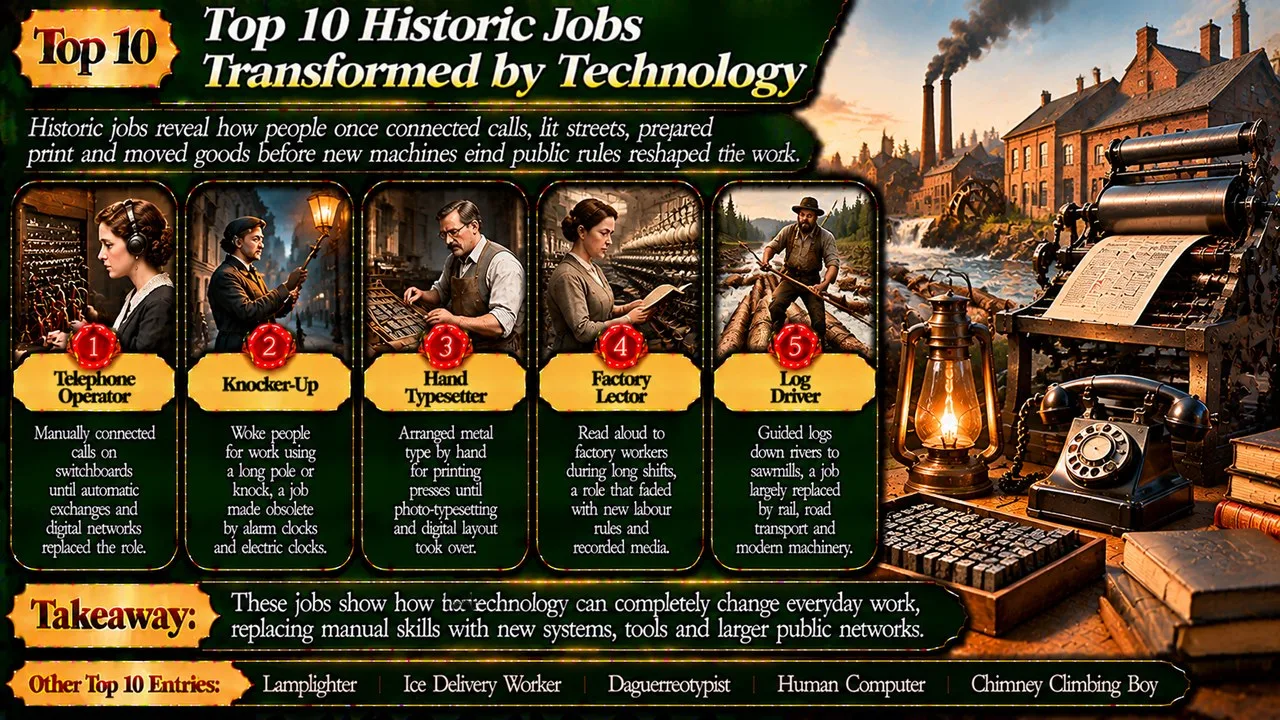
Historic jobs reveal how people once connected calls, lit streets, prepared print and moved goods before new machines and public rules reshaped the work.
A vanished task does not always mean a vanished skill. Some occupations became smaller, some moved into heritage settings, and others developed into new forms. The change was rarely caused by one invention alone. Cost, law, working conditions and public expectations helped determine whether a new technique replaced an older one or operated beside it.
This order weighs the scale of the task's former importance, the clarity of the technological change and the quality of the historical evidence. The Listverse jobs topic is the starting point [18], not a claim that every entry is extinct. The selection also distinguishes improved tools from reforms against exploitation: dangerous child labour did not become unacceptable only when a machine could replace it.
Key Facts
These ten entries highlight contrasting features and contexts.
Historic Jobs Transformed by Technology at a Glance
| Rank | Name | Context | Main feature | Notable point |
|---|---|---|---|---|
| 1 | Telephone Operator | Communications | Connected calls | Automatic switching |
| 2 | Lamplighter | Streets | Tended lamps | New lighting |
| 3 | Knocker-Up | Industry | Woke workers | Personal alarms |
| 4 | Ice Delivery Worker | Households | Delivered ice | Powered cooling |
| 5 | Hand Typesetter | Printing | Arranged type | Digital layout |
| 6 | Daguerreotypist | Photography | Made plate images | New processes |
| 7 | Factory Lector | Factories | Read aloud | Shared attention |
| 8 | Human Computer | Research | Calculated results | Electronic computing |
| 9 | Chimney Climbing Boy | Chimneys | Child cleaning | Law and equipment |
| 10 | Log Driver | Forestry | Guided timber | New haulage |
1. Telephone Operator
Telephone operators manually connected callers through exchange equipment. At a cord switchboard, an operator could respond to a signal, ask for the desired connection and place plugs to complete the call. Early networks relied on this human mediation to make a connection that later users would expect to obtain simply by dialling or selecting a contact. [1] [11]
Automatic switching changed the routine, but the transition was gradual. Different places adopted new equipment at different times, and some calls continued to need assistance after ordinary local connections became automatic. Operators also handled enquiries and special services. The history is therefore not one clean moment in which a machine appeared and every worker disappeared. New equipment changed the mix of tasks, the number of staff required and the skills employers valued. [1] [11]
It leads the list because the former human step has become almost invisible in ordinary experience. A successful connection now feels like a simple action by the caller. Remembering the operator restores the labour behind an earlier network and shows how automation can change expectations about what a service should do without personal assistance.
2. Lamplighter
Lamplighters tended street lamps that needed direct attention. Their duties could involve lighting and extinguishing flames, cleaning fittings and checking equipment. Oil and gas lamps created different practical demands, but both made public lighting a form of regular work rather than a service that could be assumed to operate unattended. [2]
Electric lighting and automatic controls reduced the need for repeated manual visits. The change also depended on investment and on the condition of existing lamps. Not every street or city adopted the same technology at once. Heritage services have preserved or revived manual lighting in some settings, where the older method contributes to the character of a place rather than providing the main model for urban illumination. [2]
The job ranks for turning a basic public amenity into a visible daily routine. It also cautions against romanticising an occupation through one picturesque image. Keeping lights reliable required maintenance, punctuality and work in poor weather. The modern convenience lies not only in a brighter lamp, but in reducing how much repeated human effort each light needs.
Related: Top 10 Most Bizarre Phobias: Strange Fears That Exist
3. Knocker-Up
A knocker-up was paid to wake clients at an agreed time, often before an early shift. The worker might tap a window with a long pole or use another method suited to the building. In industrial communities, being awake at the right moment could determine whether a person reached work on time. A reliable human alarm therefore had practical value before cheap alarm clocks became readily available. [3]
The occupation depended on an arrangement between the waker and the client, not on everyone in a street keeping identical hours. Surviving photographs and accounts show how the job fitted around factory schedules and dense housing. Clocks gradually made the service less necessary, while later electrical and electronic alarms further changed the task. [3]
Its place reflects a small but revealing part of industrial life. A factory's timetable reached into the household long before a shift began. The job also demonstrates that an invention becomes transformative when it is affordable and trusted. The mere existence of an alarm clock did not immediately remove the demand for a person who would make sure a client woke.
4. Ice Delivery Worker
Ice delivery workers supplied blocks of ice for cooling food and other goods before household mechanical refrigeration became widespread. The ice might come from seasonal harvesting or from an ice-making plant. Delivering it involved storage, transport and frequent handling, with losses as the cargo melted. [4] [12]
A household icebox did not create cold in the manner of a powered refrigerator. It used the melting ice as a cooling resource that had to be replaced. Mechanical refrigeration moved more of that task into the appliance, reducing the need for routine domestic deliveries. Ice continued to have commercial and recreational uses, so the change should not be mistaken for the disappearance of every business that produced or delivered it. [4] [12]
The entry ranks for showing how a machine can replace a recurring service with a different kind of infrastructure. Reliable electricity, manufacture and repair became more important to domestic cooling. Convenience did not eliminate all work; it moved much of the work away from the doorstep and into other occupations and supply arrangements.
5. Hand Typesetter
Hand typesetters arranged individual pieces of type to form words and pages. The pieces had to be selected, aligned and spaced before printing could begin. After use, type could be distributed back for another job, creating further skilled work that an ordinary reader would never see on the finished sheet. [5] [13] [17]
Related: Top 10 Facts About Dogs
Mechanical composition, phototypesetting and digital layout changed that process in stages. New techniques could speed production or remove the need to handle separate metal letters. They also created different problems involving equipment, spacing, correction and page design. Printing and typesetting are related but distinct tasks: a press transfers the image, while composition determines what will be printed and how it is arranged. Confusing the two hides the specific change in the typesetter's work. [5] [13] [17]
It ranks for the contrast between an apparently weightless digital page and its older material counterpart. Skills in typography did not vanish with metal type. Judging line length, readability and visual balance remained valuable, but the tools and division of labour changed. The job illustrates transformation more accurately than a simple story of craft being erased.
6. Daguerreotypist
A daguerreotypist made photographs through the process associated with Louis Daguerre. The image formed on a prepared, silver-coated metal plate rather than on a paper print produced from a separate negative. Each plate was an individual object, usually protected in a case. [6] [14]
The work required specialised equipment, chemical knowledge and careful handling. It also involved potentially hazardous materials, so a historical account should not be treated as a practical recipe. Later photographic methods offered different advantages, including easier reproduction and new forms of support. As those approaches spread, the daguerreotype lost its leading commercial role, though the plates remained important records and examples of photographic craft. [6] [14]
Its position reflects a profession tied closely to one technical method. Photography survived and expanded while the dominant process changed. That distinction makes the daguerreotypist a useful case: a broad occupation can flourish even as a particular tool or technique becomes specialised, and the oldest surviving image should not be judged only by the convenience of its successor.
7. Factory Lector
Factory lectors read aloud to workers, especially in cigar-making settings associated with Cuba and Cuban communities abroad. Newspapers, novels and other texts could accompany repetitive manual work. The reader supplied information and entertainment to an audience whose hands were occupied. It was a collective service shaped by the interests of the listeners, rather than simply a foreman giving orders or a worker reading privately during a break. [7]
Related: Top 10 Tallest Buildings in the World
Accounts from Cuba show a tradition that continued after it had faded in American factories. That survival complicates an easy label such as obsolete job. Recorded sound and broadcasting offered alternatives, but a live reader could select material, respond to an audience and bring a shared event into the workplace. The job's fate also depended on politics, labour relations and the organisation of the factory, not merely on the invention of a loudspeaker. [7]
It earns a place because it resists a purely mechanical story of replacement. A technology may reproduce a voice without reproducing the relationship between speaker and listeners. The lector's history reveals work as a social environment, where attention, shared knowledge and public discussion could matter alongside the immediate task of making a product.
8. Human Computer
Human computers performed calculations as paid work before electronic machines took over many routine numerical tasks. They might use tables, calculators and carefully defined procedures to produce results for astronomy, engineering or other technical projects. The title referred to a person doing computation. It did not mean that the worker was necessarily unskilled or simply repeating a process without understanding the problem being studied. [8] [15]
Women made important contributions in several computing workplaces, though the occupation was not exclusively female. At NASA's predecessor and at NASA, Katherine Johnson's work illustrates the mathematical expertise involved in flight research. Electronic computation changed the speed and scale of calculations, while people still had to formulate problems, check results and judge whether an answer made sense. Some workers moved into programming or other technical roles as the tools changed. [8] [15]
The job ranks for restoring people to a word now usually associated with a device. It also challenges the idea that a faster calculation makes expertise unnecessary. The machine can alter who performs an operation, but choosing the operation and checking its meaning remain separate responsibilities. That distinction is central to understanding the transition rather than celebrating speed alone.
9. Chimney Climbing Boy
Chimney climbing boys were children made to enter narrow flues to remove soot. The work exposed them to severe danger and exploitation. It belongs in a history of changing occupations, but not as a charming lost craft. The use of children depended on commercial practices and failures of protection, and the harms were not made acceptable by a demand for clean chimneys or by the absence of a particular modern tool. [9] [16]
Related: 10 Sikh Gurus: The Pillars of Sikhism Who Shaped Faith, Equality, Courage, and Humanity
Brushes and other equipment allowed cleaning without sending a child through the flue. In Britain, nineteenth-century legislation and stronger enforcement were also essential to ending the practice. Technology alone did not guarantee reform: an available alternative could be ignored while employers still benefited from abusive labour. The development of cleaning equipment and the public effort to protect children therefore belong in the same account, without being treated as interchangeable causes. [9] [16]
Some changes require rules, accountability and a different judgement about whose welfare matters. Modern chimney work remained necessary, but the dangerous use of children did not. Distinguishing the service from an exploitative method prevents nostalgia from erasing the people who bore its costs.
10. Log Driver
Log drivers guided floating timber along rivers towards mills and collection points. Water offered a way to move heavy wood through regions where suitable roads were limited. Workers managed the flow and helped free obstructions, often in dangerous conditions. The familiar image of balancing on moving logs reflects a real working environment, but the commercial purpose was to keep a large quantity of timber travelling towards its destination. [10]
Road haulage, rail transport and changes in forestry practice reduced river driving in many places. Environmental concerns also altered attitudes towards using waterways in this way. The transition was uneven, since terrain, cost and access differed between regions. A road did not automatically make every river route uneconomic, and a later sport or demonstration should not be confused with the scale and purpose of the older timber industry. [10]
It closes the list because work can be transformed by changes in the whole route of a material, not just by a replacement hand tool. The driver belonged to a landscape of forests, rivers and mills. When the preferred means of moving timber changed, the need for that particular combination of balance, local knowledge and physical effort changed with it.
Conclusion
These occupations show several kinds of change: a repeated task becomes automatic, a craft gains new tools, or an abusive practice is ended through law as well as equipment. They complement major inventions and accidental inventions without reducing labour history to a parade of gadgets. Behind every convenient service is a choice about skills, costs and working conditions. Remembering the people makes the technological story more accurate, not merely more nostalgic.
- ^ [1] "Telephone Operator". Wikipedia. Read
- ^ [2] "Lamplighter". Wikipedia. Read
- ^ [3] "Knocker-Up". Wikipedia. Read
- ^ [4] "Ice Delivery Worker". Wikipedia. Read
- ^ [5] "Hand Typesetter". Wikipedia. Read
- ^ [6] "Daguerreotypist". Wikipedia. Read
- ^ [7] "Factory Lector". Wikipedia. Read
- ^ [8] "Human Computer". Wikipedia. Read
- ^ [9] "Chimney Climbing Boy". Wikipedia. Read
- ^ [10] "Log Driver". Wikipedia. Read
- ^ [11] "Telephone". Encyclopaedia Britannica. Read
- ^ [12] "Refrigeration". Encyclopaedia Britannica. Read
- ^ [13] "Typesetting". Encyclopaedia Britannica. Read
- ^ [14] "Daguerreotype". Encyclopaedia Britannica. Read
- ^ [15] "Katherine Johnson Biography". NASA. Read
- ^ [16] "Children and Chimneys". UK Parliament. Read
- ^ [17] "Printing press". Encyclopaedia Britannica. Read
- ^ [18] "Topic inspiration: Historic Jobs Transformed by Technology". Listverse. Read























Discussion
Log in with