





 By
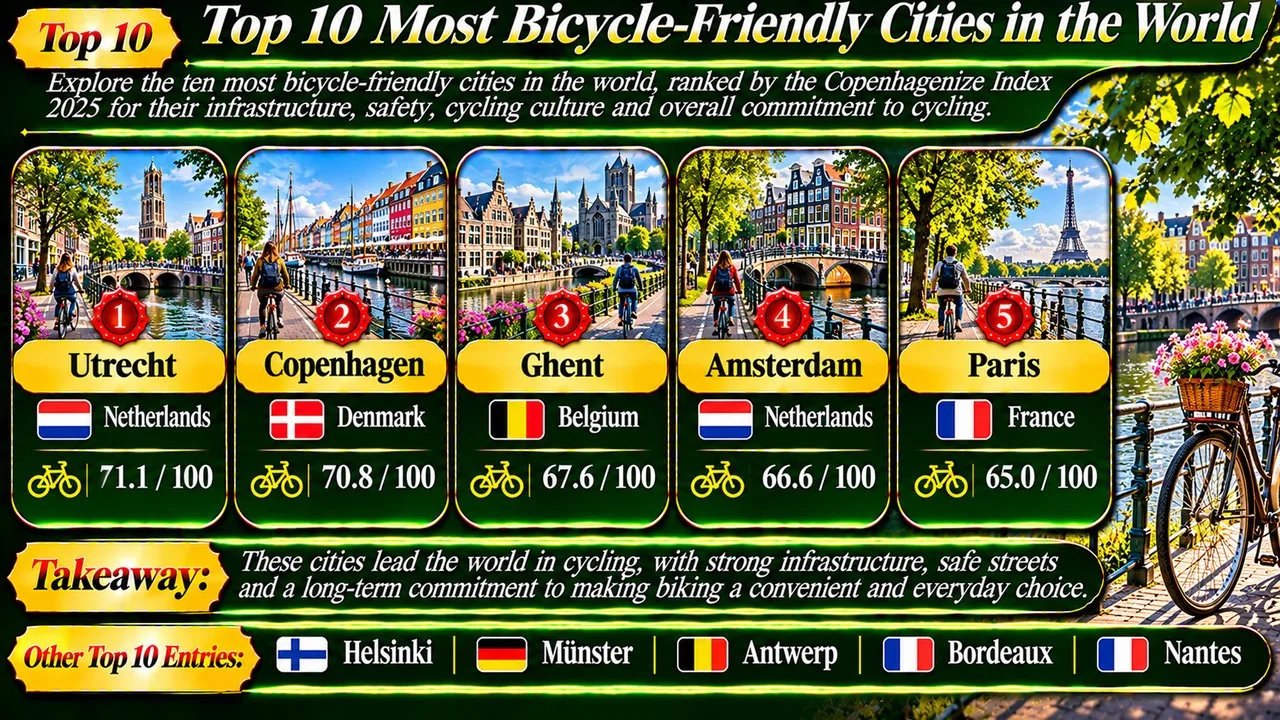
The world's most bicycle-friendly cities are led by Utrecht, Copenhagen and Ghent, where safe bike networks and calm streets make cycling the obvious choice.
Cycling is cheap, healthy, quiet and produces no exhaust, and cities around the world are investing in it to cut traffic and pollution. Yet only a handful of places have made riding a bike so safe and convenient that a large share of residents choose it for everyday trips. Their secrets include protected cycle tracks, lower speed limits for cars, plentiful parking and steady political support [1].
This Finepedia list follows the Copenhagenize Index 2025, the best-known global ranking of bicycle-friendly cities. Published in November 2025 with support from EIT Urban Mobility, this edition was the first in six years. It assessed 100 cities from 44 countries using 13 indicators grouped into three pillars: safe and connected infrastructure, usage and reach, and policy and support [1][2]. Scores are out of 100, and all figures are as of November 2026.
Key Facts
Here is a quick overview of the ten cities, with their 2025 index score and one standout fact for each.
Bicycle-Friendly Cities at a Glance
| Rank | City | Country | Index score 2025 | Standout fact |
|---|---|---|---|---|
| 1 | Utrecht | Netherlands | 71.1 | Nearly a third of all trips by bike |
| 2 | Copenhagen | Denmark | 70.8 | 52 km of protected tracks per 100 km of road |
| 3 | Ghent | Belgium | 67.6 | Cycling share rose from 22% to 34% |
| 4 | Amsterdam | Netherlands | 66.6 | 37% of trips by bike |
| 5 | Paris | France | 65.0 | Bike share of trips up from 5% to 11% in five years |
| 6 | Helsinki | Finland | 64.9 | 20 million euros a year for cycling since 2020 |
| 7 | Munster | Germany | 64.7 | Germany's self-styled bicycle capital |
| 8 | Antwerp | Belgium | 64.4 | Nearly 600 km of protected infrastructure |
| 9 | Bordeaux | France | 62.9 | About 19% of workers commute by bike |
| 10 | Nantes | France | 62.8 | Nearly 90% of roads at 30 km/h or less |
1. Utrecht
Utrecht, a compact university city in the centre of the Netherlands, took first place in the 2025 Copenhagenize Index with a score of 71.1. Nearly one third of all trips in the city are made by bicycle, and the index describes the bike as the default way of getting around [1].
The city combines a connected cycle network with calm streets and a growing number of routes where bikes have priority. It has more than 100,000 bike racks and guarded parking spaces, and invests around 64 euros per resident each year in cycling, one of the highest levels in the index [1].
Utrecht's most famous cycling landmark is the bicycle parking garage at Utrecht Centraal station, the largest in the world, with room for about 12,500 bikes [3]. Riders can cycle straight into the building, find a free space using electronic signs and walk directly to their trains.
2. Copenhagen
Copenhagen, the Danish capital, came a close second with 70.8 points. For decades it has set global standards for cycle track design, and the index credits it with the densest network in the world: 52 kilometres of protected bicycle tracks for every 100 kilometres of road [1].
Around 29 percent of all trips in the city are made by bike, and the share is much higher for journeys to work and school [1][4]. Famous projects include bridges built just for cyclists and pedestrians, as well as tracks up to nine metres wide in the busiest corridors. Over the past five years, the city has spent nearly 38 euros per resident each year on cycling [1].
Related: Top 10 Most Bizarre Phobias: Strange Fears That Exist
Copenhagen also counts and surveys its cyclists regularly, publishing reports on the network, safety and how riders feel about it [4]. The index says the city's next challenge is to calm car traffic further, expand 30 km/h zones and create car-free areas around schools [1].
3. Ghent
Ghent in Belgium rose to third place with a score of 67.6, making it the country's most bicycle-friendly city. Its cycling strategy dates back to 1992 and rests on four pillars: practical infrastructure, parking, awareness and dedicated governance [1].
The turning point came with a bold circulation plan introduced in 2017. Through traffic was moved to the ring road, the city centre was split into sections that cars cannot cross directly, and parking shifted underground. The switch happened over a single weekend, changing traffic patterns on more than 80 streets and about 2,500 road signs. The freed-up streets became squares, bicycle streets and quiet areas, and the car-free zone in the historic centre more than doubled in size [1][5].
The results were dramatic. Cycling's share of trips rose to 34 percent, up from 22 percent a decade earlier. Ghent also created Belgium's first bicycle street, where cyclists have priority over cars, in 2011 [1].
4. Amsterdam
Amsterdam is one of the most famous cycling cities in the world and ranked fourth with 66.6 points. About 37 percent of all trips are made by bike, and the city's network includes nearly 560 kilometres of protected cycle tracks [1].
After a city-wide 30 km/h speed limit was introduced in 2023, about 82 percent of the city's streets now carry slower traffic. Amsterdam has also built huge bike parking facilities, including an underwater garage near Central Station that added 11,000 spaces [1].
The city faces new challenges as a result of its success, including crowded bike paths, faster e-bikes and parking shortages. Residents own far more bicycles than there are households, and thousands of bikes are pulled out of the canals every year [6].
5. Paris
Paris has been one of the biggest cycling success stories of recent years, rising to fifth place with 65.0 points. The share of trips made by bike in the city more than doubled from 5 percent to 11 percent in five years [1].
Related: The Science Behind Auroras: How Solar Winds Create Colorful Skies
The transformation came from strong political will. Famous streets such as Rue de Rivoli and the riverside roads along the Seine have been closed to cars, and new protected bike tracks are added regularly. Speed limits have been cut to 30 km/h on 85 percent of roads, and there are more than 122,000 public bike parking spaces [1].
Paris's shared bike schemes offer more than 45,000 bicycles, which generated 56 million trips in 2024 [1]. The city launched its Velib bike hire system in 2007, and it has since become one of the largest in the world [7].
6. Helsinki
Helsinki, the Finnish capital, ranked sixth with 64.9 points, proving that a city with long, snowy winters can also be a great place to ride. Its flagship project is the Baana network, which began as a cycle route along a former railway cutting and now includes new bridges and links across the city [1].
In 2020, Helsinki reached its target of spending 20 million euros a year on cycling infrastructure for the first time [1]. The city has also expanded its network of routes that are cleared of snow as a priority in winter, from 105 to 150 kilometres in 2025 [1].
Helsinki aims to reach a 20 percent cycling share of trips by 2030. The index says that achieving this will mean improving winter access further, adding secure parking and tackling safety concerns [1].
7. Munster
Munster, a historic university city in northwest Germany, came seventh with 64.7 points. It claims to be the bicycle capital of Germany, and some estimates suggest there are more bicycles in the city than people [1][8].
Related: Top 10 Facts About Dogs
According to the index, cycling's share of trips rose from 43.5 percent in 2019 to 47 percent in 2022, and about half of residents use the bicycle as their main way of getting around. Two thirds of streets have 30 km/h limits, and the city has spent about 33 euros per resident a year on cycling over the past five years [1].
Munster's best-known route is the Promenade, a tree-lined ring for cyclists and pedestrians that follows the line of the old city walls. The city has also built a scenic 20-kilometre route along its canal, called the Kanalpromenade, and paints its bicycle streets red so drivers know cyclists have priority [1].
8. Antwerp
Antwerp, Belgium's largest municipality and home to one of Europe's biggest ports, ranked eighth with 64.4 points. The index praises it for showing that a busy port city and a cycling city can exist side by side [1].
Antwerp has nearly 600 kilometres of protected cycle infrastructure and 22 kilometres of bicycle streets. Its "100 missing links" programme is closing gaps in the network with new underpasses and bridges, so that routes are continuous across the wider metropolitan area [1].
The city has also extended 30 km/h speed limits to more than 70 percent of its streets. Antwerp scored especially well for usage and reach, reflecting how many residents already cycle in daily life [1].
9. Bordeaux
Bordeaux in southwest France ranked ninth with 62.9 points. About 19 percent of workers in the city now commute by bicycle, a sign that steady, coordinated policy is changing travel habits [1].
The city has focused on traffic calming, limiting nearly 90 percent of its streets to 30 km/h or less, so that cyclists feel safer even where there are no separate tracks. An express cycle network is closing gaps along both banks of the Garonne River [1].
Related: Top 10 Tallest Buildings in the World
Bordeaux's best-known cycling project is the Simone Veil Bridge, which carries wide two-way cycle tracks across the Garonne. In the historic centre, ground-floor rooms have been converted into secure bicycle storage for residents who lack space to park their bikes [1].
10. Nantes
Nantes in western France returned to the index after missing the previous edition and took tenth place with 62.8 points. It accelerated its cycling transformation by building a network of high-quality routes called the Grandes Voies Velo, with a strong visual identity that helps riders find their way [1].
Like Bordeaux, Nantes has limited nearly 90 percent of its roads to 30 km/h or less. Car-free zones, shared streets and low-traffic neighbourhoods are turning busy corridors into calmer spaces [1].
The city's main railway station now offers one of the most attractive bike parking facilities in France, with 1,200 secure spaces and services for commuters. Awareness campaigns and community events promote cycling as both transport and a way of life [1].
Conclusion
The world's most bicycle-friendly cities share a few common ingredients: protected and connected cycle networks, lower speed limits for cars, secure parking and long-term political support. Dutch, Danish and Belgian cities still lead, but Paris, Helsinki and others show that rapid change is possible.
Every city in the top ten is in Europe, but the index notes growing momentum in cities across North America, Asia and beyond. As more places invest in safe streets, the list of great cycling cities is likely to keep growing. For more city rankings, see the most walkable cities in the world and the famous city squares around the world on Finepedia.
- ^ [1] "Copenhagenize Index 2025 - EIT Urban Mobility Edition". Copenhagenize. Copenhagenize Index 2025 report
- ^ [2] "Copenhagenize Index 2025 ranks the most bicycle-friendly cities, including many POLIS members". POLIS Network. POLIS Network news
- ^ [3] "Utrecht Centraal station". Wikipedia. Wikipedia: Utrecht Centraal station
- ^ [4] "Cycling in Copenhagen". Wikipedia. Wikipedia: Cycling in Copenhagen
- ^ [5] "Ghent". Wikipedia. Wikipedia: Ghent
- ^ [6] "Cycling in Amsterdam". Wikipedia. Wikipedia: Cycling in Amsterdam
- ^ [7] "Cycling in Paris". Wikipedia. Wikipedia: Cycling in Paris
- ^ [8] "Munster". Wikipedia. Wikipedia: Munster























Discussion
Log in with