





 By
The best places to see the northern lights sit under the auroral oval, from Arctic Norway and Swedish Lapland to Alaska, northern Canada, Iceland and Greenland.
The northern lights, or aurora borealis, appear when energetic electrons from Earth's magnetosphere crash into oxygen and nitrogen in the upper atmosphere, usually between about 80 and 500 kilometres above the ground. The gases glow green, red or purple as they release that energy, creating curtains and arcs of light that can ripple across the whole sky [1].
According to the US Space Weather Prediction Center, the best viewing zone is a ring-shaped band between about 60 and 75 degrees of latitude, where auroras can be seen on more than half of all nights in a year [1]. Viewers also need clear skies and real darkness, so summer's midnight sun rules out sightings at these latitudes. The places below combine good latitude, reliable weather, low light pollution and easy travel. Seasons and dates are given as of November 2026, and no display is ever guaranteed.
Key Facts
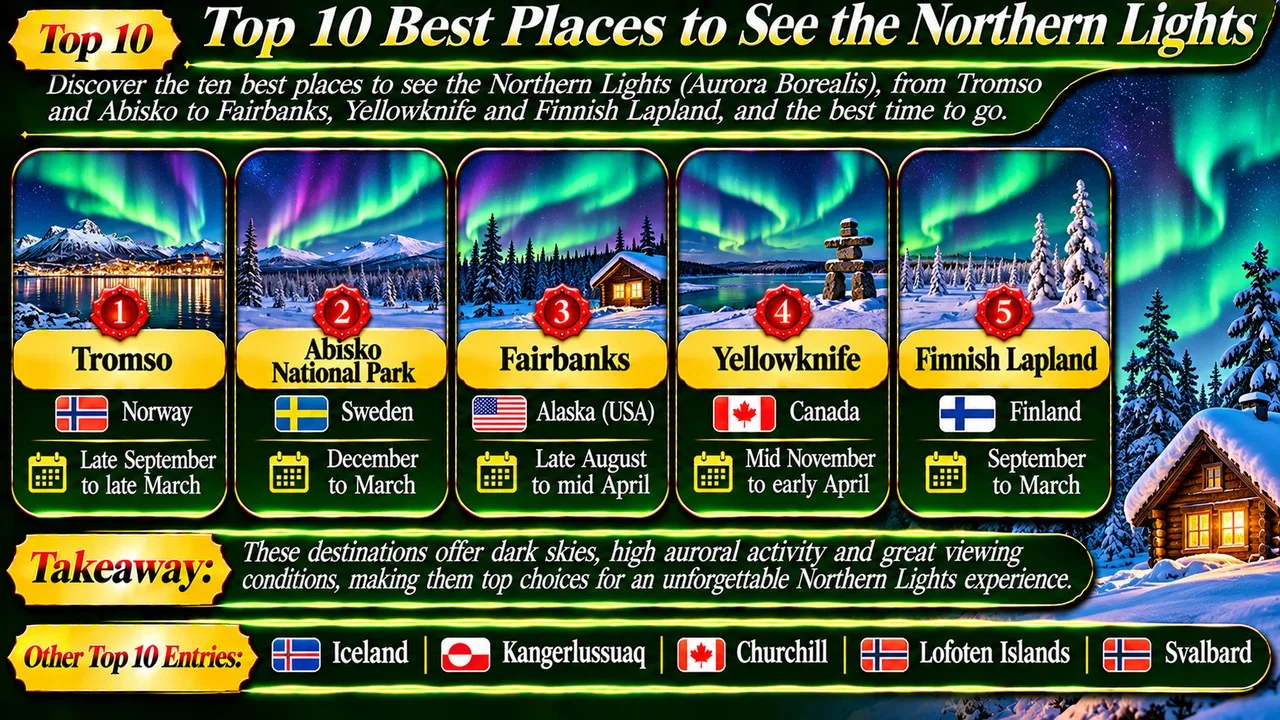
Here is a quick overview of the ten destinations, with their country, the best viewing season and one highlight for each.
Northern Lights Destinations at a Glance
| Rank | Name | Location/Country | Best season | Highlight |
|---|---|---|---|---|
| 1 | Tromso | Norway | Late September to late March | Arctic city with tours, fjords and the polar night |
| 2 | Abisko National Park | Sweden | December to March | Dry microclimate and dark skies |
| 3 | Fairbanks | Alaska, United States | Late August to mid April | Home of a leading aurora research institute |
| 4 | Yellowknife | Northwest Territories, Canada | Mid November to early April, plus late summer | Flat land and clear inland skies |
| 5 | Finnish Lapland | Finland | September to March | Up to about 200 auroral displays a year |
| 6 | Iceland | Iceland | September to April | Lights over waterfalls, glaciers and rift valleys |
| 7 | Kangerlussuaq | Greenland | September to April | Stable weather beside the ice sheet |
| 8 | Churchill | Manitoba, Canada | February to March | Northern lights plus polar bears |
| 9 | Lofoten Islands | Norway | September to March | Dramatic peaks and fishing villages |
| 10 | Svalbard | Norway | Late October to mid February | Auroras possible even at midday |
1. Tromso
Tromso, the largest city in northern Norway, lies about 350 kilometres north of the Arctic Circle, right inside the auroral zone. The city is often called the capital of the Arctic, and its airport, hotels and long list of guided tours make it one of the easiest places in the world to chase the northern lights [2].
From about 28 November to 14 January the sun stays below the horizon, a period known locally as the polar night or morketid. The blue twilight around midday and the long dark evenings give plenty of chances to see the aurora. In contrast, there is so much daylight in summer that no aurora can be seen from late April until the middle of August [2].
Because Tromso sits on the coast, clouds can block the view even when the lights are active. Tour operators therefore drive guests inland, sometimes all the way to the Finnish border, in search of clearer skies. Visitors can also take a cable car above the city for wide views, or join dog-sledding, reindeer and fjord trips by day.
2. Abisko National Park
Abisko National Park in Swedish Lapland was established in 1909, the same year Sweden passed its first nature conservation laws. It lies about 195 kilometres north of the Arctic Circle, beside the long lake of Tornetrask and surrounded by mountains [3].
Mountains to the west create a rain shadow, so Abisko is among the driest places in Sweden and gets far less precipitation than nearby Riksgransen near the Norwegian border. This sheltered weather, combined with almost no light pollution, makes it one of the most reliable aurora spots in Europe [14]. A chairlift carries visitors up Mount Nuolja to the Aurora Sky Station, an observation point high above the valley.
Related: The Science Behind Auroras: How Solar Winds Create Colorful Skies
Abisko is easy to reach by train from Stockholm or the Norwegian port of Narvik. In summer the same landscape becomes a hiking base: the park marks one end of the Kungsleden, a long-distance trail that runs about 440 kilometres through the Swedish mountains [3].
3. Fairbanks
Fairbanks, in the heart of interior Alaska, sits almost directly beneath the auroral oval. Its inland location gives it a relatively dry climate with many clear winter nights, and the aurora can often be seen from the edge of town [4].
The city is home to the University of Alaska Fairbanks, whose Geophysical Institute has studied the aurora for decades and publishes forecasts used by travellers. Winters are severe, with average January temperatures around minus 22 degrees Celsius, and the valley often traps very cold air in strong temperature inversions [4].
Popular ways to see the lights include heated cabins and viewing lodges in the hills around the city, and nearby Chena Hot Springs, where visitors can soak in warm pools under the night sky. In winter the Alaska Railroad also connects Fairbanks with Anchorage, making the trip part of the adventure.
4. Yellowknife
Yellowknife, capital of Canada's Northwest Territories, lies on the northern shore of Great Slave Lake, about 400 kilometres south of the Arctic Circle. Despite being south of the circle, the city lies under the auroral oval, and its flat terrain and dry inland climate give it frequent clear skies [5].
The city grew from a 1930s gold rush, and diamonds found to the north in 1991 brought new mining activity. Today aurora tourism is a major industry, and many visitors come from Asia and Europe on packages that include heated teepees, cabins and lakeside viewing sites [5].
Yellowknife has two aurora seasons. In winter, from about mid November to early April, the lights shine over snow and frozen lakes. In late summer and early autumn, before the lakes freeze, the aurora can be reflected in still water, which creates spectacular photographs.
5. Finnish Lapland
Finnish Lapland covers the northernmost third of Finland, a land of forests, fells and frozen lakes with very little light pollution. In the far north, the aurora can appear on as many as 200 nights a year, compared with fewer than 20 in southern Finland [6].
Related: Top 10 Most Bizarre Phobias: Strange Fears That Exist
Rovaniemi, the regional capital, sits right on the Arctic Circle and is known as the official home town of Santa Claus. Its busy airport makes it the usual gateway to the region. From there, travellers head north to resorts such as Saariselka, Levi and Inari, where glass-roofed igloos and cabins let guests watch the sky from their beds [6].
Winter activities include husky and reindeer safaris, snowmobiling and visits to Sami cultural centres. Finland's Meteorological Institute runs an aurora alert service, helping visitors decide when to head outside.
6. Iceland
Iceland sits just south of the Arctic Circle, under the edge of the auroral oval. Long, dark nights between September and April give plenty of viewing time, and the aurora can sometimes be seen even from the outskirts of Reykjavik when activity is strong [7].
What makes Iceland special is the scenery beneath the lights. The aurora can be photographed above waterfalls, black sand beaches, glacier lagoons and volcanic landscapes. Thingvellir National Park, a UNESCO World Heritage Site since 2004, is a favourite spot close to the capital. It lies in a rift valley on the boundary between the North American and Eurasian tectonic plates, and it was the meeting place of Iceland's parliament from the year 930 [8].
Iceland's main drawback is changeable weather, as Atlantic storms often bring cloud. The national weather service publishes cloud cover and aurora forecasts, and many visitors rent a car so they can drive to wherever the sky is clear.
7. Kangerlussuaq
Kangerlussuaq is a small settlement at the end of a long fjord in western Greenland, just north of the Arctic Circle. It grew around an airport built during the Second World War and was long Greenland's main air hub, until the new Nuuk airport opened in 2024 [9].
Related: Top 10 Facts About Dogs
The settlement lies inland, close to the edge of the Greenland ice sheet. That location gives it a dry climate with very little rainfall and unusually stable weather, which is good news for aurora watchers [9]. On a clear winter night, the lights can stretch across the whole sky above the frozen tundra.
Kangerlussuaq is also the only place in Greenland with road access to the ice sheet. Visitors can combine aurora nights with trips to the ice, dog sledding and spotting musk oxen and reindeer, which live on the tundra nearby.
8. Churchill
Churchill is a remote town on the shore of Hudson Bay in northern Manitoba, reached only by plane or train. It sits beneath the auroral oval, and February and March are usually the best months for clear, dark skies [10].
The town is best known as the polar bear capital of the world. Each autumn, bears gather along the coast waiting for the bay to freeze, and visitors watch them from specially built tundra vehicles. In summer, thousands of beluga whales move into the Churchill River estuary [10].
Winter aurora tours often use heated viewing domes or cabins far from town lights, protecting guests from the bitter cold. Lucky visitors in late autumn can sometimes see polar bears by day and the northern lights by night.
9. Lofoten Islands
The Lofoten Islands are an archipelago off the coast of northern Norway, famous for jagged mountains rising straight out of the sea. Red fishing cabins, sandy beaches and small harbours create some of the most photographed aurora scenes anywhere [11].
Lofoten has remarkably mild winters for a place north of the Arctic Circle. Warm currents in the Norwegian Sea keep temperatures far higher than at similar latitudes elsewhere, which makes long nights outdoors more comfortable [11].
Related: Top 10 Tallest Buildings in the World
The trade-off is that maritime weather can bring cloud and rain. Photographers often stay several nights to improve their chances. Lofoten can be reached by air or by ferry from the mainland town of Bodo, and villages such as Reine, Hamnoy and Svolvaer are popular bases.
10. Svalbard
Svalbard is a Norwegian archipelago far north in the Arctic Ocean, roughly halfway between mainland Norway and the North Pole. Its main town, Longyearbyen, has polar night from about 26 October to 15 February, so the sky stays dark around the clock for months [12].
This high latitude means Svalbard actually lies north of the main nighttime auroral oval. Instead, it sits under the part of the oval found on the day side of the Earth, which means visitors can sometimes see auroras around midday, a rare experience available in only a few places in the world [13]. These daytime displays are usually fainter and redder than the bright green curtains seen further south.
Svalbard is a wild and fragile place, home to polar bears, Arctic foxes and reindeer. Visitors explore by snowmobile, dog sled and guided tour, and must not leave settlements without proper protection against polar bears. Its remoteness and extreme cold make it a destination for experienced travellers.
Conclusion
The best places to see the northern lights combine high latitude, dark winter nights and a good chance of clear skies. Norway, Sweden, Finland, Iceland, Greenland, Canada and Alaska all offer excellent options, from comfortable cities to remote wilderness.
Patience is still essential. Checking space weather forecasts, cloud maps and local tour advice greatly improves the odds. For more surprising sights in nature, see the unusual local phenomena around the world, or read about the polar south in interesting facts about Antarctica.
- ^ [1] "Aurora". NOAA Space Weather Prediction Center. NOAA SWPC: Aurora
- ^ [2] "Tromso". Wikipedia. Wikipedia: Tromso
- ^ [3] "Abisko National Park". Wikipedia. Wikipedia: Abisko National Park
- ^ [4] "Fairbanks, Alaska". Wikipedia. Wikipedia: Fairbanks
- ^ [5] "Yellowknife". Wikipedia. Wikipedia: Yellowknife
- ^ [6] "Rovaniemi". Wikipedia. Wikipedia: Rovaniemi
- ^ [7] "Aurora". Wikipedia. Wikipedia: Aurora
- ^ [8] "Thingvellir National Park". UNESCO World Heritage Centre. UNESCO: Thingvellir National Park
- ^ [9] "Kangerlussuaq". Wikipedia. Wikipedia: Kangerlussuaq
- ^ [10] "Churchill, Manitoba". Wikipedia. Wikipedia: Churchill, Manitoba
- ^ [11] "Lofoten". Wikipedia. Wikipedia: Lofoten
- ^ [12] "Svalbard". Wikipedia. Wikipedia: Svalbard
- ^ [13] "Svalbard's special northern lights". University Centre in Svalbard (UNIS). UNIS: Svalbard's special northern lights
- ^ [14] "Abisko". Wikipedia. Wikipedia: Abisko




















Discussion
Log in with