






 By
Crusader castles are the stone fortresses built or rebuilt by European knights and military orders in the Middle East between about 1100 and 1291. Many still stand on hilltops and coastlines in Syria, Jordan, Lebanon and Israel today.
After the First Crusade captured Jerusalem in 1099, four Crusader states were created along the eastern Mediterranean: the County of Edessa, the Principality of Antioch, the County of Tripoli and the Kingdom of Jerusalem [1]. They were small states surrounded by stronger neighbours, so their rulers relied on castles to guard roads, borders and ports. Military orders such as the Knights Hospitaller, the Knights Templar and the Teutonic Order took over many of the largest fortresses because only they had the money and manpower to hold them.
This Finepedia list ranks ten Crusader castles by state of preservation, size, historical importance and influence on castle design. Several sites lie in regions affected by recent conflict, so visitors should check current official travel advice before planning a trip. Dates and measurements are those given by UNESCO and standard historical references as of November 2026.
Key Facts
The table below summarises each castle's location, main building period and its most notable feature.
Crusader Castles at a Glance
| Rank | Name | Location/Country | Key date | Notable fact |
|---|---|---|---|---|
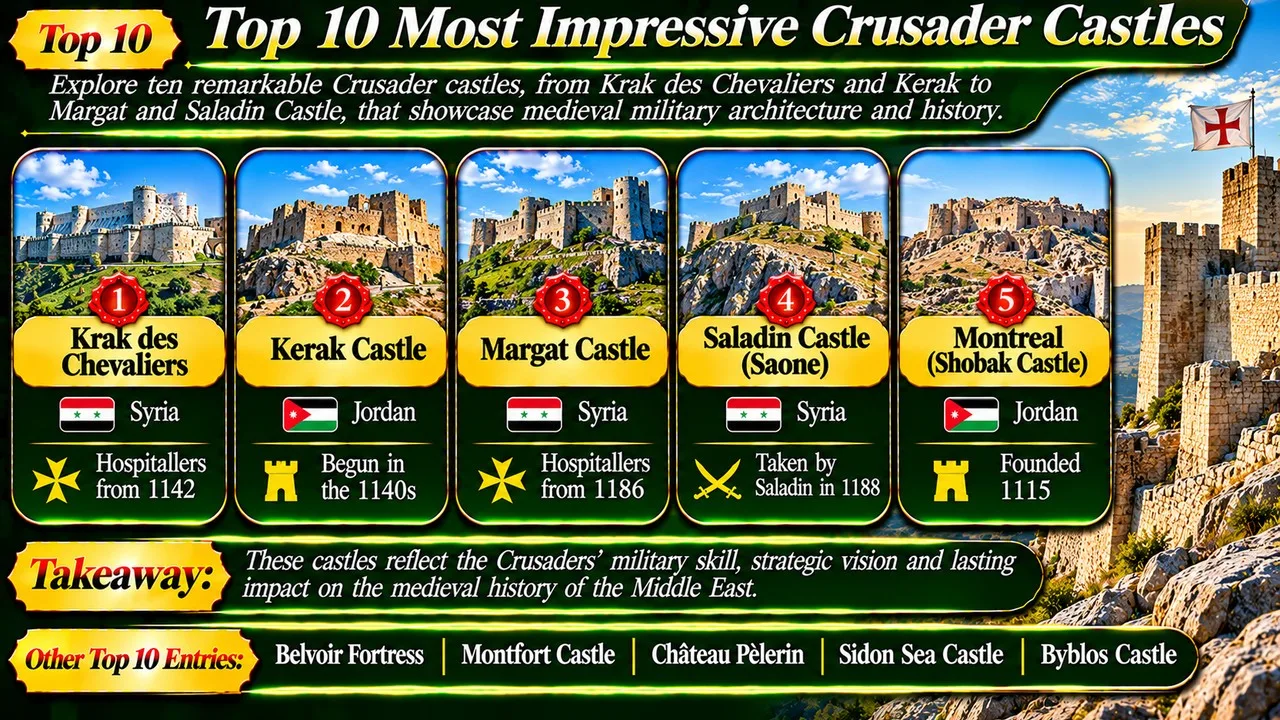
| 1 | Krak des Chevaliers | Near Homs, Syria | Hospitallers from 1142 | UNESCO-listed concentric castle |
| 2 | Kerak Castle | Al-Karak, Jordan | Begun in the 1140s | Among the largest castles of the Levant |
| 3 | Margat Castle | Near Baniyas, Syria | Hospitallers from 1186 | Hospitaller headquarters in Syria |
| 4 | Saladin Castle (Saone) | Near Latakia, Syria | Taken by Saladin in 1188 | Rock-cut ditch about 28 m deep |
| 5 | Montreal (Shobak Castle) | Shoubak, Jordan | Founded 1115 | First major Crusader castle east of the Jordan |
| 6 | Belvoir Fortress | Lower Galilee, Israel | Begun 1168 | Early concentric plan with a deep moat |
| 7 | Montfort Castle | Upper Galilee, Israel | Teutonic Order from 1220 | Headquarters, archive and treasury of the order |
| 8 | Chateau Pelerin (Atlit) | Atlit, Israel | Begun 1218 | Templar fortress never taken by siege |
| 9 | Sidon Sea Castle | Sidon, Lebanon | Built 1228 | Island fort reached by a causeway |
| 10 | Byblos Castle | Byblos, Lebanon | 12th century | Stands within the UNESCO site of Byblos |
1. Krak des Chevaliers
Krak des Chevaliers, about 40 kilometres west of Homs in Syria, is widely regarded as the finest surviving Crusader castle. A fort on the site was handed to the Knights Hospitaller in 1142 by the ruler of the County of Tripoli, and the order rebuilt and enlarged it over the following century [2].
A second major building phase in the thirteenth century added an outer wall, turning Krak into a concentric castle with two rings of defences. A steep sloping glacis protected the inner wall from siege engines and earthquakes. At its peak the castle may have held a garrison of around 2,000 people, letting the Hospitallers dominate the surrounding region and collect tribute [2].
The castle fell to the Mamluk Sultan Baybars in 1271 after a siege of about 36 days. T. E. Lawrence later praised it as perhaps the best-preserved and most admirable castle in the world. UNESCO inscribed Krak des Chevaliers together with Qal'at Salah El-Din as a World Heritage Site in 2006 [3]. The site was damaged during the Syrian civil war, and conservation and repair work has been carried out since 2014, with UNESCO monitoring its condition.
2. Kerak Castle
Kerak Castle rises above the town of al-Karak in Jordan, on the ancient King's Highway east of the Dead Sea. Building began in the 1140s under King Fulk of Jerusalem and his official Pagan the Butler, and the fortress became the centre of the Crusader lordship of Oultrejordain [4].
The castle is among the largest in the Levant. Long vaulted halls served as living quarters and stables, and their upper levels formed fighting galleries facing the approaches. In 1176 the castle passed to Raynald of Chatillon, whose raids on caravans and Red Sea shipping provoked Saladin. Saladin besieged Kerak in 1183 and again in 1184 but withdrew both times when relief armies arrived [4].
Related: Top 10 Lost Cities That Were Rediscovered
After Saladin's victory at Hattin in 1187, Kerak was cut off and surrendered in 1188 after a blockade of several months. The Mamluk Sultan Baybars later strengthened it with a new tower. Today the castle is one of Jordan's best-known historic sites, and a nearby archaeological museum explains the long history of the region of Moab [4].
3. Margat Castle
Margat, known in Arabic as Qal'at al-Marqab, or Castle of the Watchtower, stands on a high hill about 2 kilometres from the Mediterranean coast near Baniyas in Syria. The local Mazoir family held it until 1186, when they sold it to the Knights Hospitaller because they could no longer afford its upkeep [5].
The Hospitallers rebuilt and expanded the fortress and made it their headquarters in Syria. With fourteen towers, it was considered almost impregnable and was second in size and power only to Krak des Chevaliers. From Margat the order controlled the coastal road and collected tolls from pilgrims and merchants travelling along it [5].
In 1285 the Mamluk Sultan Qalawun besieged the castle after the Hospitallers had supported a Mongol invasion of Syria. After a 38-day siege, miners brought down part of the southern wall, and the garrison surrendered and was allowed to leave. Instead of destroying the castle, Qalawun repaired its defences and garrisoned it to guard the coast. Restoration work began in 2007 after a long period of neglect [5].
4. Saladin Castle (Saone)
Saladin Castle, known to the Crusaders as Saone and in Arabic as Qal'at Salah El-Din, lies about 30 kilometres east of Latakia in Syria. It occupies a narrow ridge about 700 metres long between two deep gorges in forested mountains, a site fortified since at least the tenth century [6].
The castle's most famous feature is a huge ditch cut into the solid rock on its eastern side. It is about 28 metres deep and 156 metres long, and a single tall rock needle was left standing in the middle to support a drawbridge [6]. Behind it stands a massive keep with walls around 5 metres thick, along with cisterns and stables.
Saladin captured Saone in 1188 after a siege of only three days, and the castle later took his name. UNESCO listed it with Krak des Chevaliers in 2006, noting that the two castles together illustrate the exchange of military architecture between Byzantine, Crusader and Islamic builders [3][6].
5. Montreal (Shobak Castle)
Montreal, known today as Shobak Castle, stands on a conical hill in the mountains of Edom in southern Jordan, near the town of Shoubak. King Baldwin I of Jerusalem founded it in 1115 during an expedition that reached Aqaba on the Red Sea, making it one of the earliest major Crusader strongholds east of the Jordan River [7].
Related: Top 10 Historic Prisons That Became Landmarks
The castle guarded caravan routes between Syria, Egypt and Arabia and gave the Crusaders control of fertile land below. After the defeat at Hattin, Saladin's forces besieged it for nearly two years. Because of the steep hill they could not use siege engines effectively, and the starving garrison finally surrendered in May 1189 [7].
Later rulers enlarged the castle, especially the Mamluks, who added much of the outer wall and towers. The Mamluk Sultan Baybars took control of it in 1261. Today visitors can explore a long tunnel leading down to spring-fed cisterns, the remains of two chapels and carved Mamluk inscriptions, and the castle is often combined with a trip to nearby Petra.
6. Belvoir Fortress
Belvoir Fortress, called Coquet by the Crusaders and Kochav HaYarden in Hebrew, stands on a plateau roughly 20 kilometres from the southern end of the Sea of Galilee in northern Israel. The Knights Hospitaller bought the site in 1168 and began building a powerful castle that overlooked the Jordan Valley [8].
Belvoir is an early example of the concentric castle, with an inner square enclosure set inside an outer square wall. A moat about 20 metres wide and 12 metres deep surrounded the outer wall, and vaulted chambers inside both walls stored supplies and sheltered defenders during bombardment [8]. Historians see its layout as an influence on castle design for centuries.
After the battle of Hattin, Belvoir held out under siege for about a year and a half before surrendering on 5 January 1189. Its defences were later deliberately dismantled in 1219 to stop Crusaders from reusing it. The ruins are now protected as Belvoir National Park and are described as the best-preserved Crusader castle in Israel [8].
7. Montfort Castle
Montfort Castle lies on a narrow, steep ridge above the Nahal Kziv stream in the Upper Galilee, northeast of Nahariya in Israel. The Teutonic Order bought the land from the de Milly family in 1220 and turned it into its main castle in the Holy Land [9].
Related: Top 10 Most Haunted Places in America
Unlike most Crusader fortresses, Montfort was not built mainly to guard a frontier. The knights moved their archive and treasury there from Acre in 1229 to keep them away from rival military orders in the city. Donations from pilgrims, collected with papal support, funded construction of a keep and a long two-storey hall along the ridge [9].
The Mamluk Sultan Baybars besieged Montfort in 1271, and the defenders surrendered after about two weeks. The ruins were later explored by an expedition from the Metropolitan Museum of Art in New York in 1926, and the castle now lies within a nature reserve that is popular with hikers [9].
8. Chateau Pelerin (Atlit)
Chateau Pelerin, or Pilgrim Castle, stands on a rocky promontory on Israel's northern coast near Atlit, about 13 kilometres from Haifa. Work by the Templars started in 1218, while the Fifth Crusade was under way, and the fortress could reportedly house up to 4,000 troops during a siege [10].
Two massive walls cut the promontory off from the land. The inner wall was about 30 metres high with towers rising higher still, allowing defenders to shoot over the outer wall. Because the fortress could always be resupplied by sea, it was never taken by siege, and some historians have called it the crowning example of Crusader military architecture [10].
After the fall of Acre in 1291 the Templars evacuated the castle that August, ending the Crusader presence on the mainland. The fortress stayed largely intact until an earthquake in 1837. Today it lies inside an Israeli naval base and is not generally open to the public [10].
9. Sidon Sea Castle
Sidon Sea Castle sits on a small island just off the harbour of Sidon in southern Lebanon. Crusaders built it in 1228 as a fortress guarding the port, on an island once occupied by a Phoenician temple to the god Melqart [11].
The castle is linked to the shore by a stone causeway about 80 metres long. It was partly destroyed when the Mamluks captured the city, then rebuilt by them, and later restored again in the seventeenth century by Emir Fakhreddine II. Two towers survive, joined by a wall, and ancient Roman columns can be seen reused in the masonry [11].
Related: Top 10 Oldest Surviving Buildings on Earth
Its photogenic setting, with waves breaking around the walls and fishing boats nearby, has made it one of Lebanon's best-known landmarks. The castle shows how the Crusaders reused older sites and materials, while its later Mamluk and Ottoman phases reveal how coastal defences continued to evolve after the Crusader states fell.
10. Byblos Castle
Byblos Castle stands in the ancient port city of Byblos in Lebanon, one of the oldest continuously inhabited towns in the world. The Crusaders built it in the twelfth century from local limestone and stones taken from Roman buildings. It belonged to the Embriaco family of Genoa, who ruled the town as the Lords of Gibelet from about 1100 to the late thirteenth century [12].
The castle has a square outer wall with corner towers built around a central keep, giving two layers of defence. Saladin captured the town in 1188 and partly dismantled its walls, but the Crusaders retook it and rebuilt the fortifications in 1197 [12].
The castle lies within the archaeological site of Byblos, a UNESCO World Heritage Site since 1984 that includes Phoenician temples and remains spanning thousands of years [13]. From its walls visitors can look over excavated temples, a Roman theatre and the old harbour, which makes it a good starting point for exploring the site.
Conclusion
The Crusader castles of the Middle East were built for war, but they have survived as some of the most remarkable medieval buildings anywhere. Their concentric walls, rock-cut ditches and sea defences influenced castle design in Europe, while later Mamluk and Ottoman additions show how each new ruler adapted them.
Other notable sites include Kolossi Castle in Cyprus and Bodrum Castle in Turkey, both linked to the Knights Hospitaller. Together these fortresses tell a long story of conflict, trade and cultural exchange in the eastern Mediterranean. For more medieval history, see the most beautiful castles in the world, medieval knight facts and myths and walls that shaped history.
- ^ [1] "Crusader states". Wikipedia. Wikipedia: Crusader states
- ^ [2] "Krak des Chevaliers". Wikipedia. Wikipedia: Krak des Chevaliers
- ^ [3] "Crac des Chevaliers and Qal'at Salah El-Din". UNESCO World Heritage Centre. UNESCO: Crac des Chevaliers and Qal'at Salah El-Din
- ^ [4] "Kerak Castle". Wikipedia. Wikipedia: Kerak Castle
- ^ [5] "Margat". Wikipedia. Wikipedia: Margat
- ^ [6] "Sahyun Castle". Wikipedia. Wikipedia: Saladin Castle
- ^ [7] "Montreal (castle)". Wikipedia. Wikipedia: Montreal castle
- ^ [8] "Belvoir Castle (Israel)". Wikipedia. Wikipedia: Belvoir Fortress
- ^ [9] "Montfort Castle". Wikipedia. Wikipedia: Montfort Castle
- ^ [10] "Chateau Pelerin". Wikipedia. Wikipedia: Chateau Pelerin
- ^ [11] "Sidon Sea Castle". Wikipedia. Wikipedia: Sidon Sea Castle
- ^ [12] "Byblos Castle". Wikipedia. Wikipedia: Byblos Castle
- ^ [13] "Byblos". UNESCO World Heritage Centre. UNESCO: Byblos






















Discussion
Log in with