



 By
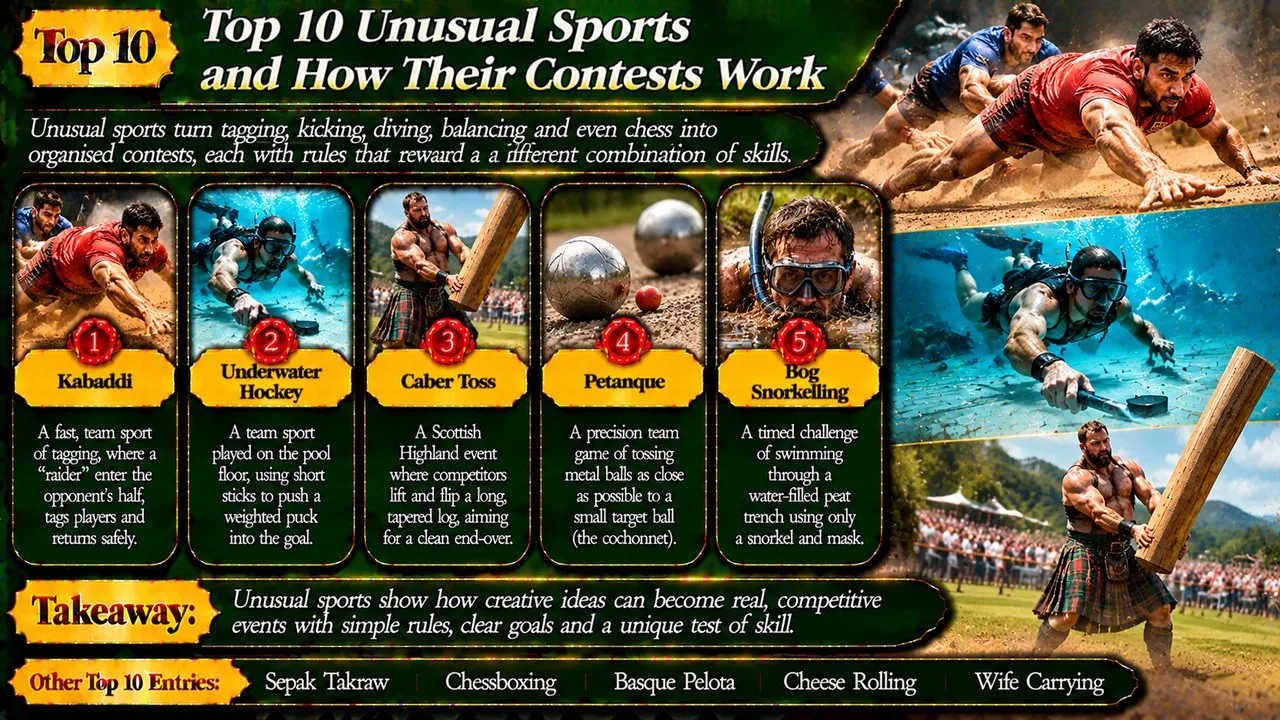
Unusual sports turn tagging, kicking, diving, balancing and even chess into organised contests, each with rules that reward a different combination of skills.
Unusual depends on the audience. A sport that surprises a visitor may be a familiar part of another community's life. This list places established regional games beside newer hybrids and festival contests, explaining the objective rather than treating participants as curiosities. The comparison is about the design of play, not a judgement that one culture's pastime is more normal than another's.
The order weighs the distinctiveness of the contest, clarity of its rules and cultural setting. A Listverse sports list supplies the topic [18]; documented games replace animal-based stunts and poorly defined novelties. Rules can vary by format and organiser. These summaries explain what spectators are watching, not how to practise contact sports, enter hazardous water or imitate steep-hill races.
Key Facts
These ten entries highlight contrasting features and contexts.
Unusual Sports and How Their Contests Work at a Glance
| Rank | Name | Context | Main feature | Notable point |
|---|---|---|---|---|
| 1 | Kabaddi | South Asia | Tag and return | Team defence |
| 2 | Sepak Takraw | Southeast Asia | Kicks over net | No hand play |
| 3 | Underwater Hockey | Pool | Move a puck | Repeated dives |
| 4 | Chessboxing | Hybrid | Board and ring | Alternating play |
| 5 | Caber Toss | Scotland | Turn a pole | Alignment matters |
| 6 | Basque Pelota | Basque region | Ball-game family | Varied equipment |
| 7 | Petanque | France | Place metal balls | Target accuracy |
| 8 | Cheese Rolling | England | Downhill race | Injury risk |
| 9 | Wife Carrying | Finland | Carry a partner | Obstacle course |
| 10 | Bog Snorkelling | Wales | Trench race | Restricted strokes |
1. Kabaddi
Kabaddi places a raider inside the opposing team's territory. The raider tries to tag defenders and return safely, while the defenders try to stop that return. The contest turns a simple playground idea into a tactical exchange involving movement, timing and coordinated resistance. It is especially associated with South Asia, where established competitive forms have given the game an audience far beyond a local informal match. [1] [11]
The balance of risk makes each raid interesting. A player who reaches farther may gain an opportunity to score but also give defenders a better chance to trap the attacker. Team formats and detailed scoring rules vary, so one summary should not present every local tradition as identical to a televised professional match. Accounts of ancient origins also need more caution than a confident legend about one heroic beginning usually allows. [1] [11]
It leads the list because its central objective is easy to grasp while the tactical choices are rich. That difference helps explain why agility, cooperation and awareness of boundaries all matter, even before a spectator learns the finer rules.
2. Sepak Takraw
Sepak takraw is a net game in which players send a ball across using permitted parts of the body such as the feet, knees and head rather than the hands. It is strongly associated with Southeast Asia. The resulting play can include airborne kicks that look acrobatic, but the objective remains a recognisable sporting one: place the ball beyond the net in a way the other side cannot return legally. [2]
The game brings together skills that a newcomer may associate separately with football and volleyball. That comparison is a useful introduction, not a complete account of its history or rules. The sport should not be reduced to a spectacular kick selected from a short video, since positioning and controlled exchanges are equally important. [2]
It ranks highly for changing a familiar constraint. Removing hand contact reshapes how players receive, set up and attack, turning the body into a different kind of striking tool. The rules explain the unusual movements more clearly than calling the sport an extreme trick, and they reveal a contest built around coordination as much as display.
Related: Mount Everest: The Pinnacle of Earth's Heights
3. Underwater Hockey
Underwater hockey moves a weighted puck along the bottom of a pool with short sticks. Players wear equipment including masks, snorkels and fins, then make repeated dives to take part in the play. The game therefore unfolds across two levels at once: the visible movement above and the contest for position and possession below. [3] [12]
CMAS provides an international setting for organised underwater hockey competition. Teamwork matters because an individual cannot remain continuously involved beneath the surface. Players must coordinate their efforts while respecting contact and equipment rules. The puck's position and the need to breathe create a rhythm unlike ordinary field or ice hockey, even though the broad idea of moving a puck towards a goal remains familiar to spectators. [3] [12]
It earns its place by changing the physical medium without abandoning a clear objective. Water alters movement, visibility and communication, giving the contest its distinctive character. The explanation is not an invitation to improvise a game in deep water: organised play requires appropriate supervision, training and conditions, and breath-holding challenges outside that setting carry serious risks.
4. Chessboxing
Chessboxing combines rounds of chess with rounds of boxing. Competitors must cope with both a board position and a physical opponent, and a contest can be decided through the rules of either discipline. The hybrid is striking because success requires switching between activities that spectators usually encounter in very different sporting settings. [4]
The modern organised form developed from an artistic idea into a competitive practice. Its exact round structure and timing depend on the adopted rules, so a general account should not make one format universal. The essential feature is alternation: the game on the board continues between periods in the ring. Time management, legal moves and physical contest all contribute to the result rather than forming two unrelated exhibitions. [4]
It ranks for making the transition itself part of the challenge. A competitor cannot rely entirely on endurance or entirely on a prepared opening. The rules place different kinds of concentration under pressure, but that does not prove a general claim that one group of athletes is more intelligent than another. It is a specific designed contest, not a test of personal worth.
5. Caber Toss
The caber toss asks a competitor to turn a long wooden pole end over end. Unlike many throwing events, the main aim is not to send it the greatest distance. A successful turn and the final alignment matter. The ideal landing is described through an imaginary clock face, with the caber pointing towards twelve o'clock in relation to the competitor's direction of movement. [5] [13] [17]
Related: Top 10 Most Dangerous Mountains in the World
Cabers are not all one fixed size, so comparing a bare distance or weight without context can misrepresent a performance. Judges assess the turn and its direction according to the rules, including how an incomplete attempt is treated. Strength is necessary, but control and balance help determine whether a heavy pole ends in the intended orientation rather than merely travelling a long way. [5] [13] [17]
A large object being thrown encourages people to ask how far it went, yet the relevant question is how it turned and landed. Understanding the scoring makes the event more legible and shows why a visually impressive launch is not automatically the best attempt.
6. Basque Pelota
Basque pelota is a family of ball games associated with the Basque region, not one universal contest with a single implement. Some forms use the bare hand, while others use bats, racquets or curved baskets. Many involve playing the ball against a wall within a defined court. The equipment changes the speed, reach and tactics, making the shared tradition more varied than a single dramatic highlight might suggest. [6]
Jai alai, associated with a curved basket, is one well-known branch rather than a name for every form of pelota. Court arrangements and team formats also differ. What unites many variants is the challenge of returning the ball legally while making the next return difficult, using the available surfaces and the particular rules of the form being played. [6]
It ranks for reminding readers that a sporting name can contain a family tree. Learning which variant is being watched is the first step towards understanding a match. The regional tradition gains depth from that diversity, showing how shared spaces and ball play can support several distinct contests rather than one fixed formula.
7. Petanque
Petanque asks players to place metal balls close to a small target ball, often called the jack. An opponent's well-placed ball can also be struck away, so a turn may favour careful placement or a more forceful attacking shot. A player must judge not only the target but the position that the next turn will inherit. [7] [16]
Related: Top 10 Muslim Female Athletes Who Made History
The game belongs to the broader family of boules sports and is closely associated with southern France. Its distinctive convention involves playing from a defined circle with the feet kept planted until the thrown ball lands. That differs from forms in which players take a run-up. The constraint puts emphasis on controlled delivery, while uneven ground can make a promising-looking approach behave differently after the first contact. [7] [16]
It earns a place because modest movement can produce a demanding contest. Spectacle is not the only measure of sporting interest. A quiet throw may change the tactical situation as decisively as a leap or sprint elsewhere, and understanding the position of every ball makes the next decision more compelling than watching the target alone.
8. Cheese Rolling
Cheese rolling at Cooper's Hill in Gloucestershire sends a round of cheese down a steep slope, followed by competitors. The popular image suggests that the aim is to catch the cheese. In practice, reaching the bottom first determines the winner of the race, while the fast-moving cheese is not an easy object to seize. The slope turns the event into a much less controlled descent than an ordinary running race. [8]
The contest is associated with a local festival tradition, but precise claims about its ancient beginnings are difficult to prove. A long history of celebration does not automatically verify every explanation offered for its origin. Nor should footage of tumbling participants be mistaken for harmless comedy. [8]
It ranks for the unusual role of the moving object. The cheese begins the action and gives the contest its identity, but the practical result comes from the competitors' descent. That gap between the apparent chase and the winning condition shows why even an eccentric festival event needs its rules explained accurately.
9. Wife Carrying
Wife carrying is a race in which one partner carries another through a course with obstacles. Finland's Sonkajarvi is closely associated with the organised competition. Despite the name, the person being carried need not be the carrier's own spouse. The title preserves the event's identity, while the actual eligibility and equipment rules are set by organisers rather than by an assumption drawn from the everyday meaning of wife. [9] [14]
Related: Top 10 Most Dangerous Bridges in the World
As of November 2026, the organiser's published rules describe a course with water and dry obstacles and define requirements for the participants. Exact formats elsewhere can differ. Carrying style, balance and the ability to negotiate the course all matter, but a spectator's account need not become a guide to attempting the lifts. The challenge involves two people whose safety depends on suitable preparation, conditions and compliance with the event's rules. [9] [14]
Its place reflects a race built around cooperation as well as speed. One participant supplies most of the running effort, but the other's position affects the pair's movement. The contest is clearer when explained through that partnership and its stated rules, without repeating an uncertain legend about a robber as though it were an established origin.
10. Bog Snorkelling
Bog snorkelling turns a water-filled trench into a timed contest. Competitors use masks and snorkels to travel along the course and return, with the rules limiting ordinary swimming strokes. The Welsh event associated with Llanwrtyd Wells gives an unglamorous landscape feature a formal competitive purpose. Progress depends on movement through confined, murky water rather than on the clear lanes and familiar strokes of a swimming-pool race. [10] [15]
As of November 2026, the organiser's published rules require touching the marked ends and keeping the face in the water, with brief looks allowed for direction. They permit a limited doggy-paddle movement below the waterline, so saying that every arm movement is forbidden would be inaccurate. Equipment and conduct rules also apply. These details matter because a memorable one-line summary can preserve an older simplification after the actual published requirements are more nuanced. [10] [15]
It closes the list for turning a highly particular setting into a recognisable race against the clock. The unusual venue does not remove the need for organisation and water safety. It is a controlled event to observe or enter through qualified organisers, not a reason to explore an unknown trench with improvised equipment or to treat murky water as harmless.
Conclusion
These contests become more understandable once the objective and constraints are clear. A pole's direction, a player's safe return or the position of a small ball can matter more than an unfamiliar appearance. They connect with ancient board games and other sporting choices, while resisting the idea that one audience's surprise defines a sport's value. Rules turn movement into competition, and cultural context explains why people keep gathering to play or watch.
- ^ [1] "Kabaddi". Wikipedia. Read
- ^ [2] "Sepak Takraw". Wikipedia. Read
- ^ [3] "Underwater Hockey". Wikipedia. Read
- ^ [4] "Chessboxing". Wikipedia. Read
- ^ [5] "Caber Toss". Wikipedia. Read
- ^ [6] "Basque Pelota". Wikipedia. Read
- ^ [7] "Petanque". Wikipedia. Read
- ^ [8] "Cheese Rolling". Wikipedia. Read
- ^ [9] "Wife Carrying". Wikipedia. Read
- ^ [10] "Bog Snorkelling". Wikipedia. Read
- ^ [11] "Kabaddi". Encyclopaedia Britannica. Read
- ^ [12] "Underwater Hockey". CMAS. Read
- ^ [13] "Caber Toss". Scottish Athletics International. Read
- ^ [14] "Competition Track and Rules". Wife-Carrying World Championship. Read
- ^ [15] "Competition Rules". Green Events. Read
- ^ [16] "Boules". Encyclopaedia Britannica. Read
- ^ [17] "Highland Games". Encyclopaedia Britannica. Read
- ^ [18] "Topic inspiration: Unusual Sports and How Their Contests Work". Listverse. Read






















Discussion
Log in with