






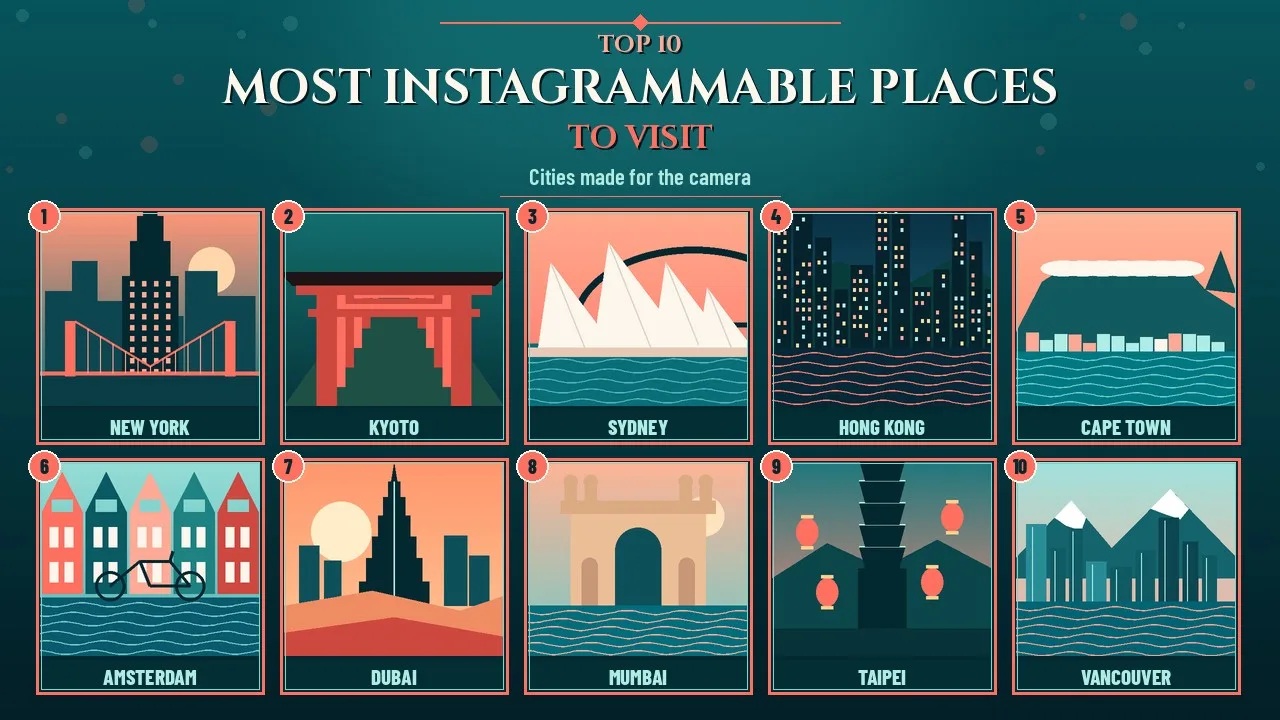
The most Instagrammable places to visit, from New York and Kyoto to Sydney and Cape Town, pair famous landmarks with views that look stunning on camera.
A great travel photo needs more than a pretty backdrop. The best photo cities pack many recognisable scenes into a small area, mix architecture with water, mountains or greenery, and reward anyone who turns up at the right hour with light that flatters everything it touches. They also have a personality of their own, so a picture taken there could not have been taken anywhere else.
This Finepedia guide ranks ten cities that photographers, content creators and ordinary holidaymakers return to again and again. For each one you will find the headline shots, the history behind them, practical timing advice and a few lesser-known facts. Opening dates, heights and heritage listings have been checked against official and encyclopaedic sources, and popularity claims that could not be verified have been left out.
How We Ranked the Most Instagrammable Places to Visit
There is no official league table of photogenic cities, and hashtag counts change daily, so this is an editorial ranking built on four tests:
- Density of iconic shots: how many instantly recognisable scenes can a visitor capture in a single day without long transfers?
- Contrast: does the city combine a skyline or historic streets with a natural setting such as a harbour, mountain, river or coastline?
- Access: can most travellers reach the classic viewpoints on foot, by public transport or with an affordable ticket, rather than needing a helicopter or special permit?
- Cultural uniqueness: does the city offer scenes, colours and traditions that look like nowhere else on Earth?
Cities that score highly on all four tests sit at the top. Places with one outstanding feature but fewer easy shots appear lower down. The list focuses on cities rather than single attractions, which is why famous one-view spots such as a lone lake or island village sit in the honourable mentions instead.
Most Instagrammable Places to Visit at a Glance
| Rank | City | Country | Signature shot | Best light | Best season |
|---|---|---|---|---|---|
| 1 | New York City | United States | Manhattan Bridge framed from Washington Street, DUMBO | Sunrise and blue hour | April–June, September–November |
| 2 | Kyoto | Japan | Vermilion torii tunnels at Fushimi Inari | Early morning | Late March–April, November |
| 3 | Sydney | Australia | Opera House and Harbour Bridge together | Sunset from Mrs Macquarie's Chair | September–November, March–May |
| 4 | Hong Kong | China (SAR) | Victoria Harbour skyline from The Peak | Blue hour and night | October–December |
| 5 | Cape Town | South Africa | Table Mountain above the city and bay | Golden hour | November–March |
| 6 | Amsterdam | Netherlands | Gabled houses mirrored in the canals | Soft morning light | April–May |
| 7 | Dubai | United Arab Emirates | Burj Khalifa above Downtown Dubai | Sunset into night | November–March |
| 8 | Mumbai | India | Gateway of India on the harbour front | Early morning | November–February |
| 9 | Taipei | Taiwan | Taipei 101 from Elephant Mountain | Sunset and blue hour | October–December, March–April |
| 10 | Vancouver | Canada | City skyline across water from Stanley Park | Golden hour | June–September |
1. New York City
| Attribute | Details |
|---|---|
| Country | United States |
| Signature shots | Manhattan Bridge from DUMBO, Brooklyn Bridge, Empire State Building, Central Park, Times Square |
| Best season | Spring blossom (April–May) and autumn colour (October–November) |
| Best light | Sunrise on the bridges; blue hour from rooftop observation decks |
| Getting around | Subway and ferry reach almost every classic viewpoint |
Origins and History
New York has been reinventing its skyline for well over a century, and that layered history is why it photographs so well. The Brooklyn Bridge opened in 1883 as a pioneering steel-wire suspension bridge, and its granite towers and spider-web cables still frame the Lower Manhattan skyline. The Flatiron Building followed in 1902, and the Empire State Building opened in 1931 after a construction race that took barely over a year.
The Statue of Liberty, a gift from France, was dedicated in 1886 and is now a UNESCO World Heritage Site. Central Park, laid out from 1858 by Frederick Law Olmsted and Calvert Vaux, gave the city a vast green counterpoint to all that stone and glass. Newer additions such as the Summit One Vanderbilt observation deck, which opened in 2021, keep adding fresh angles.
Key Features
- Washington Street in DUMBO, Brooklyn: the Manhattan Bridge appears neatly framed between old warehouse buildings, with the Empire State Building visible through the arch on clear days.
- Brooklyn Bridge promenade: early morning gives clean shots of the cables before the crowds arrive.
- Central Park: Bow Bridge, Bethesda Terrace and the Mall lined with American elms look their best in spring and autumn.
- Times Square at night: the wall of digital billboards creates bright, colour-saturated street photography.
- Observation decks: Top of the Rock, the Empire State Building, Edge at Hudson Yards and Summit One Vanderbilt each offer a different view of the grid.
- Staten Island Ferry: a free ride that passes close to the Statue of Liberty and looks back at the Financial District.
Significance
New York earns first place because no other city on this list packs so many globally recognised scenes into such a compact, walkable area. Films, television series and advertising have made its streets familiar to people who have never visited, so a visitor's photo instantly connects with a shared visual memory. The mix of bridges, rivers, parks and skyscrapers also means it looks different in every season.
Interesting Facts
- The Empire State Building held the title of world's tallest building for about four decades, from 1931 until the early 1970s.
- Central Park covers roughly 843 acres (about 341 hectares), larger than the principality of Monaco.
- The Times Square name dates from 1904, when The New York Times moved its headquarters there.
- The Staten Island Ferry has been free to ride since 1997.
2. Kyoto
| Attribute | Details |
|---|---|
| Country | Japan |
| Signature shots | Fushimi Inari torii gates, Arashiyama bamboo grove, Kinkaku-ji, Kiyomizu-dera, Yasaka Pagoda |
| Best season | Cherry blossom (late March–early April) and autumn maples (mid to late November) |
| Best light | Just after sunrise, before tour groups arrive |
| Heritage status | Historic Monuments of Ancient Kyoto, UNESCO World Heritage Site since 1994 |
Origins and History
Kyoto served as Japan's imperial capital for more than a thousand years, from 794 until the court moved to Tokyo in the 1860s. That long reign left the city with an extraordinary concentration of temples, shrines, gardens and wooden townhouses. Seventeen of its historic sites, along with properties in neighbouring Uji and Otsu, are listed together by UNESCO as the Historic Monuments of Ancient Kyoto.
Fushimi Inari Taisha, the head shrine of the deity Inari, traces its founding to 711. Its paths up Mount Inari are lined with thousands of vermilion torii gates donated by businesses and individuals, each inscribed with the donor's name. The golden Kinkaku-ji pavilion seen today is a 1955 reconstruction, because the original was destroyed by arson in 1950.
Key Features
- Fushimi Inari Taisha: the Senbon Torii section creates the famous tunnel effect; climbing higher up the mountain thins the crowds.
- Arashiyama Bamboo Grove: tall stalks form a green corridor that glows in soft morning light.
- Kinkaku-ji: the gold-leaf pavilion reflects in its mirror pond on calm, sunny days.
- Kiyomizu-dera: the large wooden stage juts out over the hillside and looks spectacular above autumn maples.
- Yasaka Pagoda and the sloping lanes of Ninenzaka and Sannenzaka: stone steps and traditional shops lead the eye up to the five-storey tower.
- Philosopher's Path: a canal-side walk that becomes a pink tunnel during cherry blossom season.
Significance
Kyoto ranks second because its scenes are so distinctive that a single photo identifies the city at once. Few places allow visitors to step so directly into living tradition, with tea houses, festivals and seasonal rituals still part of daily life. The city is also a lesson in respectful photography: some private lanes in the Gion geisha district were closed to tourists in 2024 after complaints about visitors chasing and photographing residents, and signs now warn against it.
Interesting Facts
- Mount Inari rises to about 233 metres, and a full loop of the torii trail takes roughly two to three hours.
- The main hall of Kiyomizu-dera, rebuilt in 1633, was built without nails.
- Kyoto was spared large-scale Second World War bombing, which is one reason so much of its old fabric survives.
- The temple complex of Kiyomizu-dera was founded in 778, before Kyoto even became the capital.
3. Sydney
| Attribute | Details |
|---|---|
| Country | Australia |
| Signature shots | Sydney Opera House, Sydney Harbour Bridge, Bondi Icebergs pool, Bondi to Coogee coastal walk |
| Best season | Spring (September–November) and autumn (March–May) |
| Best light | Sunset from Mrs Macquarie's Chair; sunrise at Bondi |
| Heritage status | Sydney Opera House, UNESCO World Heritage Site since 2007 |
Origins and History
Sydney's two great icons sit within sight of each other across Circular Quay. The Sydney Harbour Bridge opened on 19 March 1932, and its huge steel arch earned it the local nickname "the Coathanger". Four decades later, the Sydney Opera House opened in October 1973. Its sail-like shells were designed by the Danish architect Jørn Utzon, and in 2007 it became one of the youngest buildings ever added to the UNESCO World Heritage List.
Beyond the harbour, the city's beaches and sandstone cliffs give it a second identity. The Bondi Icebergs Club, founded in 1929, built an ocean pool where waves crash over the edge, and the coastal walk south to Coogee runs for about six kilometres past bays, rock pools and lookouts.
Key Features
- Mrs Macquarie's Chair: a sandstone ledge in the Royal Botanic Garden that lines up the Opera House in front of the Harbour Bridge.
- Circular Quay and the Overseas Passenger Terminal: close-up views of the Opera House shells.
- BridgeClimb: guided climbs to the top of the bridge arch, running since 1998.
- Bondi Icebergs pool: the classic overhead shot shows turquoise lanes beside the Pacific surf.
- Bondi to Coogee walk: sea cliffs, Tamarama and Bronte beaches, and the ocean baths along the way.
- Vivid Sydney: a winter festival of light that projects colour onto the Opera House sails each year.
Significance
Sydney takes third place because its harbour gives almost every view a dramatic natural frame, and its main landmarks are free to see from public paths. The city shows how architecture and water can work together on camera. It also offers a cautionary tale. Wedding Cake Rock in the Royal National Park, south of the city, became so popular online that rangers fenced it off because the brittle sandstone is at risk of collapse, and visitors are warned not to climb past the barriers.
Interesting Facts
- The Royal National Park, established in 1879, is often described as the world's second-oldest national park.
- The Opera House roof is covered with more than a million glazed tiles made in Sweden.
- The Harbour Bridge arch spans about 503 metres and carries road, rail, cycle and pedestrian traffic.
- Utzon left the project in 1966, years before the building opened, and never saw it completed in person.
4. Hong Kong
| Attribute | Details |
|---|---|
| Country | China (Special Administrative Region) |
| Signature shots | Victoria Harbour from The Peak, Tsim Sha Tsui promenade, Star Ferry, Monster Building, Tian Tan Buddha |
| Best season | October to December, when skies are clearer and humidity drops |
| Best light | Blue hour, when the towers light up against a deep sky |
| Getting around | MTR, trams, Star Ferry and the Peak Tram |
Origins and History
Hong Kong's skyline is the product of very little flat land and a great deal of ambition. Squeezed between steep hills and the sea, the city built upwards, and it now has one of the largest collections of skyscrapers in the world. The Peak Tram began climbing to Victoria Peak in 1888, and the Star Ferry has carried passengers across Victoria Harbour since the late nineteenth century.
Away from the glass towers, the territory also holds dense public housing estates, outlying islands and country parks. On Lantau Island, the bronze Tian Tan Buddha, completed in 1993, sits on a hilltop near Po Lin Monastery and can be reached by the Ngong Ping 360 cable car, which opened in 2006.
Key Features
- Victoria Peak: the viewing areas at the top look down over Central, the harbour and Kowloon.
- Tsim Sha Tsui waterfront and Avenue of Stars: the best place to photograph Hong Kong Island lit up at night.
- A Symphony of Lights: a nightly light and music show launched in 2004 across buildings on both sides of the harbour.
- Yick Cheong Building, Quarry Bay: the courtyard of tightly packed flats, often called the Monster Building, is a famous symmetrical shot; residents ask visitors to stay quiet and respectful.
- Choi Hung Estate: pastel, rainbow-painted blocks around a rooftop sports court.
- Ding ding trams and neon-lit streets in Mong Kok for street photography.
Significance
Hong Kong ranks fourth because it delivers a dense, futuristic skyline in a setting of mountains and harbour that few cities can match. It is also unusually easy to shoot: a single cheap ferry ride gives a front-row view of the skyline, and the main viewpoints are reachable by public transport. The contrast between neon street life, quiet temples and green hiking trails gives photographers variety within a short distance.
Interesting Facts
- On the steepest part of the Peak Tram ride, the tower blocks outside appear to lean, an optical illusion caused by the angle of the tram.
- A Symphony of Lights was recognised by Guinness World Records as the world's largest permanent light and sound show.
- The Tian Tan Buddha stands about 34 metres tall, and visitors climb 268 steps to reach it.
- The Dragon's Back trail on Hong Kong Island offers sea views less than an hour from the city centre.
5. Cape Town
| Attribute | Details |
|---|---|
| Country | South Africa |
| Signature shots | Table Mountain, Lion's Head, Bo-Kaap houses, Boulders Beach penguins, Chapman's Peak Drive |
| Best season | November to March (southern summer), though wind can be strong |
| Best light | Golden hour from Lion's Head or Signal Hill |
| Natural landmark | Table Mountain, named one of the New 7 Wonders of Nature |
Origins and History
Cape Town grew from a supply station founded by the Dutch East India Company in 1652, sheltered beneath the flat-topped bulk of Table Mountain. The mountain dominates every view of the city and is often draped in a layer of cloud nicknamed the "tablecloth". The Table Mountain Aerial Cableway first opened in 1929, and since 1997 its cars have had rotating floors so riders see the full panorama on the way up.
The city's cultural history shows in its streets. The Bo-Kaap neighbourhood on the slopes of Signal Hill is known for brightly painted houses and its historic Cape Malay community. Around the peninsula, the Cape of Good Hope and Cape Point mark a rugged headland where cliffs drop into the Atlantic.
Key Features
- Table Mountain summit: reached by cableway or by hiking trails such as Platteklip Gorge, with views over the city bowl and Table Bay.
- Lion's Head: a popular sunrise and sunset hike with a final section using chains and ladders.
- Bo-Kaap: cobbled streets lined with pink, turquoise and yellow houses.
- Boulders Beach: a protected colony of African penguins among granite boulders near Simon's Town.
- Chapman's Peak Drive: a cliff-hugging coastal road with views over Hout Bay.
- Kirstenbosch: the curving Tree Canopy Walkway, opened in 2014, rises through the treetops of the botanical garden.
Significance
Cape Town ranks fifth because it offers the strongest city-meets-nature contrast on this list, with mountain, ocean, vineyards and beaches all within an hour's drive. The quality of light at the southern tip of Africa is famous among landscape photographers. Visitors should plan with care, though: Cape Town also appears in Finepedia's guide to the most dangerous tourist destinations in the world (https://finepedia.com/post/most-dangerous-tourist-destinations-in-the-world-top-10), so it pays to hike in groups, avoid isolated spots after dark and keep cameras out of sight when not in use.
Interesting Facts
- Table Mountain was confirmed as one of the New 7 Wonders of Nature in 2012 after a global public vote.
- The Boulders Beach penguin colony began with just two breeding pairs in 1982.
- The Zeitz MOCAA art museum opened in 2017 inside a converted grain silo at the V&A Waterfront.
- Kirstenbosch National Botanical Garden was founded in 1913.
6. Amsterdam
| Attribute | Details |
|---|---|
| Country | Netherlands |
| Signature shots | Canal ring houses, bridges with bicycles, Magere Brug, Rijksmuseum, nearby windmills and tulip fields |
| Best season | April to May for tulips; December for canal lights |
| Best light | Calm early mornings, when the water reflects the houses |
| Heritage status | Seventeenth-century canal ring, UNESCO World Heritage Site since 2010 |
Origins and History
Amsterdam's famous canal belt was dug during the Dutch Golden Age of the seventeenth century, when the city was one of the richest trading ports in the world. Merchants built tall, narrow houses with decorative gables along the Herengracht, Keizersgracht and Prinsengracht, and many still lean slightly forwards so goods could be hoisted to upper floors. UNESCO listed the canal ring in 2010.
The city's oldest building, the Oude Kerk, was consecrated in 1306. Outside the centre, the windmills of Zaanse Schans and the spring bulb fields around Lisse, including the Keukenhof gardens that first opened to the public in 1950, are easy day trips and often appear in Dutch travel photos.
Key Features
- Canal ring: the classic shot lines up a humpbacked bridge, parked bicycles and gabled houses mirrored in still water.
- Magere Brug: a white wooden drawbridge over the Amstel that is lit with bulbs after dark.
- Rijksmuseum: the grand building and its underpass, often filled with cyclists and street musicians.
- Dancing houses on the Damrak: a row of crooked facades facing the water.
- Jordaan: quiet lanes, flower boxes and small bridges away from the busiest streets.
- Keukenhof (spring only): millions of tulips, daffodils and hyacinths planted in curving beds.
Significance
Amsterdam earns its place because almost every street corner is a composed picture, and the city is compact enough to explore entirely on foot or by bike. Its waterways and gables give it one of the most recognisable townscapes in Europe. The city has also become a model for responsible tourism messaging, asking visitors to respect residents and forbidding photography of sex workers in the Red Light District.
Interesting Facts
- Amsterdam has around 1,500 bridges and roughly 100 kilometres of canals.
- The city is famously said to have more bicycles than residents.
- Keukenhof plants around seven million bulbs every year and opens for only about eight weeks in spring.
- Many canal houses have hooks on their gables, still used to winch furniture through upper windows.
7. Dubai
| Attribute | Details |
|---|---|
| Country | United Arab Emirates |
| Signature shots | Burj Khalifa, Dubai Fountain, Dubai Frame, Museum of the Future, Palm Jumeirah, Al Fahidi |
| Best season | November to March, when temperatures are mild |
| Best light | Sunset into night, when the towers and fountain light up |
| Tallest building | Burj Khalifa, 828 metres, opened in 2010 |
Origins and History
Dubai was a pearling and trading town on the Gulf until the oil era transformed it in the second half of the twentieth century. Since the 1990s the emirate has built some of the world's most ambitious architecture. The sail-shaped Burj Al Arab hotel opened in 1999 on its own artificial island, and the Palm Jumeirah, shaped like a palm tree, was reclaimed from the sea in the early 2000s.
The Burj Khalifa opened in January 2010 at 828 metres, becoming the world's tallest building. Newer landmarks keep appearing: the Dubai Frame, a giant golden picture frame about 150 metres tall, opened in 2018, and the Museum of the Future, its silver torus covered in Arabic calligraphy, opened in 2022.
Key Features
- Downtown Dubai: the Burj Khalifa rising above the Dubai Fountain, which performs choreographed water shows every evening.
- At the Top, Burj Khalifa: observation decks on the 124th, 125th and 148th floors.
- Dubai Frame: frames old Dubai on one side and the modern skyline on the other.
- Museum of the Future: a silver ring-shaped building that photographs beautifully at night.
- Al Fahidi Historical Neighbourhood: sand-coloured lanes and traditional wind towers, a striking contrast with the glass towers.
- Desert dunes: sunset dune trips outside the city give rippled sand and long shadows.
Significance
Dubai ranks seventh because it offers record-breaking modern architecture, desert landscapes and beaches within a short drive. Its landmarks were designed to be seen and photographed, and night views are especially strong. Photographers should know the local rules: UAE law treats photographing people without their consent as a privacy offence, and flying drones requires official permission.
Interesting Facts
- The Burj Khalifa has held the title of world's tallest building since it opened in 2010.
- The Dubai Fountain, which opened in 2009, sits on a lake of about 30 acres at the foot of the tower.
- Dubai Miracle Garden, opened in 2013, displays millions of flowers but closes during the hottest months.
- An abra (wooden water taxi) ride across Dubai Creek costs only a few dirhams.
8. Mumbai
| Attribute | Details |
|---|---|
| Country | India |
| Signature shots | Gateway of India, Chhatrapati Shivaji Maharaj Terminus, Marine Drive, Bandra-Worli Sea Link, Global Vipassana Pagoda |
| Best season | November to February, after the monsoon |
| Best light | Early morning at the Gateway; evening on Marine Drive |
| Heritage status | Three UNESCO World Heritage Sites in and around the city |
Origins and History
Mumbai began as a group of seven islands that were joined by land reclamation over the eighteenth and nineteenth centuries. As a major port of British India, it gained grand Victorian Gothic buildings, followed in the 1930s by one of the world's largest collections of Art Deco architecture. These two styles were listed together by UNESCO in 2018 as the Victorian Gothic and Art Deco Ensembles of Mumbai.
The Gateway of India, an arched monument on the Apollo Bunder waterfront, was built to commemorate the visit of King George V and Queen Mary in 1911 and was completed in 1924. The city's railway landmark, Chhatrapati Shivaji Maharaj Terminus, was built between 1878 and 1888 and became a World Heritage Site in 2004.
Key Features
- Gateway of India: the basalt arch faces the harbour, with the Taj Mahal Palace hotel beside it.
- Chhatrapati Shivaji Maharaj Terminus: a richly carved Gothic station that is still one of India's busiest railway hubs.
- Marine Drive: a curving seafront whose streetlights form the "Queen's Necklace" after dark.
- Bandra-Worli Sea Link: a cable-stayed bridge across Mahim Bay, opened in 2009.
- Global Vipassana Pagoda, Gorai: a huge golden meditation dome inaugurated in 2009.
- Haji Ali Dargah: a white shrine built in 1431, reached by a causeway that floods at high tide.
Significance
Mumbai ranks eighth because it combines heritage architecture, seafront views and some of the most vibrant street life anywhere. Markets such as Chor Bazaar and Crawford Market, the open-air laundry of Dhobi Ghat and festivals such as Ganesh Chaturthi produce colourful, energetic scenes. As in any crowded city, ask before photographing people up close, and respect rules at religious sites.
Interesting Facts
- The Elephanta Caves, a short ferry ride from the Gateway of India, have been a UNESCO World Heritage Site since 1987.
- The Global Vipassana Pagoda is often described as the largest stone dome in the world built without supporting pillars.
- Banganga Tank in Malabar Hill is an ancient water tank surrounded by temples and steps.
- Bandra's walls are covered in large street-art murals that change regularly.
9. Taipei
| Attribute | Details |
|---|---|
| Country | Taiwan |
| Signature shots | Taipei 101 from Elephant Mountain, Chiang Kai-shek Memorial Hall, Longshan Temple, night markets, Jiufen |
| Best season | October to December and March to April |
| Best light | Sunset and blue hour from Elephant Mountain |
| Tallest building | Taipei 101, 508 metres, opened in 2004 |
Origins and History
Taipei grew from farming and trading settlements along the Tamsui River, and its older districts still hold temples and shophouses from the Qing era. Bangka Lungshan Temple (often written Longshan Temple) was founded in 1738 and has been rebuilt several times after earthquakes, fires and war damage. Dihua Street preserves rows of restored merchant houses selling dried goods and tea.
The modern skyline is dominated by Taipei 101, which opened at the end of 2004 and was the world's tallest building until 2010. Its design echoes a stack of bamboo segments, and its New Year's Eve fireworks display is one of the best-known in Asia.
Key Features
- Elephant Mountain (Xiangshan): a short but steep stair trail with the classic view of Taipei 101 rising above the city.
- Chiang Kai-shek Memorial Hall: a white monument with a blue roof set in a vast plaza between two traditional-style halls.
- Longshan Temple: carved dragons, incense smoke and lantern-lit roofs.
- Night markets: Raohe and Shilin are full of steam, neon and food stalls.
- Jiufen: a former gold-mining town on a hillside, with red lanterns and tea houses overlooking the sea.
- Shifen: visitors release paper sky lanterns beside a railway line that runs through the village.
Significance
Taipei ranks ninth because it pairs a modern skyline with traditional temples, mountain views and some of Asia's liveliest food scenes, while staying clean, safe and easy to navigate. It is less crowded with photographers than Tokyo or Hong Kong, so visitors can often find classic angles without long queues. Hot springs at Beitou and the volcanic landscape of Yangmingshan add nature within the city limits.
Interesting Facts
- Taipei 101 contains a tuned mass damper weighing about 660 tonnes that steadies the tower in wind and earthquakes, and visitors can see it.
- The tower's observation deck is on the 89th floor, with an outdoor platform on the 91st.
- Jiufen is often linked by fans to the film Spirited Away, although Studio Ghibli has not confirmed it as the inspiration.
- Taipei's MRT metro system first opened in 1996.
10. Vancouver
| Attribute | Details |
|---|---|
| Country | Canada |
| Signature shots | Stanley Park seawall, Gastown steam clock, Capilano Suspension Bridge, Canada Place, Granville Island |
| Best season | June to September, the driest months |
| Best light | Golden hour over English Bay |
| Nature on the doorstep | Coast Mountains, Pacific shoreline and temperate rainforest |
Origins and History
Vancouver stands on the traditional territories of the Musqueam, Squamish and Tsleil-Waututh Nations. The modern city was incorporated in 1886 and grew quickly after the transcontinental railway arrived. Stanley Park opened in 1888 and now covers about 400 hectares of forest, beaches and gardens at the tip of the downtown peninsula.
Two landmarks link the city to its rugged surroundings. The Lions Gate Bridge opened in 1938 across the entrance to the harbour, and the Capilano Suspension Bridge in North Vancouver, first built in 1889, sways high above a forested canyon. Vancouver also hosted the 2010 Winter Olympics, and the Olympic cauldron still stands beside the waterfront.
Key Features
- Stanley Park seawall: a waterside path with views of the skyline, the Lions Gate Bridge and the North Shore mountains.
- Gastown: cobbled streets and the steam clock, which whistles every quarter-hour.
- Capilano Suspension Bridge: a long footbridge strung high above the Capilano River.
- Canada Place: white, sail-like roofs on the cruise terminal beside Coal Harbour.
- Granville Island: a public market, colourful floating homes and street performers.
- Grouse Mountain and the Sea to Sky Highway: alpine views and fjord scenery within easy reach.
Significance
Vancouver completes the list because few cities set glass towers so close to snow-capped peaks and the Pacific Ocean. It is ideal for travellers who want nature photography and city scenes on the same day. Its weather can be grey and wet for much of the year, which is why summer and the occasional clear winter day are prized by photographers.
Interesting Facts
- The Vancouver seawall runs for about 28 kilometres, and is often described as the longest uninterrupted waterfront path in the world.
- The Capilano Suspension Bridge is about 137 metres long and hangs around 70 metres above the river.
- The Gastown steam clock was built in 1977 and is partly powered by the city's underground steam heating system.
- Granville Island Public Market opened in 1979 on a former industrial site.
Honourable Mentions
Several places narrowly missed the list because they are smaller, harder to reach or famous for one main view rather than a whole cityscape:
- Paris, France: the Eiffel Tower from the Trocadéro and Haussmann boulevards.
- Santorini, Greece: whitewashed houses and blue domes above the caldera at Oia.
- Venice, Italy: gondolas, bridges and palazzi along the Grand Canal.
- Jaipur, India: the pink sandstone Hawa Mahal and Amber Fort.
- Rio de Janeiro, Brazil: Christ the Redeemer and Sugarloaf Mountain above the bay.
- Istanbul, Türkiye: mosques, domes and minarets above the Bosphorus.
Comparison: City Skyline versus Nature Contrast
| City | Main skyline or heritage icon | Natural backdrop | Free classic viewpoint |
|---|---|---|---|
| New York City | Empire State Building and bridges | East River, Central Park | Brooklyn Bridge promenade |
| Kyoto | Temples, shrines and pagodas | Forested hills, bamboo | Fushimi Inari (no entry fee) |
| Sydney | Opera House and Harbour Bridge | Harbour and ocean beaches | Mrs Macquarie's Chair |
| Hong Kong | Victoria Harbour towers | Peaks and harbour | Tsim Sha Tsui promenade |
| Cape Town | City bowl and waterfront | Table Mountain, Atlantic coast | Signal Hill |
| Amsterdam | Canal houses and bridges | Canals, tulip fields nearby | Any canal bridge |
| Dubai | Burj Khalifa and Downtown | Desert and Gulf coast | Dubai Fountain lakeside |
| Mumbai | Gateway of India and Gothic buildings | Arabian Sea | Marine Drive |
| Taipei | Taipei 101 | Mountains and hot springs | Elephant Mountain trail |
| Vancouver | Downtown towers and Canada Place | Coast Mountains, Pacific | Stanley Park seawall |
Tips for Taking Better Travel Photos
Great travel pictures depend as much on timing and manners as on equipment. These habits help in every city on the list:
- Go early: sunrise usually brings the softest light and the fewest people at famous spots.
- Use blue hour: the twenty to thirty minutes after sunset are ideal for skylines, when city lights balance with the sky.
- Look beyond the classic angle: walk a few minutes away from the crowd for a fresher composition.
- Respect people: ask before photographing locals, and never enter private property for a shot.
- Follow rules on fences, drones and religious sites, which exist for safety and privacy.
- Travel light: a phone with a clean lens and a small tripod covers most situations.
For more inspiration, see Finepedia's lists of the most popular beaches in the world (https://finepedia.com/post/most-popular-beaches-in-the-world-10-icons-to-visit), the most famous trees in the world (https://finepedia.com/post/most-famous-trees-in-the-world-top-10) and the most beautiful flowers in the world (https://finepedia.com/post/most-beautiful-flowers-in-the-world-top-10), several of which make memorable photo stops of their own.
Frequently Asked Questions
What are the most Instagrammable places to visit in the world?
New York City, Kyoto, Sydney, Hong Kong and Cape Town top this ranking, followed by Amsterdam, Dubai, Mumbai, Taipei and Vancouver. Each combines famous landmarks with dramatic natural settings and easy access to classic viewpoints, so even first-time visitors can take memorable photos within a day or two.
What is the best time of day for travel photos?
The hour after sunrise and the hour before sunset, often called golden hour, give warm, soft light and long shadows. Blue hour, just after sunset, is best for skylines. Early mornings have the added advantage of fewer crowds at popular landmarks such as Fushimi Inari or the Brooklyn Bridge.
Which Instagrammable city is best for a budget trip?
Taipei and Kyoto offer excellent value, with free or low-cost temples, viewpoints and street food. Mumbai is also affordable for most visitors. In New York and Sydney, many top views are free from public promenades, parks and ferries, even though accommodation is expensive.
Is it allowed to fly a drone in these cities?
Rules vary widely. Dubai, Hong Kong, Japan and most major cities require permits or restrict drones near airports, crowds and landmarks, and many parks ban them entirely. Always check the national aviation authority's rules before travelling, because fines and confiscation are common for unauthorised flights.
How can I photograph famous places without crowds?
Arrive at sunrise, visit on weekdays and avoid peak holiday seasons. Walking a little further along a trail, such as climbing higher at Fushimi Inari, often leaves the crowds behind. Booking timed entry slots for observation decks and choosing less famous viewpoints nearby also help.
Is it respectful to photograph local people while travelling?
Always ask first, especially for close-up portraits, and accept a refusal politely. Some places, including the private lanes of Kyoto's Gion district and Amsterdam's Red Light District, actively ban intrusive photography, and the UAE treats photographing people without consent as a legal offence.
Conclusion
The most Instagrammable places to visit share a few simple ingredients: memorable landmarks, a strong natural setting, good light and streets full of character. New York's bridges, Kyoto's torii gates, Sydney's harbour, Hong Kong's skyline and Cape Town's mountain show how differently those ingredients can be combined, while Amsterdam, Dubai, Mumbai, Taipei and Vancouver each add their own colour and contrast.
The best photographs, however, come from slowing down, respecting the people who live there and seeing a place with your own eyes before seeing it through a screen. For more rankings, browse Finepedia's Top 10 Facts collection (https://finepedia.com/category/top-10-facts) and the Landmarks category (https://finepedia.com/category/landmarks).
- NYC Tourism + Conventions: official guide to New York City attractions – https://www.nyctourism.com/
- National Park Service: Statue of Liberty National Monument – https://www.nps.gov/stli/
- Central Park Conservancy: park history and facts – https://www.centralparknyc.org/
- UNESCO World Heritage Centre: Historic Monuments of Ancient Kyoto; Sydney Opera House; Seventeenth-century canal ring area of Amsterdam; Chhatrapati Shivaji Terminus; Victorian Gothic and Art Deco Ensembles of Mumbai; Elephanta Caves; Statue of Liberty – https://whc.unesco.org/
- Kyoto City Tourism Association (Kyoto City Official Travel Guide) – https://kyoto.travel/en/
- Sydney Opera House: history of the building – https://www.sydneyoperahouse.com/
- NSW National Parks and Wildlife Service: Royal National Park – https://www.nationalparks.nsw.gov.au/
- Hong Kong Tourism Board: Discover Hong Kong – https://www.discoverhongkong.com/
- Table Mountain Aerial Cableway – https://www.tablemountain.net/
- South African National Parks: Table Mountain National Park and Boulders – https://www.sanparks.org/
- I amsterdam (official city guide) – https://www.iamsterdam.com/
- Keukenhof – https://keukenhof.nl/en/
- Burj Khalifa official site – https://www.burjkhalifa.ae/
- Visit Dubai (Dubai Department of Economy and Tourism) – https://www.visitdubai.com/
- Maharashtra Tourism – https://www.maharashtratourism.gov.in/
- Taipei 101 Observatory – https://www.taipei-101.com.tw/
- Taipei Travel (Department of Information and Tourism, Taipei City Government) – https://www.travel.taipei/
- Destination Vancouver – https://www.destinationvancouver.com/
- City of Vancouver: Stanley Park and the seawall – https://vancouver.ca/
- Encyclopaedia Britannica and Wikipedia (cross-check): Brooklyn Bridge, Empire State Building, Kinkaku-ji, Kiyomizu-dera, Sydney Harbour Bridge, Peak Tram, Gateway of India, Capilano Suspension Bridge

















Log in with