






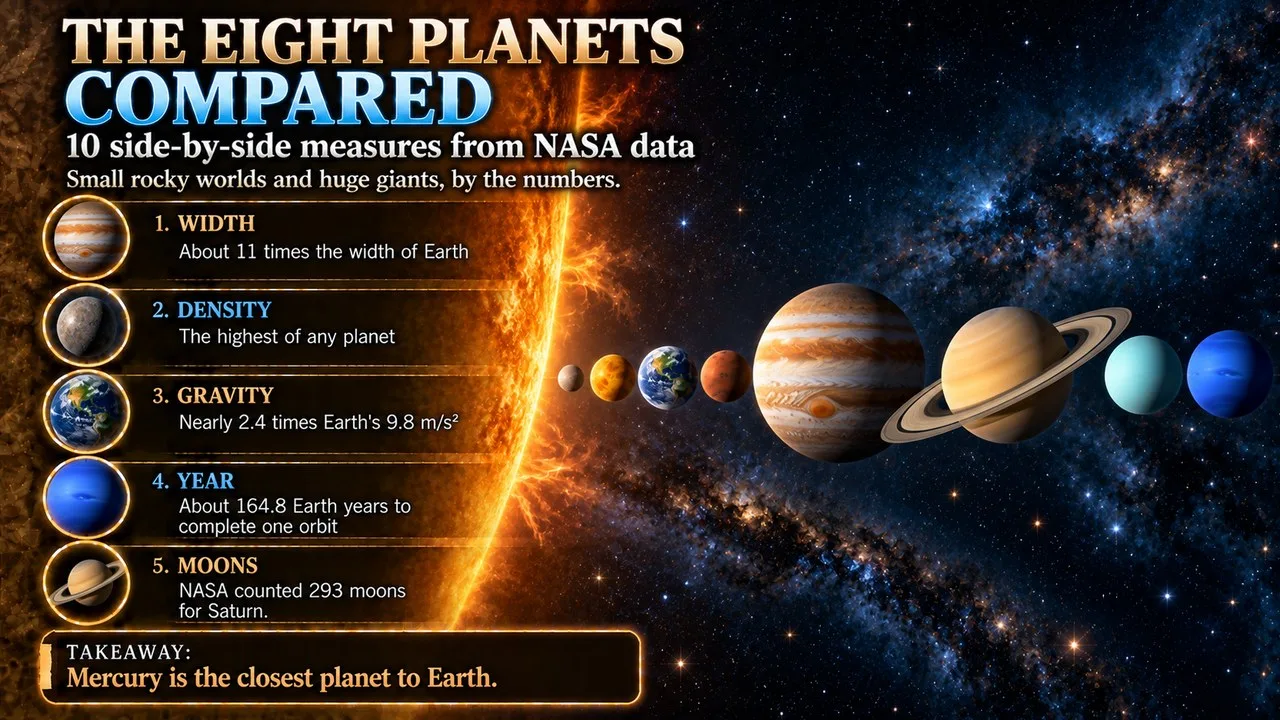
The Solar System has eight planets. In order of distance from the Sun they are Mercury, Venus, Earth, Mars, Jupiter, Saturn, Uranus and Neptune.[1] They all formed from the same disc of gas and dust about 4.6 billion years ago, yet they are very different worlds.[3] The largest, Jupiter, is 318 times as massive as Earth, while the smallest, Mercury, has just 0.055 Earth masses.[1] A day on Jupiter lasts about ten hours. On Venus, a single day lasts longer than half its year.[8][5] Saturn has hundreds of moons, while Mercury and Venus have none.[11][1]
This Finepedia guide, updated in October 2026, compares the eight planets side by side. It covers their size, mass and gravity, how long their days and years last, how many moons they have and how hot or cold they get. It also explains what makes a planet a planet, and why Pluto no longer counts. All moon counts are the latest confirmed figures as of 2026.
Key Facts
| Planet | Type | Mass (Earth = 1) | Length of day | Length of year | Known moons |
|---|---|---|---|---|---|
| Mercury | Terrestrial | 0.055[1] | 58.65 Earth days (sidereal)[4] | 88.0 Earth days[4] | 0[1] |
| Venus | Terrestrial | 0.815[5] | 116.75 Earth days (solar day)[5] | 224.7 Earth days[5] | 0[1] |
| Earth | Terrestrial | 1 | About 23 hours 56 minutes (sidereal)[6] | 365.25 days[6] | 1[6] |
| Mars | Terrestrial | 0.11[7] | 24.6 hours (solar day)[7] | 687 Earth days[7] | 2[7] |
| Jupiter | Gas giant | 318[1] | About 10 hours[8] | 11.86 Earth years[8] | 115[9] |
| Saturn | Gas giant | 95[1] | About 10 hours 33 minutes[10] | 29.45 Earth years[10] | 293[11] |
| Uranus | Ice giant | 14.5[12] | 17 hours 14 minutes[12] | 84 Earth years[12] | 29[12] |
| Neptune | Ice giant | 17[13] | About 16.11 hours[13] | 164.8 Earth years[13] | 16[13] |
What Makes a Planet a Planet?
- It orbits the Sun.
- It has enough mass to pull itself into a nearly round shape, known as hydrostatic equilibrium.
- It has cleared the neighbourhood around its orbit.
Under this definition the Solar System has eight planets.[1] Bodies that meet the first two conditions but not the third are called dwarf planets, as long as they are not moons of other planets.[1] As a result, Pluto, a body in the Kuiper belt beyond Neptune, was reclassified as a dwarf planet in 2006.[14]
- Terrestrial planets: Mercury, Venus, Earth and Mars. These are made mostly of rock and metal.
- Gas giants: Jupiter and Saturn. These are made mostly of hydrogen and helium, and are the most massive planets.
- Ice giants: Uranus and Neptune. These are made mostly of water, methane and ammonia, with thick atmospheres of hydrogen and helium. They are much less massive than the gas giants, at 14 and 17 Earth masses.
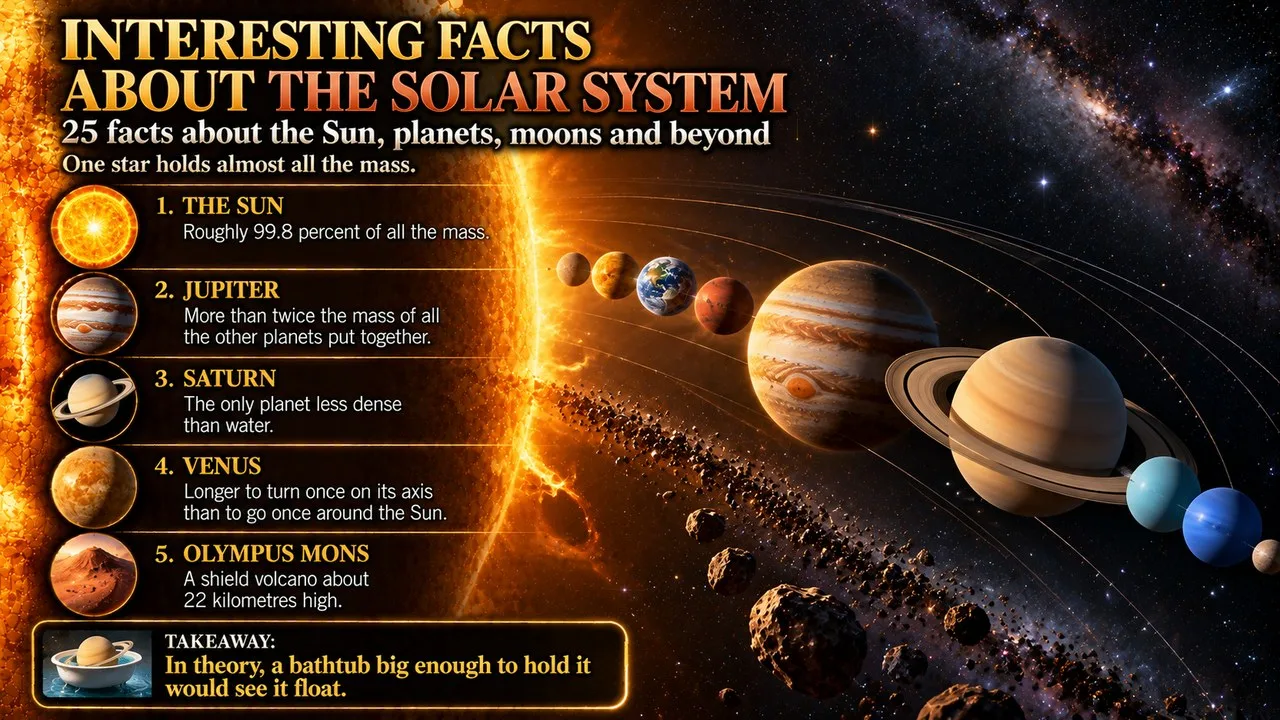
The Sun holds 99.86 per cent of all the mass in the Solar System, so all the planets together make up only a tiny fraction.[3] Between Mars and Jupiter lies the asteroid belt, home to the dwarf planet Ceres and many smaller bodies.[3]
Mercury: The Smallest and Fastest
Mercury is the first planet from the Sun and the smallest in the Solar System. Its equatorial radius is 2,439.7 km (1,516.0 mi), and its diameter is about 4,880 km.[4] It orbits between 0.31 and 0.59 AU from the Sun.[3] Mercury is smaller than the two largest moons in the Solar System, Ganymede and Titan, although it is more massive than either of them.[4] It is a rocky planet with only a trace of atmosphere, and its surface gravity is slightly lower than that of Mars.[4]
Mercury's year is the shortest of any planet, at 88.0 Earth days. Its sidereal day, the time it takes to spin once, is 58.65 Earth days.[4] The two are locked in a 3:2 ratio, so one solar day on Mercury, from one sunrise to the next, lasts about 176 Earth days. That is twice as long as its year.[4] Mercury is the closest planet to the Sun, but it is only the second hottest after Venus, because it has no atmosphere to trap heat.[4] Its equatorial regions range from −170 °C (−270 °F) at night to 420 °C (790 °F) in sunlight.[4] It has no natural satellites.[3]
Mercury has a huge metal core, which takes up about 57 per cent of its volume. For Earth the figure is 17 per cent.[4] Its largest crater, Caloris Planitia, is 1,550 km (960 mi) across, about a third of the planet's diameter.[4] Mariner 10 made the first successful flyby of Mercury in 1974. Since then, the MESSENGER and BepiColombo orbiters have explored it.[4]
Venus: The Hottest Planet
Venus is Earth's near twin in size. It has a diameter of 12,103.6 km (7,520.8 mi), only 638.4 km less than Earth's, and its mass is 81.5 per cent of Earth's.[5] It orbits the Sun at an average distance of about 0.72 AU (108 million km), completing an orbit every 224.7 days.[5] When Venus lies between Earth and the Sun, it comes closer to Earth than any other planet, at an average distance of 41 million km.[5]
Venus spins very slowly, and backwards. Its rotation is retrograde, so it turns clockwise, opposite to the anticlockwise direction in which it orbits the Sun.[5] As a result, a Venusian day is 116.75 Earth days long, about half a Venusian year.[5] Venus has no moons.[5]
Its atmosphere is 96.5 per cent carbon dioxide, which causes an intense greenhouse effect.[5] The average surface temperature is 464 °C (867 °F), which makes Venus the hottest planet in the Solar System. The pressure at the surface is about 92 times that at Earth's sea level.[5] Thick clouds of sulfuric acid cover the whole planet.[5] Venus may once have had liquid water and a habitable environment, before a runaway greenhouse effect boiled the water away.[5] From Earth, Venus is brighter than any other natural point of light in the sky, and it appears as the "morning star" or the "evening star".[5]
Earth: The Only Known Home of Life
Earth is the third planet from the Sun and the only astronomical object known to harbour life.[6] It is about eight light-minutes, or 1 astronomical unit (AU), from the Sun, and it takes about 365.25 days to orbit it.[6] Earth spins on its axis in about 23 hours and 56 minutes.[6] Its equatorial diameter of 12,756 km (7,926 mi) makes it the largest of the terrestrial planets.[6] It is also the densest planet in the Solar System.[6]
Near Earth's surface, gravity accelerates objects at about 9.8 m/s2, the standard against which the other planets are compared below.[6] Earth is the only planet in the Solar System with liquid water on its surface, and its ocean covers 70.8 per cent of its crust.[6] It has one natural satellite, the Moon, which orbits at 384,400 km and is about a quarter as wide as Earth.[6] The Moon's gravity helps keep Earth's axis stable, causes the tides and gradually slows Earth's rotation.[6]
Related: The Phenomenon of Solar Flares: Unlocking Solar Mysteries
Mars: The Red Planet
Mars is known as the "Red Planet" because of its orange-red appearance.[7] Its mean diameter is 6,779 km (4,212 mi), about half of Earth's and twice the Moon's. Its surface area is about the same as all the dry land on Earth.[7] Mars has about 15 per cent of Earth's volume and 11 per cent of its mass, which gives it about 38 per cent of Earth's surface gravity.[7]
A day on Mars, called a sol, lasts 24.6 hours, only a little longer than an Earth day. A Martian year lasts 687 Earth days, or 1.88 Earth years.[7] Mars orbits at an average distance of about 230 million km from the Sun.[7] Its air temperature ranges from −153 to 20 °C (−243 to 68 °F), and its atmospheric pressure is only a few thousandths of Earth's.[7]
- Phobos, about 22 km across
- Deimos, about 12 km across
A popular theory says they were asteroids captured by Mars.[7] Mars also has the tallest volcano in the Solar System, Olympus Mons, which rises 21.9 km (13.6 mi). It also has one of the largest canyons, Valles Marineris.[7] Rovers such as Spirit and Opportunity have found minerals that form in water, evidence that Mars was once wet.[7]
Jupiter: The Giant
Jupiter is the largest planet. It is about eleven times wider than Earth, and its mass is 318 times Earth's. That is 2.5 times the mass of all the other planets combined.[8] Even so, it has slightly less than one-thousandth of the Sun's mass.[8] Jupiter orbits at 5.20 AU from the Sun and takes 11.86 years to go round once.[8] It has the shortest day of any planet. It spins once in about ten hours, so fast that its equator bulges, and its equatorial radius is about 7 per cent larger than its polar radius.[8]
Jupiter's atmosphere is 76 per cent hydrogen and 24 per cent helium by mass.[8] Storms form along its coloured bands, and the largest of them is the Great Red Spot, a giant storm that has been recorded since 1831.[8] Jupiter also has a faint ring system, made mainly of dust.[8] It is thought to be the oldest planet in the Solar System, having formed about a million years after the Sun.[8]
Jupiter has 115 known moons as of 9 April 2026.[9] The four largest, Io, Europa, Ganymede and Callisto, can be seen with ordinary binoculars.[8] Ganymede, the largest of the four, is bigger than the planet Mercury.[8]
Related: Top 10 Famous Impact Craters on Earth
Saturn: The Ringed Planet
Saturn is the sixth planet from the Sun and the second largest, after Jupiter.[10] Its average radius is about 9 times Earth's, and it is over 95 times as massive. However, it has less than a third of Jupiter's mass.[10] Saturn is the only planet in the Solar System that is less dense than water, by about 30 per cent.[10] It orbits 9.59 AU from the Sun and takes 29.45 years to complete one orbit.[10]
A day on Saturn is hard to pin down, because different latitudes rotate at different speeds. One estimate, based on data from the Cassini, Voyager and Pioneer probes, is 10 hours 32 minutes 35 seconds. Studies of the C Ring give about 10 hours 33 minutes 38 seconds.[10] Because of Saturn's bulge and fast spin, gravity at its equator is 8.96 m/s2, a little lower than Earth's.[10]
Saturn's rings are bright and wide. They are made mainly of ice particles, with smaller amounts of rock and dust.[10] Saturn has 293 moons with confirmed orbits as of June 2026, the most of any planet.[11] Its largest moon, Titan, is the second largest in the Solar System. It is larger than Mercury, though less massive, and it is the only moon with a thick atmosphere.[10]
Uranus: The Tilted Ice Giant
Uranus is a cyan-coloured ice giant.[12] It has the third-largest diameter and the fourth-largest mass of the planets. At about 14.5 Earth masses, it is the least massive of the giant planets.[12] Its average distance from the Sun is about 20 AU (3 billion km).[12] William Herschel observed Uranus on 13 March 1781. It was the first planet discovered with the help of a telescope.[12]
Uranus is famous for its tilt. Its axis is tipped by 82.23°, and it rotates backwards, with a day of 17 hours and 14 minutes.[12] Its year lasts 84 Earth years, so each pole gets about 42 years of continuous sunlight, followed by 42 years of darkness.[12] Uranus has the coldest atmosphere of any planet, with a minimum temperature of 49 K (−224 °C; −371 °F).[12] It has 29 known moons, and the five largest are Miranda, Ariel, Umbriel, Titania and Oberon.[12] As of 2026, only one spacecraft has visited Uranus: Voyager 2 flew past in 1986.[12]
Neptune: The Windiest World
Neptune is the eighth and farthest planet. It orbits the Sun once every 164.8 years at 30.1 AU (4.5 billion km).[13] It is the fourth-largest planet by diameter and the third most massive, at 17 times Earth's mass, and it is the densest of the giant planets.[13] Its equatorial radius of 24,764 km is nearly four times Earth's.[13] Its gravity at the 1-bar level is 11.27 m/s2, 1.15 times Earth's, and only Jupiter's is stronger.[13]
Related: Top 10 Most Bizarre Phobias: Strange Fears That Exist
Neptune's position was worked out by mathematics before anyone recognised it in a telescope. After the death of the astronomer Bouvard, John Couch Adams and Urbain Le Verrier each predicted its position from his observations. Johann Gottfried Galle then saw it through a telescope on 23 September 1846, within a degree of Le Verrier's predicted position.[13] Neptune's day is about 16.11 hours long.[13] It has the strongest sustained winds of any planet, reaching 2,100 km/h (1,300 mph).[13] Its cloud tops are among the coldest places in the Solar System, at about 55 K (−218 °C).[13] Neptune has 16 known moons, and the largest is Triton.[13] Voyager 2 flew past on 25 August 1989 and is still the only spacecraft to have visited Neptune.[13]
Comparing the Planets
Size
From largest to smallest by diameter, the planets rank: Jupiter, Saturn, Uranus, Neptune, Earth, Venus, Mars and Mercury.[8][10][12][13][6][5][7][4] Jupiter is about 11 times wider than Earth, and Saturn's radius is about 9 times Earth's.[8][10] Neptune is nearly four times as wide as Earth.[13] Mars is about half Earth's width.[7] Neptune is smaller than Uranus but more massive, which is why it is the densest giant planet.[13]
Gravity
- Neptune's gravity is 11.27 m/s2, about 1.15 times Earth's. Only Jupiter's is stronger.[13]
- Saturn's gravity at the equator is 8.96 m/s2, slightly less than Earth's, even though Saturn has 95 times Earth's mass.[10]
- Mars has about 38 per cent of Earth's gravity.[7]
- Mercury's gravity is slightly lower than that of Mars.[4]
Days
- A solar day on Mercury lasts about 176 Earth days.
- A solar day on Venus lasts 116.75 Earth days.
Venus and Uranus are the only planets that rotate clockwise, the opposite direction to most planets.[1]
Years
- Mercury: 88 days
- Venus: 224.7 days
- Earth: 365.25 days
- Mars: 687 days
- Jupiter: 11.86 years
- Saturn: 29.45 years
- Uranus: 84 years
- Neptune: 164.8 years
Moons
All the planets except Mercury and Venus have moons. Earth has one, Mars has two, and the giant planets have large families of moons.[1] As of 2026, Saturn leads with 293 moons and Jupiter has 115.[11][9] Uranus has 29 and Neptune has 16.[12][13] Some moons of the giant planets, especially Europa and Enceladus, have been studied as places where life might exist.[1]
Temperatures
Distance from the Sun is not the only thing that sets a planet's temperature. Venus is the hottest planet, at an average of 464 °C, because its thick carbon dioxide atmosphere traps heat. Mercury is closer to the Sun but cooler, because it has almost no atmosphere.[5][4] Uranus has the lowest minimum temperature of any planet, at 49 K (−224 °C), even though Neptune is farther from the Sun.[12][13]
Key Figures
- 8: Planets in the Solar System under the IAU's 2006 definition.[2]
- 99.86%: Share of the Solar System's mass held by the Sun.[3]
- 318: Jupiter's mass in Earth masses, the largest of any planet.[1]
- 0.055: Mercury's mass in Earth masses, the smallest of any planet.[1]
- 464 °C: Average surface temperature of Venus, the hottest planet.[5]
- −224 °C: Minimum temperature on Uranus, the coldest planetary atmosphere.[12]
- 2,100 km/h: Strongest winds on Neptune, the fastest of any planet.[13]
- 293: Confirmed moons of Saturn as of June 2026.[11]
- 115: Known moons of Jupiter as of April 2026.[9]
- 82.23°: Axial tilt of Uranus.[12]
- 164.8 years: Length of Neptune's year.[13]
- 21.9 km: Height of Olympus Mons on Mars.[7]
Frequently Asked Questions
Which is the biggest planet?
Jupiter is the biggest planet. It is about 11 times as wide as Earth, and it has more than twice the mass of all the other planets put together.[8]
Related: Top 10 Facts About Dogs
Which planet has the most moons?
Saturn has the most moons, with 293 confirmed as of June 2026. Jupiter has 115.[11][9]
Why is Venus hotter than Mercury?
Venus's thick carbon dioxide atmosphere causes an intense greenhouse effect, which keeps its surface at about 464 °C. Mercury has almost no atmosphere to trap heat.[5][4]
Which planet has the longest day?
Mercury and Venus have the longest days. A solar day on Mercury lasts about 176 Earth days, and a solar day on Venus lasts 116.75 Earth days.[4][5]
Why is Pluto not a planet?
In 2006, the IAU said a planet must clear the neighbourhood around its orbit. Pluto, a body in the Kuiper belt, does not, so it is classified as a dwarf planet.[2][14]
Is Saturn really less dense than water?
Yes. Saturn's average density is 0.69 g/cm3, about 30 per cent less than water, and it is the only planet like this.[10]
See also
- Top 25 Interesting Facts About the Solar System
- Top 10 Interesting Facts About the Moon
- Top 25 Interesting Facts About the Universe
- ^ [1] "Planet". Wikipedia. Wikipedia
- ^ [2] "IAU definition of planet". Wikipedia. Wikipedia
- ^ [3] "Solar System". Wikipedia. Wikipedia
- ^ [4] "Mercury (planet)". Wikipedia. Wikipedia
- ^ [5] "Venus". Wikipedia. Wikipedia
- ^ [6] "Earth". Wikipedia. Wikipedia
- ^ [7] "Mars". Wikipedia. Wikipedia
- ^ [8] "Jupiter". Wikipedia. Wikipedia
- ^ [9] "Moons of Jupiter". Wikipedia. Wikipedia
- ^ [10] "Saturn". Wikipedia. Wikipedia
- ^ [11] "Moons of Saturn". Wikipedia. Wikipedia
- ^ [12] "Uranus". Wikipedia. Wikipedia
- ^ [13] "Neptune". Wikipedia. Wikipedia
- ^ [14] "Pluto". Wikipedia. Wikipedia





















Discussion
Log in with