






 By
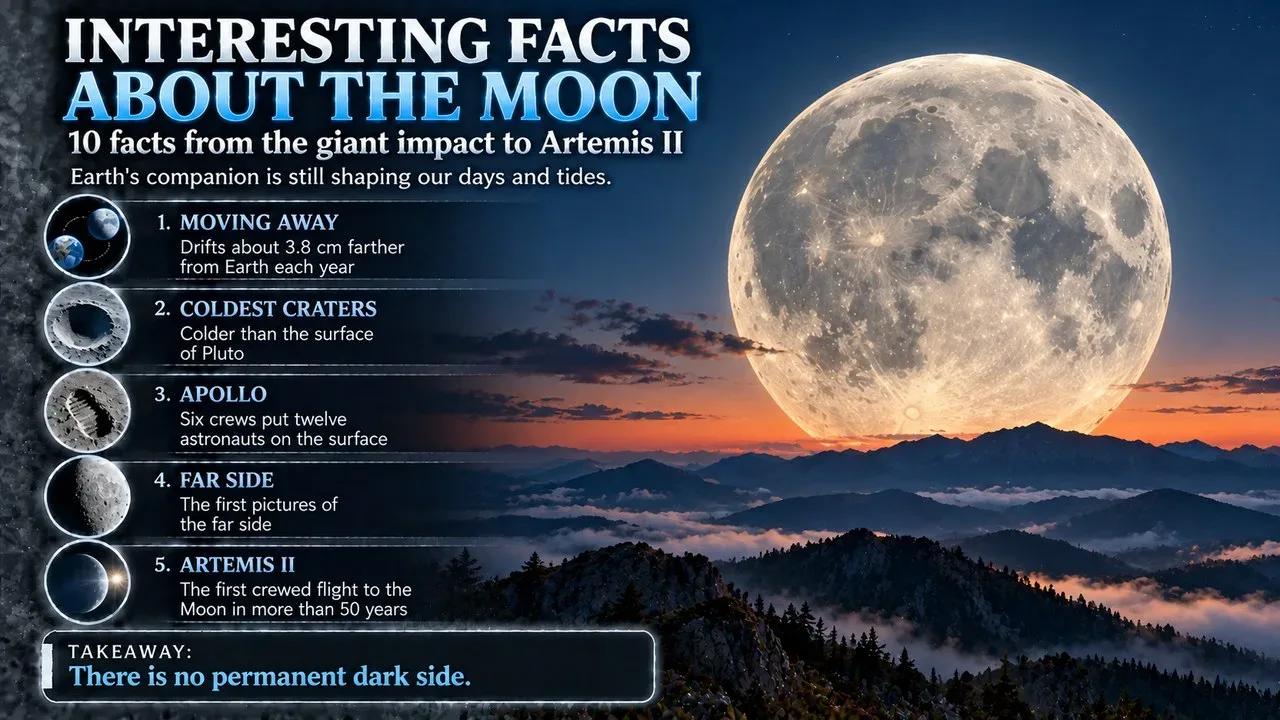
The Moon is Earth's only natural satellite and the brightest object in the night sky.[1] It is about a quarter as wide as Earth, its gravity drives the ocean tides, and it is the only world beyond Earth that people have walked on.[1][7] It has also returned to the centre of space exploration. In April 2026, the Artemis II crew flew around the Moon and travelled farther from Earth than any people before them.[16]
This Finepedia guide, updated in October 2026, collects the top 10 interesting facts about the Moon. Each fact is backed by a source and covers where the Moon came from, why we always see the same face, how it shapes life on Earth, and what the newest missions have found.
Key Facts
| Property | Value |
|---|---|
| Type | Earth's only natural satellite[1] |
| Diameter | 3,474 km, about one-quarter of Earth's[1] |
| Mass | 1.2% of Earth's mass[1] |
| Average distance from Earth | About 384,400 km[5] |
| Cycle of phases | 29.5 days[1] |
| Surface gravity | About one-sixth of Earth's[1] |
| Surface temperature | From about 120 °C down to −171 °C[1] |
| Age | About 4.35 billion years[1] |
| People who have walked on it | 12, on six Apollo missions[1] |
1. The Moon Was Probably Born in a Giant Collision
Most scientists think the Moon formed from material that was blasted off the young Earth when a body about the size of Mars crashed into it.[1] This idea, called the giant-impact hypothesis or the Theia Impact, was first proposed in 1946 by the Canadian geologist Reginald Daly.[2] It suggests that the early Earth collided with a planet-sized body about 4.5 billion years ago, early in the Hadean eon.[2] The impactor is sometimes named Theia, after the Greek Titan who was the mother of Selene, goddess of the Moon.[2]
Dating of crystals from the Moon's ancient magma ocean suggests that the Moon formed about 4.35 billion years ago, late in the formation of the Solar System.[1] After it formed, the Moon cooled and lost most of its atmosphere. Today it has only a tiny atmosphere, a tiny amount of water and a weak magnetic field.[1]
2. We Always See the Same Side
The pull of gravity between Earth and the Moon is strongest on the sides that face each other. Over time these tidal forces have locked the Moon so that the same near side always faces Earth.[1] This is called tidal locking. A tidally locked body takes exactly as long to spin once on its axis as it does to orbit its partner, so the Moon's day matches its month.[1][3]
Because the Moon wobbles slightly in its orbit, a motion called libration, about 59 per cent of its surface can be seen from Earth at one time or another.[4] The rest stayed hidden until 7 October 1959, when the Soviet probe Luna 3 took the first photographs of the far side.[4] The far side is often wrongly called the "dark side", but it gets just as much sunlight as the near side, once every 29.5 days.[1]
Why the Moon Has Phases
As the Moon orbits, the amount of its visible side lit by the Sun changes, from nothing at new moon to nearly all of it at full moon.[17] The four main phases are new moon, first quarter, full moon and last quarter. The phases in between are the waxing crescent, waxing gibbous, waning gibbous and waning crescent.[17] The full cycle takes 29.5 days.[1]
3. The Moon Is Slowly Drifting Away
On average the Moon is about 384,400 kilometres from the centre of Earth, roughly 60 times Earth's radius.[5] Its orbit is elliptical, so the distance ranges from about 363,300 kilometres at its closest point (perigee) to about 405,507 kilometres at its farthest (apogee).[5]
The Moon is slowly moving into a higher orbit.[5] Laser ranging experiments, which bounce laser beams off mirrors left on the lunar surface, show that it is spiralling away from Earth by 3.8 centimetres a year.[6] As the distance grows, the Moon looks very slightly smaller in Earth's sky.[1]
4. The Moon Drives Earth's Tides
Tides are the regular rise and fall of sea level. They are caused by differences in the pull of gravity, mainly from the Moon and the Sun.[7] The water directly under the Moon bulges because the Moon pulls harder on the water closest to it.[1] A second bulge forms on the opposite side of Earth. It can be explained either by the centrifugal force of Earth moving around the Earth–Moon centre of mass, or by the water's inertia, since the Moon pulls the solid Earth more strongly than the far-side water.[1] As a result, many coastlines have two high tides and two low tides each day.[7]
Related: Top 10 Objects Found or Left on the Moon
The tides also work in the other direction. Over about 4.5 billion years, the tidal pull of the Moon, together with the Sun's, has helped stretch Earth's day from about 6 hours to the present 24 hours.[3] Atomic clocks show that Earth's day is still getting longer, by about 2.3 milliseconds per century on average.[3]
The Moon's pull has also been linked to many old beliefs. Aristotle and Pliny the Elder argued that the full moon could cause madness, reasoning that the brain is mostly water. In fact, the Moon's gravity is far too weak to affect a single person in that way.[1]
5. It Is Unusually Large for Its Planet
The Moon is 3,474 kilometres across, about a quarter of Earth's width and about as wide as the contiguous United States. Its mass is 1.2 per cent of Earth's.[1] It is the fifth-largest moon in the Solar System, and larger and more massive than any known dwarf planet, including Pluto. Compared with the planet it orbits, it is the largest and most massive moon of all.[1]
Its surface gravity is about one-sixth of Earth's and about half of Mars's. That is the second-highest surface gravity of any moon in the Solar System, after Jupiter's moon Io.[1]
Inside, the Moon has layers like Earth: a chemically distinct crust, a mantle and a core.[1] The core is thought to have a solid, iron-rich inner part with a radius possibly as small as 240 kilometres, wrapped in a fluid outer core of mostly liquid iron about 300 kilometres in radius.[1]
Why the Moon Looks So Bright
The Moon is the brightest object in Earth's night sky, but that is because it looks so large, not because its surface is shiny. Its surface reflects about as much light as asphalt does.[1]
Related: Top 10 Scientific Facts About Earth's Moon
6. Its Surface Is Scarred by Craters and Ancient Lava
With almost no atmosphere and no weather, the Moon keeps a record of impacts going back billions of years, and many craters are well preserved.[1] Its largest feature is the South Pole–Aitken basin on the far side. At about 2,240 kilometres across, it is the largest crater on the Moon and the second-largest confirmed impact crater in the Solar System.[1]
The dark patches that form the "man in the Moon" are the maria, Latin for "seas". These are plains of basalt made by lava that flooded old craters while the Moon was still volcanically active, until about 1.2 billion years ago.[1] The maria cover about 16 per cent of the lunar surface, mostly on the side that faces Earth.[11] Early astronomers named them seas because they thought the dark spots were water.[11]
A Shrinking Moon with Caves
The Moon is still changing. Cliffs called fault scarps suggest it has shrunk by about 90 metres in the past billion years. It has no tectonic plates, so cracks form slowly as it loses heat.[1] Scientists have also confirmed a cave near the Sea of Tranquility, not far from the Apollo 11 landing site. It is an entrance to a collapsed lava tube, about 45 metres wide and up to 80 metres long, and the first confirmed entrance to a lunar cave.[1] Its steady temperature of about 17 °C could one day shelter astronauts from extreme temperatures, radiation and tiny meteorites.[1]
7. It Is Both Scorching and Freezing, and Holds Ice
Without a thick atmosphere to hold or spread heat, the lunar surface swings from about 120 °C in sunlight to −171 °C.[1] Some craters near the poles never see sunlight. NASA's Lunar Reconnaissance Orbiter measured temperatures as low as −247 °C in the north polar crater Hermite, near the lunar winter solstice.[1]
These permanently shadowed craters can trap water ice. For a long time the Moon was thought to be completely dry, but later robotic probes found evidence of water ice in shadowed craters, and in 2018 water ice was confirmed in several places.[8] The ice is not in sheets. It is thought to be in small chunks mixed into the soil, and some water is chemically bound into minerals.[8] This is one reason NASA plans to land its next astronauts near the lunar south pole.[1]
8. The Moon Has Quakes
The Moon is not completely quiet. It has moonquakes, which were first discovered by the Apollo astronauts.[9] Seismometers placed on the surface between 1969 and 1972 provided most of what is known about them. The instruments left by Apollo 12, 14, 15 and 16 worked until they were switched off in 1977.[9] The biggest moonquakes are much weaker than the largest earthquakes. But because the Moon has fewer ways to damp vibrations, the shaking can last for up to an hour.[9]
Related: Top 10 Most Bizarre Phobias: Strange Fears That Exist
9. A Perfect Fit for Total Solar Eclipses
The Sun is about 400 times farther from Earth than the Moon, and it is also about 400 times wider.[10] This coincidence makes the Moon and the Sun look almost the same size in Earth's sky, so the Moon can cover the Sun completely during a total solar eclipse.[1][10] When the Moon passes through Earth's shadow instead, we see a lunar eclipse.[1] Because the Moon is slowly moving away, the coincidence will not last forever.[1]
10. Twelve People Have Walked There, and More Are Going Back
From Telescopes to the First Probes
The first known telescope observations and rough map of the Moon were made in the early summer of 1609 by Thomas Harriot, who never published them. That same year Galileo Galilei began observing the Moon and concluded that it was not smooth but had mountains and craters.[1] The space age reached the Moon in 1959. The Soviet Luna 1 flew past it, and Luna 2 became the first human-made object to reach its surface, by crashing into it on purpose.[1] In 1966, Luna 9 made the first soft landing and Luna 10 became the first spacecraft to orbit the Moon.[1]
The Apollo Landings
On 20 July 1969, Neil Armstrong and Buzz Aldrin landed the lunar module Eagle in the Sea of Tranquility, while Michael Collins stayed in orbit. About six hours later, Armstrong became the first person to walk on the Moon.[12] An estimated 500 million people watched the broadcast, the largest television audience for a live event at that time.[1] By 1972, six Apollo missions had landed twelve people on the Moon.[1] Together the Apollo missions brought back 2,200 samples weighing 381 kilograms.[13] Moon rocks on Earth come from four sources: the six Apollo landings, three Soviet robotic Luna probes in the 1970s, China's robotic probes, and lunar meteorites, rocks knocked off the Moon that later fell to Earth.[13] More than 370 lunar meteorites have been collected, with a total mass of over 1,090 kilograms.[13]
The New Space Race
In 2023 and 2024, India and Japan became the fourth and fifth countries to make a soft landing on the Moon, after the Soviet Union, the United States and China.[1] India's Chandrayaan-3 touched down near the lunar south pole on 23 August 2023, the first soft landing ever made in that region.[14] In June 2024, China's Chang'e 6 became the first mission to bring back samples from the far side of the Moon. Its lander collected about 1,935 grams of material.[15]
From 1 to 11 April 2026, NASA's Artemis II flew Reid Wiseman, Victor Glover, Christina Koch and the Canadian astronaut Jeremy Hansen around the Moon aboard the Orion spacecraft, which the crew named Integrity.[16] It was the first crewed flight beyond low Earth orbit since Apollo 17 in 1972. The crew reached 406,771 kilometres from Earth, breaking Apollo 13's record for the farthest humans have ever travelled.[16] NASA plans a test flight in low Earth orbit called Artemis III in 2027, followed by the Artemis IV landing at the lunar south pole in 2028. China plans its own crewed landing in 2029 or 2030.[1]
Who Owns the Moon?
No one does. The 1967 Outer Space Treaty defines the Moon and all of outer space as the "province of all mankind".[1] The US-led Artemis Accords of 2020 have renewed debate about how countries should cooperate on the Moon.[1] Even the word "moon" ties it to timekeeping. It comes from the Old English mōna, which goes back to a Proto-Indo-European word meaning "month".[1]
Related: Top 10 Oldest Buildings in the World
Key Figures
- Diameter: 3,474 km[1]
- Average distance from Earth: about 384,400 km[5]
- Rate of drift away from Earth: 3.8 cm per year[6]
- Share of the surface visible from Earth: 59%[4]
- South Pole–Aitken basin: about 2,240 km across[1]
- Share of the surface covered by maria: about 16%[11]
- Apollo samples returned: 381 kg[13]
- Artemis II's maximum distance from Earth: 406,771 km[16]
Frequently Asked Questions
How far away is the Moon?
On average about 384,400 kilometres, varying from about 363,300 to 405,507 kilometres over its orbit.[5]
Why do we only see one side of the Moon?
The Moon is tidally locked. It spins once on its axis in the same time it takes to orbit Earth, so the same side always faces us.[1][3]
Is there water on the Moon?
Yes. Water ice was confirmed in several permanently shadowed craters in 2018, mixed into the soil rather than in sheets.[8]
How many people have walked on the Moon?
Twelve, on six Apollo missions between 1969 and 1972.[1]
Is the Moon moving away from Earth?
Yes. Laser ranging shows it is moving away by about 3.8 centimetres a year.[6]
When did people last travel to the Moon?
The last Moon landing was Apollo 17 in 1972. In April 2026, the four Artemis II astronauts flew around the Moon without landing, the first crewed trip beyond low Earth orbit since then.[16]
Does the full moon make people behave strangely?
Ancient thinkers such as Aristotle and Pliny the Elder believed it did. However, the Moon's gravity is far too weak to affect a single person in that way.[1]
See also
- Top 25 Interesting Facts About the Solar System
- Top 25 Interesting Facts About Earth
- Interesting Facts About the Milky Way Galaxy
- ^ [1] "Moon". Wikipedia. Wikipedia
- ^ [2] "Giant-impact hypothesis". Wikipedia. Wikipedia
- ^ [3] "Tidal locking". Wikipedia. Wikipedia
- ^ [4] "Far side of the Moon". Wikipedia. Wikipedia
- ^ [5] "Orbit of the Moon". Wikipedia. Wikipedia
- ^ [6] "Lunar Laser Ranging experiments". Wikipedia. Wikipedia
- ^ [7] "Tide". Wikipedia. Wikipedia
- ^ [8] "Lunar water". Wikipedia. Wikipedia
- ^ [9] "Moonquake". Wikipedia. Wikipedia
- ^ [10] "Solar eclipse". Wikipedia. Wikipedia
- ^ [11] "Lunar mare". Wikipedia. Wikipedia
- ^ [12] "Apollo 11". Wikipedia. Wikipedia
- ^ [13] "Moon rock". Wikipedia. Wikipedia
- ^ [14] "Chandrayaan-3". Wikipedia. Wikipedia
- ^ [15] "Chang'e 6". Wikipedia. Wikipedia
- ^ [16] "Artemis II". Wikipedia. Wikipedia
- ^ [17] "Lunar phase". Wikipedia. Wikipedia



















Discussion
Log in with