






 By
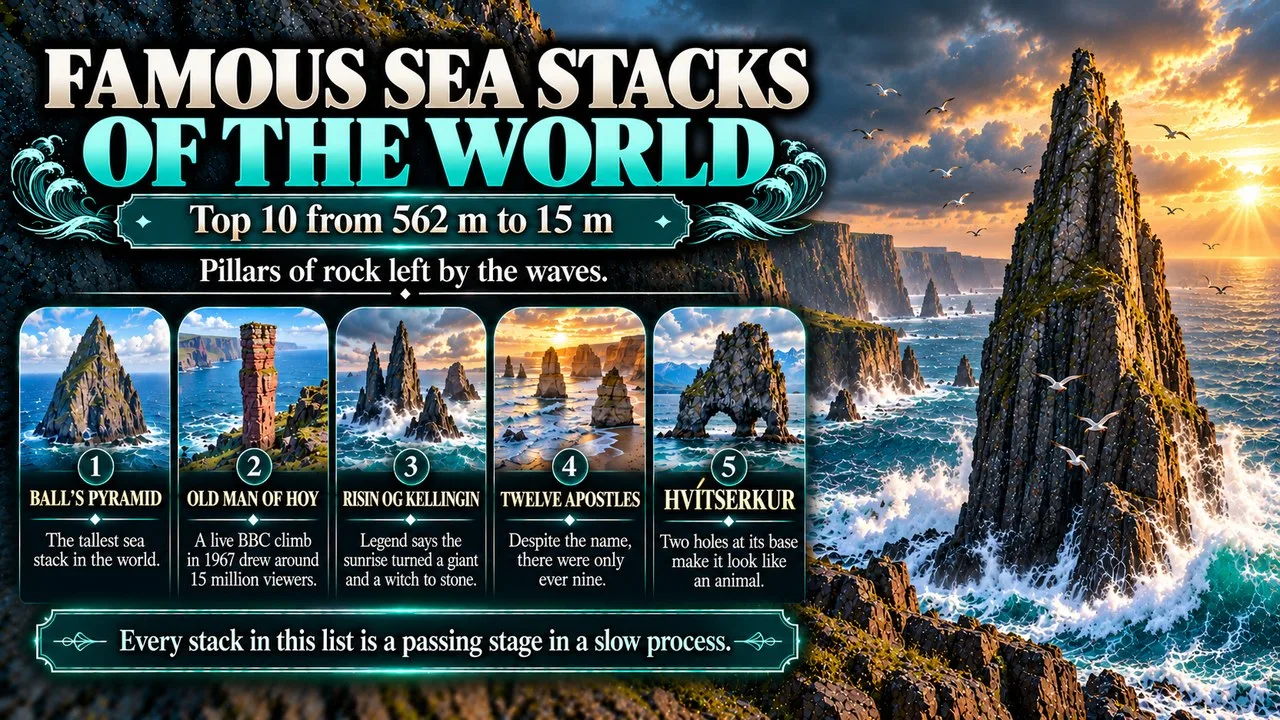
Famous sea stacks of the world are pillars of rock left standing by the waves, from Ball's Pyramid near Lord Howe Island to the Old Man of Hoy in Scotland.
This Finepedia guide, written in October 2026, visits ten of the best-known sea stacks on Earth, from the Pacific to the North Atlantic. Each entry gives the height of the stack, the rock it is made of and one story that makes it famous, whether a record climb, a rare insect or an old legend. For more coastal wonders, see the Finepedia guides Top 10 Breathtaking Natural Arches of the World and Top 10 Nations With the Longest Coastlines.
A sea stack forms when waves attack a headland from both sides [1]. Cracks widen into caves, caves meet to form an arch, and when the roof of the arch falls the seaward end is left as a free-standing pillar. Over time the stack itself is worn down to a stump, so every stack in this list is a passing stage in a slow process that can take thousands of years.
How We Chose These
We chose stacks that are famous for their size, shape, wildlife or history, and that can be seen from a boat or the shore. The list runs from tallest to shortest, using heights above sea level from encyclopaedia and park sources, rounded to the nearest metre. Heights of small stacks vary between sources, so treat them as approximate.
The 10 Famous Sea Stacks at a Glance
| No. | Sea stack | Location | Height | Rock |
|---|---|---|---|---|
| 1 | Ball's Pyramid | Lord Howe Island, Australia | about 562 m | volcanic rock |
| 2 | Stac an Armin | St Kilda, Scotland | about 196 m | volcanic rock |
| 3 | Old Man of Hoy | Orkney, Scotland | about 137 m | red sandstone |
| 4 | Percé Rock | Quebec, Canada | about 88 m | limestone |
| 5 | Haystack Rock | Oregon, United States | about 72 m | basalt |
| 6 | Risin og Kellingin | Eysturoy, Faroe Islands | about 71 m | basalt |
| 7 | Reynisdrangar | Vík, Iceland | about 66 m | basalt |
| 8 | Twelve Apostles | Victoria, Australia | up to about 45 m | limestone |
| 9 | Ko Tapu | southern Thailand | about 20 m | limestone |
| 10 | Hvítserkur | Vatnsnes, Iceland | about 15 m | basalt |
1. Ball's Pyramid Is the Tallest Sea Stack on Earth
Ball's Pyramid rises about 562 metres out of the Tasman Sea, about 20 kilometres south-east of Lord Howe Island, and is the tallest sea stack in the world [2]. It is the worn remains of a volcano that formed around seven million years ago. It takes its name from a Royal Navy officer, Henry Lidgbird Ball.
Key Facts
- Location: Tasman Sea, New South Wales, Australia
- Height: about 562 metres
- Named after: Henry Lidgbird Ball, who sighted it in 1788
- Recognition: part of the Lord Howe Island Group World Heritage Site since 1982
Did You Know?
In 2001 scientists found a tiny colony of the Lord Howe Island stick insect living on a single bush on the side of Ball's Pyramid. The insect was thought to have died out in the 1920s after rats reached Lord Howe Island. Insects bred from that colony now live in zoos, and there are plans to return them to the main island [3].
2. Stac an Armin Is the Highest Stack in the British Isles
Stac an Armin stands about 196 metres high off the island of Boreray in the St Kilda archipelago, about 64 kilometres west of the Outer Hebrides [4]. It is the highest sea stack in Scotland and the British Isles. Together with nearby Stac Lee, it holds one of the largest northern gannet colonies on Earth.
Key Facts
- Location: St Kilda, Outer Hebrides, Scotland
- Height: about 196 metres
- Wildlife: gannets, fulmars and puffins
- Recognition: part of the St Kilda World Heritage Site [5]
Why It Matters
The people of St Kilda used to climb the stacks to catch seabirds and collect eggs, a vital source of food. In 1727 a group of men were stranded on Stac an Armin for about nine months because a smallpox outbreak on the main island left no one to fetch them. St Kilda's last residents left in 1930.
Related: Grand Canyon: A Geological Marvel Carved by the Colorado River
3. Climbers Love Orkney's Old Man of Hoy
Standing off the west coast of Hoy in Orkney, the Old Man of Hoy rises as a tower of red sandstone about 137 metres tall [6]. Old maps suggest it was still joined to the cliffs as a headland in the mid-1700s, so it may be only a few hundred years old as a free-standing stack. Geologists expect it to fall into the sea one day.
Key Facts
- Location: Hoy, Orkney, Scotland
- Height: about 137 metres
- First climbed: 19 July 1966
- Rock: Old Red Sandstone on a base of basalt
Did You Know?
Chris Bonington, Rusty Baillie and Tom Patey made the first ascent in 1966. A year later, the BBC broadcast a live climb of the stack over three evenings, which drew a television audience of around 15 million viewers. Climbers still tackle it today.
4. Percé Rock Is a Stack With a Hole Through It
Percé Rock sits off the tip of the Gaspé Peninsula in Quebec, Canada, about 88 metres high and over 400 metres long [7]. Its name is French for "pierced", after the arch worn through its seaward end. At low tide, visitors can walk out to it across a sandbar from the village of Percé.
Key Facts
- Location: Gaspé Peninsula, Quebec, Canada
- Height: about 88 metres
- Rock: limestone
- Protection: part of Île-Bonaventure-et-du-Rocher-Percé National Park
Why It Matters
Percé Rock once had more than one arch, and old accounts say a second arch fell in 1845. The rock is a reminder that arches and stacks are only stages in the life of a coast. Nearby Bonaventure Island holds one of the largest northern gannet colonies in the world.
5. Haystack Rock Guards Cannon Beach
Haystack Rock rises about 72 metres above the sand at Cannon Beach on the Oregon coast of the United States [8]. It is made of basalt from lava flows that came from far inland millions of years ago. At low tide visitors can walk to its base and look at the tide pools full of sea stars, crabs and anemones.
Key Facts
- Location: Cannon Beach, Oregon, United States
- Height: about 72 metres (235 feet)
- Wildlife: tufted puffins, nesting from spring to summer
- Protection: a marine garden and part of the Oregon Islands National Wildlife Refuge
Did You Know?
Climbing the rock is banned to protect nesting birds. Tufted puffins arrive each spring, and the rock is one of the easiest places in the lower 48 states to see them from the shore.
Related: Top 10 Rarest Rock Formations in the World
6. Risin og Kellingin Are the Giant and the Witch
Off the northern tip of Eysturoy in the Faroe Islands stand two basalt stacks called Risin og Kellingin, the Giant and the Witch [9]. The Giant is about 71 metres high and the Witch about 68 metres. They are among the best-known landmarks of the Faroes, seen from the village of Eiði across the water.
Key Facts
- Location: Eysturoy, Faroe Islands
- Heights: about 71 metres and 68 metres
- Rock: basalt
- Best view: from the cliffs near Eiði
Why It Matters
A legend says giants from Iceland sent a giant and a witch to drag the Faroes north. They worked through the night, but the sun rose and turned them to stone before they could finish. Geologists warn that the Witch may one day fall, as cracks have formed near its base.
7. Reynisdrangar Rise Off Iceland's Black Sand Beach
The Reynisdrangar are basalt stacks standing in the sea near the village of Vík, on Iceland's south coast, with the tallest about 66 metres high [10]. They lie just off Reynisfjara, a beach of black volcanic sand backed by cliffs of six-sided basalt columns.
Key Facts
- Location: near Vík í Mýrdal, south Iceland
- Height: about 66 metres
- Rock: columnar basalt
- Setting: off Reynisfjara black sand beach
Did You Know?
Icelandic folk tales say the stacks are trolls who were caught by daylight while dragging a ship to shore. The beach is famous for dangerous sneaker waves that can rush far up the sand without warning, so visitors are told to stay well back from the water.
8. The Twelve Apostles Were Never Twelve
The Twelve Apostles are limestone stacks along the Great Ocean Road in Port Campbell National Park, Victoria, rising up to about 45 metres [11]. Despite the name, there were only ever nine. Seven of the original nine remain standing after collapses, including one in 2005.
Related: Top 10 Most Breathtaking Desert Landscapes
Key Facts
- Location: Port Campbell National Park, Victoria, Australia
- Height: up to about 45 metres
- Rock: limestone
- Stacks standing: seven of the original nine
Why It Matters
The stacks were once called the Sow and Piglets, and the grander name was adopted in the 20th century to attract visitors. The soft limestone wears away at about two centimetres a year, so new stacks will form along the cliffs as old ones fall.
9. Ko Tapu Became Famous in a Spy Film
Ko Tapu is a slender limestone stack about 20 metres high in Phang Nga Bay, southern Thailand [12]. It narrows towards its base, so it seems to balance on the water. It sits beside Khao Phing Kan, an island now known to visitors as James Bond Island.
Key Facts
- Location: Phang Nga Bay, Thailand
- Height: about 20 metres
- Rock: limestone
- Protection: Ao Phang Nga National Park
Did You Know?
The stack appeared in the 1974 film The Man with the Golden Gun, which made the bay a tourist hit. Since 1998 boats have been kept away from the base of the stack to slow the erosion that is eating into it.
10. Hvítserkur Looks Like a Beast Drinking From the Sea
Hvítserkur is a basalt stack about 15 metres high off the Vatnsnes peninsula in north-west Iceland [13]. Two holes at its base make it look like an animal, often described as a dragon or a rhino, bending down to drink. Its name means "white shirt", after the pale coat of seabird guano on its top.
Key Facts
- Location: Vatnsnes peninsula, north-west Iceland
- Height: about 15 metres
- Rock: basalt
- Protection: base reinforced with concrete
Why It Matters
Local tradition says Hvítserkur is a troll turned to stone by the rising sun. In the mid-20th century farmers worried that the sea would bring it down and reinforced its base with concrete, which shows how much the stack means to the area.
Related: Top 10 Giant Sinkholes and Blue Holes
Frequently Asked Questions
What is the tallest sea stack in the world?
Ball's Pyramid, off Lord Howe Island in Australia, is the tallest at about 562 metres [2]. In the British Isles the tallest is Stac an Armin in St Kilda, at about 196 metres [4].
How do sea stacks form?
Waves exploit cracks in a headland and carve caves. When caves on both sides meet, they form an arch. When the arch collapses, the outer part is left as a stack, which is later worn down to a low stump [1].
Can you climb sea stacks?
Some stacks, such as the Old Man of Hoy, are popular with experienced climbers. Others are closed to protect nesting birds or fragile rock, including Haystack Rock in Oregon and Ball's Pyramid, which needs a permit.
Will these sea stacks last forever?
No. Every stack is slowly being worn away by the sea. Collapses at the Twelve Apostles and Percé Rock show that change can happen suddenly, after years of hidden erosion at the base.
Conclusion
Famous sea stacks of the world range from the 562-metre Ball's Pyramid to little Hvítserkur, a 15-metre rock that looks like a beast at the water's edge. They hold seabird colonies, rare insects and old legends, and they remind us that coastlines are always changing. For more coastal wonders, read the Finepedia guides Top 10 Breathtaking Natural Arches of the World and Top 10 Nations With the Longest Coastlines.
- ^ [1] "Stack (geology)". Wikipedia. Sea stack on Wikipedia.
- ^ [2] "Ball's Pyramid". Wikipedia. Ball's Pyramid on Wikipedia.
- ^ [3] "Lord Howe Island Group". UNESCO World Heritage Centre. UNESCO listing 186.
- ^ [4] "Stac an Armin". Wikipedia. Stac an Armin on Wikipedia.
- ^ [5] "St Kilda". UNESCO World Heritage Centre. UNESCO listing 387.
- ^ [6] "Old Man of Hoy". Wikipedia. Old Man of Hoy on Wikipedia.
- ^ [7] "Percé Rock". Wikipedia. Percé Rock on Wikipedia.
- ^ [8] "Haystack Rock". Wikipedia. Haystack Rock on Wikipedia.
- ^ [9] "Risin og Kellingin". Wikipedia. Risin og Kellingin on Wikipedia.
- ^ [10] "Reynisdrangar". Wikipedia. Reynisdrangar on Wikipedia.
- ^ [11] "The Twelve Apostles (Victoria)". Wikipedia. Twelve Apostles on Wikipedia.
- ^ [12] "Khao Phing Kan". Wikipedia. Khao Phing Kan and Ko Tapu on Wikipedia.
- ^ [13] "Hvítserkur". Wikipedia. Hvítserkur on Wikipedia.
- [14] "10 Most Amazing Sea Stacks in the World". 10 Most Today. Topic reference on 10mosttoday.com.






















Discussion
Log in with