





Top 10 Famous Meteorites and the Stories Behind Them
 By Dhiraj Sharma · Published
Share Post
Loading…
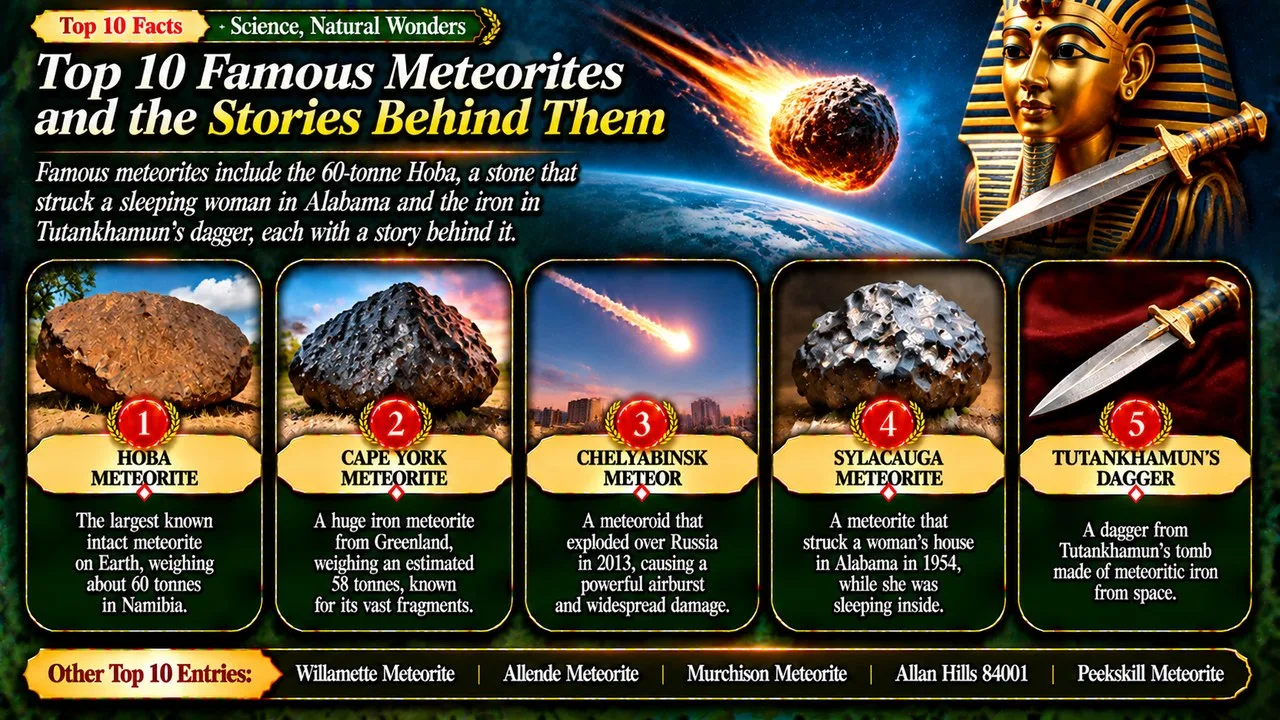
Famous meteorites include the 60-tonne Hoba, a stone that struck a sleeping woman in Alabama and the iron in Tutankhamun's dagger, each with a story behind it.
Every year, many tonnes of rock and dust from space reach the Earth's surface. Most of it is never seen, but a few meteorites have become famous, because of their size, their age, the science hidden inside them or the very unlucky places where they came down.
This Finepedia guide, written in November 2026, takes its topic from a Listverse list of meteorites with unusual backstories [21]. The selection, order and wording are our own. We kept three of its stories, the Alabama strike, the Peekskill car and Tutankhamun's dagger, and added giant irons, a Martian rock and the famous Chelyabinsk fireball. Every figure below is checked against at least two sources, and where sources give different numbers we say so or use a rounded value.
Key Facts
This table sums up the ten meteorites, where they fell or were found and why each one is famous.
Famous Meteorites at a Glance
| Rank | Name | Where | Fell or found | Why it is famous |
|---|---|---|---|---|
| 1 | Hoba Meteorite | Namibia | Found 1920 | Largest known single meteorite, about 60 tonnes |
| 2 | Cape York Meteorite | Greenland | Removed 1895 to 1897 | Inuit used its iron for tools for centuries |
| 3 | Willamette Meteorite | Oregon, USA | Known to Europeans from 1902 | Largest found in the US, sacred to local tribes |
| 4 | Chelyabinsk Meteor | Russia | 15 February 2013 | Airburst injured about 1,500 people |
| 5 | Allende Meteorite | Mexico | 8 February 1969 | Holds some of the oldest solids known |
| 6 | Murchison Meteorite | Australia | 28 September 1969 | Amino acids and stardust older than the Sun |
| 7 | Allan Hills 84001 | Antarctica | Found 1984 | Martian rock behind a 1996 claim of ancient life |
| 8 | Sylacauga Meteorite | Alabama, USA | 30 November 1954 | Struck Ann Hodges in her home |
| 9 | Peekskill Meteorite | New York, USA | 9 October 1992 | Filmed in flight, then hit a parked car |
| 10 | Tutankhamun's Meteoric Iron Dagger | Egypt | Tomb opened in the 1920s | A royal blade made of space iron |
1. Hoba Meteorite
The Hoba meteorite lies on the farm Hoba West, near Grootfontein in northern Namibia, exactly where it landed [1][2]. It is the largest known meteorite in one piece. Its main mass is estimated at about 60 tonnes, and it measures about 2.7 by 2.7 metres and less than a metre thick [1][2]. It is also the largest piece of naturally occurring iron known on the Earth's surface [1].
It is thought to have fallen less than about 80,000 years ago [1][2]. Because it is so flat, scientists believe the air slowed it down until it hit the ground fairly gently, which is why it left no crater and stayed in one piece [1]. Its discovery was pure chance. In 1920 the farmer Jacobus Hermanus Brits was ploughing a field with an ox when his plough struck something metal and stopped dead [1][2].
Over the years, erosion, sampling and souvenir hunters chipped pieces off the rock. To protect it, the government declared it a national monument in 1955, and in 1987 the farm's owner donated the site for public education [1][2]. A visitor centre and a stone amphitheatre now surround it, and vandalism has stopped [1][2]. Its record size earns Hoba first place.
2. Cape York Meteorite
The Cape York meteorite is one of the largest known iron meteorites. It fell in north-west Greenland thousands of years ago and broke into several large pieces [3][4]. For centuries the local Inughuit people knew of the stones and chipped iron from them to make blades for tools and harpoons [3].
The local people called the three biggest pieces the Woman, the Dog and the Tent [3]. In 1895 the American explorer Robert Peary shipped the Woman and the Dog to the United States, and in 1897, after great effort, he removed the Tent, now known as Ahnighito [3][4]. He later sold the pieces to the American Museum of Natural History in New York [3].
Related: Top 25 Interesting Facts About the Solar System
Ahnighito weighs about 31 metric tonnes, or 34 US tons, and the museum says it is the largest meteorite on display in any museum [4][3]. It is so heavy that its supports run straight down to the bedrock beneath the building [4]. A space rock that was once a vital source of metal for Arctic hunters takes second place.
3. Willamette Meteorite
The Willamette meteorite is an iron-nickel meteorite found near Oregon City in the US state of Oregon. Weighing about 15.5 tonnes, it is the largest meteorite ever found in the United States [5][6].
There was no crater where it was found. Scientists think it originally landed farther north, in what is now Canada or Montana, and was carried into the Willamette Valley by ice and floods at the end of the last Ice Age [5]. The Clackamas Chinook people knew it long before European settlers and called it tomanowos, often translated as spirit power [5][6].
A settler named Ellis Hughes tried to claim it in 1902 by secretly moving it onto his own land, which led to a court case [5]. The American Museum of Natural History acquired it in 1906 [5]. After a legal claim by the Confederated Tribes of the Grand Ronde, the museum and the tribes reached an agreement that allows tribal members to hold a private ceremony with the meteorite each year [5][6]. A meteorite that is both a scientific treasure and a sacred object earns third place.
4. Chelyabinsk Meteor
On the morning of 15 February 2013, a small asteroid entered the atmosphere over the Chelyabinsk region of Russia and exploded in the sky [7][8]. NASA estimated that it was about 17 to 20 metres across and weighed around 10,000 tonnes before it hit the air [8][7]. It was the biggest natural object known to enter the Earth's atmosphere since the Tunguska event of 1908 [7].
The blast released energy equal to about 440 to 500 kilotonnes of TNT [8][7]. The fireball was briefly brighter than the Sun and was recorded by many dashboard cameras and security cameras [7]. Minutes after the flash, a shock wave arrived and blew in windows across the city.
About 1,500 people needed medical treatment, almost all of them hurt by flying glass rather than by the space rock itself [7][8]. Fragments were later recovered, including a large piece pulled from Lake Chebarkul [7]. A reminder that even a small asteroid can do real harm earns Chelyabinsk fourth place.
5. Allende Meteorite
In the early hours of 8 February 1969, a brilliant fireball lit up the sky over northern Mexico and exploded above the state of Chihuahua [9][10]. The original stone was roughly the size of a car, and it broke into thousands of pieces that fell around the village of Pueblito de Allende [9][10]. More than two tonnes of fragments were collected, scattered over one of the largest meteorite strewn fields known [9][10].
Related: Top 10 Mythical Creatures in World Mythology - That Inspired Myths Across Civilizations (unchanged)
Allende is the largest carbonaceous chondrite ever found, a rare type of stony meteorite that has changed little since the planets formed [9]. Before 1969 scientists had only small amounts of this kind of material. Allende suddenly gave laboratories around the world plenty to study, and it is often called the best-studied meteorite in history [9].
Its most important treasures are small white specks called calcium-aluminium-rich inclusions. Dated to about 4.57 billion years ago, they are among the oldest solid materials that formed around the young Sun, older than the Earth itself [9][10]. A meteorite that opened a window on the birth of the planets earns fifth place.
6. Murchison Meteorite
On the morning of 28 September 1969, only months after Allende, a bright fireball split into fragments over the town of Murchison in Victoria, Australia [11][12]. More than 100 kg of material was recovered. Because it was a large, freshly fallen carbonaceous chondrite, Murchison became one of the most studied meteorites of all [11].
Murchison is rich in organic chemicals. Researchers have found many amino acids inside it, the building blocks of proteins, including common ones such as glycine and alanine and unusual ones not found in living things on Earth [11]. These finds support the idea that some of the raw ingredients for life could have been delivered to the early Earth from space [11].
In 2020 a team led by Philipp Heck of the Field Museum in Chicago reported that tiny silicon carbide grains in Murchison are stardust that formed before the Sun was born [12][11]. Some of the grains are about 5 to 7 billion years old, making them the oldest solid material ever found on Earth [12][11]. The Field Museum holds the largest portion of the meteorite [12]. A rock carrying grains older than the Sun takes sixth place.
7. Allan Hills 84001
Allan Hills 84001, usually shortened to ALH84001, is a meteorite from Mars. It was found on 27 December 1984 in the Allan Hills of Antarctica by Roberta Score, a member of a US meteorite-hunting team [13]. Like other Martian meteorites, it was blasted off the surface of Mars by an impact, spent millions of years in space and then fell to Earth [13][14].
Related: Top 25 Interesting Facts About the Universe
NASA's 1996 announcement explained that the rock was thrown from Mars about 16 million years ago and fell in Antarctica about 13,000 years ago [14][13]. In August 1996, a team led by David McKay reported that the meteorite contained organic molecules, mineral grains and tiny worm-like shapes that might be fossils of ancient Martian bacteria [13][14]. The news made headlines around the world, and US President Bill Clinton made a statement about it [13].
The claim was controversial from the start. Over the following years most scientists concluded that all the unusual features could be explained without life [13]. Even so, the debate it started helped to launch the modern science of astrobiology and boosted the search for life on Mars [13]. The rock that briefly made the world believe in Martian life earns seventh place.
8. Sylacauga Meteorite
At 12:46 in the afternoon on 30 November 1954, a meteorite crashed through the roof of a house near Sylacauga, Alabama [15][16]. Inside, Ann Hodges was napping on her couch. The rock, weighing about 8.5 pounds, bounced off a large radio and struck her on the hip, leaving a huge bruise [15][16]. She is the first person known for certain to have been injured by a meteorite [16].
At first Hodges thought a gas heater had exploded [16]. Police and Air Force officers took the stone for examination, and it was confirmed to be a meteorite [15][16]. By nightfall, around 200 reporters and sightseers crowded the yard, and Hodges became a national celebrity, appearing in Life magazine and on television [16].
There was then a long legal fight. Their landlady, Birdie Guy (spelled Bertie in some accounts), claimed the meteorite because it had fallen on her property, and the Hodgeses eventually paid her to settle [15][16]. Offers for the rock faded, and in 1956 they donated it to the Alabama Museum of Natural History at the University of Alabama, where it is still on display [15][16]. The only well-documented meteorite to strike a person earns eighth place.
9. Peekskill Meteorite
On the evening of 9 October 1992, a bright fireball streaked across the eastern United States and was seen by thousands of people [17][18]. Because it was a Friday night, many fans at high school football games were filming, and the fireball was caught on more video cameras than almost any other meteorite fall of its time [17][18].
The meteor broke up as it flew north-east, and one stony piece about the size of a bowling ball came down in Peekskill, New York [17][18]. It smashed through the trunk of a parked red 1980 Chevrolet Malibu owned by 17-year-old Michelle Knapp, and came to rest in a pit beneath the car [17][18]. When Knapp ran outside, the stone was still warm and smelled of sulfur [18]. It weighed about 12 kg [17].
Related: Top 25 Weird Facts About Left-Handed People
The many videos let scientists reconstruct the meteor's flight path [17]. Both the rock and the car were later sold to collectors [17]. A meteorite that turned a teenager's car into a museum piece earns ninth place.
10. Tutankhamun's Meteoric Iron Dagger
When the tomb of the Egyptian pharaoh Tutankhamun was opened in the 1920s, archaeologists found 19 iron objects among its treasures [19][20]. In the Bronze Age iron smelting was rare in Egypt, so iron was a precious material [19]. The finest object was a dagger with an iron blade and a gold handle, found wrapped with the king's mummy [19][20].
Scientists had long suspected that the blade's iron came from space because of its high nickel content [19][20]. A 2016 study used X-ray fluorescence to analyse it without causing damage and found that the blade is mostly iron with about 11 percent nickel and 0.6 percent cobalt, a mix that matches iron meteorites [19][20]. Iron from rocks on Earth very rarely contains so much nickel [20].
A further study in 2022 found a criss-cross pattern on the blade typical of one common group of iron meteorites, and concluded that it was forged at relatively low heat [20]. The Amarna letters, ancient diplomatic records, mention an iron dagger with a gold hilt sent to Tutankhamun's grandfather by the king of Mitanni as a wedding gift, which may be this very blade [20]. The dagger is now displayed at the Grand Egyptian Museum [19]. A king's weapon forged from a fallen star closes our list.
Conclusion
From a 60-tonne iron block in a Namibian field to a fragment of Mars in the Antarctic ice, these ten meteorites show how much a single rock from space can tell us. Some have changed science, some have changed lives and a few have simply landed in the wrong place at the wrong time.
The figures here follow museum and research records, which are sometimes revised. For the giant scars that bigger impacts have left behind, see Top 10 Famous Impact Craters on Earth and Top 10 Most Beautiful Crater Lakes in the World.
- ^ [1] "Hoba meteorite". Wikipedia. Wikipedia
- ^ [2] "Hoba meteorite, a fallen shooting star". The Namibian. The Namibian
- ^ [3] "Cape York meteorite". Wikipedia. Wikipedia
- ^ [4] "Ahnighito". American Museum of Natural History. AMNH
- ^ [5] "Willamette Meteorite". Wikipedia. Wikipedia
- ^ [6] "The Willamette Meteorite". American Museum of Natural History. AMNH
- ^ [7] "Chelyabinsk meteor". Wikipedia. Wikipedia
- ^ [8] "Additional Details on the Large Feb. 15 Fireball over Russia". NASA Jet Propulsion Laboratory. NASA JPL
- ^ [9] "Allende meteorite". Wikipedia. Wikipedia
- ^ [10] "The Oldest Material in the Smithsonian Institution Came From Outer Space". Smithsonian Magazine. Smithsonian Magazine
- ^ [11] "Murchison meteorite". Wikipedia. Wikipedia
- ^ [12] "Meteorite contains the oldest material on Earth: 7-billion-year-old stardust". Field Museum. Field Museum
- ^ [13] "Allan Hills 84001". Wikipedia. Wikipedia
- ^ [14] "Meteorite Yields Evidence of Primitive Life on Early Mars". NASA. NASA
- ^ [15] "Sylacauga (meteorite)". Wikipedia. Wikipedia
- ^ [16] "Hodges Meteorite Strike (Sylacauga Aerolite)". Encyclopedia of Alabama. Encyclopedia of Alabama
- ^ [17] "Peekskill meteorite". Wikipedia. Wikipedia
- ^ [18] "Peekskill Meteorite". American Museum of Natural History. AMNH
- ^ [19] "Tutankhamun's meteoric iron dagger". Wikipedia. Wikipedia
- ^ [20] "X-rays help unlock secrets of King Tut's iron dagger, made from a meteorite". Ars Technica. Ars Technica
- ^ [21] "10 Meteorites with Quirky and Scary Backstories". Listverse. Topic reference on Listverse





















Discussion
Log in with