




 By
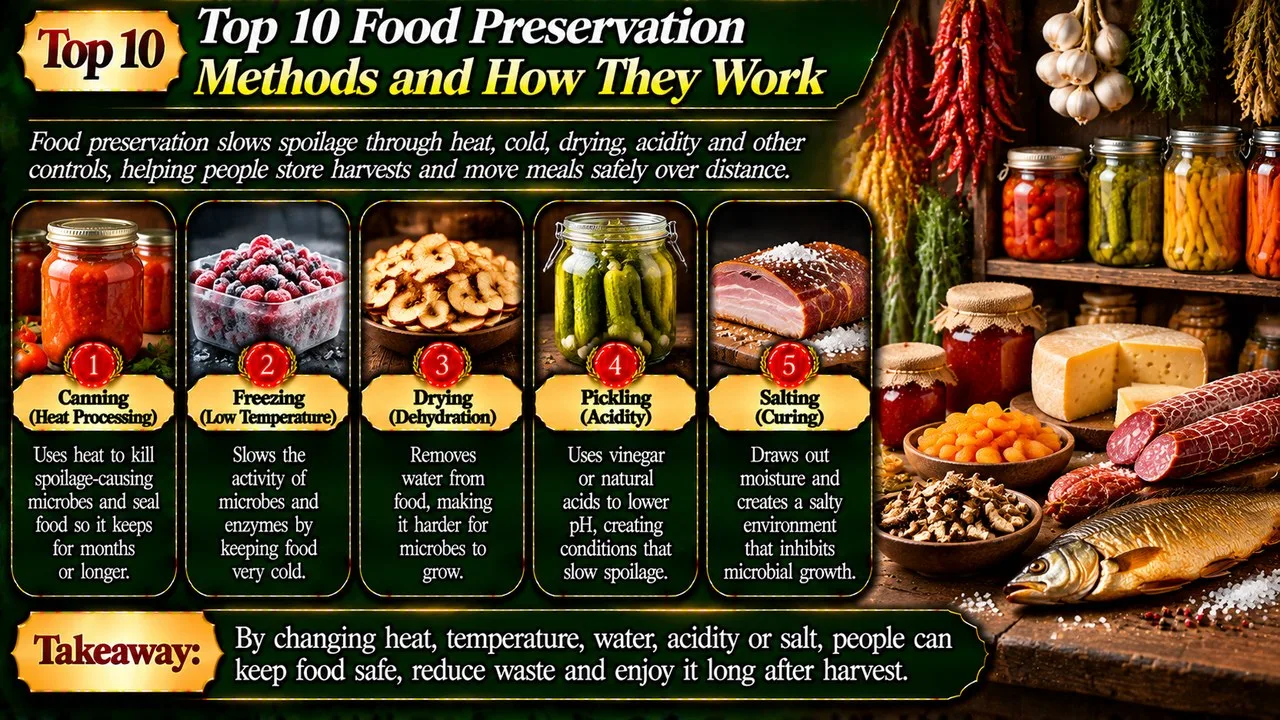
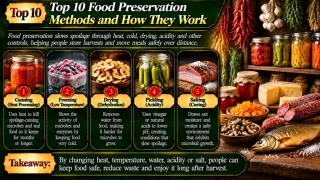
Food preservation slows spoilage through heat, cold, drying, acidity and other controls, helping people store harvests and move meals safely over distance.
A harvest may arrive all at once, while hunger returns every day. Preserving food bridges that mismatch. It also helps people carry meals on journeys, trade beyond local markets and reduce waste. The challenge is not simply making a product look unchanged: safety, flavour, texture and nutritional quality are related but different goals.
This November 2026 guide adapts a Listverse topic on keeping food longer [21]. Four source approaches remain, while six better-established comparisons replace entries with weak safety claims or overlapping methods. Our independent order considers historical reach, everyday usefulness and the clarity of the underlying mechanism. This is an overview, not a recipe guide. Home preservation requires tested procedures from a reliable food-safety authority; an attractive jar or a pleasant smell cannot establish that food is safe.
Key Facts
The table summarises each entry; the order reflects the editorial criteria above, not a universal measure of value.
Food Preservation Methods and How They Work at a Glance
| Rank | Name | Context | Main feature | Notable point |
|---|---|---|---|---|
| 1 | Canning | Heat and a sealed container | Vegetables, fruit and prepared foods | Processing must match the food |
| 2 | Refrigeration | Low temperature | Milk, fresh produce and meals | Cold slows growth rather than sterilising |
| 3 | Freezing | Water turned into ice | Meat, vegetables and prepared meals | Safe thawing still matters |
| 4 | Drying | Reduced available water | Fruit, grains and dried fish | Moisture-proof storage is essential |
| 5 | Fermentation | Useful microbial activity | Yoghurt, sauerkraut and kimchi | Controlled change is not random decay |
| 6 | Pickling | Acidity | Vegetables and relishes | A tested balance of ingredients matters |
| 7 | Salting | Salt and water availability | Fish, meat and some vegetables | Salt alone is not a universal guarantee |
| 8 | Modified-Atmosphere Packaging | Selected gases and packaging | Fresh produce and packed foods | A sealed bag still needs correct storage |
| 9 | Food Irradiation | Ionising radiation | Spices and approved fresh foods | Treatment does not make food radioactive |
| 10 | High-Pressure Processing | Intense pressure | Juices and ready-to-eat products | Effectiveness depends on the product |
1. Canning
Canning combines suitable heat treatment with a container that prevents later contamination. The container need not be a metal can: glass jars belong to the same broad approach. Nicolas Appert's work in France helped establish practical preservation by heating food in sealed vessels before the microbiology behind the method was fully understood [1][2].
The central point is that the seal and the treatment do different jobs. Closing a lid does not remove every hazard already inside. Heat must be sufficient for the product and its conditions, while the intact container protects the treated food afterwards. Acidity is especially important in choosing a safe method, so procedures for one food cannot simply be transferred to another [1][2].
First place reflects storage without continuous chilling. That achievement depends on correct processing, not just a closed lid. Contamination need not announce itself by smell. Anyone making preserves should follow current, tested guidance for the particular food and equipment. A sealed jar alone cannot establish whether its contents are safe.
2. Refrigeration
Refrigeration removes heat and keeps food at a lower temperature, slowing microbial growth and many changes that reduce quality. Long before the electric refrigerator, people used cool caves, snow, icehouses and harvested ice. Mechanical cooling made it possible to maintain low temperatures more consistently rather than relying entirely on the weather and a dwindling block of ice [3][4].
A refrigerator does not sterilise its contents. Some microorganisms can still grow under chilled conditions, and raw food can contaminate ready-to-eat food if handling is careless. The cold chain also extends beyond a household appliance: storage, transport and retail display all need appropriate temperature control for products that depend on chilling [3][4].
Related: Top 10 Most Bizarre Phobias: Strange Fears That Exist
Its ranking reflects daily usefulness and support for varied diets. Opening a package, warming food in transit or overloading an appliance can change its expected life. Continuous temperature control matters more than one cooling event. Refrigeration slows deterioration; it cannot reverse every change that happened before storage or restore abused food.
3. Freezing
Freezing preserves food partly by converting water into ice and greatly restricting microbial activity. It offers longer storage than ordinary chilling for many products, but it does not reliably kill every organism present. When food thaws, surviving microbes can become active again if conditions allow. Safe handling therefore remains important before freezing and after thawing [5][6].
Speed affects quality as well as convenience. Faster freezing generally produces smaller ice crystals, which can reduce damage to the structure of foods such as vegetables and fish. Different products respond differently: a food may remain safe under appropriate frozen storage while losing the texture that made it appealing. Safety and eating quality should not be confused [5][6].
Freezing preserves many foods without making them sour, salty or dry. Its benefits depend on maintaining suitable conditions, however. Refreezing does not erase a product’s earlier history. Third place recognises the value of a biological pause while stressing its limit: ice cannot cancel every consequence of previous warmth or careless preparation.
4. Drying
Drying removes moisture so that less water remains available for microbial growth. Traditional sun and air drying helped communities store grains, fruit, meat and fish long before powered equipment. Modern dehydrators use controlled airflow and heat to make the process more predictable, while specialist approaches can protect products that are easily damaged by warmth [7][8].
The important property is available water, not simply whether something feels dry at the surface. A thick piece may retain moisture inside, and different foods need different preparation and handling. After drying, a product must be protected against moisture returning from the air. Packaging is therefore part of preservation, rather than a decorative final step [7][8].
Removing water reduces carrying weight and changes texture, sometimes creating valued foods rather than merely preserving fresh ones. Dried fruit and fish have culinary identities of their own. Fourth place reflects that long usefulness. As always, suitable processing matters: drying an already spoiled ingredient does not reliably make it safe.
5. Fermentation
Fermentation uses the activity of selected or encouraged microorganisms to transform food. In lactic fermentations, acids produced by bacteria can help inhibit unwanted microbes. Other fermentations produce alcohol or create flavour and texture. Yoghurt, sauerkraut and many other foods are therefore products of organised biological change rather than efforts to stop all microbial life [9][10].
Related: Top 10 Facts About Dogs
Calling this simply controlled rotting is misleading. Useful fermentation depends on conditions that favour the intended organisms and discourage hazards. Ingredients, salt, temperature and time can all matter, depending on the food. A bubbling mixture is not automatically a successful ferment, and a traditional name does not make every improvised version safe [9][10].
Fermentation joins preservation with the creation of flavours communities value. It shows why microbes are not a uniform enemy: outcomes depend on which organisms thrive and what they produce. Reliable practice manages that distinction. A tested ferment and random spoilage may both involve microbial activity without being equally useful or safe.
6. Pickling
Pickling preserves through acidity, either introduced directly with an acidic ingredient or produced through fermentation. This is why pickling and fermentation overlap without being identical. A quick vinegar pickle and a fermented vegetable can both taste sour, but they reach that state through different routes. The method chosen affects both safety and the character of the finished food [11][12].
Reliable recipes control the relationship between the food and its preserving liquid. Adding more vegetables, weakening the vinegar or changing proportions may change more than taste. The National Center for Home Food Preservation stresses that acidity is essential to safety and warns against altering tested proportions casually. A jar is not safe merely because its contents seem sharp on the tongue [12].
Changing acidity can make food less hospitable to unwanted microbes, but storage still matters. Some pickles need chilling; others require a validated heat process before cupboard storage. Sixth place recognises a useful mechanism with specific limits. Similar names and sour flavours do not justify treating every pickle in the same way.
7. Salting
Salting makes water less available to microorganisms and can draw moisture from food. It has long been used with fish, meat and some vegetables, often alongside drying, smoking or fermentation. The preservative effect depends on the resulting conditions within the product, not simply on a visible layer of white crystals or a salty taste [13][14].
Related: Top 10 Tallest Buildings in the World
Some organisms tolerate salt better than others. That is why the statement that salt kills everything is both inaccurate and unhelpful. Food thickness, distribution of salt and other ingredients can affect the outcome. Traditional cured foods often depend on several coordinated controls, and their familiar appearance should not conceal the care required in making them [13][14].
Salted foods supported trade and journeys while influencing cuisine. The method ranks for that historical reach, not as a universal stand-alone safeguard. Seasoning and preservation are different tasks: a pleasant salty taste need not establish safety. Tested procedures must determine preparation and storage, rather than intuition about flavour alone.
8. Modified-Atmosphere Packaging
Modified-atmosphere packaging changes the mix of gases surrounding food inside a package. Manufacturers may use different proportions of oxygen, carbon dioxide and nitrogen to slow particular forms of deterioration. The packaging material must also have suitable barrier properties, because gases and moisture can move through some films rather than remaining permanently fixed [15][16].
There is no single ideal gas mixture for every food. Fresh produce continues to respire, while fatty foods may need protection from oxidation. The choice of film and atmosphere therefore depends on the product. Removing oxygen can inhibit some unwanted activity, but it does not remove every food-safety hazard or make chilling unnecessary [15][16].
The package controls an overlooked part of preservation: the food’s immediate surroundings. Opening it changes those conditions, so an unopened product’s expected life cannot simply carry over. Eighth place recognises that useful control. A long date and neat seal do not remove the need to follow storage and handling instructions.
9. Food Irradiation
Food irradiation exposes approved products to ionising radiation under controlled conditions. Depending on the treatment and food, it can reduce harmful microorganisms, control insects or delay processes such as sprouting. It does not make the food radioactive. The energy is used as a processing tool, rather than leaving a radioactive ingredient behind in the meal [17][18].
The US Food and Drug Administration distinguishes several approved radiation sources and assesses their uses in particular foods. The exact permissions vary between jurisdictions, so a general explanation should not be mistaken for a worldwide list of approved applications. It is also different from simply warming a meal in a microwave oven; the treatments use different physical effects [17][18].
Related: 10 Sikh Gurus: The Pillars of Sikhism Who Shaped Faith, Equality, Courage, and Humanity
The method targets microbes without relying solely on ordinary heating, but later contamination remains possible. The FDA warns that it cannot replace safe handling and storage. Ninth place recognises a useful intervention, not immunity from every hazard. Neither a radioactive-dinner fear nor complete confidence in an unopened label explains its real limits.
10. High-Pressure Processing
High-pressure processing subjects food to intense pressure for a controlled period. It can inactivate many microorganisms while limiting some changes associated with strong heating. Products such as juices and ready-to-eat foods can be treated this way, often after packaging, reducing opportunities for contamination introduced by later handling [19][20].
Its effectiveness is not identical for every organism or every food. Pressure, duration, temperature and the product's properties all matter. Resistant spores are a particular reason not to equate an ordinary pressure treatment with complete sterilisation. The European Food Safety Authority's assessment emphasises defined treatment conditions and the specific hazards being controlled, rather than a promise that pressure always removes everything [19][20].
A treated product may still need refrigeration. This final entry illustrates the broader rule: match preservation to the food, verify the effect and maintain suitable conditions afterwards. Intense-pressure equipment adds an option rather than cancelling other controls. It should not be confused with household pressure cooking or adapted into an untested home substitute.
Conclusion
Heat, cold, water availability, acidity and controlled packaging each address different causes of deterioration. Many foods rely on several barriers together. That is why the best preservation method is not necessarily the newest one, but the one validated for the product and supported by correct storage and handling.
For the objects that help turn ingredients into meals, see Top 10 Most Important Kitchen Tools. The stories in Top 10 Accidental Inventions That Changed Everyday Life show another side of food technology and household innovation. Neither curiosity nor historical success replaces tested food-safety guidance when making preserves at home.
- ^ [1] "Canning". Wikipedia. Read
- ^ [2] "Canning". Britannica. Read
- ^ [3] "Refrigeration". Wikipedia. Read
- ^ [4] "Refrigeration". USDA Food Safety and Inspection Service. Read
- ^ [5] "Freezing". Wikipedia. Read
- ^ [6] "Freezing". USDA Food Safety and Inspection Service. Read
- ^ [7] "Drying". Wikipedia. Read
- ^ [8] "Drying". Britannica. Read
- ^ [9] "Fermentation". Wikipedia. Read
- ^ [10] "Food preservation". Britannica. Read
- ^ [11] "Pickling". Wikipedia. Read
- ^ [12] "Pickling". National Center for Home Food Preservation. Read
- ^ [13] "Salting". Wikipedia. Read
- ^ [14] "Preserving food with salt". Britannica. Read
- ^ [15] "Modified-atmosphere packaging". Wikipedia. Read
- ^ [16] "Modified-atmosphere packaging". Britannica. Read
- ^ [17] "Food irradiation". Wikipedia. Read
- ^ [18] "Food irradiation: what readers should know". US Food and Drug Administration. Read
- ^ [19] "High-pressure processing". Wikipedia. Read
- ^ [20] "High-pressure processing and food safety". European Food Safety Authority. Read
- ^ [21] "Topic inspiration: Food Preservation Methods and How They Work". Listverse. Read























Discussion
Log in with