




 By
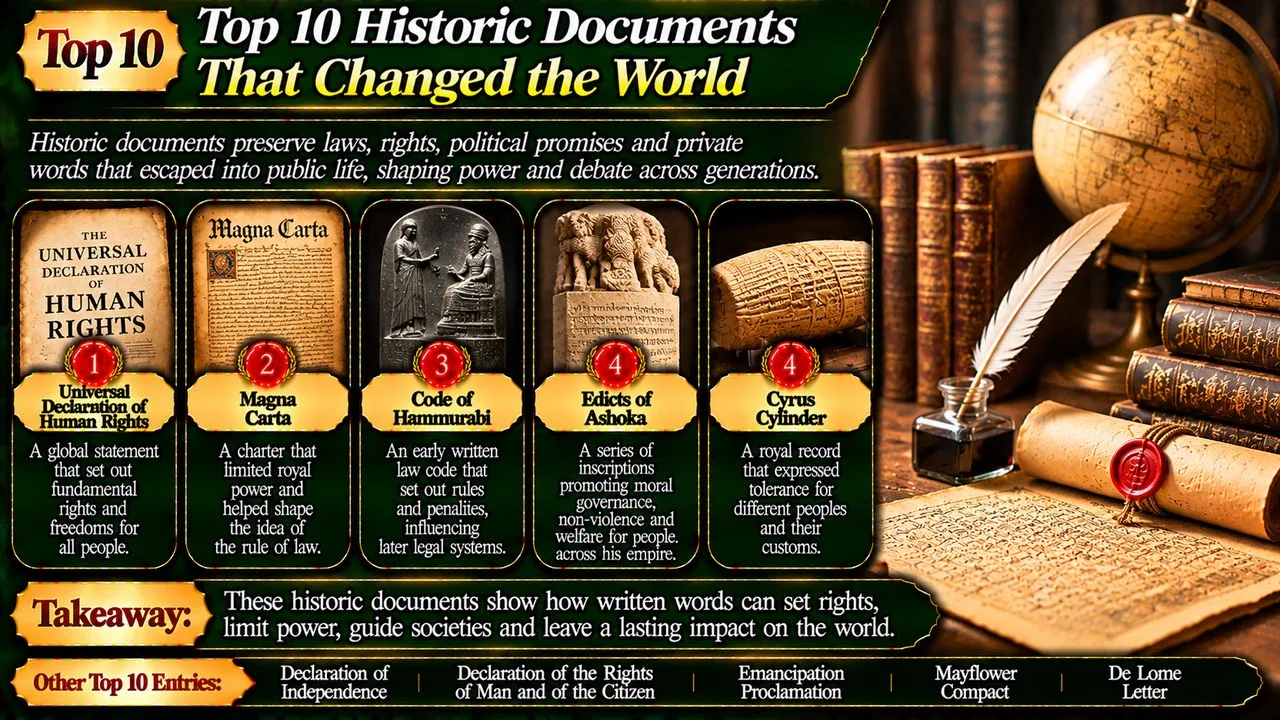
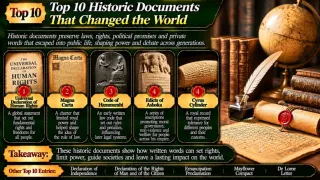
Historic documents preserve laws, rights, political promises and private words that escaped into public life, shaping power and debate across generations.
A document can proclaim an unfulfilled ideal, justify conquest or expose a private opinion. Its influence may rest on its wording, its authority or a meaning found by later readers. Records let historians compare public claims with events.
This November 2026 guide adapts a Listverse topic on influential documents [21]. Three entries remain from that reference; seven replacements give the list a broader range of legal and political landmarks with strong documentary evidence. Our independent order weighs reach, institutional influence and durability. These are not ten equivalent declarations of freedom: some asserted royal authority, some challenged it, and several left major groups outside their promises.
Key Facts
The table summarises each entry; the order reflects the editorial criteria above, not a universal measure of value.
Historic Documents That Changed the World at a Glance
| Rank | Name | Context | Main feature | Notable point |
|---|---|---|---|---|
| 1 | Universal Declaration of Human Rights | International | 1948 | A universal statement of rights |
| 2 | Magna Carta | England | 1215 | Royal power is subject to law |
| 3 | Code of Hammurabi | Babylonia | 18th century BC | Legal rules set out in enduring form |
| 4 | Declaration of Independence | North America | 1776 | Colonies explain their separation |
| 5 | Edicts of Ashoka | South Asia | 3rd century BC | A ruler publicises ethical government |
| 6 | Declaration of the Rights of Man and of the Citizen | France | 1789 | Rights become a revolutionary foundation |
| 7 | Emancipation Proclamation | United States | 1863 | A wartime measure transforms emancipation |
| 8 | Mayflower Compact | Cape Cod | 1620 | Settlers agree to a political body |
| 9 | Cyrus Cylinder | Babylon | After 539 BC | A conqueror presents legitimate rule |
| 10 | De Lome Letter | Spain and United States | 1898 | Private criticism becomes a public crisis |
1. Universal Declaration of Human Rights
The Universal Declaration of Human Rights was adopted by the United Nations General Assembly in 1948. Its thirty articles set out rights and freedoms intended to apply to every person, rather than only to members of one state or religious community. The drafting drew on participants from different legal and cultural backgrounds, with Eleanor Roosevelt chairing the commission involved [1][2].
Its importance does not depend on pretending it was a treaty that immediately made all its provisions enforceable everywhere. The declaration established a shared standard and influenced later agreements, constitutions and campaigns. The distance between its language and actual conditions remains part of its history: a statement of universal rights can become a basis for criticism precisely because governments fail to meet it [1][2].
It ranks first for addressing humanity as a whole, rather than protecting only a defined local group. Disagreement about interpretation continued, but the shared language changed public argument. Its enduring role lies partly in giving later generations a standard they can invoke when demanding that institutions act against injustice.
2. Magna Carta
Magna Carta emerged from a struggle between King John and his barons in 1215. It was not written as a modern democratic constitution, and many of its provisions addressed the concerns of an elite. Its enduring significance developed from the idea that royal authority was constrained by law, together with language that later generations connected to lawful judgement and protection from arbitrary power [3][4].
The first settlement did not bring lasting peace. The charter was annulled and later reissued in revised forms, so references to Magna Carta can conceal a history of changing texts and changing uses. Treating it as one untouched object that instantly established modern liberty loses that complicated development. Its Middle Ages setting and its later reputation need to be distinguished [3][4].
Related: Top 10 Pilgrim and Mayflower Myths: What History Really Shows
Its afterlife became larger than the original dispute. Lawyers and campaigners repeatedly invoked it to limit rulers, sometimes stretching its historical meaning. Second place recognises that durable influence without endorsing every later interpretation. A particular bargain could become a wider symbol because successive readers found principles worth applying anew.
3. Code of Hammurabi
The Code of Hammurabi is a major surviving collection of Babylonian legal provisions, associated with the king who ruled in the eighteenth century BC. Its best-known monument carries a long text beneath an image of royal authority linked to the divine. The rules cover matters such as property, trade, family relationships, debt and penalties for wrongdoing [5][6].
It was not humanity's first written law, and its provisions did not offer equal treatment in the modern sense. Status mattered, and penalties could differ according to the people involved. Those inequalities are part of the evidence, not an embarrassment to be edited out. The collection reveals a society organising obligations and disputes through categories very different from those of contemporary human-rights law [5][6].
Third place reflects the value of a substantial ancient legal text. It lets historians examine particular responsibilities rather than imagine only arbitrary royal commands. Its relationship to daily practice still needs investigation. A monumental statement of justice reveals authority’s public claims, not a complete account of every judgement in a town.
4. Declaration of Independence
The American Declaration of Independence explained the separation of Britain's thirteen mainland colonies in 1776. It combined a statement of political principles with complaints against royal rule and a formal assertion of independent status. The Continental Congress adopted it on 4 July, a date that became central to the national calendar of the United States [7][8].
Its claims about equality and legitimate government travelled far beyond the immediate conflict. They also exposed contradictions within the society making them. Slavery persisted, women lacked equal political standing and Indigenous peoples were not included on equal terms in the new republic's political project. Those exclusions are essential to understanding both the declaration and the later struggles conducted in its language [7][8].
It offered a model for explaining separation through public reasons and general principles. It was not a complete constitution. Fourth place recognises the declaration’s durable influence, including the tension between broad claims and unequal practice. Later readers could invoke the founding language while demanding inclusion its original political settlement had denied.
5. Edicts of Ashoka
The edicts associated with the Mauryan ruler Ashoka were placed on rocks and pillars across a wide area of South Asia during the third century BC. They communicated policies, ethical concerns and claims about responsible rule. Rather than being one sheet sent to a single court, they formed a distributed record intended to reach people in different parts of a large realm [9][10].
Related: Top 10 Most Bizarre Phobias: Strange Fears That Exist
Their language promotes dhamma, including restraint, care, respect and attention to the welfare of subjects. Accounts of Ashoka's remorse after the Kalinga conquest are central to his historical reputation. The edicts also address relations among religious communities, making them important evidence for the public presentation of tolerance under an ancient ruler [9][10].
Fifth place recognises political communication joined to ethical argument. These remain royal statements, not independent proof that every promise was fulfilled. Their survival preserves a public voice for historians to test against other evidence. They also broaden the idea of a document: durable stone writing can proclaim, instruct and preserve memory.
6. Declaration of the Rights of Man and of the Citizen
France's National Assembly adopted this declaration in 1789 during the opening phase of the French Revolution. Its seventeen articles addressed liberty, equality before the law, property and the source of legitimate political authority. It challenged inherited privilege by presenting rights as principles rather than favours granted by a monarch [11][12].
The claim was far wider than the political inclusion actually available. Women and enslaved people did not automatically receive the full benefits suggested by universal language. Critics and campaigners could therefore take the declaration seriously while arguing that the new political order had failed to apply its own reasoning consistently. Its omissions became part of its influence [11][12].
It made a compact statement of rights central to constitutional debate, without supplying a complete solution to revolutionary conflict. Sixth place recognises standards against which institutions could be judged. Alongside American and later international declarations, it shows how political language crosses borders and gains new force when earlier exclusions are challenged.
7. Emancipation Proclamation
Abraham Lincoln's Emancipation Proclamation took effect on 1 January 1863, during the American Civil War. It declared freedom for enslaved people in the designated areas still in rebellion. Its scope had important limits: it did not abolish slavery throughout the entire United States, and its practical reach depended on the advance of federal forces [13][14].
Related: Top 10 Facts About Dogs
Those limitations do not make it merely symbolic. It changed the political and military character of the war and authorised the recruitment of Black men into the armed forces. Enslaved people had already been acting to secure their own freedom, and the proclamation became part of that wider struggle rather than a story in which one president alone created emancipation [13][14].
A later constitutional amendment established national abolition. The proclamation nevertheless made slavery’s destruction an explicit wartime objective. Seventh place rejects both exaggeration and dismissal: it neither freed everyone instantly nor changed nothing. Its force emerged through the interaction of legal language, military advance and enslaved people’s efforts to secure freedom.
8. Mayflower Compact
The Mayflower Compact was agreed in 1620 by male passengers preparing to establish a settlement after the ship reached Cape Cod. They were outside the area where their original arrangements had expected them to settle, and disagreement threatened cooperation. The compact committed its signers to form a political community and obey laws made for their shared undertaking [15][16].
Its later reputation as an uncomplicated birth certificate of democracy needs caution. Women were not signers, it did not establish equal rights for everyone and it did not settle the colonists' right to occupy Indigenous land. It was a practical agreement among a limited group facing uncertainty, not a universal charter or a full constitution [15][16].
Its later reputation grew within American self-government traditions, often simplifying the original setting. Eighth place recognises agreement as a justification for authority while acknowledging those excluded. A limited founding bargain can matter historically without embodying every modern value. Reading critically means preserving its significance without treating the national origin story as complete.
9. Cyrus Cylinder
The Cyrus Cylinder is a clay object carrying a Babylonian text about Cyrus the Great's conquest and rule. It was deposited after the capture of Babylon in 539 BC. The account condemns the previous ruler, presents Cyrus as favoured by the god Marduk and describes restoration of religious practices and displaced communities [17][18].
The object is often called an ancient human-rights charter, but that label imports a much later concept into a royal proclamation. The British Museum stresses its place in Babylonian traditions of kingship and political legitimation. Recognising those conventions does not make the text worthless; it makes it possible to understand what its claims were intended to accomplish [18].
Related: Top 10 Tallest Buildings in the World
It ranks ninth for ancient significance and modern reinterpretation. A conqueror’s account is not an independent report, yet its priorities reveal how rule was justified. Context matters: language that sounds familiar now may have served a different political purpose when first composed. The cylinder rewards that distinction rather than a convenient modern label.
10. De Lome Letter
The De Lome Letter was a private communication by Spain's ambassador to the United States that became a public controversy in 1898. Enrique Dupuy de Lome criticised President William McKinley in unflattering terms while discussing diplomacy connected to Cuba. After interception and publication in the New York Journal, the letter intensified anger in the United States and damaged the ambassador's position [19][20].
It did not single-handedly cause the Spanish-American War. Relations were already strained by the Cuban conflict, competing political aims and an aggressive press environment. Its significance is better understood as an accelerant within that larger situation. The difference matters: a memorable insult can dominate a retelling even when the deeper causes of a conflict lie elsewhere [19][20].
Most entries here were intended as public statements; this one gained force by escaping its private setting. It closes the list because publication changed the words’ political power. Writers do not control every later use: intermediaries, newspapers and readers can turn a communication into evidence, controversy or pressure for action.
Conclusion
These documents changed public life in different ways: establishing standards, asserting authority, explaining separation, proclaiming freedom or exposing private attitudes. Their importance does not depend on accepting every claim at face value. Careful reading asks who wrote a text, whom it addressed, who was excluded and what happened after the words appeared.
For another route through influential writing, read Top 10 Books That Changed the World. The much older cultural evidence in Top 10 Ancient Board Games That Shaped Modern Play offers a different kind of historical record. Texts, objects and later interpretations work best together, allowing an engaging story without replacing context with a convenient myth.
- ^ [1] "Universal Declaration of Human Rights". Wikipedia. Read
- ^ [2] "Universal Declaration of Human Rights". United Nations. Read
- ^ [3] "Magna Carta". Wikipedia. Read
- ^ [4] "Magna Carta". Britannica. Read
- ^ [5] "Code of Hammurabi". Wikipedia. Read
- ^ [6] "Code of Hammurabi". Britannica. Read
- ^ [7] "Declaration of Independence". Wikipedia. Read
- ^ [8] "Declaration of Independence". US National Archives. Read
- ^ [9] "Edicts of Ashoka". Wikipedia. Read
- ^ [10] "Edicts of Ashoka". Britannica. Read
- ^ [11] "Declaration of the Rights of Man and of the Citizen". Wikipedia. Read
- ^ [12] "Declaration of the Rights of Man and of the Citizen". Britannica. Read
- ^ [13] "Emancipation Proclamation". Wikipedia. Read
- ^ [14] "Emancipation Proclamation". US National Archives. Read
- ^ [15] "Mayflower Compact". Wikipedia. Read
- ^ [16] "Mayflower Compact". Britannica. Read
- ^ [17] "Cyrus Cylinder". Wikipedia. Read
- ^ [18] "Cyrus Cylinder". British Museum. Read
- ^ [19] "De Lome Letter". Wikipedia. Read
- ^ [20] "De Lome Letter". US National Archives. Read
- ^ [21] "Topic inspiration: Historic Documents That Changed the World". Listverse. Read























Discussion
Log in with