




Top 10 Unusual Musical Instruments and How They Work
 By Dhiraj Sharma · Published
Share Post
Loading…
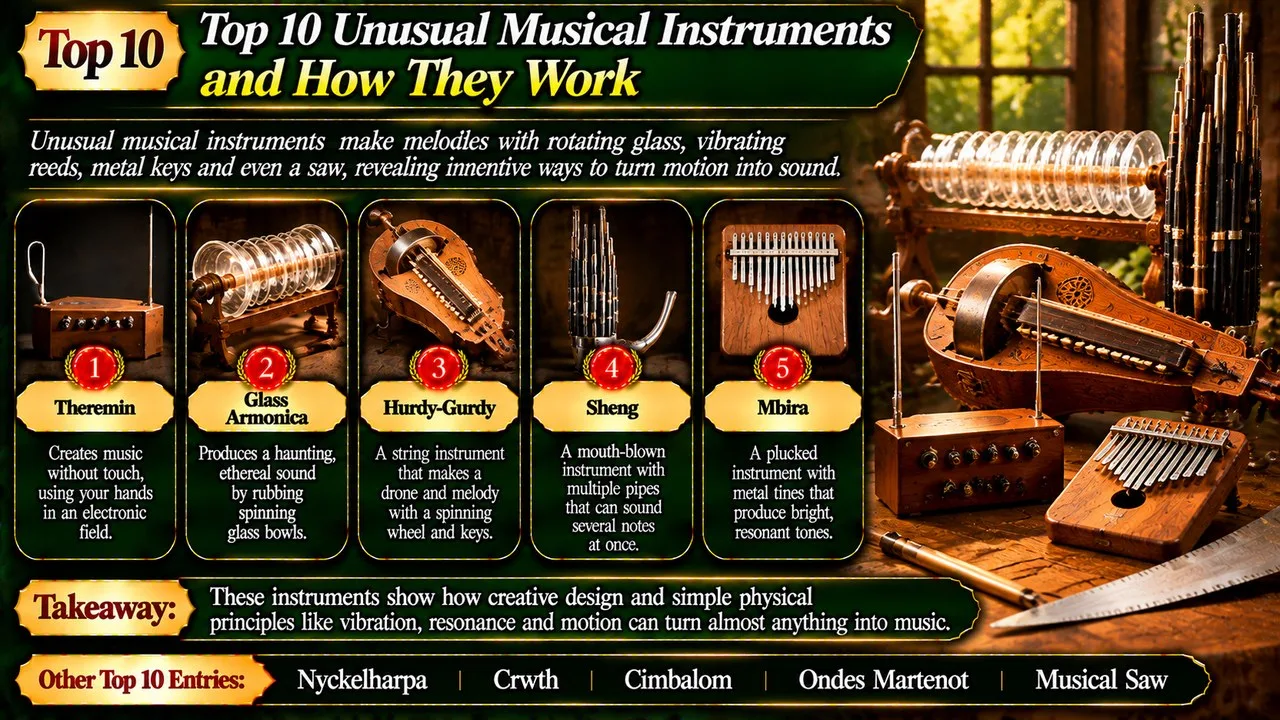
Unusual musical instruments make melodies with rotating glass, vibrating reeds, metal keys and even a saw, revealing inventive ways to turn motion into sound.
A familiar piano hides a remarkable machine beneath its lid. Move beyond the orchestra, and the possible relationships between hands, materials and sound become wider still. Some musicians guide a note without touching the instrument; others turn a crank, bend a blade or pluck carefully shaped metal tongues.
This November 2026 guide takes its starting topic from Listverse [21], but uses an independent selection and order. We rank the entries by the distinctiveness of their sound-making method, their musical importance and the strength of the surviving evidence. Five entries remain from the reference; the other five are replaced by well-documented traditions and inventions. Unusual here means less familiar to a general international audience, not less sophisticated or less valuable.
Key Facts
The table summarises each entry; the order reflects the editorial criteria above, not a universal measure of value.
Unusual Musical Instruments and How They Work at a Glance
| Rank | Name | Context | Main feature | Notable point |
|---|---|---|---|---|
| 1 | Theremin | Russia | Electronic oscillation | Hands move near aerials |
| 2 | Glass Armonica | Britain and North America | Glass friction | Nested bowls rotate on a spindle |
| 3 | Hurdy-Gurdy | Europe | Wheel against strings | A crank supplies the bowing motion |
| 4 | Sheng | China | Free reeds | Several pipes can sound together |
| 5 | Mbira | Southern Africa | Plucked metal tongues | Sound and ceremony are intertwined |
| 6 | Nyckelharpa | Sweden | Bowed strings with keys | Tangent keys change sounding length |
| 7 | Crwth | Wales | Bowed lyre | An open frame surrounds the neck |
| 8 | Cimbalom | Central and Eastern Europe | Struck strings | Hand-held beaters supply the attack |
| 9 | Ondes Martenot | France | Electronic oscillation | Keyboard and finger-ring control |
| 10 | Musical Saw | International folk traditions | Vibrating steel blade | Bending changes the singing pitch |
1. Theremin
The theremin produces sound without requiring the player's hands to touch a keyboard or string. Developed by the Russian inventor Leon Theremin, it uses electronic oscillators and aerials to translate hand movements into changes of pitch and loudness. One hand usually shapes the note while the other controls its strength, giving the performer the appearance of conducting an invisible ensemble [1][2].
The challenge is accuracy. There are no frets or physical keys to mark the exact location of a note, and the space between notes can be crossed continuously. A skilled player must learn a precise relationship between posture, distance and sound. The continuous glide can create an eerie effect, but it is a musical choice, not a limit that confines the instrument to novelty noises [1][2].
Clara Rockmore demonstrated its potential as a concert instrument. Its film associations can obscure that expressive history. First place recognises a radical interface: touch gives way to movement through space. Circuitry supplies the tone, but a convincing musical performance still depends on a trained ear and disciplined physical control.
2. Glass Armonica
Benjamin Franklin's glass armonica transformed the familiar trick of sounding a glass rim into a purpose-built musical instrument. His design, dating from 1761, arranged tuned glass bowls along a rotating horizontal spindle. Their rims remained accessible to the player's moistened fingers. Instead of reaching around a table of separate glasses, the performer could bring notes together in a much more compact arrangement [3][4].
The sound comes from friction setting the glass into vibration. Bowls of different sizes supply different pitches, and the rotating assembly allows a sustained note without the hand having to travel repeatedly around a stationary rim. The instrument is not simply a collection of water-filled goblets: its construction and tuning are a more specialised solution to the same underlying acoustic idea [3][4].
Related: Top 10 Most Bizarre Phobias: Strange Fears That Exist
Composers including Mozart wrote for the instrument, whose tone also encouraged fanciful rumours. Franklin made a known effect easier to use musically rather than discovering that glass could sing. Its unusual appearance follows a practical decision: place several resonating rims where a performer can reach them together and form chords.
3. Hurdy-Gurdy
A hurdy-gurdy uses a rotating wheel in place of a conventional bow. Turning a hand crank keeps the wheel rubbing against the strings, while keys alter the vibrating length of the melody strings. Other strings can maintain a drone beneath the tune. Its sound therefore comes from bowed-string friction, even though its controls may initially remind a listener of a small organ [5][6].
The instrument has a long European history, moving through religious, courtly and popular settings in different forms. Its social reputation changed over time, which makes it misleading to label it merely a poor person's fiddle or a curiosity from a single historical period. The crank, key box and drone arrangement offered a distinctive combination that musicians could adapt to different repertoires [5][6].
Good playing requires more than steady turning. Melody fingering must coordinate with the crank, and some designs allow buzzing rhythmic accompaniment. It ranks third because several musical roles can emerge from one visible mechanism: a sustained foundation, a moving melody and a rhythmic texture shaped by the same performer.
4. Sheng
The sheng is a Chinese mouth organ built around a group of pipes connected to a wind chamber. Free reeds vibrate as the player breathes and closes the appropriate finger holes. The pipes do not all function as a row of simple whistles: the relationship between reed, air column and covered hole determines whether a note will speak [7][8].
Its most striking musical ability is to sound several notes together. That makes it valuable both as a melodic voice and as a source of harmony. Traditional forms stand alongside modern concert versions, so photographs showing different numbers or arrangements of pipes need not depict entirely different families of instrument. Makers have adapted the design to changing performance demands [7][8].
The sheng challenges the assumption that a wind instrument naturally makes one note at a time. It also matters in free-reed history, without needing claims that every later design copied it directly. Its own tradition deserves attention: breath and fingering can shape a carefully blended group of tones.
5. Mbira
Mbira is a name associated with African instruments whose metal tongues are fixed to a board and plucked with the fingers. In the mbira traditions of southern Africa, those tongues are arranged to allow interlocking patterns rather than simply to imitate a Western keyboard. A resonator can enlarge and colour the sound, while added buzzing elements contribute an intentional texture [9][10].
Related: The Evolution of Stranger Things: Seasons, Themes, and Characters
UNESCO recognises the shared craft and playing heritage of mbira and sansi in Zimbabwe and Malawi. Its account places the instrument within ceremonies, social life and the transmission of knowledge. That context matters: presenting it only as a small portable object strips away relationships between makers, players, families and community events [10].
Its apparent simplicity conceals rich coordination between the hands. Overlapping figures can suggest a new melody even without another voice entering. Fifth place recognises this way of directing musical attention. Resonance, repetition and community meaning matter alongside individual tunes, revealing complexity that cannot be judged from the instrument’s small size.
6. Nyckelharpa
The nyckelharpa is a Swedish keyed fiddle. A bow sets its playing strings in motion, while rows of keys push small tangents against the strings to change their sounding length. The player's fingers therefore control pitch indirectly, unlike the direct fingerboard contact used on a violin. Many modern examples also carry sympathetic strings that resonate without being bowed [11][12].
Those sympathetic strings give the instrument a rich halo of sound. Its form has changed over time, and the modern chromatic instrument should not be treated as an unchanged relic. A living tradition involves makers solving practical problems, performers extending the repertoire and teachers finding ways to pass on skills. UNESCO's recognition of the nyckelharpa network highlights precisely that circulation of knowledge [12].
Keys do not make it purely automatic: bowing still shapes attack, phrasing and expression. The player combines moving-bow control with keyed stopping. Sixth place recognises an unusual but coherent partnership of mechanisms, sustained by makers and musicians who continue to develop the instrument rather than merely preserving its appearance.
7. Crwth
The crwth is a Welsh bowed lyre, recognisable by its open wooden frame around the neck. In its historical form, some strings run over the fingerboard while others sit beside it as drones. The frame preserves the outline of an older lyre family, but the addition of bowing changes how the performer can sustain and combine sounds [13][14].
Related: Chernobyl Miniseries: Stories of Tragedy of a Nuclear Catastrophe, Heroism and Sacrifice
Surviving instruments and written evidence are more reliable guides than confident claims that one exact design was invented in one distant year. The crwth belonged to Welsh musical life before other bowed instruments became dominant. Modern interest has involved reconstruction and renewed performance, with makers studying historical examples rather than simply treating the object as a decorative national emblem [13][14].
The crwth makes boundaries between instrument families look less rigid. Quick comparisons with a harp or fiddle explain only part of its structure. Understanding how its strings are supported, sounded and stopped reveals a coherent design, not an awkward transitional object waiting for someone to invent a proper violin.
8. Cimbalom
The cimbalom is a struck-string instrument associated particularly with Central and Eastern European music. Strings stretch across a broad, roughly trapezoidal soundboard and are sounded with light hand-held beaters. The concert form stands on legs and uses a damping arrangement to control the ringing strings. Its ancestry belongs to the wider family of hammered dulcimers [15][16].
Unlike a piano, it does not place a keyboard and internal hammer action between the player's fingers and the point of attack. That direct control lets the musician vary the touch and move rapidly across groups of strings. At the same time, controlling resonance is essential: a cascade of notes can become blurred if earlier sounds are left ringing without intention [15][16].
Folk ensembles and orchestral composers have both used the cimbalom. It ranks eighth for combining direct striking with a resonant string voice. Its sound differs from both drum and keyboard: the musician balances the crisp moment of impact against the lingering tones that may blend or blur afterwards.
9. Ondes Martenot
The ondes Martenot is an electronic instrument developed in France by Maurice Martenot and publicly introduced in 1928. It can be played with a keyboard, but its most distinctive control is a ring worn on a finger and moved along a wire. That arrangement allows a performer to slide continuously between pitches while shaping a sustained electronic tone [17][18].
Another hand control governs expression, helping separate the choice of pitch from the shaping of loudness. Special loudspeakers and resonating components became part of its characteristic sound world. It is therefore too simple to call it an early keyboard synthesiser and leave the matter there. The performer's touch and the way sound reaches the room are central to its identity [17][18].
Related: The Family Man: A Spy Thriller of Modern India Balancing Family Life and National Security
Composers including Messiaen gave it an orchestral role. It answers the theremin’s question differently: how can an electronic tone become expressive music? A tangible guide supports the performer while preserving sliding pitch. Its significance lies in inventing a playable interface as well as a new source of sound.
10. Musical Saw
A musical saw turns a flexible steel blade into a singing instrument. The performer bends it into a curved shape and uses a bow to excite a resonant region of the metal. Changing the bend changes the pitch. The teeth are not what produces the melody, which is why the effect can also be achieved with blades made specifically for musical use [19][20].
Its voice often has a smooth, wavering quality because the pitch can move continuously rather than jumping between fixed steps. Accurate playing depends on hearing and controlling the blade's changing shape. Vibrato and phrasing come from small movements, so the apparent joke of playing a workshop tool gives way to a demanding task of coordination [19][20].
The saw closes the list because an instrument is partly defined by learned use. Suitable material, a workable technique and a trained player can reveal an unsuspected voice in an everyday object. This does not make every tool musically useful; it shows why a resonator’s original purpose need not dictate its sound.
Conclusion
These ten instruments do not share a single strange sound. They share the invention of a useful connection between a performer's movement and an acoustic result. Glass friction, free reeds, plucked tongues and electronic oscillation all become expressive when musicians learn how to control them.
The creativity behind such designs has a parallel in Top 10 Accidental Inventions That Changed Everyday Life, although not every musical invention began by chance. For another example of traditions that change while retaining a recognisable identity, explore Top 10 Ancient Board Games That Shaped Modern Play. In both music and play, a durable idea can support centuries of variation.
- ^ [1] "Theremin". Wikipedia. Read
- ^ [2] "Theremin". Britannica. Read
- ^ [3] "Glass armonica". Wikipedia. Read
- ^ [4] "Benjamin Franklin's Glass Armonica". The Franklin Institute. Read
- ^ [5] "Hurdy-gurdy". Wikipedia. Read
- ^ [6] "Hurdy-gurdy". Britannica. Read
- ^ [7] "Sheng". Wikipedia. Read
- ^ [8] "Sheng". Britannica. Read
- ^ [9] "Mbira". Wikipedia. Read
- ^ [10] "Mbira and sansi craft and performance". UNESCO. Read
- ^ [11] "Nyckelharpa". Wikipedia. Read
- ^ [12] "Nyckelharpa network". UNESCO. Read
- ^ [13] "Crwth". Wikipedia. Read
- ^ [14] "Crwth". Britannica. Read
- ^ [15] "Cimbalom". Wikipedia. Read
- ^ [16] "Cimbalom". Britannica. Read
- ^ [17] "Ondes Martenot". Wikipedia. Read
- ^ [18] "Ondes Martenot". Britannica. Read
- ^ [19] "Musical saw". Wikipedia. Read
- ^ [20] "The physics of a singing saw". Harvard University. Read
- ^ [21] "Topic inspiration: Unusual Musical Instruments and How They Work". Listverse. Read























Discussion
Log in with